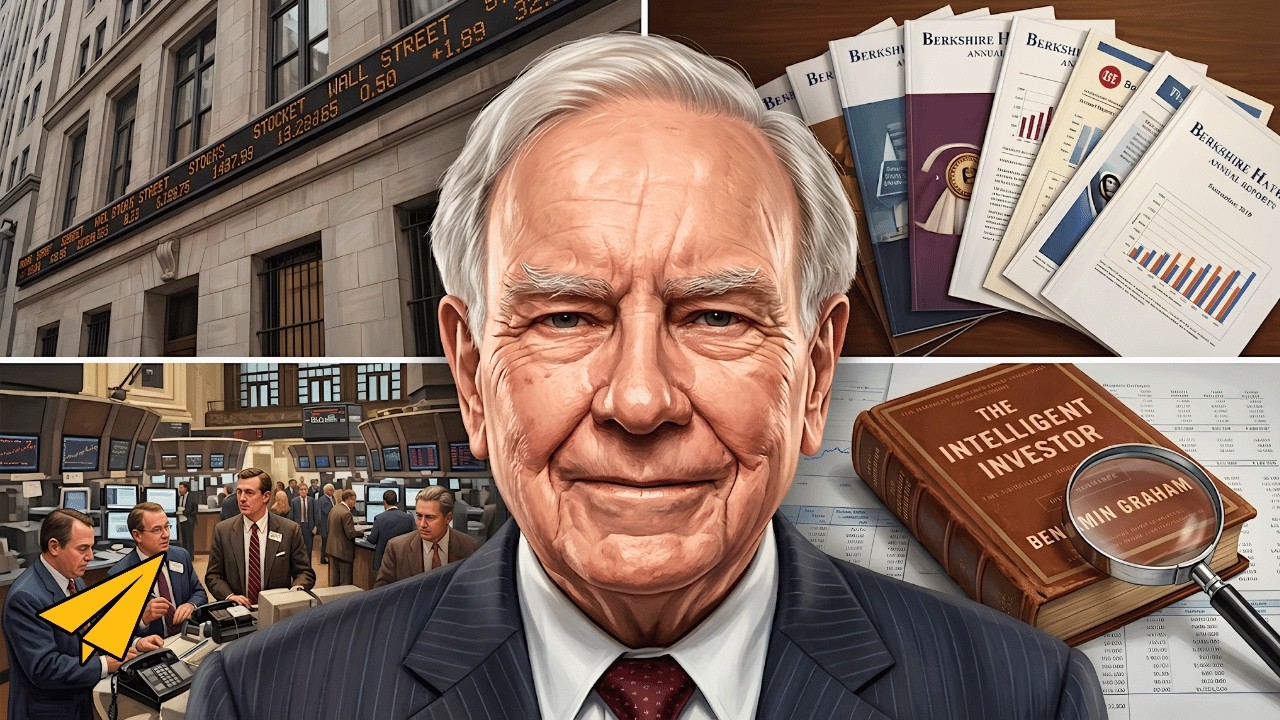
In this motivational compilation, host Evan Carmichael stitches together interview clips from some of the world’s most successful investors—Warren Buffett, Mark Cuban, Sam Altman, Bill Ackman, Robert Kiyosaki, Grant Cardone, Charlie Munger, Howard Marks, Ramit Sethi, Ray Dalio, and others—to present a concise list of ten wealth‑building principles. Each rule is introduced by Carmichael and then illustrated with a short quote from the featured investor: 1. Patience – Buffett stresses that long‑term, patient investing beats short‑term greed. 2. Seek the right, leverageable opportunities – Cuban explains that billion‑dollar wealth comes from finding uniquely leverageable deals. 3. Adopt a long‑term horizon – Altman argues that a longer time frame gives a decisive edge. 4. Do deep research – Ackman describes his systematic review of SEC filings, competitor analysis, and expert networks. 5. Use good debt, avoid bad debt – Cardone differentiates productive, investment‑linked debt from consumer debt. 6. Invest the difference – Munger highlights saving more than you spend and compounding that surplus. 7. Invest early and heavily, avoid market timing – Marks urges consistent, large‑scale investing and warns against trying to time the market. 8. Create cash‑flow assets – Kiyosaki stresses building income‑producing assets rather than relying on wages. 9. Maintain proper investment accounts – Sethi recommends automatic contributions to 401(k), Roth IRA, and taxable accounts. 10. Hold a modest allocation of gold – Dalio explains gold’s role as a diversifier and hedge against monetary risk. Throughout, Carmichael adds motivational framing, invites viewers to comment with #Believe, promotes a free worksheet, and teases a follow‑up video. The overall purpose is to distill actionable advice from elite investors for viewers seeking lasting wealth.
Chapters
Some of the world's richest investors didn't build their fortunes by chasing the next hot stock. Warren Buffett stayed patient when everyone else rushed in.
Why doesn't everybody do it? Well, it requires patience, which a lot of people don't have.
Mark Cuban waited for the right opportunities instead of forcing bad ones.
To be a billionaire, there's got to be something that's very leverageable.
Sam Altman focused on investing for the long term.
The number one advantage that you can have as an investor is to have a longer time horizon than everybody else.
Bill Ackman did the research before risking his money.
It's a bit like a big research project.
And Robert Kiyosaki built wealth by creating cash flow instead of relying on a paycheck.
The trick is, how do you not work for this but get lots of cash flow or income? This is trash.
Today we're going to break down the top 10 rules of success from the world's richest investors. If you want to think like the world's greatest investors and build wealth that lasts, this video is for you. Need motivation?
Watch your top 10 with Believe Nation.
If you've been here before, drop a hashtag #Believe in the comments below so I can feature you here in a future And if you're new, welcome to Believe Nation, the only channel that helps you believe in yourself daily, one video at a time. Okay, let's kick it off with rule number 1, be patient with Warren Buffett.
You have been talking this philosophy for years.
It's no secret. It's no secret. Why doesn't everybody do it? Well, it requires patience, which a lot of people don't have. And people would much rather be promised that they're going to win a lottery ticket next week than that they're going to get rich slowly. Gus Levy used to say that he was, he was long-term greedy, not short-term greedy. And if you're short-term greedy, If you're short-term greedy, you probably won't get a very good long-term result.
Rule number 2, look for the right opportunities with Mark Cuban. So if literally, if I started you again, with all your knowledge today, you don't think you could be a billionaire?
No, no, unless I got lucky again, right? I mean, could I find opportunities to get me there? There's only a few of those types of opportunities. You can start, you know, a hedge fund and hopefully do well, and then you raise a lot of money, you could take a company public, you can start a private company and have and be bought out. Those really are the primary ways to get to that level of wealth. And So, could I try any or all of those things? Right.
Yeah.
Like, if you put me in the witness protection program and nobody knew who I was and I had to just start purely from scratch, but I still knew what I know now, I could do well. But I would have to search out some unique opportunity because to be a billionaire, there's got to be something that's very leverageable, something that just explodes financially. But there's a whole lot of people who are really, really smart who do each of those things or one of them really well. And we don't know who they are.
Rule number 3, invest long-term with Sam Altman.
I think the number one advantage that you can have as an investor is to have a longer time horizon than everybody else and be willing to expose yourself to more illiquidity and more volatility than everybody else. So, you know, if I invest in something and my kids get the shares, I'm perfectly fine with that. I don't think enough people do enough of that. I think we should still be investing in things that might take 100 years.
Rule number 4, do the research with Bill Ackman.
So Chipotle, what attracted us initially is the stock price dropped by about 50%. Uh, great company, great concept. Um, you know, athletes love it, consumers love it. Healthy, sustainable, uh, fresh food made in front of your eyes. And, uh, you know, great. Steve Ells, the founder, did an amazing job. But ultimately, the company's lacking some of the systems and had a food safety issue. Consumers got sick, almost killed the brand. But the reality of the fast food quick-service industry is almost every fast food company has had a food safety issue over time, and the vast majority have survived. We said, look, it's such a great concept, but their approach was far from ideal. But we start with usually reading the SEC filings. Companies file a 10-K or an annual report. They file these quarterly reports called 10-Qs. They have a proxy statement which describes kind of the governance, the board structure. Conference call transcripts are publicly available. It's kind of very helpful to go back 5 years and kind of learn the story. Here's how management describes their business. Here's what they say they're going to do. Then you can follow along to see what they do. It's like a historical record of how competent and Truthful they are. It's a very useful device. And then of course, looking at competitors and thinking about what could dislodge this company. And then we'll talk to— if it's an industry we don't know well, we know the restaurant industry really well, music industry, we'll talk to people in the industry. We'll try to understand the difference between publishing and recorded music. We'll look at the competitors. We'll read books. I read a book about the music industry or a couple of books about the industry. So it's a bit like a big research project. There are these so-called expert networks now, and you can get pretty much anyone on the phone and they'll talk to you about an aspect of the industry that you don't understand and want to learn more about. Try to get a sense. Public filings of companies generally give you a lot of information, but not everything you want to know. You can learn more by talking to experts about some of the industry dynamics, the personalities. You want to get a sense of management. I like Watching, you know, podcasts. If a CEO were to do a podcast or a YouTube interview, you get a sense of the people.
Also, if you wanna take real action after this video, I made a free worksheet just for you. It covers the top lessons from today, gives you space to write your biggest takeaways, and helps you build a simple action plan. It's 100% free. Just click the link in the description below to go grab it, and I'll see you there. Rule number 5 is use debt to invest with Grant Cardone.
Consumer debt is terrible debt. Suicide debt.
That's, that's credit card debt.
Lamborghini, buying the Lamborghini on debt. Like, if you're gonna buy a Lamborghini, lease it for 24 months. If you can't afford the 24 months, you can't afford the Lambo. Debt for clothes, Christmas gifts. I mean, it's stupid. It's stupid to borrow money for, for, for this Santa Claus for your kids. I know, I know people are gonna hate that message. That's why so many people dislike, you know, they, they just don't like the truth.
It's stupid to go in debt. If you wanna do it and, uh, and for, for fun or for whatever, then that's okay. But you may— you're not investing in A potential greater future.
No. Now, if I, if I borrow money for Santa Claus, that's one thing. If I borrow money for, to, to invest, to, to, to buy, to invest in, in a piece of real estate for my kids, you know, I mean, I know which one's gonna work.
Yeah.
If you just follow the tax write-offs, you'll know the right thing to do. I can't write off Santa. I can write off the real estate.
Right.
So, um, yeah, bad debt is anything that I have to then pay the interest rate on. Good debt is I made an investment and my consumer or my tenant is going to pay my debt.
That's powerful.
So you're trying to, you're trying to get more debt.
You probably have more debt with me than you even know. Like, like, because of the investments you've made with me, you have debt. You have good debt. You just don't really know it. Your accountant does though, because, because we're sending them the K-1 at the end of the year. That's why when we send you a check, you don't pay income on that check.
That's nice.
Very nice. So you, you look at your return, but you know, whatever I paid you last year, but that is non-taxable income to you because of the debt that we have. Because of the debt and everything else. Yeah, exactly.
Rule number 6, invest the difference with Charlie Munger.
When I was young, I read that savings bank thing, The Richest Man in Babylon, which taught the joys of underspending your income and Investing the difference and how wonderfully it would work over time. And lo and behold, I did exactly what this little pamphlet suggested and it worked. And the other idea— and then so I got the idea that I had a mental compound interest thing too. And so I finally decided I was just going to give the best hour of the day to improving my own mind. And then the world could buy the rest of the time. And that may have been a very selfish thing to do, but it worked.
Rule number 7, invest a lot with Howard Marks. What is your overriding piece of investment advice for our listeners?
Invest, invest a lot, invest early, stick with it. Don't try to be a genius. Don't try to be agile. Don't try to get in and get out and get in and get out. Nobody can do that. And if you get out and the market goes down, you're lucky. But most people, if they get out and the market goes down, they pat themselves on the back for being geniuses and they forget to get back in and they miss the subsequent rise. So market timing is the hardest thing in the world, and don't try it. And you can shade or calibrate your risk posture, but you have to bear in mind that the market is made up of people. Most of those people are not idiots. And if, to the extent that they have some intelligence, usually doing something very different is probably not going to be high Highly likely to be right unless you are exceptional, which relatively few people are. And remember, I made 5 calls in 50 years. Why should you think that you can make a good market call more than once a decade?
Rule number 8 is create cash flow with Robert Kiyosaki.
One of the main reasons, if you've read Rich Dad Poor Dad, this is trash. This is the money and the people that work for this go broke. They're the poorest people on earth. They spend their whole lives chasing these things. What Rich Dad's about is this is called cash flow. So the trick is, how do you not work for this but get lots of cash flow or income? This is trash. This is paper. The trick is, is that since 1964, I started studying money. I just don't trust my government. That's the main reason. But in 1971, Nixon took the dollar off the gold standard. And I was in Vietnam when he died. I was flying for the US Marine Corps at the time. And I realized my government was screwing us. This is trash because I don't care if it's dollar, yen, euro, pesos, yuan, it's fake money. And the poorest people on earth always are going after this stuff versus cash flow. And that's all Rich Dad Poor Dad was about is how do you get cash flowing in more and more and more? So like this morning, my dear friend Ken McElroy calls up And he says, I need $100,000. Done. Do I have $100,000 on hand? No, but I know how to get it. That's where it starts. Number one is what happens to most people is they say, I can't afford it. You could be highly educated, they still say, I can't afford it. My poor dad said it all the time. I can't afford it. He got made of money. So that's where it all starts. And then the second thing is then they don't get educated. You know, my poor dad had a PhD, which stands for poor, helpless, and desperate. In education, but he never did anything about money. Whereas my rich dad, who's my best friend's father, taught his son and me about money playing Monopoly. And that's education. The word education comes from the words educere. Educere means to draw out. When I played Monopoly as a kid, it drew out the rich person in me. Whereas I went to school and what they pounded in me was the poor person. You gotta get a job. You gotta get a job. You gotta work for money. You gotta save money. And you got to invest in the stock market and all this stuff. That's why people are poor. They listen to poor people. So those are some of the basic, basic fundamentals. But let me say it again. This is trash. All over the world in 1971, this became trash. And the trick with Rich Dad Poor Dad was how do you get cash flow or income? So as I started off to say, Kenny calls up. He needs $100,000. Otherwise, I can't invest with him. I don't have $100,000 sitting around, but I know how to get it. That's the difference. I never say I can't afford it because that's what poor people say. You want to be poor? Just keep saying, just be my poor dad.
Rule number 9 is have an investment account with Ramit Sethi.
I think everybody should have an investment account. For most people, that often starts with a 401 at work. And this is an actual account where you can have money sent directly from your paycheck. And once it is in your 401 account, it's almost like a bank account. It's not the same, but it's almost like it. The money is sitting there and you choose where it gets invested. But beyond that, you can invest in other accounts such as a Roth IRA, which gives you a lot of amazing tax advantages. Forget about the ultra wealthy. You have access to amazing tax advantages. And then finally, you can invest in a normal, what's called taxable account. That, that's where you can, just like any other 401 or Roth IRA, you can choose investments like an index fund and you can set this all up to happen automatically. So every month I don't manually go in and invest. It's been happening since I was like 14, 15 years old. Boom. It just happens automatically.
And rule number 10, the last one before a very special bonus clip, is invest in gold with Ray Dalio.
You recommend that most portfolios should contain some gold.
Yeah, of course.
Why?
A lot of people think it's not of course. In fact, it doesn't make sense.
Well, first of all, to structure a portfolio, the best way to structure a portfolio is to have the right kind of balance in your portfolio. So, and some amount of gold. Gold serves a purpose. It is, first of all, a diversifier against other assets. You know, we have this risk-on, risk-off thing. We have— we also have a monetary system. We have a— the Bretton Woods monetary system began after World War II, and it had the dollar as the world's reserve currency. There's a risk there. There's a lot of dollar-denominated debt and so on. If somebody felt that they didn't want to hold that and so on, you could have exposures to that. So it's a diversifying asset that is sensible. And, you know, that's the main reason to have gold in the portfolio, 5 to 10%.
Overall, would you say, in total investments, are you up?
Are you down?
Do you have any idea?
Yeah, no, I— believe me, I track it. So, you know, we've— we have a whole team that manages this portfolio of over 57 private companies. And here's the thing we've all learned on Shark Tank. Okay, we're in the middle of season 14 right now. I'm gonna be shooting next week back in LA. I don't know what I'm gonna see, but it's gonna be amazing because each year the deal size gets bigger. Because people really want to tap into that massive social media platform, you know, 100 million plus eyeballs that when you go through syndication, 8 minutes of primetime television to a third of the country, that's pretty powerful in terms of getting a product out there and it reduces customer acquisition costs a lot. But whatever I think is the hot deal of the season, whatever I think is the number one winner that I bought and I put $300,000, $400,000 into, whatever, that's never the one that makes me back my money. I wait 2 or 3 years later, and it's some crazy piece of crap product that I thought was just a joke that ends up being a monster. And I'll give you an example. Just this year, there was a deal a few years ago called BasePaws, cat DNA. I remember this, yes. You stick a swab up your cat's ass, and you send it in, and it tells you what to feed it so you can extend its life by 30%. What a stupid idea. You can buy a new cat for $5. Why would you pay $29 for a DNA test? So I bought into it because it was so crazy, so dumb, so stupid, I thought. The company just sold for over $50 million cash last month.
Jesus.
Because who knew that pet DNA is smoking hot? There's 110 million cats in America. And the entrepreneur, the woman, was spectacular in building up this business. She got bought out by a biotech company that wanted to have her database of DNA. And it turns out that millions of people pay $29 to extend their cat's life. That— I'm not one of them, but who cares? It was a fantastic investment. My point is, you just don't know. So you need diversification in how you spread your bets out there.
Congratulations, you're one video closer to who you're meant to be.
Believe.
For 10 more amazing rules from the world's richest investors, check the video right there next to me. I think you'll love it. Continue to believe. And I'll see you there. The world's richest investors didn't follow the crowd. They followed principles that built billion-dollar fortunes. For Elon Musk, success meant betting on himself.