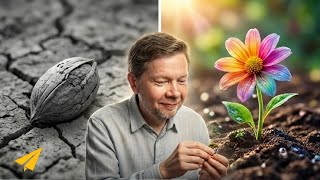
The video opens with Evan Carmichael introducing the theme “don’t get stuck in unhappiness” and handing the floor to Eckhart Tolle. Tolle argues that chronic unhappiness is a childish, unconscious strategy: people stay unhappy hoping that the feeling will trigger external change (whether divine intervention or a reaction from the world), but the opposite occurs – the more one dwells in unhappiness, the more one remains stuck. Evan then shifts to practical advice, emphasizing that the fastest way to get unstuck is to change one’s environment rather than rely on daily conscious willpower. He explains that planning a new habit once, then reshaping the physical and visual surroundings (posters, music playlists, objects that evoke joy) allows the desired feeling to arise automatically each day. He ties this to his “one‑word” concept – choosing a single guiding word (for him, “believe”) and building a morning routine and environment that constantly reinforces it, so the individual does not have to make deliberate decisions each morning. The conversation expands with other speakers discussing related ideas: the importance of presence over worrying about rent, the notion that happiness, not money, is the true measure of success, and how a mindset of happiness can attract resources. The overall message is that unhappiness is a self‑defeating trap, while intentional environmental design, a clear personal focus, and cultivating genuine happiness lead to personal freedom and success.
Chapters
Good morning, Believe Nation! It's Evan. My one word is believe, and I believe that you have something special that when you unleash it, it will be able to change the world. So to help you on your journey, today's message is don't get stuck in unhappiness. Over to you, Eckhart Tolle.
So-called unhappiness is also a childish way of trying to change things by being as unhappy as you can about them. And the underlying unconscious or semi-conscious assumption is, if I'm really unhappy, somebody, perhaps God, is going to do something about it, or I'm going to prove him wrong. I'm going to show him how dreadful it is, and then finally— this is an unconscious assumption behind the unhappiness, because you believe, if you're habitually and frequently unhappy, you believe that it has a purpose. It's an underlying assumption. Perhaps you wouldn't verbalize it in that way, but you believe that it works for you. Of course it doesn't, but Things are going to change, but just need to be really unhappy so that God finally— even if you don't believe in God, this can still be the mechanism, the underlying unconscious assumption behind it. It's something's going to happen. And of course the opposite is true because the more unhappy you are with something, the more you are stuck in the situation.
I think the fastest way to get unstuck is to change your environment. Whatever it is that you're unhappy with, whatever it is that you desperately want to change, the fastest way to do it is to change your environment. Because if you have to consciously think about it, you can think your way out of it in the short term. If you are unhappy, if you're sad, you can consciously think, okay, I want to be happier, what can I do to make myself happier? And you come up with a plan for the day, and maybe you read a book or you watch a video and that changes your tone, or you put on a music video and you're dancing or celebrating, whatever it is. And that sets you up for the rest of the day, but then you start over the next day and you're back to where you were. And it's difficult to change because it requires so much conscious thinking. It requires too much planning. You're not gonna wake up every day and plan something. It just takes up too much effort, energy, and work. And so what I find that really helps is by changing the environment. So you plan once when you're in the zone, you're feeling like you wanna make that change, and then you change your environment to support the new habit or belief system that you want. So, you know, if you want to learn Japanese, the fastest way to learn Japanese is to go to Japan.
Right?
You'll learn way more than going to a class once a week. Right? And so whatever it is that you want, if you want happiness, if you want joy, if you want love, if you want— whatever your one word is, for me it's believe. I want believe daily. I want to wake up and have believe take care of itself. I don't want to wake up every day and think, okay, how do I make today more belief. It's just too much effort every day, especially when you first wake up and you might be groggy or tired or had a rough night and you don't want to make important decisions. You want to fall out of your day, and too often we just, we do that. We fall out of bed, we fall into our day, and it's not done with any kind of design. Where if your environment forces that on you, it's much easier. And so there's a reason why in In my office, there's those posters on the wall. There's a reason why I have a morning routine that sets me up for success. There's a reason why I make these videos and I watch the videos and I'm doing the research. Like, it all helps me add more belief to my life, and it's scheduled in. It's part of the environment. It's part of my daily routine. When that happens, it pulls me to a new place. So I don't need to think daily about how to get inspired, how to feel more belief. It just happens. Because I planned that in. It just happens naturally every single day. And so I'd encourage you to do the same thing. If you know what you want, if you know what your one word is, what you stand for, or you just know I don't want to be unhappy anymore and I want more joy in my life, great. What brings you joy? What does joy look like, right? What does a joyful morning routine look like? If joy is hugging your dog in the morning, great, then go Go and hug your dog every morning, right? Make a joy music playlist that you put on as soon as you wake up. If joy is doing, you know, gratitude session while meditating outside in the sun, like, go do that. Whatever the thing is, what's on the wall when you wake up? What do you look at? Does it make you feel joyful? It might be as simple as having a Minnie Mouse plate that you eat your breakfast on, and looking at that reminds you of the great time you had in Disney World growing up, and that makes you feel joyful. Things like that. Everything in your environment. How do I make my kitchen set more joyful? And my knives more joyful? And my tabletop more joyful? And my environment? What's on the wall? All of that relates. And it may sound stupid, but if it's in your environment and it just happens on its own without you having to do anything— yes, you set it up once, but you don't have to do it daily. It just happens to you on a daily basis. You're much more likely to feel the feeling that you want. As opposed to waking up and trying to plan and trying to think your way through whatever pain and suffering you're having right now. I find that it's tremendously beneficial for me, and I hope that if you take that mindset forward and try to plan a perfect morning routine and plan an environment around you, that you'll be able to get unstuck from whatever is sticking to you right now. And more than just getting unstuck, because then you're just in a neutral state, right? Like, okay, I lost that frustration, but now I'm just neutral. I want you to be great. I want you to do amazing things every single day. And it's hard to do that when you have a really poor environment around you. So change it. So the question of the day today is, I'm curious, what is one thing that you changed about your environment that made a big impact on your feeling, on your life, on your business? Whether it was a picture on the wall or changing your knife set or whatever it was, something in your environment that you changed. I'd love to hear your thoughts. Please share in the comments below. I think it could be really beneficial for other members of Believe Nation too to see what worked for you, to give them some ideas and inspiration to change things in their lives as well. I also want to give a quick shout out to Judy Globocar. Judy, thank you so much for picking up a copy of my book, Your One Word. It really, really, really means a lot to me, and I hope you're enjoying the read. So thank you guys again for watching. I believe in you. I hope you continue to believe in yourself and whatever your one word is. Much love, and I'll see you guys again tomorrow morning for another show. You got a Vanspresso.
She's worried about the rent, okay?
She's a single mother, she's worried about her kids.
Don't worry about the rent shit. You know, nothing you can do about the rent and worrying about it. That ain't gonna get you no rent. Presence and happiness gets you rent. Money can't make you happy, but happy can make you money. So be happy, go out in the world. Look, the story of the guy, In the house, he rolls over in the morning, meditates, goes out into the world, says, damn, I'm going to have to get some bread and water before the whole shit go down, before I get back in that bed. But in the meantime, be nice to all my neighbors in the village. Everybody is suffering in what everyone else calls extreme poverty, but he's happy. He doesn't have a poverty mindset, nor is he worried about that bread and water. They gonna give me some bread. I ain't gonna worry about that shit, 'cause I'm that dude. He walks out smiling, confident, comfortable. He gets what he needs. He says, Yogananda would say, God will provide, but really, you're God, you're working to get, and it shows up. He gets his bread and water. He makes everybody happy, everybody makes him happy, lays in the bed. Next nigga, he wakes up, he's got $36 billion in the bank. He gets up, the stock market goes up, he says, "Oh, shit!" Gets some coke and some alcohol, he gets happy, he's all excited, "I'm exploding, I'm making more money, more money, more money." "Oh, shit, crash!" More cocaine, more alcohol. His heart goes up and down, and he dies at 40. The shitty house guy lives to 100. If he had the other guy's diet, not the diet the other guy took, but the other guy's opportunity for a greater diet, the guy in the shitty house The other would have made 120, but, you know, made 100. This guy died at 40. That's the reality of our— you know, our happiness is up to us. You know, our relationship with the world is up to us. Our anxiety is controlled or given to us by us.
If you follow your passion, you're going to be successful no matter what, because one, you'll be happy. And I think happiness is really important. You can't do anything well if you're not happy. You can't be a good parent. A good spouse, girlfriend, boyfriend. You can't be a good coworker. Happiness is important, and that doesn't mean euphoria every day, but a basic sense of peace. And for some of us, especially Type A and especially people who are hard on ourselves, we don't give each other— give ourselves a break. And so the pursuit of happiness as we have it written, obviously, in our Declaration of Independence is something that is challenging. So pursuing happiness, I do think, is important as a pursuit of anything else.
What's success anyway? Is success about making the most money? No, not— no. Money, for the most part, turns people into jerks. If you do become rich, the university fundraising and development office will certainly want to stay in touch with you, and if you give enough money, you'll get your name on a plaque above the dirty laundry bin here in the men's locker room. But that still doesn't make you a great person, and it definitely doesn't mean anyone will like you. I mean, don't get me wrong, as I mentioned before, you're never going to feel richer than when you've paid off those credit cards and student loans. But after that, money tends to be pretty unfulfilling. Almost all the people I know who've made a lot of money, they turn into that guy, alright, well, you know the guy who pops his collar, and if it were up to him and he were wearing two shirts, he could pop both collars. That's the guy. So how will we know when we've done it right? What's the ultimate measure of success then? What's the key to success? Well, in my experience, quite simply, success is happiness. It all comes down to happiness, and I definitely don't mean that happiness that you feel when the Gophers take over on downs in their own red zone, as great as that feels. I mean that happiness that kind of happiness that makes a noise. It announces its arrival with a deep inhale and a deep exhale.
Ah.
That happiness. You know that happiness, right? That happiness is success because it turns out happy people get jobs.
Happy people create.
Happy people win. Happy people fall in love and raise families. They lead and change the world. Happy people get what they want because often happy people are the ones who realize they don't actually need much more than they already have, and they appreciate what they've got. Happy people are contagious, and every one of us here has the chance to be truly happy.