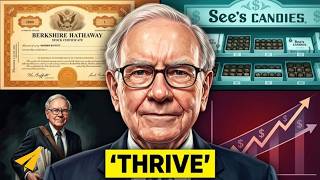
The video is a motivational compilation by Evan Carmichael that opens with a morning “espresso” greeting and introduces the concept of defining your "circle of competence" – a principle famously advocated by Warren Buffett and illustrated through quotes from Steve Jobs, Thomas Keller, Antonio Banderas, and others. The core message is that the most successful people focus on what they are uniquely good at (their "Michael Jordan‑level talent") and avoid spending time on activities they lack passion for or competence in. Evan positions himself as a belief‑coach whose unique ability is to help others believe in themselves, framing untapped human potential as the world’s biggest problem. He urges viewers to eliminate low‑value tasks, partner with those who have big ambitions, and spend the majority of their time on high‑impact work. The video ends with a call‑to‑action for viewers to share the biggest “crap” they will drop from their business and a teaser for a top‑10 rules of success video.
Chapters
Rise and shine, it's enespresso time! Good morning, Believe Nation, it's Evan. My one word is believe, and I believe in you. I believe in that amazing gift you have inside you that needs to be shared with the world. So let's start the day off right together. Grab your cup of coffee and sip on today's message: define your circle of competence. Over to you, Warren Buffett.
I have an old-fashioned belief that I can only— should expect to make money in things that I understand. And when I say understand, I don't mean understand, you know, what the product does or anything like that. I mean understand what the economics of the business are likely to look at— look like 10 years from now or 20 years from now. I know in general what the economics of, say, Wrigley chewing gum will look like 10 years from now. The internet isn't going to change the way people chew gum. It isn't gonna change which gum they chew. You know, if you own the chewing gum market in a big way and you've got Doublemint and Spearmint and Juicy Fruit, those brands will be there 10 years from now. So I can't pinpoint exactly what the numbers are gonna look like on Wrigley, but I'm not gonna be way off if I try to look forward on something like that. Evaluating that company is within what I call my circle of competence. I understand what they do, I understand the economics of it, I understand the competitive aspects of the business. Figuring out the economic consequences— TV, I think there's, I don't know, 20-25 million sets a year sold in the United States. I don't think there's one of them made in the United States anymore. I mean, You'd say TV set manufacturer, what a wonderful business. Everybody— now nobody had a TV in 1950 or thereabouts, '45 to '50. Everybody has multiple sets now, but nobody in the United States has made any real money making the sets. They're all out of business. You know, the Magnavoxes, the RCAs, all of those companies. Radio was the equivalent of the '20s. Over 500 companies making radios in the 1920s. Again, I don't think there's a a US radio manufacturer at the present time. Coca-Cola, you know, what was it, 1884, Jacobs Pharmacy or whatever, fellow comes up with something, a lot of copiers over the years, but now you've got a company that is selling roughly 1.1 billion 8-ounce servings of its product— not all Coke, Sprite, and some others— daily throughout the world, 117 years later. So understanding The economic characteristics of a business is different than predicting the fact that an industry is going to do wonderfully. So when I look at the internet businesses, or I look at tech businesses, I say this is a marvelous thing, and I love to play around on the computer, and it— now I order my books from Amazon and all kinds of things, but I don't know who's going to win. Unless I know who's going to win, I'm not interested in investing. I'll just play around on the computer. And defining your circle of competence is the most important aspect of investing. It's not how important, how large your circle is. You don't have to be an expert on everything, but knowing where the perimeter of that circle of what you know and what you don't know is, and staying inside of it, is all-important. Tom Watson Sr., who started IBM, said in his book, he said, I'm no genius, but I'm smart in spots, and I stay around those spots. And you know, that is the key. So if I understand a few things and I stick in that arena, I'll do okay. And if I don't understand something but I get all excited about it because my neighbors are talking about it and stocks are going up and everything, they start fooling around someplace else, eventually I'll get creamed, and I should.
The most successful people in the world, they know what they're great at and they know what not to touch. They know what they never want to be great at. They're not good at it now. They know they never want to be good at it. They have zero passion for it. And as long as they're spending their time doing it, they're not going to be able to be a success. I believe that everybody has what I call Michael Jordan-level talent at something. Like, you could be the best in the world at something. It's just finding what that is and then spending more of your time there. I think for those of you who even have the awareness of what that Michael Jordan-level talent is, you're not spending a lot of time there. You're spending like 10% of your time doing that thing that you could be the best in the world at, and 90% of your time doing the stuff that you hate, that you suck at, that you never want to get better at. If you suck at something but you want to get better, you have a passion for it, you can learn. You can get good really quickly. But if you have no interest in it and you're just kind of doing it, if that's how you spend your life, spending 90% of your time doing work that you hate, that you never want to get better at, you will never do great things if you're spending time on work that you hate. It just doesn't happen. If you're around people that you hate, doing work that you hate, it's not enticing, it's not inspiring, it's not pushing you. You'll never go off and do great things. And so it's finding what that thing is that you have the ability to be the best in the world at, and then going all in on that. So my new mission is I wanna help solve the world's biggest problem. I believe the world's single biggest problem is untapped human potential. I think it's the biggest problem. I don't think it's cancer. I think the person who can solve cancer right now is working at a McDonald's, and I wanna help her leave McDonald's solved cancer. I recognize that my unique ability is around belief. My unique ability is to help people believe in themselves. I believe in people more than they believe in themselves, and that by being around me, either in person or my content or the books or anything, helps people believe more in themselves to go off and do amazing things. I can't solve cancer. I don't have that ability. If I tried, I would, I would fail and suck. Like, I I don't like science. I don't want to learn science. I have no interest in getting better at that. And all the other problems that the world is facing, I don't know how to go out and solve those things. I don't have the interest in doing it. What I want to do is partner up with the people who have those big ambitions, who have those big dreams to go off and solve an important problem, and I give them that little bit of juice. I give them that little half a percent extra that makes them make that switch that every day they're waking up on fire going off and chasing that goal. That big ambition that I have of solving the world's biggest problem, untapped human potential, is never gonna be realized. Like, it never will happen. There's always more room for potential. But it's inspiring, it's exciting, and I'm doing the thing that I love best, that I'm really good at, that I have the Michael Jordan level talent at, that I have Evan Carmichael level talent at. And so I encourage you to find that thing that you are great at, that you can be great at. Maybe you're not great at it yet, but like, you can be. You can be the Michael Jordan of this. And then trying to find every possible way to spend as much time doing that thing where you can just add so much insane value compared to all the other activities and tasks and boring crap you hate doing. Stop doing the crap and start doing the Michael Jordan level work. So the question of the day today is, I'm curious, what is the biggest crap that you got to give up in your business? That you got to eliminate from your day-to-day? That you got to stop doing immediately let go of so you can be unleashed? What is that thing that you're going to drop now? Leave it in the comments below. I'm really curious to find out. I also want to give a quick shout out to Serge Berberoff. Serge, thank you so much for picking up a copy of my book, In One Word. Really, really, really means a lot to me. I love that picture that you posted. Such a great happy picture in an open field, and I hope you got a lot from the book as well. So thank you guys again for watching. I believe in you, and I hope you continue to believe in yourself in whatever you're whatever your one word is. I'll see you again tomorrow morning for another shot of espresso.
In my life, I thought I knew everything. I thought I knew how to run a restaurant. But I realized that I was a really good chef. I was a really good cook. I had no idea about finances. I knew nothing about I couldn't read a P&L. And I didn't know how to run a dining room. And those are a big part of a restaurant, certainly a big part of any business in terms of financial. So when I was able to buy Rockelle, I was able to buy French Laundry, I realized that I needed somebody in the dining room that could focus on the dining room, that was an expert on the dining room. And I needed somebody who could take care of our financial. And so it became a tripod. There was me in the kitchen focused on the food, which was really my expertise. I realized that was my expertise, that was my strength, and I need to play to my strength and find those individuals who could compensate for my weaknesses. And so Laura Cunningham became the general manager of the restaurant. We had a young bookkeeper named Pat McCarthy, and she took care of all of our financials. And that's what the basis and the foundation of the success of the French Laundry was.
A girl boss is someone who, I guess, takes charge of her own life. So it's a girl boss or a guy boss. Someone who knows their weaknesses and knows what their strengths are and knows how to play to their strengths. I think there's a lot of people out there, and I've interviewed a lot of them, who— my favorite interview question is, "Name your biggest strength and your biggest weakness," or, "What do you have to work on?" And the scariest people are the ones who say, like, "I show up early. It's my biggest weakness," or, like, "I work too much. It's my biggest weakness." And, you know, everybody has things that they can improve upon, and I think A world where everybody is more aware of that is a good one, and a place where people can be empowered to make choices in their life rather than throw themselves into places that they may not inherently be successful because the world has sold them some story of what they should be doing. So I guess a girl boss is someone who's in choice.
So when you meet new talent, emerging talent, and you're mentoring them, What if you don't have the confidence that they have the level of talent required to achieve greatness? How do you counsel them? What do you say to make them feel confident, to not rob them of that moment, but also steer them in the right direction?
I mean, you can't say, "You really, mm, you're a zero." [SPEAKING SPANISH] [Speaker] No, by talking to them, understanding what their concerns are, what sort of self-image they have, and trying to show them their strengths too. And if they have some kind of weakness, well, trying to not focus on those weaknesses. I think in the entertainment industry, that's what works. You know your strengths, you milk them. You know your weaknesses, you try not to focus on them so much. The audience doesn't focus on them as much.
Raise your standard. Apple, at the core, its core value is that we believe that people with passion can change the world for the better.
Not one drop of my self-worth depends on your acceptance of me.
I don't ever give up.
I'd have to be dead or completely incapacitated. Hey Believe Nation, if you want to see my all-time favorite top 10 rules of success, I have a very special secret video for you. These are the individual clips that I have personally learned the most from and applied to my life and my business. Check the link in the description for details.