Why "Slightly Dishonest" People Always Lose In The End
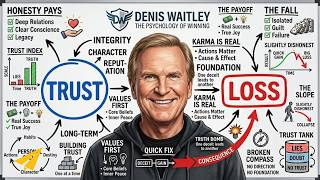
In this motivational video, host Evan Carmichael introduces a talk by Dennis Waitley that argues integrity is an all‑or‑nothing virtue: you are either honest or you are not. Waitley explains that even small, “slightly dishonest” actions eventually surface because details cannot be hidden forever. He contrasts genuine integrity with the pursuit of image, status, and short‑term gains, using historical analogies (the Roman Empire’s wax‑coated statues) and modern anecdotes (a surgical nurse insisting on counting a missing sponge, a classroom wallet‑finding experiment) to illustrate how dishonesty erodes trust and leadership. The talk emphasizes that integrity is essential for personal growth, effective leadership, and lasting relationships, and it cannot be situational or compromised for popularity. Waitley offers concrete ways to cultivate integrity: teach children responsibility and gratitude early, model ethical behavior, give credit where due, avoid plagiarism, be transparent about one’s flaws, and maintain consistent standards regardless of external pressure. He cites a Fortune 500 CEO survey that ranks integrity as the top quality for hiring and promotion, reinforcing the business case. The video concludes with a call to embody integrity in all aspects of life, promising that those who stay honest will ultimately succeed.
You either have complete honesty or you do not. There are no degrees of integrity in life. Being slightly dishonest might work for a short time, but people will notice the details eventually. You have to do what is right instead of what is popular. A special thanks to the Whateley family for partnering with us to release this video exclusively on my YouTube channel. To check out more about Dennis Whateley Global, click the first link in the description below.
A simple motto hung on the wall of our grandparents' small frame house. Where many seeds of our development were planted. Grandma and Granddad didn't talk much about those lines, but they lived them. Life is like a field of newly fallen snow. Where I choose to walk, every step will show. They believed you were either honest or you weren't. There was nothing in between. No such thing as partial honesty. Integrity, a standard of personal morality and ethics, is not relative to the situation you happen to find yourself in and doesn't sell out to expediency. Complete integrity in little things is no little thing at all. As has been said many times, "The devil is in the details," and elephants don't bite, but fleas do. There are no degrees of integrity—you have it or you don't. Being slightly dishonest may be a safe adventure for a time, But one day inevitably, little details will be noticed and the piper will have to be paid. What you are speaks so loudly, no one can really hear what you say. If what you do matches what you say, your life will speak forcefully indeed. In people, we value honesty more than any other virtue. We expect it from our leaders. We must demand it from ourselves. Its short supply is getting even shorter, but without it, leadership is a façade. Learning to see through exteriors is a critical development in the transition from adolescence to adulthood, but sadly, most people continue to be taken in by big talk and media popularity, flashy or bizarre looks, and expensive possessions. They move through most of their years convinced that the extremes are what count and are thus doomed to live shallow lives. Men and women who rely on their looks or status to feel good about themselves inevitably do everything they can to enhance the impression that they make and do correspondingly little to develop their inner value and personal growth. The paradox is that the people who try hardest to impress are often the least impressive. Devotion to image is often for the money it can reap. Puffing to appear powerful is an attempt to hide insecurity. If only we could see many of our celebrities when their guard and pretenses were down. In the Roman Empire's final corrupt years, status was conveyed by the number of carved statues of the gods that were displayed in people's courtyards. As in every business, The Roman statue industry had good and bad sculptors and merchants. As the empire became ever more greedy and narcissistic, the bad got away with as much as they could. Sculptors became so adept at using wax to hide the cracks and chips in marble that most people couldn't discern the difference in quality. Statues began to weep, or melt, under the scrutiny of sunlight. Or heat in the foyers. For statues of authentic fine quality carved by reputable artists, people had to go to the artisan marketplace in the Roman Quad and look for booths with signs declaring "sina cera"—without wax. We too look for the real thing in friends, products, and services. In people, we value sincerity from "sina cera." more than almost any other virtue. Integrity that strengthens an inner value system is the real human bottom line. Commitment to a life of integrity in every situation demonstrates that your word is more valuable than a surety bond. It means that you don't base your decisions on being politically correct. You do what's right, not what's fashionable. You know that truth is absolute, not a device for manipulating others, and you win in the long run when the stakes are highest. What can we do to increase the dwindling integrity in our society today? Like charity, integrity begins at home. One of the greatest gifts you can give your children is a strong sense of ethical and moral values. Let them accept responsibility for their own actions as early as possible. The more sense of responsibility they develop, the more they'll feel good about themselves. Above all, for integrity's sake, teach them graciousness and gratitude and how to care about the rights and welfare of others. Teach your children and business associates who look to you for leadership that their true rewards in life will depend on the quality and amount of service that they render. And show them by example how to treat others as they would have others treat them. If we were writing a single commandment for leadership, it would be: "You shall conduct yourself in such a manner as to set an example worthy of imitation by your children and subordinates." In simpler terms, if they shouldn't be doing it, neither should you. When we told our kids to clean their rooms, for example, They took a closer look at the condition of our tools and possessions in the garage. When we told them that honesty was our family's greatest virtue, they commented on the radar detector that we had installed in the family car. When we told them about the vices of drinking and wild parties, they watched from the upstairs balcony the way our guests behaved at our adult functions. One of the principles of integrity is to defend your convictions in the face of great social pressure. Consider this true story about an abdominal surgery performed in a large, well-known hospital. It was a surgical nurse's first day on the medical team. Responsible for ensuring that all instruments and materials were accounted for before completing the operation and sewing up the incision, She told the surgeon that he had removed only 11 sponges. "We used 12, and we need to find the last one," she reported. "No, I removed them all," the doctor declared emphatically. "We'll close the incision now." "No," the rookie nurse objected. "We used 12 sponges." "I'll take the responsibility," the surgeon said grimly. "Suture, please." "You can't do that, sir." blazed the nurse. Think of the patient. The surgeon lifted his foot, revealing where he had hidden the 12th sponge. You'll do just fine in this or any other hospital, he said smiling. Don't back down when you know that you're right. A second key integrity principle is always to give others the credit that's rightfully theirs, never fearing anyone who has a better idea or is smarter than you. This is becoming increasingly difficult in our age of instant access to information on the internet. We can download term papers, essays, books, music, videos, photos, documents, and concepts, all authored or created by someone else. It's tempting to pirate someone else's work and profit from it. Eventually, however, although it seems to be an easy way to get rich, there's almost always a knock on the door with a lawyer or law officer on the other side with more than a friendly greeting in hand. You are the product of your actions, and like an unfailing boomerang, what you throw out as choices will come full circle as consequences. Our third integrity principle is to be honest and open about who you really are. Be yourself. Don't exaggerate your achievements. Don't get trapped in a cover-up of past mistakes, even of personal traits that dissatisfy or displease you. When the going is tough, be tough by facing reality with adult responses. Use the good and bad as material for personal growth. We must teach our children and our subordinates self-respect and the supreme value of a clean conscience. As early as possible. They are powerful components of integrity. We enjoy discussing integrity with high school students. We throw a wallet into the center of the room where we, members of a small seminar, are sitting in a circle. The wallet contains a driver's license, credit cards, photos, and 8 $100 bills. We ask the students one by one what they would do if they found the wallet on a deserted street The answers are uncomfortably revealing. "Wow, that would be awesome!" goes the most typical. "I'd keep the money as my reward and mail back the wallet with the credit cards." Other students invariably suggest not putting a return address on the envelope so the owner couldn't call and ask if there was money in the wallet when it was found. We usually ask how the $800 windfall would be explained to parents and friends. And if word got around and ultimately back to the owner, would they say, "Losers weepers, finders keepers"? Then we place the wallet in special situational context. What if the driver's license showed that the wallet belonged to your best friend or to your mother? What if you recognized the driver's license photograph as that of an elderly neighbor who lived on the government and who probably dropped the wallet on her way to the hospital for kidney dialysis, which she needed every week. Most students somberly agreed that in those specific situations, it would be best to return the money too. Wan, one of them, ventured a slight exception. If the wallet belonged to his mother, she'd understand, he assured us, if a few hundred dollars were missing. Finally, we asked an even more sensitive and defining question: What if you were at an airport, ready to fly off on a student summer tour of Hawaii and Australia. You use the restroom and leave your wallet containing 8 $100 bills on the sink when you wash your hands. Realizing what you're missing, as you board the plane, you run back, explain your emergency to the gate agent, and race to the restroom, heart pounding. 'If you were in that situation, what would you hope?' They all say, 'That the wallet's on the counter where I left it.' Most call out that same answer in unison. 'And what do you hope is in the wallet?' we continue. 'Eight $100 bills and my credit cards and my driver's license,' they chorus. 'And if a good Samaritan like you has picked up your wallet, "Whaddo you hope he or she does?" "Turns it into lost and found or airport security or a gate agent," they say, "with all the money intact." From there we return to the wallet found on the deserted street. Now the students, many with wisdom-widened eyes, are clear about treating it as if they'd want others to behave if the wallet belonged to them. The point has been made. Honesty and integrity are non-situational, and inner standards for your performance and behavior are the foundation of true self-respect. Specific situations require different management approaches and styles, but how do you feel about the term situational integrity? We've seen that if integrity applies only to specific situations, it's not integrity at all, but expediency. Do you believe in absolutes, or does everything derive from your point of view, your temporary advantage? To answer that question with another question, you might ask what your family or your company or, or what our world would be like if everyone had your ethics. The choice is yours. We'd either be in terrific or terrible shape. Of course, people do cheat to get ahead. You know that. But when you maintain your integrity at all costs, even if you feel you might suffer in the short term, you'll win hands down in the end. Can you think of a successful relationship without integrity? I doubt it. All are based on mutual trust. Break the trust and you break the relationship. Subvert it and it's almost impossible to put together again. Creating a long-term relationship takes two or more people, whether executives, representatives of labor and management, or husband and wife, who are grounded in and operating on the same non-situational integrity. Nothing less will last. When Fortune magazine asked the CEOs of many Fortune 500 companies what they consider the most important qualities for hiring and promoting top executives, The unanimous consensus was that integrity and trustworthiness were by far the key qualities. That survey of leading businessmen, not of preachers or motivational speakers, speaks for itself. Here are some tips to help you further embrace integrity in your personal, business, and family life. Justice and fair play are integrity's core values. Go out of your way to be helpful and make others number one in your life. A smile will always be returned with a smile, and you're none the worse for the wear, even if it's not. Set high standards of ethics for yourself and expect others to do the same. Your single most powerful teaching tool is not talking about what's right, but quietly doing it. A businessperson or parent who lectures about obeying the rules but constantly breaks them is making an especially powerful negative statement. The old "do as I say, not as I do" is severely damaging to children and subordinates. Give of your best in the worst of times. Personal integrity knows no season and doesn't hinge on the weather, the stock market report, or the leading economic indicators. You have it or you don't. Do not to others what you would not want done to you. Is a pillar of ancient Chinese philosophy. Charting your course by the North Star means that you are stable, constant, resolute. You base your decisions on principle, on your immovable belief system. Respect diversity and culture and heritage. The world's rapid transportation, interactive media, virtual reality, and global communications network means that we must learn to live in harmony with other human beings. The dictionary tells us that integrity is wholeness, which implies mutual acceptance. Don't make the futile attempt at trying to be an island. Welcome the foreigner. Work hard at understanding other cultures, languages, and points of view. What would you do if you found a wallet with a good deal of money in it? Adults are often confronted by much more serious problems. So ask yourself if you have the solid bedrock values to get you through any situation without compromise. Your children and subordinates will do what they see you do. Your job as a leader is enormous, but so are the rewards. A life of principle, of not succumbing to the temptations of easy morality, and get-rich-quick shortcuts will always win in the end, leading you to the real wealth of the present and the rest of the 21st century.
And congratulations, you're one video closer to who you're meant to be. Believe. For some more incredible Dennis Waitley motivation, check the video right there next to me. I think you'll love it.
Continue to believe, and I'll see you there. Core values radiate like rings, as when a leaf falls in a pond, The self-centered constantly seek approval from and power over others. They try to impress them with their worth
More from Evan




How the Biggest Mistake in History Created A Trillion-Dollar Empire | Sergey Brin



9 Machiavelli Principles That Force People To Respect You | Machiavellian Philosophy



The First 10 Words That Instantly Ruin A Sales Conversation | Vanessa Van Edwards