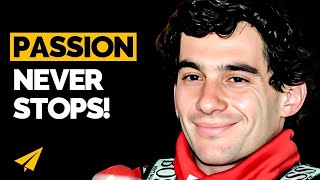
The video compiles interview excerpts, narration, and commentary to present Ayrton Senna’s "top 10 rules for success" as a framework for racing excellence. Senna repeatedly emphasizes the constant risk of being a driver, the necessity of calmness, strong education, and unwavering competitiveness. He stresses personal responsibility—not only for his own performance but also for the collective safety of the race, arguing that drivers and teams should sometimes refuse to start a race under dangerous conditions. The transcript includes Senna’s reflections on mental preparation, the importance of mentorship and support staff, and his sense of duty toward children who look up to racers. Anecdotes illustrate his competitive mindset: a gearbox jammed in sixth gear during a Brazilian Grand Prix, a high‑speed first‑corner incident, and the physical toll of extreme stress and fatigue. Alain Prost and Jackie Stewart provide complementary viewpoints on driver longevity, motivation, and race‑control decisions, reinforcing the theme that success requires both personal drive and collaborative responsibility. The video concludes with a call to viewers to discuss which of Senna’s rules resonates most, positioning the content as both inspirational and instructional for aspiring racers and entrepreneurs alike.
Chapters
By being a racing driver, you are under risk all the time.
I use those lines and those guidelines to move as a man, as a professional.
I like to do well, I like to be the best.
I am as committed as ever to my passion.
Everyone is responsible for the race having been started.
I'm only 32 and it's no sense for me to stop.
My understanding was that he would never move against me in the first corner.
He's a Brazilian race driver who won 3 Formula One World Championships.
He was killed in an accident while leading the 1994 San Marino Grand Prix.
He's considered by many as the greatest race car driver of all time.
He's Ayrton Senna, and here are his top 10 rules for success.
You should know that by being a racing driver, you are under risk all the time. By being a racing driver means you are racing with other people. And if you no longer go for a gap that exists, you're no longer a racing driver. Because we are competing. We are competing to win. And the main motivation to all of us is to compete for victory. It's not to come third, fourth, fifth.
O que que um piloto de Fórmula 1 precisa? Como é que tem que ter a cabeça para ser campeão? O que que é necessário? Que precisa?
Bom, antes de tudo você precisa ter muita, muita calma, tranquilidade e assessoria. Você precisa de ter gente que realmente tá na retaguarda te dando as dicas, te ensinando e procurando minimizar as mancadas, né? E com calma. Acho que a regra principal é saber se segurar. E é um grande problema que um jovem tem o ímpeto, tem a vontade de fazer tudo correndo. Eu sou muito assim por dentro.
Você é ansioso?
É, exatamente. Mas errando eu fui aprendendo e tô aprendendo ainda que você tem que de vez em quando dar uma freada.
I have had all my life very, very strong and good education. And from that education I have got, again, clear and strong principles in way of behaving. And that's where I'm guided for. I come, I use those lines and those guidelines to move as a man, as a professional. And I don't regret anything. I just feel I'm doing things for the right reason. Some understand, some don't. In the end, you never get everybody to understand, to agree, and to accept. But most of them, I'm sure, admire after all what I'm doing as a professional and as a man. And as many drivers do, we are exposing our lives, they are consistent. And the reason for it is only one, is to succeed, is to win, is to get the thrill when you cross the finish line in first place.
I am very competitive. I think any racing driver that gets to Formula 1 has in its personality a lot of competitiveness. I particularly believe to be extremely competitive in anything I do. But it depends where you are and what you're doing, what is your state of mind. If I'm on holiday, off-season, it's a different way of living totally than when you're doing interviews, when you're testing during the season, racing, competing during the season. You have to allow yourself a different mental approach, a different way of looking at the day and night. And only that way I find possible to get the necessary equilibrium to then give everything I have when it really matters. But in normal things, I am competitive.
I like to compete and I like to Bom, a minha responsabilidade é talvez maior do que todas, principalmente com a meninada, com as crianças, porque a gente realmente sente nas crianças uma admiração e um carinho grande, e isso motiva mais ainda você procurar transmitir alguma coisa de especial para eles. E então eu sinto sobretudo uma responsabilidade com a infância, com as crianças que gostam de corrida, levantam cedo e pegam na calça do pai, na saia da mãe, que querem que leve a um autódromo, a uma pista, enfim. E é para quem eu estou realmente aberto, para quem eu, quando encontro, me sinto bem.
3 times in 4 years. I have to ask you on behalf of your despairing rivals, is your motivation still as high as ever?
I think so.
I, I am, as you said, young. I am Healthy. I am as committed as ever to my passion, to our passion, and to my profession. And the main thing is to, to find ways time after time to stimulate myself in my own world or in my own funny ways to dedicate a lot of my time and a lot of my thinking and keep up with the commitment that is quite high to continue to be successful.
If we were to run into rain conditions of this kind again, is there a better method, Ayrton, for us to look into how the race should be stopped earlier or more positively?
We shouldn't start.
But whose decision is that, Eric?
I think it's very hard for the officials to make such a decision because there is a lot of pressure, television all over the world, and it's difficult. We understand. But I think it's in a way is our own fault. We should have started as drivers. If we just get out of the cars, stick together, and make a decision ourselves, then the race wouldn't start. In first place. It's always very difficult to get everyone together. I experienced it myself 2 years ago, today again, because also we have a lot of responsibility to the teams and the sponsors that give us so much. And there are moments that we have to also try to give them something, but it's very difficult to find the equilibrium, the balance, on making the right decisions at every single time. But as I said, I think It was a mistake to all of us to have started, not only from the officials. It was also a driver's mistake, was a team's mistake. We all should have had courage as a group, everyone that is here, to get together and go against it and not risk and not start the race. So it's not officials only. I also take responsibility.
I think as drivers and also the team, everyone is responsible for the race having been I expressed the feeling some time ago, a couple of months ago, that I wouldn't be prepared to continue driving next year unless I felt I could compete competitively. And that meant not that I had to leave McLaren or anything. It just meant if you feel you, you have some light at the end of the tunnel in which you can work and make up and be back there in a competitive way. And if that situation did not turn up for me, then I wouldn't drive without really wishing to stop, because I mean, I'm only 32 and it's no sense for me to stop. I mean, the peak of my career is still with quite a few years ahead. I have achieved so much credibility and so much experience that is it's not the time to stop. But on the other hand, it's absolutely no sense to just be a number out there, given the fact that whether you're fighting for first or second or a fifth or a sixth, you're just exposing yourself to a lot of danger continuously, a lot of stress, and a lifestyle that not always is, is attractive for me. Therefore Considering everything, the material benefits I got up until now and the ones I could get in the future, the personal satisfaction, the achievements that you can get, the only real motivation for me to continue was to be in a position where I could compete, improve, learn more, and be there, you know, be there fighting at least for it. And anything else, just, I could not justify to myself.
He moved to the inside line going towards the first corner. I just chased him then, and he opened the gap. And knowing me like he does know, he must realize that if there was a gap, I was gonna try to overtake him. And, and, and, and under those circumstances, he should never have opened a gap in the first corner and then come back again. Because by doing so, he opened the gap, gave the gap, and then closed it. And in that sequence, there was no way to avoid an incident, right?
But that only happened, Ethan, because you saw the gap. And I accept that, you're a racer. But a mature racer has to also think, if he closes the door again, we're going to have an accident. And in fact, that was a high-speed entry, so it could have been a very serious accident.
Absolutely.
So wouldn't it not have been more prudent under those circumstances to have at least seen that the gap was potentially going to close?
Not at all. He was in a position where he could never, under no circumstance, put his car anywhere near mine in a difficult position. Because if it happened just to touch, just to touch, and have a wing damage or a wheel flat tire, he had everything to lose. So, and under those circumstances, my understanding was that he would never move against me in the first corner. And I was very surprised when I found myself with him moving the car over mine.
So in that case, you were calculating that he would give way, that he would let you through?
Of course, he would not close the way he did From the moment he made the initial run, he would not come back and close the door again.
A calculated risk.
Of course.
Ayrton pulled out the lead. He was then really faced with a very easy race win. And then the gearbox jammed and he was faced with several laps to go only having a 6th gear.
Impossível pilotar um carro de Fórmula 1 com o câmbio travado na 6ª marcha. Ele queria até parar, ele não podia mais continuar a correr, mas ele tinha tentado tantas vezes vencer o Grande Prêmio do Brasil que ele encontrou dentro dele uma força especial.
Aí então, aí então, Serra do Brasil! Que gol! Ponto de Vercingetorix! Uma grande vitória de Serra do Brasil! Ele ganhou e aí desmaiou.
Foi o seu momento mais heróico.
Devido ao desgaste extremo, eu tive espasmos A dor era absurda. No final de semana inteiro com estresse, a pressão foi enorme. O resultado só podia ser esse mesmo, acabar a corrida sem nada sobrando.
Thank you so much for watching. We made this video because Devesh Somani asked us to. So if there's a famous entrepreneur that you want us to profile next, leave it in the comments below and we'll see what we can do.
We would love to know which one of his top 10 rules that you like the most. Please leave the comment below. Who are joining in the discussion.
Thank you guys for watching. Continue to believe, and we'll see you soon.