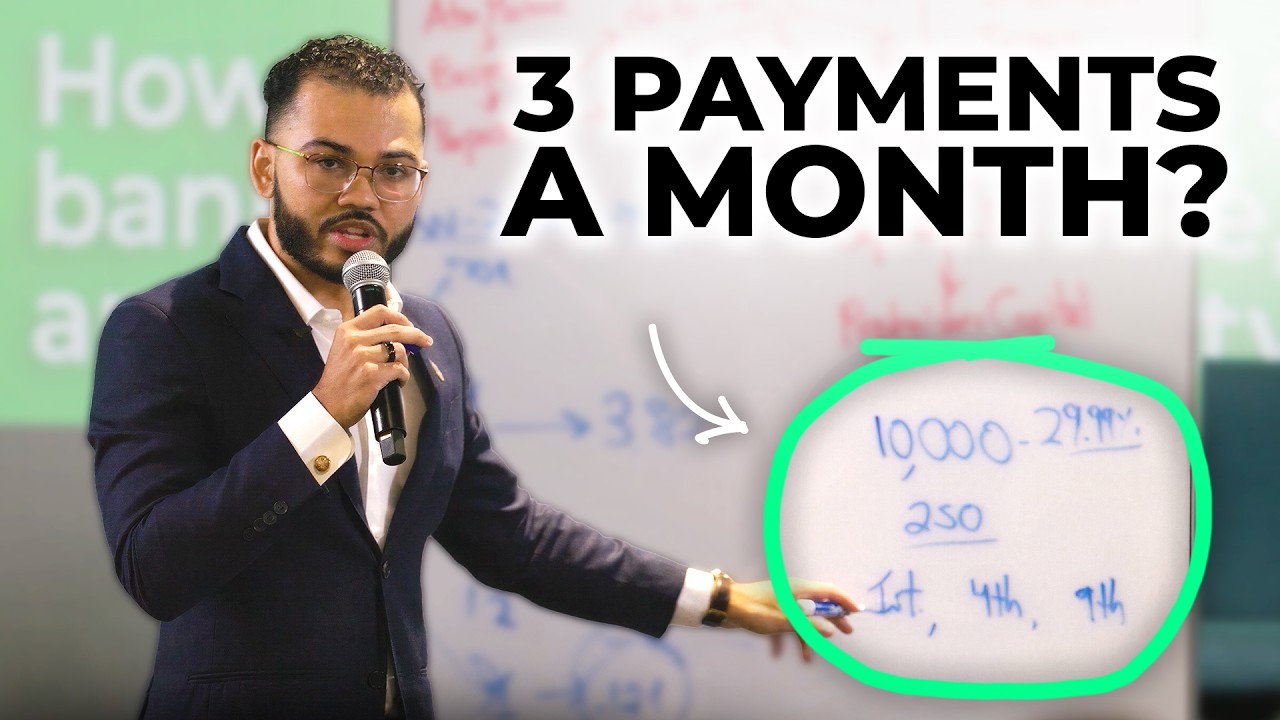
In this live financial talk, Denzel Rodriguez critiques traditional investment advice that encourages putting taxed W‑2 earnings into low‑return assets like the S&P or Bitcoin, arguing that such “slow money” yields only cents on the dollar after taxes and advisor fees. He frames the broader problem as the minority wealth gap and proposes a two‑pronged solution: becoming a value creator and building community‑based banking infrastructure to generate and retain wealth within underserved groups. The core practical takeaway is a three‑payment credit‑card strategy: make three equal payments each billing cycle—one 15 days after the cycle opens, one three days before the due date, and one on the due date. By doing so, borrowers reduce the amount of interest that accrues, accelerate principal reduction, and signal consistent repayment behavior to credit bureaus, thereby boosting credit scores faster. Rodriguez walks through the mechanics of credit‑card billing cycles (closing date, reporting date, due date), provides numeric examples (a $10,000 balance with a 2.5% minimum payment at 29.99% APR), and clarifies that the timing trick works for revolving debt but not for fixed‑rate installment loans or mortgages, where extra payments affect principal but not the scheduled interest calculation. Throughout, he emphasizes that these tactics put more cash back in the consumer’s pocket and serve as a stepping stone toward broader wealth creation and financial empowerment.
Chapters
Wayne opened up with 382% increase year over year. What does that actually mean? What does that actually mean? Ladies and gentlemen, Wayne puts $1 into his business and it spits out $3.82. If you had a business that could do that, How many times, how many dollars would you put in there? We get an answer. That's good. All of them. Okay, so why are y'all buying Bitcoin? Oh, why are y'all buying these random REIT funds you have no idea about? Why are you lending money to Joe Schmo to get a 12% rate of return? Ladies and gentlemen, a 12% rate of return An average 9% S&P. Oh my God, that's so good. All the gurus talk about that. Dude, you know what that means, right? You put a dollar, let's say you get 12%, that's 12 cents. Good for you. Good for you, ladies and gentlemen. This is slow money. When you're starting out or rebuilding or restarting for the third, for the fourth, for the fifth, for the sixth, for the seventh time, why on earth are you taking your hard-earned W-2 money that you got taxed 30 to 40% on in your state to then take what's left over? So technically you took $1 from your W-2, so now you technically only have $0.70 on that dollar. And you throw it into the S&P or your retirement account because that's what your advisor tells you to do. Now, he or she is getting full dollars when you do that because they're getting the commissions and whatnot. You're getting cents on the dollar. My whole premise of my talk today is how we fortify everything we learned today by becoming a value creator and a banker. I believe if we're going to solve what Wayne was talking about, that minority wealth gap, because I didn't even know you're going to go there. Look what I wrote: how value creation and banking can restore, sustain, and expand minority wealth. Banking is where— is banking is the foundation. But in order to have a bank, you need value. You have to create value. How do we do that? How do we create value? And just to wrap up, other really good things as Charisse was talking. I also wanted to mention about the 3-payment strategy as it pertains to when you're building your credit. Does anyone know about the 3-payment strategy? Raise your hand. No one. Oh my God, this is so good. Ready? Ready? Let's say you are in debt on a credit card that you owe $10 grand on, and let's say the monthly minimum payment is 2.5%. So let's say it's like $250 is your monthly payment. And you're being charged a horrendous interest rate, 29.99. Here you are trying to earn 12 cents, you're getting charged 29.99. Good for you. Anyways, $250 a month, okay? Let's say the due date on that credit card is the 1st. Let's say the closing date is the 4th. Anybody know what that means? Closing date? That means the cycle ends and then restarts. It says, okay, here's how much you owe now. Anybody know what the reporting date means? There you go. Let's say the reporting date is on the 9th. Typically, the reporting date is always after the closing date. The due date is always before the closing date. That's how the cycles work with your revolving credit lines. So this $250, since you're gonna pay that anyways, you're basically saving up money throughout the month until you reach your due date. Why are you waiting to pay the bill? Because you what? You don't have the what? The full payment. But with the credit card companies, you don't have to have the full payment. Before the what? The due date. So let's say we are approaching— let's just wind back like a week in April. Say, say it's April 15th, okay? You've already made a $250 payment on April 1st. Let's just say it's been 2 weeks. Most of you are biweekly or weekly pay, so you got your check. Let's just say, for example, you got your check, it's April 15th. Make a payment, a third of the amount of that $250. When you do this, not only are you creating what's called a character profile on your credit score, because credit, the way the bureaus look at it, is all about character now. The character of that individual. How likely is this person to pay me back? If I can show the banks and the institutions that I'm paying 3 times, they register at that as they're paying me back 3 times. Same amount, 3 times. They actually lose in the process a little bit of money because did you know that when you make a 30— what's 250 divided by 3? Do the math for me. I know I'm a finance geek, but— thank you, sir. Very good, very good. So make it $83, call it $84 payment on the 15th, right? Then do it again 3 days before the due date. So this is our, this, this is our timeline of the card. So you got due, due date, close date, reporting date. What I'm telling you to do is pay it 3 days before the due 15 days into the cycle. So in this case, it would literally be 4 plus 15, so call it April 19th. 15 days into the cycle of that new cycle starting on your card, and then make a payment on the due date. So 84, 84, 84, or right down to the penny. You will get out of debt faster. Not crazy faster, but you are saving some money on interest on the same amount of money you were going to pay anyways. And your credit score is going to, going to increase faster. It's going to increase faster. With me on that? That is a super cool nugget right there. No? Okay, I was just making sure. I'm gonna erase it. Do you need to write it down? Do you need to take a picture? Are you good? Just say 3/15 due. 3 days before, 15 days into the cycle, and then make a payment on due date. I just put money back in your pocket if you are in debt. Say, yes sir? Can you repeat the benefit of it? I didn't understand that. The benefit is your credit score is going to increase faster because you're showing the bureaus your ability to pay. That's all they care about, your ability to pay and the history of that. Then you actually pay down the $10,000 faster because the first 2 payments before the due date is all principal. You only get charged interest on the due date. So the faster I get my money into the card, the faster I get out of debt. Yeah, 3 days before. Yeah, go ahead. 3 days before, 15 days, and on the due date? On the due date. Okay, thank you. Yep. Can I go a layer deeper? I'm just— I just want to put money in your pocket, okay? Money in your pocket. This is really cool stuff. Hey, Denzel. Yeah? Just had a quick one right here. Yes, sir. With that process, would you have to call to indicate that, hey, we want to make that payment to principal? Nope, not with a credit card. A loan, because it's an installment, the interest was already preset. So unless it's a simple interest loan, then you can influence the amount of interest prior to the cycle ending. If we're talking about a mortgage, personal loan, student loan, you only influence it on the, on the new cycle. So say the mortgage payment is $2,000, it's due on the 1st. Some mortgage providers, if you don't have more than $2,000 before the next due date, they hold it. Because why? They want to make sure you're making the regular payment. Because even if you make an extra payment, you still owe Right? You didn't influence the actual payment itself. This applies to your revolving debts really well. Your revolving debts. Because you are influencing the payment per month, you're lowering your actual minimum payment. Which means that's more cash flow for you each and every month. It creates a compounded effect, you do get out of debt faster. Yes. The $83, is that you're gonna pay that 3 days before and then 15 days in? 15 days into the cycle. So say the closing date ended on the 4th, just count 15, April 19th. Right. Make a payment. Of $83? Of $83, April 19th. Make another payment 3 days before May 1st. The $83 again? Uh-huh. Right before the due date, and then do it again on the due date. You're gonna see a decrease in interest charged. That decrease is increased principal. Do that 12 months, 15 months, I just put what my consulting fee is back into your pocket. What you would normally pay me. There you go. Step 1 being giving. Okay, even if we don't have any money, I'm telling you, if you give, you will receive 10 times over. Monthly net income, not bad at all. The tools and resources that are in the world that we talked about yesterday. I have a fire in my belly every time I talk to my moms. Uh, the Australians start trying to make a whole ton of money. I need to first be