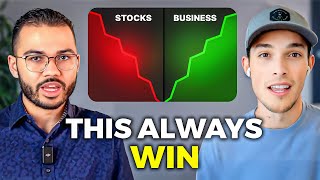
This YouTube conversation (Denzel Rodriguez interviewing Sam) discusses how entrepreneurs should allocate profit: Sam emphasizes knowing your investor personality and prioritizes reinvesting in the business or holding cash rather than buying stocks (he sells when markets dip and believes he can earn higher returns by growing active income). Denzel counters by quantifying reinvestment returns — arguing business reinvestment can produce triple- to quadruple-digit returns and offers tax advantages (home office, Augusta rule, deductible costs) when assets are bought through a business. Sam reports he began his business with ~$4–5K, turned that investment into millions, and as of 2025 is investing almost everything back into his business or holding cash to protect downside and preserve runway.
Chapters
This last question I have for you. Now that we understand how you make the money, how you steward it, the principles behind that talk to us about how do you invest the money after you've made it, paid your bills, saved your money, you now have this free cash flow that's left over, which is profit in your business. How do you now invest money? And if you can first start, not the type of investing necessarily, but if you can start with the accounts first, like where you first contributing dollars, then share the actual investing that you do.
Right. So I think people need to know their personality. I'm a bit impulsive in terms of like, I want to buy this, so. And it's like, I could afford it, but like, I'm just going to buy it, you know, so that's why I don't do stocks. That's my personal thing. Obviously, I'm sure, you know, people are going to be like, but over 30 years compounded, it's better than real estate or this or that. And they're probably right, you know, But I know for a fact if the market goes down 3%, I'm like, I need to sell. You know, like it's no, no, no, because I just, I always believe that I could invest more in my business and get a better return. So. So I think as entrepreneurs, we're not the best like investment case because we're always a little bit like egotistical. We're like, oh, the market, 8%, like, I'm going to get another sales rep and they're going to make 100 grand this year, you know, so we're willing to take more risk. We almost like seek risk sometimes because the stock market can be so passive and boring and successful long term. Sometimes we're like, nah. And again, I'm going to probably change my mind as I feel like my business, I feel like my active income isn't at its full potential. So I feel like that's why I need to continue to focus on it. So I think people focus on passive income when their active income is woefully under potential.
Correct.
As you mentioned, somebody might be, you know, in an industry for 15 years and like they're making seven grand a month before taxes and they, they're focused on, oh, but like I need passive income. It's like, but your active income is nowhere near what it could be. That's where I feel like that's why I'm not a big investor. And yeah, I have a rental and I have a house and like, again, I save a lot of Money. But I don't feel like I'm like a heavy investor because I feel like I could take that money, either leave it in cash or invest in my business to then grow my active income more. Or maybe, maybe I'm making investments in my business now that won't really pay off for the next year or two, but it's going to grow my active income then. So I feel like the, again, the entrepreneur, like entrepreneurial person is not the person to get investing advice from whatsoever. But from a, like a mindset perspective, you want to max out your active income. In my opinion, once you're like, hey, like, this is the best it's ever gonna get, then I would say, okay, then you need to really study investing and whatever that looks like for you. But I feel like my active income isn't near its potential. So I think that's why I just focus on that.
Okay. And I don't want to devalue this because I often hear other entrepreneurs, like, kind of talk like that. It's like we're kind of devaluing what. What we're doing because it's not the norm. But if we were to actually look at your P. Ls from the first year in business to now, and you look at what is Alex's rate of return based off of how much money he's put in, contributed into the business. And we look at year over year, growth year over year, year over year, how much money you put in versus how much money is coming out. I would argue, I would be willing to bet that your rate of return is in the triple digit. And this is personal in, in my experience as well, where I've gotten to the point now where it's very hard for me to invest in anything outside of my business because for every dollar I have an operational expense in my business, it spits out at least 2 to 3 more dollars. So that's a 2 to 300% return on every single dollar I put into the business. Triple digits. And in some cases it could be quadruple, right? A thousand percent or more. Where on earth can I get 100 to 1000% return on my money other than a business? So I don't want to devalue this in any way and really get people to see the other side here. Like Alex first started with, you got to know yourself. If I had to summarize that, call it investor DNA. Alex knows himself. He's got the investor DNA. The very first thing you're doing is you're reinvesting back into your business. And then there's all the tax incentives that come with reinvesting in your business. So reinvesting in your business could maybe look like you buying something you may have wanted to have or buying some kind of an asset, such as real estate. And because it was done through the business, let's say there's all these tax incentives that come with it. Having, you know, the way that you bought your house is not the way most W2 people buy their house. When you buy your house, and it's coming with a home office. It's coming with the Augusta rule. It's coming with the fact that you get to offset some of your electrical costs, your Internet costs. The fact that we're doing this right here in your office, the square footage of it, all of it factors in. And so it's increasing your net rate of return on your money. So I just wanted to, like, double down on, like, what you're doing. And I'll mention as well, like, much better than a lot of other things.
No, and that does make sense. And I'll say sometimes people just don't look at the facts. And I started my business with four or five thousand bucks, right. So even if I was a great investor and I put that in Nvidia back then, all right, 5,000 bucks might be 4,000. 5,000. I'm doing the math right now that even if, let's say I 5xed it, like, wow, 500% return. That's 25 grand, right?
Yeah.
And that's over the last almost decade. Whereas I invested the 5,000 into myself and my skills and what I'm doing, and it's made millions.
That's a flex, you know, like, that's kind of cool.
Whereas it's true. It's like if people have. But I think people think they're an investor, but it's like, you don't have the money to be an investor. Like, if you have $20,000. $20,000 times 7% is 1400 bucks per month. That's 116 bucks. People spend that at Chipotle these days with inflation. And I'm not trying to, like, say, oh, wow, you only have 20,000 bucks. I'm just saying your mindset has to shift. And like, maybe when you have 200,000. Hey, 200,000, you know, maybe you.
You.
You get 7% return, 14 grand, hey, that's like more than 1,000amonth. You compound that, like, you know, you double that at 7% comp. Compounded every seven or eight years based on the calculators. I mean, now, like, you're cooking with something. I think if people don't have that, then they should just focus on how do I make more? Because then I can make any investing hypothetically that I do, like, actually worth it.
Okay, practically. So in your case, as of right now, in 2025, are you reinvesting pretty much 100% of what you make? Or is there some, some element of investing outside of your business? Or are you just like, to your. What you said earlier, you're focusing on maxing out your ability to create active income, getting to a certain number or certain level.
I would say I'm investing almost everything back into the business. Or again, sometimes I'm like, eh, I'll just keep it in cash. You know, like, cash is an investment. People sometimes forget, like, that's true. Just. And you're earning some rate of return. It's. It's not making money based on inflation. But if you look at any hedge fund, real estate fund, or developer, like, they look at cash as it's an asset. And again, you don't need to save all your money in cash. But you know, I think at a certain point, if you feel like you've maybe maxed out your active income and you've really reached your potential, you then maybe you start doing other things and taking risk elsewhere. But I just look at, again, like, my business is a risk. It's not a guarantee. So let me protect my downside so that if I have a few bad months here and there, it's not a, it's an inconvenience. It's not, oh my gosh, I need to shut down my business and get a job. Which is unfortunately what happens to a lot of talented entrepreneurs. They just don't give themselves the Runway financially.