Velocity Banking Pre-Game Work
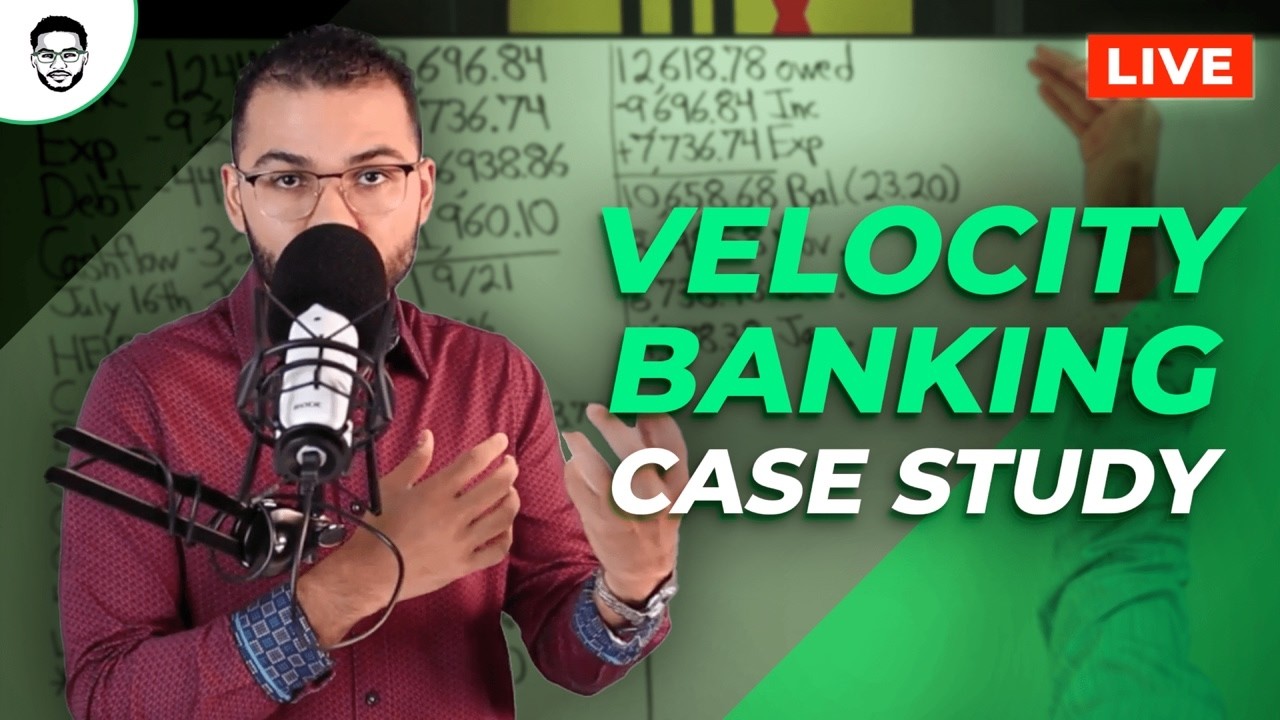
Denzel Rodriguez walks a New York pharmacist earning $10,600 monthly through velocity banking prep: credit repair to 720+, a $100k HELOC at 3.99%, and consolidating $63k of debt into a 13-15 month payoff plan. The strategy combines a 6-month emergency fund, $1.5M life insurance, and strict leverage rules to manage risk.
Questions this video answers
Because the rate determines the cost of borrowing; a lower rate allows more debt to be consolidated into the HELOC and reduces overall interest expense, making the Velocity Banking strategy more effective. Using a high‑rate HELOC (e.g., 8%) on lower‑rate debts (e.g., 5‑7%) would increase the spread and erode cash‑flow benefits, whereas a low‑rate HELOC (e.g., 3.99% intro) maximizes the arbitrage and accelerates payoff.
Chapters
on the YouTube. Now, my YouTube audience, when they start rolling in, will have some questions, they'll have some comments, things like that. But I'm going to be focusing on those of you who are on the Zoom and spending time with me. So that's the chat that I'm going to be looking at. So we're officially live on the YouTube channel, live here on Zoom. And this is all being recorded and will be sent. All right, so with that, good evening, welcome everyone if you're tuning in wherever you're at, and those of you catching the recording, welcome as well. Today we're going to be covering a case study which I took the time in advance to put everything on the whiteboard. We are going to be discussing An individual married with children based out of New York. We are a pharmacist doing that for about 20 years. We're going to start with the 4 major numbers. Those of you that have been spending time with me, this is where we always begin. Those of you that are clients, this is where we always begin on every single call. Those of you who've been following me for years, it stays the same. I gotta know this information. You have to know this information in order to achieve whatever financial results you're looking for. You have to be able to comprehend the current financial situation that you are in. How are you currently bringing in income and what is that number? How are you currently expensing? That income out? And how do we steward that properly? How do we manage what we're bringing in so that we can be trusted with more? And then after all your expenses and bills and debts are paid, what's left over each and every month? How do we project that into the future and begin to plan with that free cash flow to decide which direction we want to go in according to again, your specific situation. So I'm going to give you a specific situation here. Many of you will relate to this. Many of you are, are going through this or have gone through something like this. So in this case, the income is $10,600, made up of W-2 income and real estate income, rental income. Our total expenses is $7,556. Total debt $455,000 with a cash flow left over about $3,000 a month. This is being conservative. It can be a little bit more. What I like to do whenever I'm working with folks is underestimate their income, overestimate their expenses, and underestimate their cash flow. Then whatever I project, whatever I write out is going to be a lesser result, so they should outperform what I project. This is a little psychological play in my coaching practice that I also have just implemented over the years. It works really well when, when I show them results that is attainable, achievable, and then they exceed those results. It just builds motivation, it builds momentum. So it's not like I'm lying, I'm just underestimating according to their current financial situation and where we could end up. Okay, so now here's a breakdown of some of their debt. If you add this up, it's not going to equal $455,000. It's some of the debts that we've identified that we want to address immediately as part of our foundation. And when we're building a financial foundation, it's not based off of a cookie-cutter plan of what a financial guru says your finances should look like, or a financial professional, or a licensed individual in the financial services space. No. What I like to do is ask the individual, what does a strong financial foundation look like to you? Explain it, talk it out. Then I use my skills, gifts, and talents to interpret that into an actual financial foundation. So I'm going to say words that came from this person's mouth of what a strong financial foundation looks like. To them, which ultimately will lead us to financial freedom. This person wants 2 more rental properties. This person wants to spend more time with their kids. This person wants to volunteer more at their church. Okay, these are initial standards that this person is outlaying for themselves. This is what I want for my life. Now I interpret that into an actual cost and value equation. So if I am a man married with kids— person has 3 kids— and I want 2 more rental properties because that's going to help replace their W-2 income, if I want to spend more time with my kids and I want to volunteer more at the church, Well, what does that actually cost? There's a cost associated with everything we want to do in this life. Everything. So if I want to spend more time with my kids, guess what? I have to create value in the marketplace through activity my own skills, gifts, and talents, my own works, so to speak, then I need to convert that into something passive because I can't continue to actively work in those skills, gifts, and talents that I have for my whole entire life if it's gonna require 40, 50, 60-hour work weeks in order to achieve a financial result. So I have to think differently. I have to think Okay, how can I do this activity for a period of time but then convert that activity into a passive activity that continues to pay me regardless of whether I show up to that job or not? That's how we have to be thinking with our, our finances long term. It's not going to happen overnight. Over time, if we're thinking about it, we begin to create ideas. This person is a man of faith. So guess what? When you are an individual of faith and you follow the Creator and you build a relationship with Jesus and you dive into his way of thinking rather than ours, guess what? You can skip the line. You can skip the suffering line. You can skip the hard work line, you can skip the pull yourself up by the bootstraps line, and whatever other line you want to call out there. You get to skip all that by just relying on what the Lord's will is over your life, and then begin to walk in that direction and just obey. It's really, really effective. I've seen it happen so many times over, and I continue to witness it. So I, I also include that into this, into the discussion. So because this person is a man of faith, pretty easy, he understands this. We're, we're going to leverage what we already know to be true, and we're going to submit all of these plans to the Father, receive guidance. He'll have me as his coach for accountability and support, and we'll get to where we want to get to. Sound good? So continuing on, let's take it to the board again. There is some pregame work based on what he's trying to achieve, and according to the finances, where we need to go. There are some initial frameworks and principles that we need to put in place. So I've identified 4 things as it relates to the Velocity Banking Strategy. He wants to leverage debt to accelerate debt faster, pay less in interest, which results in higher amounts of cash flow, which also results in more clarity. By removing all of this debt over here, I'm going to stress less, I'm going to have better night sleeps, my wife's going to be happier, I'm going to have more money left over to decide where to where to put that. So again, we're addressing multiple things at the same time, but it's all leading to the ultimate ways of living, that ways of operating that he wants to be in. So the 4 critical steps in the beginning, what we need to do is fix our credit. I can't tell you how many people I work with who make really good money And somewhere along the way in their life, they accumulated debt. And somewhere along that path, whether it was a death in the family, a loss of a job, a divorce, children, family, situations after situations, even though our income increases, over time, naturally. Our credit often doesn't correlate with how much money you make. That's something I've noticed really interesting in the, in the, just in, in life, working with folks, is I could be talking to someone that makes only $4,000 a month with an 800 credit score. Then I can talk to someone who makes $25,000 a month with a 600. Credit score. I'm like, what? And the person that makes $4,000 a month with a credit score of 800 has way more access to capital, technically speaking, and opportunities to improve where they're at than the person making $25,000 a month. Now, what can also happen— this, this is a a— call it a blind— yeah, a blind spot for high-income earners. Once their credit goes but their income jumps, they don't see the value often in improving their credit. Sometimes I've noticed this really, really weird. Then when they need something, they want to finance something, because they're making more, their debts are bigger. So now they're subjecting themselves to terrible loan terms and agreements, double-digit rates on loans, high rates on credit cards— we're talking 29% and higher— and they're just getting eaten They're just— we're talking thousands of dollars a month that these higher income earners out there, some of you might be in the room watching, catching the recording, who knows, you're getting eaten up just from your interest costs on the debts you carry. But since you make so much money, you're not paying no mind to it because you're able to what? Pay it. You're able to pay the payments every month, but with just a little bit of capital, not a whole lot of money, that you allocate towards credit repair— delegate that. Why try to learn credit repair? Get someone to do it for you. Delegate that. I'm someone that can help you with that. Pay a couple dollars, that credit score will flip. In no time. 6 months, maybe a little longer, but there's a lot of progress that you can make. And because you make so much money, if I'm able to restructure and refinance those higher interest debts into lower interest debts, oh my goodness, we're recapturing so much cash flow. And then just keep doing what you're doing, pay extra payments, whatever it is, and you're gonna go just way faster. So that's an example here with this individual is that we're gonna do some credit repair. I broke down the pricing, $99 to start. It's $99 a month, $19.99, $19.99 a month for the credit monitoring for the 3 credit bureaus. That's it. That's all he has to put towards repairing this individual's credit. While we're doing that, that's just delegated, provides the information, credit begins to get repaired. I'm helping him on paying down debt while our credit's being restored. So that's removing late payments, hard inquiries, any errors, anything that's not being reported properly. All those different things can boost the score. Which is going to lead us to acquiring the tool that we need in order to accelerate this debt faster. Okay, so credit repair is going to lead us to acquiring a better tool. Currently we don't have a tool, but he has an asset. We have a property, mortgage is $348,000, mortgage payment, interest rate, value the home was around $600,000. Plenty of equity in there that we could access for a very low rate compared to the rates that you see here of the debts that we want to eliminate. We have an IRS debt close to $30K, and we have, what, $20,000+ across 4 different credit cards, all in the 20+ percent range. And if you look at the cash flow opportunity we're talking $1,000 plus, right? $524, $457, $391. So 9, 10, 13— we're talking $1,500 at least over here in cash flow, easy. That can get recaptured very, very fast. Instead of just sending this cash flow towards one debt at a time and trying to chip away at it we can just restructure the whole thing and then chip away at it. Why, why have all this resistance when we can be leveraging our credit to put us, put us in a better place? So that's one part. In addition, this person does not have an emergency fund. Very interesting. Talk to a lot of— I work with higher income earners, individuals, uh, and they either have a lot of money in retirement accounts locked up, liquid, or in assets locked up, liquid, but really no cash reserves available. So this is just, again, a standard framework. So what I suggested was Let's begin because we're a married individual, 3 kids. Let's establish some cash outside of our financial strategy. The purpose of having cash outside of your financial strategy is to protect the financial strategy. Makes sense. So now we can leverage credit in a sense. To have some available capital, but you always want to have good old cash liquid somewhere, either savings, cash value, somewhere liquid that I can pull from. All right, so I suggested of the cash flow, $3,000, we take 10% or more, put it off to the side. This is in addition to tithing. All right, so I already include that into the, into the expense. This is money off to the side that's secured reserve capital, starting $300 to $500 a month. Ideally, I want to build 6 months worth of expenses off to the side, outside of the strategy. So that is the additional thing that we're implementing. There's different ways to name this. Another really nice thing I like to say is profit first, or some say, some say pay yourself first. So I like profit first. And the best way to do this is to set up autopay from your paychecks. This way you don't think about it. And we do a number that's so easy to do that you'll forget about it. I like starting that out in the beginning. You can always increase along the way. So whether you call it emergency fund, profit first, pay yourself, whatever you want to call it, is money we're setting outside the strategy, and we can park that in a high-yield savings account, earn some interest, okay? And that's easy too. Can't tell you how many people I talk to that are parking their money in Wells Fargo, Bank of America, and Chase earning 0.1%. And I'm like, what are you doing? You could be earning 3, 4% or more in a high-yield savings account doing nothing. That's just money that's not doing anything. Just park it over there. Okay, second thing is life insurance protection. This individual has no life insurance. Wild. No protection whatsoever. Your number one asset is yourself. Number one asset is yourself. So let's ensure that, please. I've already designed a policy for the individual, $1.5 million, simple term, convertible term with living benefits. $1.5 million, we're projecting maybe $160 a month. All right, so Let's say we do those 3 things. That's gonna reduce my cash flow that I can put towards debt. That's gonna be the initial resistance that some of you will have. It's like, well, I'm trying to get out of debt, Denzel, but now you're making me spend more money over here in these different things. There's a give and a take when you're first starting out, when you're first resetting, when you're, when you're building a financial foundation. When you're trying to implement a financial strategy you've never done before, to avoid injury and pain and future suffering, I'm establishing a foundation that will protect you from yourself. Simple. Whether you choose to do that or not is up to you. I like to simply be as conservative as possible because I know life happens. I work with so many families, and every single time, every single call, life is happening. Good or indifferent. I'm not gonna say bad, just good or indifferent. Life happens. So when you have a foundation, it's hard to get— it's hard to react in a desperate way when you have a strong foundation. You just like, "Oh, okay, cool. My foundation will proactively handle that, and we'll just keep on." keep it on. So here's an example of taking that net cash flow. We're gonna add more expenses before actually paying off debt. So I'm gonna minus $99 a month, minus $19, that's towards credit repair. I'm gonna minus $160 towards life insurance protection, and I'm gonna minus $300 towards savings. So that brings my cash flow down to $2,000 421, and I'll even round down and call it 2,400. It will do this anywhere from 3 months, maybe a max of 6 months, depending on how fast we can repair this credit and get it to The 720 or higher is the goal. So 720 or higher. This person already has good income, so that's check. This person has equity, second check. The only thing I'm missing really is credit. When it comes to utilization debt, I'm gonna restructure it to lower the utilization. That'll bump the credit score even higher. If I can get close to 720, within that range before I apply for my tool, being a home equity line of credit in the second lien position. Ideally, they have a 3.88%. It doesn't make sense for them to refinance this 348 and get a first position home equity line of credit. It's not going to make sense. The rates are going to be too high. But if I can get a second lean home equity line of credit with an intro rate for the first year below prime. Where's prime today, everyone? It's at 6.75%. If I can obtain a home equity line of credit anywhere around $100,000, plenty of equity to get that. Even if I get less, that's fine, no big deal. Even if I get somewhere around 6.75%, it's way better than all of these rates here. That's easy, easy, right? I know very confidently, and I will show you the proof. Going to share my screen, take you to a video I did specifically for the state of New York. Here you go. As you know, I've been doing an entire series on how to find the right HELOC, and I'm going state by state. So this is one specifically for my New York residences. And when I did this video, prime interest rates were at 7.25%. So that means everything you see on the right side of the board where that line draws on the right side of the board, all of it is no longer relevant. What is relevant is the left side of the board. If you do the pregame work, I promise you, you won't get denied for a home equity line of credit if you follow all of those steps. I was just talking to a client today They did not follow those steps. And guess what? They applied for a HELOC and they got denied because they didn't do my steps. Period. It's as simple as that. It's a learning experience. Many of you are going to have to knock your head against the wall until you listen to the young kid. But when you do, you will be so grateful. You're going to have fun. You're going to have a blast. Okay, until then, here you go. This is the evidence. This is the proof. This video came out again September 22nd, 2025 is when I did this video. Today prime rates are at 6.75%. So the right side of the board, everything, all of those banks are probably going to have better offers now. Shall I prove it? Yes, Denzel. Prove that to me. Cool. We're gonna look up credit unions in New York that offer a home equity line of credit, and we're gonna— let's take Broadview. Let's see if their rates have changed. Let's see if anything has been updated. So they have these rate options. Let's go back to my board. Was it here? So back in 2025— oh, look at that, look at that! 5.25% fixed for 5 years, 3.99% for 12 months. Those are the The intro rate periods, then it says variable 7% on a 90% LTV. What do you see there? 5% on a 10-year HELOC, ladies and gentlemen, right? Oh no, 5-year draw. Forgot me, I got too excited there. I got a little too excited. So 5-year draw, 5 5%, so it went down 0.25. So that means if you're watching that New York video, you live in New York, and then you do the work, you're going to get an even better home equity line of credit than what I was projecting back in September of 2022. Then the 3.99 APR, that stayed the same. That makes sense because again, 3.99 That's just the APR. Look how it says 6.25% thereafter. Uh-oh, let's go back, make sure y'all see this. See that variable 7% after 12 months? Oh my goodness, I just made you some more money. Look at that. So 3.99% for 12 months and then it's 6.25% after. Let's say this person on the board listens to all of my instruction and does that. So I'm going to use those numbers because that's relevant. If I can get a 3.99 for the first 12, then it's 6.25 after Mind you, we need to have the credit in order to get that. That's important. Say we get that, so 6.25% would be prime minus 0.5%. Prime minus 0.5%. That is huge. So now let's implement Denzel Rodriguez's leverage rules. Leverage rules. You know, I've done videos on this. Again, whenever we're using debt, there's an, there's an element of risk. We want to be aware of those risks, and we want to mitigate those risks all the way down to an offset So whatever I risk compared to the reward outweighs the risk. Too many of us will take risk on risk because you're already at risk. Get it? Many of us take risk from a financial place where you're already at risk, and then that risk has risk. For example, because I know that, that sounds a little weird, say you have a dollar in your bank account. This represents however much you would invest in something. So you have a dollar, right, in your bank account. Most people do not have a dollar and 3 cents to back up that dollar. So that's what I meant by you're already coming from a place of risk because you don't have a— what's called a backstop. You don't have a backstop. So here's what you do, because no one taught you this, and not too many gurus teach on this: having a backstop protect you from you. So you don't have that, you have this dollar. You take that dollar and you go risk it. Okay, I don't have a problem with risk. I have a problem with not having rules. I have a problem with not having a foundation. I have a problem with not being able to understand what you're doing. So you take this blind risk, right? You take that dollar, that dollar's now here. You now have $0. You're at risk. Makes sense. So you move the dollar over here and in, in the investment. Now the question is, that dollar sitting in this account taking risk, how much of that dollar is at risk? Many of you put 100% of that dollar at risk, meaning it could go to zero or it could even go negative. Where now you owe. So that's— this is an example of taking risk from a position of risk, putting your money at risk, and adding more risk. That's horrible. Let me tell you Denzel's way. When Denzel has a dollar, I have a backstop. $1.03 or more to protect every dollar I have. I take the dollar, I do the same amount of risk. I now have my same dollar in your risk account, but instead of putting 100% of that dollar at risk, I have contingencies or exit plays which reduces the 100% risk to 67, all the way down to a third. In some cases, I can bring all that down, all the way down to zero. It just depends on what the investment is. I can offset it, meaning if this happens in the economy, well, then I do this. If this happens, then I can do this. I have many scenarios for when I'm putting that dollar to work, for it to generate some sort of return. So many of us are taking our dollars, we're sticking it in retirement accounts in hopes of an average rate of return of 8 to 10%, maybe 12% or something. Ladies and gentlemen, that's, that's only 8 cents. That's only 10 cents. Like, doesn't make any sense to me. Again, I'm not against it. I'm not against retirement accounts. I just, I believe in sequencing. I believe in timing. Whereas when I take my dollar, because I have a value creator spirit, I have, I have this spirit of creating value in the marketplace. So when I create value, that's what this person does, that dollar, I like to make that dollar become $2. So that's 100% return for maybe 10 to 30% of risk. Maybe 10% to 30% of risk. So I'm going to use this same method of thinking as it pertains to leveraging debt. Same way. We're going to have a backstop and I'm going to map it all out. But I wanted to share that with you. Hopefully that hits home. Hopefully that ruffles some feathers for you. So here we are. Let's assume person has good credit. We went to that bank, Broadview Federal Credit Union, got ourselves a HELOC for $100,000. By now the debts would have been down, but we're going to keep those numbers the same. That's went down. We're going to keep the numbers the same. Let's add it all up. We got $29,000, and I'll just make round numbers, make it easy. So let's do, let's do $30,000. Let's do 55. We're going to make it hard again. Like, this is what I like to do with clients. So 12, 2, 13, 9, 50, and then 1, 7. Let's do that. $63,350 of debt. That's how much debt we want to eliminate, let's say. I'll round it down, say $63K. Keep in mind, if we're projecting 6 months into the future, let's say after implementing these steps, person's just been making their regular monthly payments, and let's just say that $2,400 was making an extra payment towards, towards their debt. So we could assume at least 2 credit cards would have been paid off by, by then. All right, so I'm like really putting myself behind the 8-ball here. We have a HELOC at $100 grand, so my leverage rules are simple. We take cash flow times 12 and we take credit limit times 2/3. Right, 66% or 67%, whichever you feel comfortable with. So $100,000 times 2/3, $66,000 is in this case max leverage. So $66K max leverage. When I have clients that get approved for a certain amount of credit limit, I tell them, don't assume you have that. So if you get approved for $100,000, you actually have what, $67,000, $66,000 is your credit limit. The gap is our backstop. So I just took $100,000 of leverage. That means there's 100% risk associated with that if I use that money, and I just took 33% off the top of that risk by only leveraging a max of $66,000. Then we take cash flow times 12, $28,000. $800,000. We're looking to increase our cash flow by eliminating all of these debts here. Question is, does it make sense to move all of this over into the HELOC, or do we do it in stages? This is where We can allow personal preference to come in. Both are going to yield results really well. Let's assume we used all of the debt. $63,000 was our number. We parked it into the line of credit that's near max. So it's within my rules, haven't violated it. Then we calculate the new cash flow number that got obtained. So I'll make this more accurate. 524, 157, 391, 409, and 64. So $1,545. So $40 cash back, that reduced my cost of living by 2%, and we'll apply that to the credit card statement each and every month. Follow me. Watch this. We now need to factor in this income. 10/6 is income going in. $63,000 minus 10/6 will happen throughout the month. So the lowest that my HELOC would go down to would be $52,400 times 3.99% divided by 12. Now we're looking at $174.23. Divide that by 30 days, that's about $5.80 a month. Then we calculate new expense number. It dropped, so it went from $7,556 minus $1,545 of payments, so $6,011. Is our new expense number, $5,240. Then throughout the month, $6,011 will come out of the HELOC slowly. My ending balance should be somewhere around $58,411 times 3.99% divided by 12, $194 divided by 30, $6.47 a day. Uh, let's do the 209 number at the top, so that's 6.9 and let's add the 3. 5.8 divided by 3. Average cost of interest throughout the first month: $6.41 times 30 days, $192. So now my new low In the first month is $192. So I took $209, and with the strategy alone, we can reduce it down to about $17 less paid in interest. Then add that $192 minus $40, now it's down to $152 less interest paid. The fact that that $2,000 didn't actually come out of the HELOC for 20-odd days or so is even less interest. So again, very conservatively, we could say somewhere around $192 to $150, somewhere in that range, is what I would pay in interest in the first first month. How long would it take me to pay off the line of credit with the cash flow of $3,945 with an average cost about $175 a month? Mind you, that number goes down each month, probably by about $15 is what it'll go down each month. So we can just say $63,000 divided by the cash flow, $3,945, 15.9 months, which would actually end up being maybe 13. So right when that promo expires, the HELOC is practically paid off, only a couple thousand dollars left in there. Each month we pay down the HELOC reduces the risk. At play. I'm gonna pause and see if anyone's got any questions, any questions at all. I'm going to focus on my folks that are in the Zoom meeting. Those of you that are watching live and you want to spend time with me on Zoom, all you gotta do is join my email list, reach out get you included on the Zoom. We can spend that more time together. So mostly I have clients that are watching live with me and we spend time, come up and you ask some questions. And those who are either in my courses or we do some— or you're in another community where you get me in addition. So question from Boss says, greetings Denzel, I have a question about rates with the HELOC if we are using it as a debt tool. Why does it matter about the interest rate if you use cash flow as payment for Velocity Banking since the home equity line of credit is normally a variable rate? Can you explain that please? So the rate always matters to me simply because I know what's out there and I want to simply get what's best for my client. So when my client says, hey, I'm looking at a bank that, you know, I have this bank right here I've been banking with for 20 years, I got pre-approved for a HELOC at 8%. Do a quick search in their state, and I'm like, the bank over here is offering 5% fixed for 5 years. Which would you rather have, 8% or 5%? So I don't want to like elaborate too much on that, but I think it's just pretty simple. Straightforward that I would rather pay less in interest by having a better overall tool that can stay with me for a long duration. Another huge value is the lower my HELOC starts out that I acquire, potentially the more debts that we can consolidate into the HELOC. So if you got a 10% HELOC, say you have a 7% loan, a 9, uh, you know, 6% loan, it's not going to make sense to accelerate that loan into your 10% HELOC. It's a 4% spread. But if you had a 3.99 and then 6.25 afterwards and you have a 7% loan it's gonna make sense to continue doing Velocity on those, on those additional debts. So there's many cases where I work with folks where we do the Velocity strategy for only their credit cards and maybe 1 or 2 personal loans and an IRS debt. And then after that, we're left with a car loan and their mortgage, and I'm like, it doesn't make sense, so turn it off. We turn off the strategy, we go and use maybe 0% credit cards, or until we can get a better tool, we're just not going to use that HELOC or that personal line of credit. Where if we would have spent the time improving our credit, getting a better tool, you extend the duration of the strategy on how long you can go. All right, so that is very valuable in that sense. Let me take a look at some YouTube comments and questions. Let's see what you guys are saying. So Christian, want to thank you for all your knowledge and following that has helped me get out of debt. Lovely, lovely. Internet's dropping. Well, it's been fine on my end the whole time. I haven't seen anything. Okay, that's all I see in terms of questions. Coming back to the board, just to recap here, we projected anywhere from 13 to 15 month timeline to eliminate $62,000 worth of debt. And remember, I totally underestimated what we were doing for the first 6 months, estimated credit repair, getting life insurance, building an emergency fund, getting the HELOC. During that time of pregame work is when we're doing one of three strategies. We're doing debt snowball, debt avalanche, or cash flow index. Those are your other three debt removal strategies that don't involve leverage. It's just simply whatever you have left over, you're making an extra payment towards your smallest debt balance, towards your highest interest cost debt, or towards the most amount of cash flow you can recover. So attacking the highest cash flow opportunity debt, and it doesn't pay attention— Cash Flow Index doesn't pay attention to interest rate or balance, only cash flow. Debt Avalanche does not pay attention to balance or payment, only interest. Debt Snowball does not pay attention to interest or cash flow, only balance. So notice how each of these strategies focuses on one thing at a time. The Velocity Strategy implements everything all together. We still need this in the beginning. It's just not a, a resting place. It's not where I stay. We can graduate. And then when it comes to velocity strategy, we can graduate from there as well. The next graduation is infinite banking, where you can obtain the superior line of credit, being cash value life insurance. That's the superior product when it comes to leveraging, creating arbitrage, having your money grow in two places at the same time, reducing risk dramatically, offsetting risk altogether from a guaranteed perspective. That would be the next stage. With that, I'm pretty much all done. I won't hold you any longer this evening for those of you that are watching live. Again, you want to spend some time with me, you want to get your numbers ran, you want to do work with me one-on-one, click the links below. You can either work with me or people in the industry on my, on my team that I do a lot of joint work with. Those of you who are clients, loyal clients and followers, this is your reminder to book time on my calendar. Use me. I'm learning so much this year. Love to share with you everything that I'm learning about how you can continue to improve your finances. And for everyone else that is just still getting to know me, continue to do your due diligence. Work through, work back the steps here. There's a lot of great information just in this session alone that can literally put money back into your pocket. If we're talking credit repair, I now have a credit repair service in my business with partner for very, very affordable rates to begin getting your credit repaired. As soon as your credit's where it needs to be, you can drop it. No need to keep paying, okay? I'm not someone that's like, keep paying. Like, no, you can drop it and we can redirect that cash flow elsewhere. So with that, God bless you. Enjoy the rest of your evening. We'll be talking soon. Bye now.









