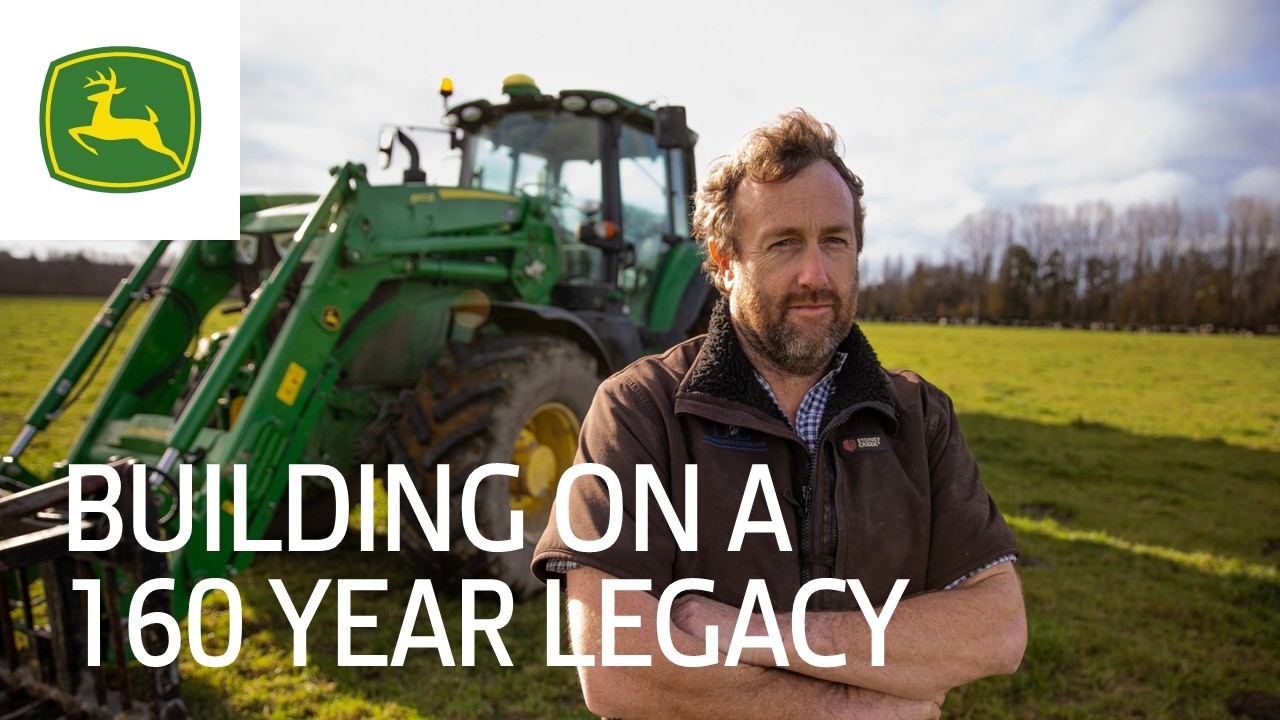
The video is an interview with Gareth Hale, a South and Mid Canterbury dairy farmer who milks about 2,600 cows and comes from a family dairy lineage dating back to the 1850s. Hale explains the agronomic fundamentals needed to achieve 500‑550 kg of milk solids per cow—high‑quality silage harvested on time, precise fertiliser application within narrow windows, and proper grain management. He then details his 15‑year partnership with John Deere, highlighting the transition from another brand to Deere’s integrated technology suite. Specific tools discussed include RTK GPS (1.5 cm pass‑to‑pass accuracy versus the standard 15 cm), GreenStar auto‑steer, AutoTrac, the OptiCentre remote‑display system, and ISOBUS‑enabled equipment. Hale describes how these technologies enable precise lime and fertiliser spreading, reduce overlap, cut diesel use, and dramatically lower maintenance costs (to about a quarter of his previous tractors). He also notes comfort improvements that reduce driver fatigue on long days. The OptiCentre provides real‑time data on hectares worked, fuel per hectare, idle versus working time, and alerts for service issues, allowing proactive farm management. Hale concludes that GPS‑driven precision, variable rate applications, and data‑driven decision‑making are key to improving efficiency, lowering costs, and supporting the broader goal of feeding a growing global population, hoping the farm can continue its 160‑year legacy.
Chapters
Kia ora. I'm Gareth Hale. I'm a South and Mid Canterbury dairy farmer. Been milking 2,600 cows in the South Island for about 25 years now. My great-grandfather has been dairying in the Taranaki since the mid-1850s. If you want to sort of do 500 to 550 milk solids a cow, you just need the good quality silage and making sure it's harvested on time and the grain. Getting the fertiliser on, you've got short windows really, so you might only have 2 or 3 weeks, and if you miss that window, you probably reduce your yield by a couple of tonnes.
We've been working with Gareth for, I think it's about 15 years now. He was previously with another brand, and part of his changeover was just sort of dealer support. Gareth also uses RTK on this 250 here. The benefits with RTK is just a smaller pass-to-pass accuracy, so I think we're sitting at about 1.5 centimeters pass to pass, whereas your SF1 is the standard, which is about 15 centimeters pass to pass. So just on applications like lime and fert spreading and all that, he's just really nailing it down and getting better onto it. What we're doing here is we're watching him on the OptiCentre. We see that he's on his AB line here. This is a useful tool. We can just track, see how he's getting on, see if he's doing the right speeds, which is what AutoTrac does. So essentially Gareth is sitting there He's just a seat weight. The tractor's steering itself, it's staying on its path. We can log on to remote display access, which allows us to see exactly what Gareth is seeing at the time. Kgs per hectare, spread width, how much of the paddock he's done, tracking the overall fuel usage. We can see his idle time, working time, transport time, area worked, fuel per hectare, hectares per hour. You can get alerts on here as well, so this is all of our sort of service codes if something goes wrong with it. You know, the moment you start using it, you start getting the benefits straight away. So get into it, talk to the dealer and see what we can offer, see what we can do for you.
It's a big reason why I've been using the John Deere, just the efficiencies with that GreenStar and the GPS and auto-steer has made a massive difference with our cropping and that. Every time you're sort of bang on and you're not overlapping, you're not wasting diesel. But yeah, we just sort of found when we went to John Deere, our maintenance is probably about a quarter of when we were running other branded tractors. So I suppose it's more integrated 'cause John Deere build most things themselves. The front axles are heavier, so we don't have front axle problems or kingpin problems. Especially down south here when you're pulling big feed-out wagons, you know, you're pulling 20-tonne wagons, you need a solid tractor to pull them really. It's not just the main engine, it's all the little bits around the outside, they just keep going. The other thing I like about the John Deere is they're quite comfortable to drive, they've got good front axle suspension. Some of those high-quality seats at the end of the day, you can— it just makes a difference really. You're not fatigued after a 12-hour day really. The biggest impact on productivity would probably be GPS for us really with the tractors and that. You can plug like the fert spreader in and that'll all come up on the GPS screen and you can split your GPS screens now so you can sort of be watching your tram lines as well as looking at the fert spreader and it's bringing up all the information and same with the seed drills. You can alter all the seeding rates on the ISOBUS screen and all that sort of smart technologies. Linear, the other good thing with the Ops Centre is just keeping track of all our servicing and all that sort of stuff really. With technology, just to try and be more efficient with resources, hopefully technology and GPS and variable spreading fertiliser and spraying and all that sort of stuff will start saving on costs really. It's quite a satisfying result when you see the milk in the gun and the vat and Growing food for the world's population, really. Hopefully another 160 years with a bit of luck.