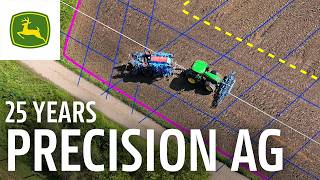
In this concise dialogue, two speakers trace the 25‑year evolution of John Deere’s digital fieldwork tools. They begin with the early FieldDoc system, where data was stored on a keycard and manually exported, and move to today’s cloud‑connected JDLink that streams data in real time to mobile devices. The conversation highlights the 2001 launch of the first StarFire GNSS receiver and GreenStar display, which gave operators visual guidance and introduced parallel tracking. In 2002, AutoTrac was introduced, providing GPS‑assisted automatic steering with 30‑50 cm accuracy, marking a game‑changing step toward precision farming. Overall, the exchange showcases how field data capture, transmission, and machine guidance have progressed from manual, pocket‑sized methods to fully automated, cloud‑enabled smart farming solutions.
How did digital fieldwork begin?
A revolution started in the fields 25 years ago.
In the past, you literally put the data in your pocket.
FieldDoc saved all fieldwork on a keycard, which was then manually exported in the office.
Today, data flows automatically into the cloud. JDLink transmits it in real time straight to your smartphone, tablet, or computer.
2001, John Deere launches the first StarFire receiver and the GreenStar display.
For the first time, the operator could see where they were meant to steer. GreenStar supported parallel tracking and enabled more precise steering. The display showed whether the operator should steer further to the left or further to the right. AutoTrac was then launched in 2002. A game changer! GPS-assisted automatic steering keeps machines on track independently for the first time with 30 to 50 centimeter accuracy. FieldDoc documents field data digitally. Working hours, performance, yield— everything digitally recorded and analyzable long before smart farming became a trend.
In 2003, Yield maps start to become widespread. For the first time, they show with site-specific precision how much yields vary across cells and become the basis of modern precision agriculture. 2004: AutoTrac with RTK achieves 2.5 cm accuracy. Now tractors and combines follow exactly the same tracks for years. Perfect for row crops, hoeing operations, and soil-conserving work. 2010: JDLink connects machines. Telemetry, remote diagnostics, and professional fleet management are now possible. The foundation for connected agriculture. John Deere's AutoPath Rose was launched in 2020 for even greater guidance precision. With AutoPath Rose, the actual path driven is recorded and repeated with absolute precision. Since 2024, AutoPath Boundaries has allowed optimized guidance lines to be automatically calculated and created based on field boundaries, either on the display in the cab or from the operation center. And that includes the headland. Today, around 1 million John Deere machines are digitally connected connected, one of the largest connected fleets in the world and the backbone of modern data-driven agriculture. Back then, FieldDoc and Keycard, the beginning of digital documentation. Today, G5 display and wireless data transfer with JDLink. Starfire receiver, automated creation of guidance lines. AutoTrack and AutoPath for maximum precision in the field. From Keycard to the cloud, from manual steering to fully automated guidance systems, John Deere has been making precision farming easier, more accurate, and more efficient for 25 years.