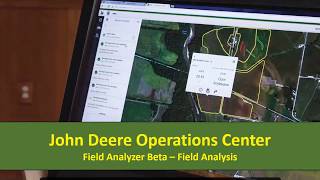
This is a YouTube video titled "Análisis de campo | Analizador de Campo Beta | John Deere" created on March 23, 2020. The content is a detailed tutorial explaining the features of the Field Analyzer Beta tool by John Deere, focusing on how to use map layers to analyze field data such as seeding quality, prescription rates, yield comparisons, and soil correlations to optimize agricultural production. The video is presented by a single speaker providing step-by-step guidance on the tool's functionalities.
Today we will go through a few Field Analyzer Beta Field Analysis tools With the addition of Field Analyzer Beta, users will now have an enhanced ability to view their production and better understand how to optimize both available land and machinery through map layers. For this video we will take you through scenarios with the overview, compare and Overlay features to better understand how to use each with different map layers. To get into Field Analyzer Beta, we will first go to the Field Analyzer, select a field we want to view, then click on Field Analyzer Beta on the left side of the screen. For the first part of this video, we will use the Overview feature to observe seating quality operation. Another new feature in Beta is the addition of the Drawers tab at the bottom of the page. This gives you data in more detail than Field Analyzer. We want to pull up the prescription rate on this field. We can see that there are five different zones that have different rates associated with the prescription file. Now we want to go view the quality map Prescription versus Applied layer. We can see in the AS Applied map that the zones are not consistent all the way through like the RX file. And at the bottom of the summary drawer we can see the planner followed the rx with only 85% quality, giving insight that the operator did not follow the prescription rate correctly on the field. However, when we look at the target versus applied quality map, we see a value of 95% which may indicate the operator used a flat rate instead of an RX given for the field. This could cost a producer a lot of money if more seed was applied on the poorer ground than necessary or not enough on the better ground resulting in a yield loss. Next, let's jump into compare mode. For this example, we are going to compare our average corn yield from 2011 and 2013 against our 2015 crop. When we do this, we have a few main areas that jump out as consistently producing lower yields if these areas in the field are poorer soil quality. We can use this data to assess how we may be able to reduce input costs through prescriptions on seeding and possibly chemical in order to maximize profit in these areas. Now we are going to compare the average corn harvest maps from 2011, 2013 and 2015 to the Surgo soil maps to see if there are any conclusions we can drop based on the soil type. We can see in the Okoboji silt clay loam that we tend to struggle in our yield across the average. These could be areas of the field that we could focus on cutting input costs in order to maximize the profitability of these acres. For our last example in compare mode, we are going to take a look at the 2015 harvest dry yield map. First is the 2015 harvest map elevation data. If we look at some of the low areas, we can see that they correlate with lower yield. This could be an opportunity to do some tiling if there is excess water running to these low areas. For the last example, we are going to take a look at our 2012 soybean harvest map. We are going to go into the overlay mode and show our dry yield underneath the elevation for the field. We can then adjust the opacity for the elevation map to see how the yield in the field correlates with elevation. The overlay feature is just another tool to help producers better understand previous results and help make better decisions for future production. Thanks for watching.