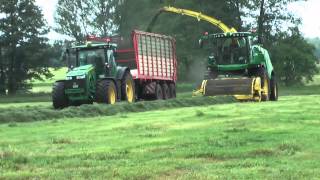
John Deere engineers walk through the design and testing of the new 8000 Series SPFH, covering engineering decisions, design challenges, and factory preparations ahead of the 2014 harvest season.
By the end of 2012, the Core Engineering configuration had been decided and we had completed our road safety testing. Now it was time to finalize the design. The team was led by Professor Matthias Schonhe, a well known industrial designer with previous experience at Porsche. The goal was to create an overall impression of the machine, one that conveys the agility, the dynamics, the powerful dominance, while at the same time not making the machine appear overly massive. That is why we moved many parts of the machine slightly upwards so that the machine doesn't appear massive, but instead you have have a dynamic and agile impression. The greatest challenge for the design was to get all of the elements of the machine into a single form system to create a whole. There are elements such as the spout and the cab or the functional stairs that want to break out of the entirety of the machine and you have to try to bind these elements back into the overarching system. On the other hand, we're also working with very different technologies. The stairs, an important functional element, are made of steel, but there are also plastic parts. In my opinion, the 8000 series will be successful because here we are able to combine innovative technology with innovative consistent design. The wind tunnel at our Mannheim factory was used to test the cooling efficiency of the final designs with thermal imaging identifying any hot spots. We then took the new designs back to the field for more testing. Our new grass pick up proved to be a major step forward. The variable speed auger drive improved cutting efficiency in all conditions. It fed the cut ahead more evenly for higher quality forage. CERN had also designed a completely new Proficut whole crop header for the 8,000 series. It proved the perfect match, cutting at high speed with excellent ground following. The Kemper rotary headers also performed well in whole crop testing. With grass, whole crop and maize headers all fully tested, it meant contractors can depend on a full range of optimized header options from launch. With the development almost complete, it was now time to turn our attentions back to the Zweibrucken factory. A series of major investments in facilities and infrastructure had already begun and needed to be finalized before production could begin. After all, our first customers were due to take delivery in time for the 2014 harvest season.