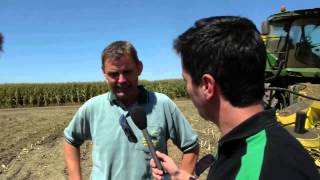
This is a YouTube video titled "California Chopping - The new John Deere 8000 Series SPFH (Ep. 4)" created in July 2015. It features a detailed presentation and field testing report involving multiple speakers including Tim Meister, Peter Lauer, and others, discussing the performance, testing conditions, and features of the new John Deere 8000 Series self-propelled forage harvester in California's agricultural environment. The content focuses on machine testing, crop processing, and operator feedback in a professional and technical context.
The United States, with its long harvesting season, was an essential part of our worldwide test program. We begin with Tim Meister, marketing manager for North America, taking Peter Lauer from the Zweibrucken factory team to meet the 2x8 prototypes in Central California.
Well, right now we're driving west of Tulare, California, the San Juan Valley. We're Tulare county right now, the largest hairy county in the entire world. They feed a lot of different things. For cows, obviously we have dry hay, some haylage, a lot of wheat silage, barley silage. The mainstay would be corn silage.
When they arrived, the team were busy getting the machines ready.
We're at our contractor, Viera Custom Shopping. They're located in Polari, California. They have typically about 15 John Deere forage harvesters and they do, I think, close to 30,000 acres of corn out here. So that's primarily why our test site's located here. We can get a lot of testing in one area without having to travel very far.
Testing had already been running for several months and the team were making real progress. At the Moment, we have 2x8 machines running here in California. The harvest is only just starting. We were in Arizona with one machine, mainly because the temperatures climb above 40 degrees, close to 50 degrees, to test the layout of the cooling package and find out if we got the layout right. To do that, you need to go where the temperatures are highest. Now we're back in California, my impression is positive. What makes the conditions here so challenging? On the one hand, it's the fact that we have different types of row spacing. We have 30 inches, 38 inches, very different water systems. And the soil types vary greatly in regards to the tyres on the forage harvester. It's a big challenge that we don't find elsewhere. That is one challenge. Another is that the harvest here in California, massive amounts of sun and water, targeted irrigation leads to output of over 100 tons per hectare. And that is mainly a challenge for the header. In general, I would say the Kemper header, as it's still known around the world today, is clearly top of the line. We don't need to hide, but we must go further. We're standing here in front of a 10 row header, large drum. We have a smaller drum for the Western European market and the large drum is for the conditions here. The 10 row header is done. We're going further. We must make it wider also, because forage harvester performance continues to increase despite the heavy crop. The kernel processor was handling the extra throughput well.
It'S processed really well. There's no pieces, big pieces of cobs that the cow can sort. All the kernels are broken into smaller pieces. One thing you notice is the crop is a lot wetter than it actually looks here in the field. It's higher moisture than what it really would appear to be. So the stalk is carrying a little bit more moisture than what it looks like standing. Okay.
Does that make it harder then for the machine to process the crop as well?
That is one thing that makes it difficult, that the harder the kernel it is, the harder it is to process. With our 32% speed differential that we've had and kernelstar, I think with the 7000 series, we're doing a good job, but this is excellent processing needs. The crop flow through the machine is nice. It's a nice tight exit from the spout. The kernel processor is running really well. Thus far the machine's performed well. It's been putting out a little bit more tonnage than the 7950 when we had down in Arizona, we were putting about 35 tons more per hour than 7950 does. So that's quite impressive.
Matthew Sapada, chief financial and chief operating officer of Viera Custom Chopping, was equally impressed by the chop quality.
So far so good. It seems to be good on fuel. The processing has been good. The production is very good.
Early on when we talked about it, you commented a bit on the corn. What do you think from the performance of the corner compared to the 770s?
Yeah, the 10 row this year has been doing a fantastic job so far. Best job I've seen since it's been out and I'm very impressed with it as you can see right here. Nice job. Low to the ground.
What are the customers expecting in regards of chopping?
They would ultimately like 100% of the kernels cracked. What you see here is a very good job. You see them all broke up into at least three to four pieces. We don't see whole pieces anywhere. The chop looks good. It's not shredded. Looks like we got the KP's about right. And it looks like our particle length is pretty consistent. So that's exactly what they're looking for.
But what was the view of the driver really?
The biggest thing for me or one of the biggest things right now is the cab. We have more room in the cab and better visibility, so that's a big thing. And then we have some other options on the header that we don't or the machine that we don't have have on our current production machines like a variable speed header drive, so that's really valuable.
So, yeah, talking about the cab, how do you rate the visibility out of the cab, especially in those 12 maze conditions?
I'd say it's a nine out of a 10. You're always going to have that corner post in the way, but for the most part you can see really well. The only thing on the machine I was driving, it's got the low spec cab, which doesn't have the side wipers. So it's a little bit harder to keep the dust off the windows. But we always deal with dust out here, so you're going to have to get out and clean the windows a couple pounds a day. It's just the way it is.
So you would definitely take a cab that has the side wipers in too?
Definitely. Clearly a lot of progress has been made in the past two years of testing. We're on track. We know that a forage harvester doesn't just fall from the sky. There's a lot of hard work that goes into it. The key lies in testing a machine like this around the world to verify, that's the motto, so that we can be certain that we can take it to market. We are in the long term test test phase. We are on track, but we still have some homework to do. Quite simply, part of that work was refining the final designs in response to customer comments, find out how the team at Zweibrucken were progressing in the next episode.