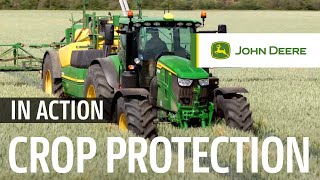
UK farmers around Cambridge explain how they use John Deere precision ag technology like RTK and variable rate application to protect crops and map yields. They discuss what works, what's hard, and where precision farming goes next.
So thank you, Alistair, for having us today. Thank you very much for all your time. Would you like to start by telling us about your farming system here?
Yeah. So this is Chibus Farm Farms, based on the outskirts of Cambridge. We're roughly a thousand hectares. That includes a bit of contract farming, quite a bit of spring cropping, wheat, barley, some rape. That's obviously becoming harder to grow. No root crops. This is quite heavy soil, high ph, high magnesium calcium, centred sort of in blocks around the outskirts of Cambridge.
When did you start your precision farming journey and how did you get into it?
I suppose we got into it variably spreading P and K, which we. We no longer do, but. And then from then we stepped onto variably spreading solid fertilizer and then we've switched out of that and gone to liquid, so we're now variably applying liquid N. Also at the same time we went into variable drilling, variable seed rates. We've just generally sort of progressed because we could do one, we learned about one, we sort of moved on to the other. And also, you know, it's incremental gains, isn't it? So, you know, you may gain a little bit from one, but if you're stacking them all up, hopefully you build a bigger bit of the pie by using them all.
You started your precision farming journey back in 2010, so 13 years ago, what.
Were the challenges you found compared to now? I'd have to spend a lot more time on the computer moving files about and creating files, putting them on a USB stick. Now, if you were to start tomorrow, that's all gone. I can now literally send a prescription for variable rate fertiliser or a seed drilling mat from the office here. Plus the fact you've got a lot of younger guys out there now who've grown up with it and are used to it. They're used to gardens on the tractor, they're used to bringing in folders, recording everything, so, you know, they're pretty slick anyway, so that helps a lot.
What has been your experience of the precision farming journey here at Chivers Farm?
We've had a lot of changes, bringing on RTK on all machines, mapping all the fields. That's had a lot of benefits. We know exactly what we're farming. When you fill the spray, know exactly what you've got in. It is a big learning curve. We've had some good help from Ben Burges, some training where they've been out to us, we've been to them to set a lot of it up. I think everyone's now used to it, on board with it and it works really well.
Originally you were working with two systems, so you had Trimble and Greenstar. What made you go down the route of Greenstar?
Just accuracy, but simplicity really. You're dealing with one system, they're using the one file type, so you're not trying to work with one and one or the other because they don't cross over.
And what made you go down the variable rate route? There's so many journeys you could do with precision farming. Why variable rate?
Well, it's simple to do with the sprayer that we've got and many spreaders on the market. It's not difficult, they'll all do it now. You just produce the map, put it in there.
Why not?
Why would you not? It's really not that difficult. In terms of cost, there is a slight cost for the satellite imagery. I can't see why you wouldn't do it.
What's your experience then of variable rate application?
We find that you'll still use the same amount of products over a field. What it tends to do is it will take product from bits that look really good, where it doesn't need so much and put that on the bits that are a bit more backwards, needs a bit more and therefore still using the same amount but using it more efficiently. At the end of the year, crops do look more even they tend to look nicer level. You have to say that from a visual, it works well.
What information do you use to make your variable rate decision?
Well, the. The N would be sort of based, just based on the satellite imagery, perhaps a bit of historic cropping in there as well. The variable seed, that's a tricky one. If we could ground truthing what we've done in the past, you know, seeing what we actually get compared with what we think we're going to get. But that does take time. That's what you should really be doing is getting out there after you've drilled. When it's coming up using a scouting app, being able to go to the areas of the. Find the areas of the field where you've changed the seed rate and just count what you've got.
You've got your trail sprayer behind us here. So how does that help with your variable rate application?
With the sex control, we see a 1% overlap with this machine, which is obviously a huge saving from doing it manually. If you had to do it manually, I don't know what the exact figure is, but you would be probably 10%, especially on a 36 meter like this. Trying to turn sections off is not easy. Obviously that is a massive saving over a year.
You collect your yield map data off your combine. So you have that historical data. So if you do want to in future.
Yes, yes, yeah, yeah, we have the, yeah, we have the data. I mean, you can create an awful lot of data. Let's, you know, let's be frank about this. We've got some lovely maps, but if you don't, you know, and they sit on the computer and you don't do anything with them, generally, that's probably the next step. That's the next precision thing that we need. Something that helps you, that you can upload it to and can do all the work very quickly for you to come up with something or other, because otherwise you've got one heck of a lot of work on your hands.
What do you think the next steps are for precision farming here?
I'd like to try and layer everything, so from the seed map all the way through the firt maps to the combine at the end and try and find correlations. So to prove that it's working and it's giving us the return it needs to.