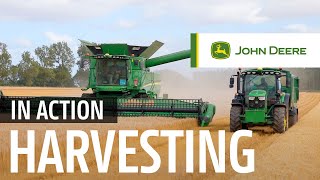
This is a YouTube video titled "Farmers in Action: HARVESTING with John Deere Precision Ag Technology in Scotland" created in October 2024. The content features Mike Cummin, manager of Lure Farms in Angus, Scotland, discussing the use and benefits of John Deere precision agriculture technology on their mainly arable estate. The video covers topics such as variable rate drilling, yield mapping, wireless data transfer, and operational efficiencies during harvest, highlighting the integration of technology in modern farming practices. The content is a monologue or interview-style presentation with a single main speaker and no mention of Francisco Jimenez.
I'm Mike Cummin, I manage Lure Farms.
Which is the trade name of Lure Estate, which runs to around 800 hectares here in Angus in central Scotland. The estate's privately owned, has been in the same family for over 300 years.
We are a mainly arable estate.
We combine around 500 hectares a year and grow around 110 hectares of seed potatoes. We also have a livestock enterprise.
So we're farming here in Angus, which.
As far as Scotland goes is quite a favourable area. That said, our weather window is significantly shorter than it would be in some other regions in Britain. That's one of the reasons in this area that you'll probably find that combines or maybe more over specified than you would expect. This year has been particularly challenging. Here we are on the 29th of August and we still have a substantial area of harvesting to do. We started our precision farming journey about 12 to 15 years ago and the reason was that like most farms in this area, the enclosures that we have now are a combination of perhaps three or four enclosures going back a generation before. And what we're attempting to do is to farm a single enclosure in four or five separate parts. In dealing with those according to the soil type, our first step individually was variable rate drilling. And the biggest challenge was translating the map in the computer, the instruction in the drill machine. In those early days we were using 26, 30 panels and mixed machinery manufacturers. The drill machine was not a John Deere machine where software packaged were all separate. That journey has got much, much easier. In the early days we were using USB sticks to transfer data back and for and often you had to go to the field before you knew whether everything was aligned and was going to work properly. As we've moved forward in time, we're now using 4600 panels. We're wirelessly connected by John Deere link. I can see much easier from my office that the job is received at the machine and he's ready to go before he starts work. We've moved forward leaps and bounds. The move to John Deere, we bought a John Deere combine last year, has certainly helped that data flow massively. We now have a live data stream of yield maps coming through. It's available to me at any time, either my mobile phone or in the office. I no longer have to use USB sticks, I no longer have to pay a fee to do it. The quality of data is much higher and the interface with my software has proved to be better. I think we can now move forward since we've got the John Deere Combine in the operations center to the next phase, which is what I've been trying to do for the last few years. I give you the of we have wild oats in certain fields as an issue. Historically we'd have been spraying the entire field. We can make significant savings by just spraying the areas that are infested. We can use the John Deere combine to record those areas and use my John Deere in Operations Centre to create the variable rate maps live in there without coming out into third party software. I've tried this in the past with other machines, but those steps have failed and I haven't been able to achieve that. But I can see we can do that now. So at the start of harvest with the John Deere combine, what we do now is I prepare a harvest job, if you like, in Gatekeeper and I can export that straight out Operations Centre with all the fields listed, all the varieties under the boundaries as well, so that the operator can go straight through the field and start harvesting. The benefits of workplanner are firstly that the operator doesn't have to select the crop. The operator doesn't make the mistake when cutting the wrong crop and happen to be edited later. And it also means that when I bring the yield data back in from Operations Centre, it matches the jobs I've already created. Operations Centre at this time of year will be running my second screen in my office continually. I can see the combine operating. I like to see what moisture in particular the grain is coming off at. In Scotland we have to dry grain. It's interesting to see that also it gives me an idea of logistics and how far through the crop they are and where they're going next. And there's another aspect at harvest time, it's important is the lone worker policy. Someone who's on a baling machine may be away separate from the rest of the crew, but I can see that he's moving and that he's fine. Post harvest I use the operations centre. It's only the second year I've been doing this, but last year we brought all the harvest data directly into our software management package, which in our case is Gatekeeper. And that was seamless. We simply brought back, imported the data from the jobs that I had sent to set the combine up at the beginning of the year. And this then allows me to look at gross margins for each field or for each crop. And that has been so simple. With the John Deere wireless system coming in from the cloud, I really haven't had proper harvest data. I only really have it now. So we have active yield fitted on our combine and I can't quite believe.
How accurate it actually is.
At lure farms we have a weighbridge and every single load of grain that comes off the field passes over a weighbridge and we are regularly achieving 98% accuracy. And I'll give you an example. On a 20 hectare field, we had a weighbridge reading of 223 tonnes against a combine of 220. Now, how does it do that? I mean, we are bringing crop in at the front and offloading at the same time. It really astounds me. One of the main things I do with the yield data from a John Deere combine is compare it to the variable rate maps that we use to drill the fields where we use it, because there's no point doing this unless you can see a benefit. But we can. And we can see that our average yields have been increasing over the years and that we are averaging them up from field to field, and that we can see that these fields that we are variable rate drilling, that the yield map is much more even across the.
Field than it would be if we'd.
Been doing it conventionally. So over the years, at the outset, when we started in this precision Org journey, it was quite onerous. In the early days it would have been very easy to give up. I think you've got of a certain mindset back then to do it, but we're in a different world now. It's so easy. I mean, why wouldn't you do it? I mean, anyone who buys a John Deere machine has got access to my John Deere. It's there available to use. And I think there's another side to this coin that's missed, is that the younger operator feels much more involved in the business. They are receiving these instructions that are sent out. They're not just somebody sitting on a machine doing a job, they're part of the whole process. And as I said to you before, who wouldn't do it?
So we've had a very long standing relationship with our John Deere dealer, Netherton Tractor, spanning more than 25 years. And right throughout this precision AG journey, they've been very helpful to me, especially in the early days, the difficult period of getting all the pieces of equipment to talk together. Until now, where we're on my John Deere, the involvement is not as much on a day to day basis, but.
As I need it.
So I'm very, very happy with the.
Support we've been given.
There's no accident that this estate is entirely John Deere. And the reason for that is the.
Support we get from our dealership.
If we've never, ever been without a machine, if we've a tractor down, we'll have it up and running either a very short period of time or a replacement machine supply test. And that is absolutely crucial in this day and age. During harvest time, the Precision AG is an extra tool for me. I can see from my John Deere screen where the combine is at 1 a 1 point in time. I can tell what the moisture is coming off. So I don't need to go to the field to check that. I can make arrangements for someone to shift the header because I know they're coming to the end of the field. And also RDA has a good place to play. You know, if the driver has got an issue or he wants to explain something to me, I can see it in real time in the office. I mean, it's a fantastic feature and it's one that we use, you know, regularly.