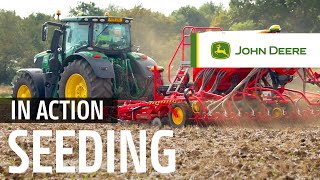
Chris Shellack, farm manager at Tuckwell Farms in Suffolk, walks through how John Deere precision ag technology cuts costs and boosts efficiency. Section control and variable rate seeding let him apply exactly what each part of the field needs, not more. The software integration took work, but the payoff is real.
I'm Chris Shellack, I'm farm manager here at Tuckwell Farms. We're based in the heart of Suffolk, farming roughly 1800 acres. Cropping comprises of wheat, bullseed, rape and more recently parsley and maize. And we employ five staff, two and three part time. We started our precision farming journey about 15 years ago where we introduced section control onto the farm for the sprayer alongside machinery guidance and also some variable rate nutrient applications. And today we have just invested in xactoply. So the main drivers for us really were rising input costs. So we needed to make sure that we had full control of that and we were only applying inputs as and where they were needed and as accurately as we could. So section control is a great example of that. We were reducing overlap and ultimately reducing overall cost by quite a considerable amount. But when we started looking at variable rate seeding and nutrient application, that was just sort of natural progression on, in terms of application and controlling costs, basically. So we're putting every product where it needs to go at the correct rate. So here at Tuckwell Farms we're quite, you know, we're quite fortunate. Our soil type is quite consistent here, so we're predominantly sandy clay loams. We do have some lighter areas on the farm, but, you know, a lot of the areas are quite consistent. But that doesn't mean to say that we don't have time issues within the field, so that may be drainage issues. Historically we've grown a lot of oilseed rape on the farm, so we do have quite bad slug problems and we can identify all these problems through the yield maps through the OP center. And that gives us a great insight into, you know, what we may need to do with precision ag technology or variable rate technology to sort of overcome these issues. One of the biggest challenges, I guess in the early days is sort of staff uptake of technology. Some would take it up easy, some needed hand holding a little bit more, which is fine. But in the early days we didn't have things like remote display access where I could give them help from the office. It meant back and forth to the field quite a lot, which, you know, is fine. But it meant a lot of my time was taken up unnecessarily driving back and forth to fields. Today, you know, life is a lot easier purely because technology on farm is more commonplace. I guess the younger generation which are coming onto the farm, it becomes a lot more natural to them. But for me, I can control or I can see what's going on from my phone via the operations centre phone app. Or if I'm in the office, you know, I can dial into the screen and you know, usually a problem is solved in minutes as opposed to hours. Seeding applications, I guess for me comes with a lot of historical knowledge of the fields. You know, we have had our field scanned so we know what soil types are where, but that doesn't always give us the clearest picture where we, where we may have a problem on a field. So for instance, we have some fields which historically are bad for slugs and I know that through my knowledge. But a soil scanner can't necessarily tell me where slugs are on field. So I'll use that when creating a variable rate seeding map if an area needs increasing, probably edit maps myself based on my knowledge of a field as opposed to what a, what a software program is telling me what to do. So I think my own knowledge, historical knowledge is really important when creating variable rates, even maps. One of the tools I would use in the OP center is something as simple as a yield map. It's usually quite telling as to what's happening in a field, whether there's an issue. And once I've identified what that issue may be in a field, I can then use these yield maps through the Agrion prescription generator to create a variable raised seed map. It's really simple, quite seamless to use. We can alter the areas, edit any area we want to have as many zones within a field as we want to. And it's, you know, the most seamless thing is getting it out to machine then so there's no USB sticks, there's no back and forth to a field, it's wirelessly transferred and that's what I love about it, it saves me time and it's free. So some of the agronomic challenges that we've got and why we would use a variable rate technology, maybe because we've got grass weeds on the field. So in particular backgrass. We use quite a vigorous variety in those situations which outl but where we know we've got backgrass issues, where we've identified that on a field, then we can increase those seed rates to sort of out compete that backgrass. And that's where another area where variable rate seeding comes into its own as well as the operations centre, we currently use two other software platforms. So the Omnia Precision AG platform which we use for our other variable rate applications and we also use the Gatekeeper platform as well for our cost management, both have an API through to the operations center which means that there's real seamless data transfer basically to our machines or to the OP center. It all adds to the time saving capability of the OP center. Most farms now are collecting data on farm and not doing anything with it. So you know, they've probably already taken the first step to, you know, precision ag farming in collecting data. It's what they then do with that data. And I think, you know, a lot of people are perhaps a little bit scared of technology and not willing to start investing money, physical money into technology. And that's why I would suggest start using the operations centre, which is free. You can analyze your data and then decide whether you actually want to do something with it. You can see those variations in your data and you can see there's an opportunity to make some cost savings. Well, actually you can do all that for free. You don't need to invest in technology before you do that. So my advice would be speak to your local dealer and get the operations centre up and running for yourself and go from there. I think looking to the future, we're looking at introducing potentially drivers, tractors to the farm. We know that's not in the too distant future. I think also just introduced exact suppliers. Well on a farm. So that's now taking the application, precision application to the next level.