
Interview with John Deere Senior Vice President and Chief Technology Officer, Jahmy Hindman
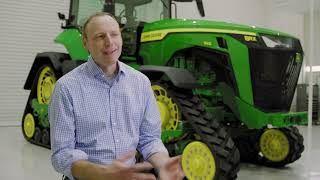
This is a YouTube video titled "Interview with John Deere Senior Vice President and Chief Technology Officer, Jahmy Hindman" containing an English interview conducted on March 18, 2024. The content features a detailed discussion between an interviewer and Jahmy Hindman, John Deere's CTO, covering topics such as agricultural technology, software development, connectivity solutions like Starlink, electrification of farm machinery, automation, AI applications in farming, and the evolving skill sets required for future farmers.
My name is Jamie Hindman, I'm the chief technology officer for John Deere. And that really means I've got responsibility for. We would call it our end to end technology stack. So that's our embedded software, embedded hardware, our digital software, like John Deere operations center. And then the automation and autonomy work that we take on on behalf of the production systems that we serve.
And what brought you to Australia?
Yeah, mostly to learn about Australian agriculture. So it's different. Agriculture has some similarities across the globe, but there are certainly differences as well by market. So it really was a learning expedition, if you will, to better understand Australian agriculture.
And what struck you the most?
Oh, I think a handful of things. I think the, one of the significant differences in Australian agriculture is the pressure on the grower is different, the constraints around agriculture are different. And you know, for example, the constraint around water and water availability, that's not unique to Australia, but it's most significant probably in Australian agriculture. And I think that drives growers to actually, especially since there's no subsidies for agriculture, it drives growers to be more innovative, you know, to take more risk. They shoulder more of the risk of the business themselves. And so they're always looking for solutions that can mitigate that risk and make their operations more efficient. And I think the drive to do that is greater here than it probably is just about anywhere else in the world.
I think you might have once said that John Deere employs more software engineers than mechanical engineers. Is that true? And if so, why is that so surprising to people?
Yeah, well, I think it's surprising to people because we're a durable goods manufacturer in most people's minds, right? The, the infamous John Deere tractor and combine, et cetera, that's what the images that get conjured up when you hear about the brand and that elevates this idea of mechanical engineering as a competency. And it certainly still is. We still need that, right? We still need to produce the best equipment on the planet, the most efficient tractors, the most productive pieces of equipment. But increasingly part of the opportunity in front of us is to think about farming as a system, right? Not just the individual machines that execute the work on the farm, the tractor sprayer, combine. But how do those pieces of equipment work together? How do they work within the ecosystem that is the growers environment, with additional data that's coming in. How do you deploy technology across those pieces of equipment to make them learn from one another and get better as a consequence of the data that comes from one. So for example, how do I use My seeding data that comes off my tractor and seeder to make the spraying operation that I might go do better. Autopath is a good example of that. Where we use the tracks that were made, the guidance tracks that were made during the planting operation to help inform where the sprayer should go in the spraying operations and finally where the combine should go. And so those are software intensive exercises. Right. That software intensive value creation opportunities, which is why we have a significant number of software developers in the organization today and have a nearly insatiable appetite to add more.
You've been with John deere for almost 30 years. Looking back over your career, is there a piece of technology you think has been the biggest game changer?
There's so much that we build off of guidance. If you think of the auto track, you know, Navcom acquisition 25 years ago and this idea that you could locate a machine on the surface of the planet with a high degree of precision.
Right.
And today that's two and a half centimeters of precision. That has unlocked all sorts of opportunities. It's certainly unlocked the opportunity. Things like yield mapping. Prior to having guidance on machines and GNSS capability on machines, yield mapping wasn't a possibility. It certainly unlocked and laid the foundation, I would argue, for autonomy in the future. Not really in the future. It's happening as we speak, I guess. And so if you. I think that one technology 25 years ago and the investment that we made in it 25 years ago has really set the stage for a lot of what's happening today. It's not the only thing. If I had to pick something else, I'd say connectivity is another one.
Right.
The ability to get information, data bi directionally, both off the equipment but also back to the equipment so that farmers can make better decisions not just within the growing season, but from growing season to growing season.
Yeah. Connectivity, massive issue in Australia, particularly in those growing and farming regions. Tell me about this partnership with Starlink, SpaceX, what that's going to mean for farmers and growers in Australia.
I'll tell you the full story from the beginning. So it's been 18 months ago we asked the players in the satellite connectivity industry to meet us on Jensen Farms in the Midwest, right near Ankeny, Iowa. And we invited them to the farm shed and they were all wondering, we're satellite people, why are we meeting on a farm in the middle of Iowa? But we had most of the major industry players there and we challenged them that day in the shop and told them the opportunity in agriculture was great. If we could just solve for this connectivity bit because there are so many places where agriculture by definition generally happens in rural locations that are poorly connected.
Right.
And so much of the technology that's not just here today but is coming is connectivity dependent. And so the growers don't, they fundamentally don't benefit until connectivity happens. And it was sort of an enlightening conversation in the shop and they understood maybe for the first time the opportunity in agriculture that as people that work in space all day, they don't necessarily think about, they saw it as an attractive market and we challenged them to put together proposals that we could then go validate and see if they meet our needs. And we had some requirements around cost and performance of the system, those sorts of things. Two of the companies put together prototype systems that we were capable of testing. We've tested those over the last 12 months in field, both in the US and in Brazil, on a variety of equipment and a variety of production systems and applications and really settled on Starlink as the, the one that provided the best cost to benefit ratio, if you will, and was willing to help customize the hardware for agricultural environments and purposes. So we're super excited about that. We're going to, we're being paced actually right now by their development process. So they're in the midst of creating a new version of a satellite terminal, version four of their terminal. That's the version that we will be customizing on our behalf and we'll use for the ag use cases that will start production for them early this year. We'll be able to certify that in both the US and Brazilian markets hopefully this year on a limited production basis and then go to full production in those markets next year. But once that's in production, it also gives us the opportunity to certify it with the various governmental entities in other countries like Australia, Canada, etc. So that's sort of step two behind this is getting the hardware certified and capable of operating in this country moving forward. And you know, I call it a zero to one proposition.
Right.
It's when you go from no connectivity to connectivity there are. It just opens up a world of opportunities. And I think the agricultural use case is one where the value can be immense. And I'm really excited actually to see where it all goes.
Yeah, and farmers obviously would have to buy when you receive a four day machine.
Yeah, we're going to start with it's a field retrofittable.
Right.
So you buy the terminal, the modem and a power supply and put it on a piece of equipment, any piece of equipment that has a 4G LTE MTG. Today the MTG is used to be the ethernet bridge for the connectivity source. So yeah, put it on a piece of existing equipment and you have connectivity.
Can you tell me about electrification and what that is going to mean for farm machinery?
Yeah, to be determined I think is the answer. If you look at where the state of lithium ion chemistries are for volumetric power density and gravimetric power density, so weight density and volume power density, the sort of natural breaking point for us is about 100 kilowatts. So 100 kilowatts and under. It makes sense in certain. It makes technical sense to. Or it's technically feasible is probably the right way to describe it. To replace an internal combustion engine with a battery powered piece of equipment. It's duty cycle dependent. You know, it's certainly power dependent, but it's possible. The economics of it in those smaller machines are still challenged. It's still more costly than an internal combustion engine is to produce it at the moment. But costs are coming down for battery electric and with the emission requirements becoming more restrictive for internal combustion engine, the cost of those are going up. So I'm bullish on the opportunity in the small powered segment portion of the product line. If you look at our large equipment, if you look at production agriculture as an example, an 8R tractor, we designed that tractor today to run for 14 hours at 75% full load rated speed. So the amount of energy that that machine consumes is enormous. The math would say you need 39 Tesla Model 3 batteries to equivalent the amount of fuel that we can carry on board that machine. And if you could just picture that mental, mental image in your mind is not tractable. Right. It completely changes the machine form. The size of the machine gets significantly bigger, the weight of the machine gets significantly higher and it just, it doesn't make sense. So I think in those larger pieces of equipment a more near term opportunity for us are bridge fuels, things like renewable diesel, biodiesel, those sorts of things that farmers grow themselves. It's got this nice circular economy feature to it that they can then use to help power the equipment that grows more crops that then can be turned into more fuel, et cetera and so on. I think that's a better solution, especially in the near term at some of the higher power levels.
Yeah, so we're due 2026 in Australia to get an electric tractor. So are we talking up to about the 5ml type of.
Yeah, 5 series tractors is kind of the upper end. I do think there is an opportunity in some of our equipment to hybridize. So a combination of internal combustion engine and battery electric to downsize the internal combustion engine and offload some of the power requirements to a battery. But yeah, the pure battery electric 5 Series tractor.
Automation, another massive trend we talk a lot about. Most drivers have been using automation for years. Lane assist, emergency braking. We've got auto track turn automation in John Deere equipment. Has it been a deliberate strategy just to kind of roll this in slowly so people get used to it?
Yeah. Our path to full autonomy is paved on these stepping stones of automation. You look at the tractor as the first use case from an autonomy perspective. And fundamentally what we've done is conditioned operators, farmers to utilize automation, in this case autotrack over the course of two decades until they got to the point where they're asking us, why am I still here?
Right.
Why don't you just remove me? This is the fun. The job that this is doing doesn't require me in the cab any longer.
Right.
And so we have to solve the perception problem from a safety perspective. But the jobs have been automated enough, especially in the tillage application, that there's a high degree of confidence from a customer perspective that we can go do this. We have to earn the right to have that level of confidence from the customers in some of the other jobs. If you think of seeding, planting, harvesting, spraying, we have to continue this step of increasing the level of automation in those machines until you get to the point where an operator, a customer would tell you, I don't need to be here anymore either. And then we've earned the right to make that product, to make that job fully autonomous.
Okay, so what kind of time frames are you looking at for that? Cultivating?
Yeah, 2030 in corn and soy production systems is how we've characterized it. To have a fully autonomous production system that's going to bleed over into other production systems because some of the jobs are common and consistent.
Right.
So if you look at the tillage application, it won't just be tillage and corn and soy, obviously, it can be tillage and other crops, crop types and production systems. But that's our, that's our target is by 2030 to be able to say we can execute autonomously and all the job steps in a corn and soy production system.
2023 was the year AI really kind of arrived in the public consciousness as well with ChatGPT. How long has John Deere been working with it? Because I Know, you've got a lot of background in AI. How long has John Deere been working on AI solutions?
Yeah, long time. So See and Spray would be probably the most notable commercial offering that we have that relies on AI. So it is a convolutional neural network that's looking at these 36 cameras across 120 foot boom, processing 5 billion pixels a second and discriminating pixels that have weeds in them from pixels that don't have weeds in them.
Right.
And then we only spray the areas for the pixels that have weeds in them. That's AI on the edge, if you will. It's all happening in graphical processing units that are sitting on that sprayer.
Right.
So all the math is happening on the machine. You talk about ChatGPT and generative AI. These transformer models that are coming into existence now, they're super interesting to us for a variety of reasons. One is the training that has to happen for us on some of these models like See and Spray are because of the Ag cycle being an annual cycle. The collection of the training data is a long process. Right. We have to collect data. In the case of the weed doesn't look the same on day one of emergence out of the ground as it does on day five or day 10. It doesn't look the same in low light conditions as it does in sunlight conditions. It doesn't look the same in soil type A as it does in soil type B. So if you want the models to generalize well, you have to take a generalized set of training data and you have to find these corner conditions where the weed looks slightly different here than it did here, or it's a slight genetic variation here than it was here. That's time consuming, it's laborious. We actually go out, people go out with backpacks and cameras and collect this data. Like you can think of the energy and the effort that has to go into this. One of the interesting opportunities with generative AI is for, for some of those corner conditions in those use cases, the hard to get data to be manufactured. So can you ask the transformer model to generate an image of a radish weed at three weeks old in low light conditions and use that to augment your training data set? If you don't have that image in there already, I think that that has the opportunity to speed up the model development for us and allows us to get into more applications more quickly.
We've spoken all about this technology, these changes that have happened in your career. What are the skills that farmers are going to need in the future, are they going to need to be tech savvy or computer savvy, engineering savvy, what do you see? Or is it going to get easier?
Yeah, I do think. I think it's incremental. Like you still have to know agriculture, they have to know what they know today.
Right.
But they're also going to have to be tech savvy moving forward, like technology's. It's true in areas outside of agriculture also.
Right.
The impact of technology in our lives is significant and growing and will continue to grow. The same thing is happening in the agricultural industry. So I think this, there is this need to think about the skill sets on the farm and how do they change what's additive, what do you still need to have that you can't let go of? And what does that look like over the next five, 10, 15 years? I think operating a farm autonomously is very different than not doing that.
Right.
There are certain skill sets associated and not just skill sets, but the way you farm is going to be different. We talked about that a little bit this morning. The notion that I no longer have to be in this piece of equipment to operate it, it's a freeing idea. Like you're given the gift of time when that's a possibility. So what do you do with that time? How do you plan your day differently? What are the constraints around how you plan your day? Because you're going to have to move the machine from paddock to paddock to paddock. How does that change how you approach the activities of the day? And all of those sorts of things are new, right? As technology happens on the farm, I think the wonderful thing about agriculture is it's always been impacted by new things, new innovations. It's one of the most innovative industries, I think, on the planet. So farmers are very adept at adapting.
Right.
They're very adept at internalizing new things and understanding how they can benefit them and then modifying the farm to accommodate.
Jamie, thank you very much for your time.
Appreciate it. Likewise.
More from Francisco




Desh Ke Superhero | Mr. Madhava Rao | Faster Pole Installation with GreenSystem™ Post Hole Digger



En CasaToro John Deere encuentras el respaldo que necesitas para mantener tu maquinaria lista



