
John Deere | 50 years’ experience vs automated combine harvester – Part 2
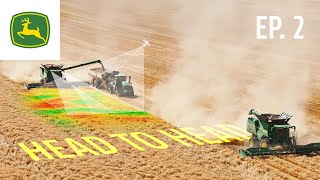
Joe and Angus test John Deere's new S7 automated combine harvester against 50 years of manual experience during an Australian wheat harvest. The video shows how the machine's automation handles real field conditions and compares its consistency and efficiency to traditional operation.
We've come here today to really, I think pitch technology against experience.
This time of year is definitely peak time. Conditions are tough, I think autonomy and that's definitely on its way.
I'm very skeptical of that sort of stuff.
Never tried this before in the field.
The new John Deere S7 combine carries a suite of new harvest automation technologies. Predictive ground speed automation uses new cameras that look out at the crop 8.5 metres ahead and adjust the machine speed to match the crop conditions. Harvest settings Automation is a new outcome based system. Input the desired grain loss, foreign material and broken grain and the machine will self optimise to hit those targets. Along with machine sync, auto track and a stack of other features, this combine is a force to be reckoned with. So In November of 2024, a team from John Deere travelled to Gourley near Moree in New South Wales to put the new harvest automation technology to the test in a real Australian harvest.
Gone for about 30 minutes. 30 minutes in. Joe's been operating four max. You want to talk us through, talk us through what you're seeing.
Yep.
So it's all manual mode there. Unloading on the go. He is pushing it like he's achieving some really good capacity loss wise.
Right on that one, right on them.
Right on that 1% limit. But what you see is he's just slowed down and you should see when he, when he stops unloading.
Yeah, there we go.
Straight away. So straight away sped back up.
Yep.
Because he's now not having to worry about uploading on the go.
Yep.
And you'll see that loss went from 3.2 to 4.1. So he was slowly tempted as he started to rev back up again.
He's doing a good job.
Doing a good job.
Setting the P, setting a benchmark. Hard to see. It's going to be, it's going to be tough. All right, we'll get you in the cab and gotta get into it.
I don't know if you guys can.
See but you can see the crop standing up quite nicely down near that header there. But as you get up to the end of the run here, the crop's fallen over, the crops dry, it's brittle, it's a big crop and it's starting to lean over. So this is really going to be a good test of the technology. Those cameras, those predictive ground speed automation cameras on the front of the cap there, they can pick up lodged or fallen over crop and standing crop. And particularly when you go to that fallen over crop, you start taking more Material. The machine senses that and slows down and that's looking eight and a half metres in front of the cutter bar. So it's really going to test this.
Technology, I think autonomy, and that's definitely on its way. More time in the paddock is crucial.
If you can drive one piece of machinery, you can usually adapt to most machinery.
We can hop in there, show them what to do, so they have an idea of what to do. And then as for the setting up, they don't have to worry so much about that, they just have to drive them.
I'm very sceptical of that sort of stuff, but you always can be proven wrong.
You there, Joe?
We're about two hours in. How's it all going? You liking the machine?
That's all good.
Keeping a close eye. You've got it pinned, that's for sure.
A few more horsepower, time wouldn't go straight.
I've never heard a farmer say that before. What about you, Angus? You enjoying your time up in the automated machine?
It's all going well. Pretty cruisy.
That's all we want to hear. Got your feet up, feet up, radio on. It was all happening nicely.
Pretty well.
Neck and neck from a performance point of view right now. And I think it's, you know, a testament to how good Joe is. And at the same time, Angus has got this machine fully automated. You can see all the blue lights down the bottom. It's. It's on the move, it's automating speed and this is going to be a real test. So Joe's just about to unload on the go here and you can literally see as soon as you start unloading there, dropping performance in it. Whereas again, that automated machine, which will unload just after this, it's just super consistent and that that adds up.
And I think as hours are going on, we're starting to see potentially, you know, distractions coming in and that automated machine is just continuing to hit its benchmarks.
We've only got a small sort of window to make it all happen, so efficiency is the most crucial part, but.
The main thing is keeping it consistent.
We've got to make sure every hour.
That machine's running, it's doing the best it can.
You get a bit of storm cloud like we've got around here at the moment. People get very, very nervous because it costs you a lot of money.
Hey, how'd it go?
Yeah, good, good experience.
Just another green thing with yellow wheels.
The consistency in the header load from solid clean sample and all that to handle the dust well and everything. So it was really good. Yeah, great result.
I'll be up there somewhere. I suppose anywhere I stuffed up was when I was unloading because the chase would be in a keep on his speed and I'd be.
Yeah.
So I didn't spill it.
How do you think your numbers are going to continue? Oh, it'd be interesting. I think I was packing in there. Did a few times.
So be interested to see what happened.
Yeah.
See if he's a bit more tighter slows as well. All right, we'll let you get back. Right, thanks.
Angus and Joe have now finished their four hour run and with plenty of wheat still out in the paddock, we put Joe back in the machine to get a feel for the performance of the S7. This time with the full suite of harvest automation technology turned on.
Oh, well, we'll see what happens.
Quick thoughts on the difference?
Oh, yeah, no, definitely a lot easier to drive.
Really.
Like the unloading.
Yeah, the machine sink.
Machine sink, unloading.
Yep.
Just the speed and. And yeah, just those to fill the bin. Different crop conditions. That crop there was a lot harder because it was so variable. So you were going faster and slower. Faster and slower where I had to keep up with him. Where if I would have had the sink, he would have had to keep up with me.
How do you feel?
I guess after that's how you drive it.
Yep.
You know, after another 10 hours on top of it, you'd be getting a bit wary and then even when you did your lap it and it put it back to where I set it. So that made me think, well, I might know something.
And you said you'd like the front.
Do you reckon you could focus on.
The front because you didn't have to focus on what was behind you. You reckon?
I think the front made a lot easier, sort of followed the ground a lot more than that traditional 740 stuff. So I suppose I couldn't really push it any further than what it was doing, but I went, I traditionally push it forward. It sped up itself, it slowed down where I'd slow down. Yeah, yeah. No, I think it kept a pretty consistent load the whole time, which is great.
So probably a good, good segue to talk about consistency.
Yeah. Let's take a look at some of the, some of the results.
Yeah.
So this is a, this is a screen graph just of a point in time through. We were looking at both, both your displays and Max. Yeah, Take us through the result.
So on the left here we've got Joe and as you can see here, you're absolutely wringing the neck out of it. What I could see here is probably that that line graph's a bit jagged but you're absolutely getting the performance there. And every now and again your bosses sneak out, sneak back down when you are not on the go and got to chase it. And then on anger. This machine, probably the big thing there, it's so consistent. I just, just constantly did that 55.
Ton an hour average.
Just it always stayed below that loss limit, below that 1% pretty well all day. I don't think I saw it get above it. I don't think you did. And then sample wise, slightly cleaner sample but hey, that was our limit there and you never really went above it.
Joe, we asked where rivals claimed upon when to get that. I, I most probably lost the first hour that I was tinkering old school. Do one thing, see if it changes. If it doesn't change, try another thing.
Whereas, whereas your machine sort of.
Yeah, it was quite aggressive. Like, you know, wasn't ideal stripping condition down there by any means.
I can see why people are pushing the. That bandwagon. Staff is a big problem, a very big problem. That's where I can see your staff. It's most rubby the vet or where we get our operators that are not as highly skilled.
Definitely it's all pointing towards autonomy, I suppose in the way it's all going. You know, as long as everything's still reliable. That's the key factor for us. As long as we stick with reliability. That is John Deere's known for then. Yeah, I think autonomy. And that's definitely on its way.
We've come here today to really, I think pitch technology against experience. You know, picking someone like Joe, who has 50 harvests, he's owned 30 John Dee combines, he still runs 10. Today was the best choice we can make because he really put that machine to the test. You know, he came out of the gate hard. Yeah, he really pushed it. And then as every hour went by, that technology was just making up the difference and it was a consistency.
If every operator had 50 years of.
Experience, we wouldn't have to worry about this.
What this tech has proved that we.
Can bridge that gap.
If you get, if you can get.
Staff in the cab, we can bridge the gap of experience. And that's what today's proven.
And what we, what we saw is.
The tech doesn't unlock a hidden extra road or a hidden extra bit of mechanical performance, but what it does unlock is consistent mechanical performance. And that's what we saw today.
That.
Yeah.
Almost straight back line.
Yep.
I think it's pretty simple. Every new John Deere combine comes with 50 years experience.
Yeah.
As simple as that? It's as simple as that. We proved it today.
Yeah, it.
It really does make that difference. Good job hunting.
Yeah.
Let's go for this.
Showtime's over.
See you later.
More from Francisco




Desh Ke Superhero | Mr. Madhava Rao | Faster Pole Installation with GreenSystem™ Post Hole Digger



En CasaToro John Deere encuentras el respaldo que necesitas para mantener tu maquinaria lista



