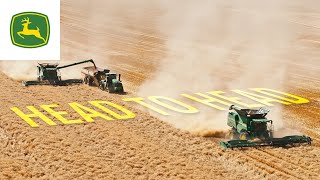
Joe Cornish, a farmer with 50 years of harvesting experience, goes up against John Deere's automated S7 combine harvester in a real harvest challenge near Moree, Australia. The video tests whether the machine's automation can match the skill of someone who's spent half a century in the field.
We've come here today to really I think pitch technology against experience.
Harvest is a real special time. You know, all the hard work we've put in and seeing the actual rewards, what we've done, I think autonomy and that's definitely on its way.
I don't know, I think dawn of Motion most probably be on its game better than me in spots. In the more challenging bits I might be a little bit better than.
The new John Deere S7 combine carries a suite of new harvest automation technologies. Predictive ground speed Automation uses new cameras that look out at the crop eight and a half metres ahead and adjust the machine speed to match the crop conditions. Harvest settings Automation is a new outcome based system. Input the desired grain, loss foreign material and broken grain and the machine will self optimize to hit those targets. Along with machine sync, auto track and a stack of other features, this combine is a force to be reckoned with. So In November of 2024 a team from John Deere travelled to Gourley near Moree in New South Wales to put the new harvest automation technology to the test in a real Australian harvest.
My name is Ben Kelly and I'm the director of marketing at John Deere. We're back again here in Moree to really put the new S7 combine, which you can see behind me, through its paces. It's all about the technology on the S7. Harvest automation can deliver up to 20% increase in productivity. We found what we believe is probably the most experienced harvest operator in Australia of Joe. He has over 50, 50 years of experience, over 50 harvests under his belt and we're going to get him in the S7 and he needs to drive that machine manually without using any of the technology tools. And then we're going to get Angus. The next generation, the young up and coming new generation that's coming into agriculture, they're going to put him in the combine with all of that technology at his disposal and we're going to see whether he can match, you know, the productivity, capacity and efficiency of someone like Joe.
I better not stuff up better. My name is Joe Cornish and we're a farmer and contractors from Dubbo. That six seven eighty, it's been all right for oil since.
Yeah, no, it's good.
My brother and I have been farming together since 82. We started our partnership and we started with a bulldozer and one secondhand header and now we've got 12 machines and four bulldozers and make our own farming country. I don't know, there was never any Other thought that's how we were brought up. I still live in the house where I was born in and always been farmers.
What's it like working with your brother?
Oh, like challenging some days and good other days, but it's still family. It's most probably good. Yeah. Do it now. The belts are right. That's all good. Yeah.
Yeah, that's it. Yeah. That's my favorite part, fixing them. We don't have toolboxes around here. Don't need them. My name's Angus Carrigan. I'm from Gourley, Northwest New South Wales in Australia. We're broad acre croppers with a little bit of irrigation, cotton and cattle feedlot and a bit of sheep. I'm fifth generation. So, yeah, I suppose my great, great grandfather, it started here in sort of early 1900s. Yeah. They sort of had a pub around here and then sort of went into a bit of land and here we are today. All grew up off the sheep's back, I suppose probably in the wool sheds would be probably one of the spots I remember the most of when I was younger. Yeah. And then as we sort of grew into the cropping side of things, fell in love with tractors and. Yeah, it's definitely where my passion is, what you love doing, you see. You see your dad doing it, you see your grandfather doing it, and so I suppose, yeah, really not much. Not much else I know, really, which is good. Yeah. Harvest is a real special time.
It's the culmination of the year. All the hard work from when you pull that header out of the last time to when you get it back.
In, the grains flowing, the dust flying.
You know, all the hard work we've put in and seeing the actual rewards of what we've done.
Not only do you see your fruit of your labour, but actually the fruit of your decisions, how well you've made those decisions.
So we must get the most out.
Of our equipment that we use for harvest and I think the S7 enables that. What we're really wanting to find out here is can the technology on these combines bridge that gap of 50 years of harvesting experience? Conditions are tough. We've got some down crop, we've got tangled crop, but that's what we want to do. We want to put it through the toughest conditions we can find. Angus, Joe, welcome to our 24 Harvesting Challenge here in Gurley, just outside of Moree. We've got our two model year 25 brand new S7 900 combines that we want both of you to put through their paces. The Rules of the challenge, Joe. We're going to get you going first on manual. Four hours harvesting. Harvest as many hectares, as many tons as you can, Angus. Then we're going to get you going an hour after so we can start to see can you reach that benchmark. You get your four hours and we'll have a look at the end of what the results are. Post that, Joe. We'll get the technology turned on for you and we'd love to get your feedback on that as well. One last question. Do you think is going to happen today? How do you think it's going to play out?
Don't know.
I don't know. It'd be interesting to see. I think they might keep up, but just whether or not the fuel economy or the clean samples out of the technology might be better, I don't know.
All right, well, let's go see.
Yep, sounds good. I don't know, I. I think the automotion most probably be on. It's going better than me in spots in the more challenging bits. I might be a little bit better than it.
Yeah. This is our operation center here for the day. We've got our TV set up here. We're going to monitor remotely. We can see to these machines and see what each operator is doing. We're going to be monitoring productivity, grain loss, grain quality as well. We want to make sure that they're hitting those benchmarks. But we're really here is where we can start to see does technology start to have an advantage over that?
Manual operation this time of year is definitely peak time. One of the main issues is just finding the manpower. You know, skilled labour is always a battle. Technology's making our jobs a lot easier.
We were there before GPS like we used to have a bit of a pipe out the front of the tractor with a bit of rope on it that dangled. That was our guidance.
New headers always seem to have new technology that always seem to be able to help us.
I don't believe the thing in the screen. I'll go to the back of the machine and just see where the settings are.
The use of the cameras will. They've got the ability to see something coming up that's less time. Me in the front of the header pulling a straw out of blocked up headers. I suppose.
I'm very skeptical of that sort of stuff. But you always can be proven wrong. If you can drive one piece of machinery, you can usually adapt to machine. Machine.
More time in the paddock is crucial.
But the main thing is keeping it.
Consistent pretty well neck and neck from a performance point of view only. Got a small sort of window to make it all happen.