
John Deere Africa Middle East | From Factory to Farm | Interview with Doug Felter
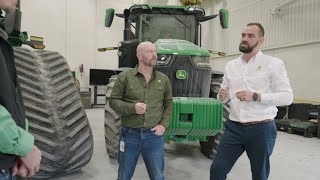
This is a YouTube video titled "John Deere Africa Middle East | From Factory to Farm | Interview with Doug Felter" containing an interview conducted on July 24, 2023. The content features a discussion primarily between Jaques, Sat, and Doug Felter, the product marketing manager at John Deere Waterloo, focusing on the differences between tire and track tractors, their applications, technologies, and customer feedback, particularly in the South African market. The conversation is technical and marketing-oriented, aimed at educating customers about tractor options and innovations.
So we're having an in depth conversation with Doug Felton, he's the product marketing manager here at Waterloo. And we're discussing tires versus tracks, the differences and of course very important way to use what. Come and join us.
So Doug, looking at the, the large AG or the large tractor market on the high horsepower, we've got options available on tracks and tires. Can you unpack a little bit about the options available on the track options as well as the wheel options?
Yeah, you bet. So you know, we have, as you mentioned, three main machine forms that we offer both in the 8 family and in the 9 family. Right. The tire tractors that we've been familiar with a long time, the two track RTs that we've also had for a couple of decades now and then more recently the four track rx. And really within that we see some particular merits and maybe some things that some of them aren't so good at across that portfolio. So it's been important for us to maintain those three unique machine forms to best fit the needs of all the operations that are out there.
So Doug, if we look at the differences between tracks and tires, what would you suggest when a customer considers tracks and tyres? Obviously looking at the two different options, what are the couple of things a customer needs to consider when choosing between the two?
Yeah, so I think there's, there's a lot of variables, but some of the big ones. Right. Is first and foremost kind of what is the primary purpose of that tractor the more you're pulling or the more you're worried about maybe what you're doing to the field while you're out there in terms of compaction, you start to think about tracks a little bit more. Right. To, to really push that weight across a bigger area. And with that as well, with that nice flat pad area, you get a lot of really good traction out of the track. You got a lot of contact with that. And so the ability for that to minimize slip down to maybe 2 or 3% and really put most of that power into pulling is a really good advantage of the tracks. On the flip side, one of the challenges that we see with tracks is heat is kind of the enemy of a track. And especially as you get heavy loads and you try to go on a lot of roads or high speeds, you can build up a lot of heat and that's, that's a real trade off for a track. And so if you're in applications that you're, you're needing to transport a lot of, you might want to think more strongly about A tire maybe with some of the different technologies that are there. But a tire is going to be a lot more good for transport as well as really a lot of times sometimes a tire tractor is just more versatile in the, the multitude of jobs that you do on the farm, you know, as you go from mowing to feeding and farm tasks, sometimes a tire is a little more flexible than a track when you get into some of those jobs. And that can be a real factor as well.
You mentioned earlier we were talking about track in South Africa and I mean there's certain areas that got issues with track, again with heat and all the rest. Give us a case study of what's happening and the challenges some of these farmers face.
Talk. So we've got a case study in South Africa where we've got customers running with track machines and we've seen the side effects of running with tracks. And it's like Doug says, you get a lot of cases where facts run in a lot of high heat potentials. And we need to start considering those, those, those differentials. And when looking at those different options, we need to start considering whether it should rather move over to a wheel machine. Is that not going to be the best application but also considering the benefits in the track machines where your two track machine gives you the better straight line pull on longer fields. So that also needs to be in taken consideration. So at the end of the day a customer needs to decide what's going to be the best fit for him and he also needs to decide where is the priority for him. Is it going to be in the transport or is it going to be in a long strike straight line working environment where you need to have the accuracy for longer periods of time.
Doug, I'm just curious. Now it's coming back to good old marketing. I mean do you guys, when you get the message out in terms of the application of track, again we're not singling out track, but do you tell farmers, listen, these guys or your colleagues down the road type thing, this is the application as part of that education and marketing process.
How does that work? Yeah, we do try to. Right. And it's important to know that every operation is different but sometimes in certain areas in certain crops there's a more of a tie, right, that because this guy's using this machine successfully, there's more of a tie to you. And so, you know, if I look at say the eight family tractors, you know, a lot of people adopted the two track tractors because they were worried about soil health and that compaction piece Right. And. And they do a great job at some ends. And one of you just mentioned that efficient straight line pull. They're so great at putting that power into pulling heavy objects. One of the downsides, though, right, is the driving is a little bit unique when you, when you crowd that, and it can maybe make some berms on the ends. And so some people didn't really like that driving characteristic. And so they maybe stayed with a wheel tractor. That's one of the interesting things that we see with this new 4 track in 8 Rx or 9 Rx is they get all that benefit of a track, but they drive much more like a wheel tractor. It has that very comfortable driving experience. It's much easier to operate. And so that's one of the things that we say about the RX is really sort of the best of both worlds, right. The pulling and the merit of tracks, but that driving experience and comfort that they get out of wheels. And then of course, like wheels, as we say, you know, they're just so versatile. They're great across the horsepower range. They're equally happy at a hay field, as in a tillage field or on the road. They're just really versatile and everything. And. And tied into that as well. Right. One of the important things is a wheel tractor often has a much lower shipping weight, but can be ballasted to an equal level of a track tractor. And so if you have some jobs that you'd prefer to not have all that weight, the ability to pull those suitcase weights off and lighten that machine up, flexibility is very good. Right. So you can get light when you need to and. And alternatively heavy when you need to. Also, that and that versatility of a wheel tractor just. Just really can't be beat if you've got a tractor doing a really wide variety of jobs across your farm.
Doug, looking at the tracks, obviously there's a big hype around tracks. And just like you mentioned now, there is still a place in the market for the wheel machine. Not saying that the track machine is superior above the wheel machine. So one of the main things that needs to be kept in mind when your customer needs to decide between a track machine and a wheel machine.
Yeah, I think, again, the main things that I think about is in your operation, what are the most important jobs? First, where do you place the most importance in really, like, what do you buy that tractor for more than any other thing? And if that's heavy draft and pulling, or if that's working in fields that are maybe sometimes too wet and you're concerned about the soil, you've got to start thinking really hard about that track tractor as the best for you. Alternatively, you've got to keep some of the opposite side on there. Maybe there's a job that you can't really see completing with a track tractor at all. Or you have these long distances on the road where you say that's kind of a challenge for the track life. Those are things that might start bringing you back to a wheel. But if you don't have those, those areas where you say, yeah, a track would really be better at those things that are most important to me. A lot of customers, once they go through that exercise, realize, you know, a tire tractor with the right tire package is really a great fit for my operation.
What's happening as far as in the tire world and even the track world? I mean, obviously it sounds like track is the new kid on the block, you know. So what are you guys seeing across the board from tyre technology? What's happening? What are the challenges, opportunities, and the same on the track side.
Yeah, I think in both respects, you're seeing a lot of effort on making both better. There's a lot of work into track technologies to make them better in transport, and we'll see how that works out. Right. And similarly on tires, a lot of. A lot of really good technologies coming into that. Right. It's not too many decades ago, we saw a lot of bias ply tires. You hardly see that in a large tractor today as radials became favored. But we're really past that radial baseline, and you're seeing a lot of work into higher flexion tires. So most of the manufacturers will call this either if increased flexion or vf, very high flexion. And really what it is is a sidewall that can handle flexing. So you can in effect, put lower pressure in the tire, which lets the sidewall compress and it makes the bottom longer, more like a track. So on a given size tire now I can actually get a longer footprint and start to get more close to a track in terms of the pounds per square inch that I put on the soil, as well as, you know, just the overall footprint that I'm able to do. So the, the difference between the two is sort of always changing as a better tire comes out that allows it to do that. Tires can kind of gain some advantage. And then we're also starting to see some interest in tire inflation systems that can actually allow one to change to a low pressure in the field that's adequate at those low speeds. But then Increase the pressure when you're on the roadway to a more appropriate and maintain tire life and really be better in both conditions there. So a lot of technology, a lot of effort going into working on both of them to continue to make them better.
But it sounds like track is forcing tires to raise the game.
Right? One might argue that.
So Doug, overall, looking at the bigger picture, there is no superior product above the 2. I just want to touch a little bit. Up until recently, John Deere introduced the 8Rx to the market where we became one of the first producers to produce an 8R tractor or the horsepower range. We're in both the ranges of the four track, the two track as well as in the wheel. What has been the customer feedback on the 4 Track 8R tractors?
Yeah, I think the feedback on the 4 Track 8 RX has been really good. And I'll go back a little bit to what I talked about. We had a certain amount of people that tried the 8RT because they wanted to get away maybe from the width of duals or get more of this flotation capability that they got. But in some cases they just really weren't happy with the way it turns and it would create some berming on their ends that they would have to deal with, especially a no till that was a negative. Or maybe they just didn't prefer that experience of how it drove. It's a little bit more unsettling. And so when you look at the 8 RX, right. It gets away from that. It drives just like an eight hour wheel tractor. And it actually does have improved footprint by having those four tracks. It's able to follow the ground quite well and just gives that operating experience that's very comfortable, which is preferred especially in a lot of those row crop tractor type of tasks, especially planting and things. It's also been really interesting because while we didn't have it right away, right. It's opened up some new opportunities and some things that we've done. I'll point to the exact right. Tractor tanks, for instance. We're able to get a high level of commodities on that tractor without making the tractor any wider, without being in the way of the ladder. And it's really become a really niche tractor in that respect. So it's still early, but we're definitely seeing some people grasp onto that machine form within that row crop tractor space.
Great. So Doug, last week John Deere also recently introduced the CTIA system on the wheel machines. What do we see the benefit in the central tyre inflation system? That's going to benefit the operator or the customer at the end of the day, being able to inflate or deflate their tyres from within the cab.
Yeah. I think central tire inflation really is about not having to compromise. So if you really think about it, when you look at choosing the inflation pressure for your machine in a given application, speed is a major factor. And so the inflation that you should have while on the road is much higher than that that you should have in the field. And you're probably on the road very little, but you don't want to overheat that tire and cause a failure. Right. So you end up with some sort of a compromise. Usually you pick some number in between and you hope for the best, but in reality, you could run a much lower inflation pressure in the field for the tire, but you're probably not going to bring your service truck out and pump those tires up every time you get on the road. So you're usually overinflated at the time that you care the most. And the great part about that central tire inflation system is it allows you to do that. You can go ahead and drop that inflation pressure down when you're in the field, get that bigger footprint, get lower slip, get better traction. Yet when you're done with the field, you can hit the, hit the flip of a button, air those back up to the appropriate inflation that you need on the road and you're going to get a lot of tire life benefits out of that too. So it really helps you avoid that compromise that you just can't, you know, you should do it right, but you really can't practically do it right.
Where do you see the application? South African market. I mean, where? Top of mind. Where is this going to have major impact, Jaques?
So we've got a variety of customer bases in South Africa, so I want to tend to go with Doug's discussion and say there's not one specific that we would want to allude to and saying there's a specific application that we want to focus on. So for the South African market, we will keep all the options available and we will make sure that the options are available for different applications and making sure we get the best tractor for the best customer operation at this point in time.
That's a good answer. Doug, thank you so much for your time. Thank you for your hospitality. I mean, it's just, it's been an absolute pleasure meeting you guys and the team and it's inspirational. It's nice to be in and experience things firsthand.
Yeah, no, we appreciate the opportunity to host you guys and help you out with a message. And selling tractors.
Sat.
More from Francisco




Desh Ke Superhero | Mr. Madhava Rao | Faster Pole Installation with GreenSystem™ Post Hole Digger



En CasaToro John Deere encuentras el respaldo que necesitas para mantener tu maquinaria lista



