
John Deere Africa Middle East | From Factory to Farm | Interview with Paul Richardel
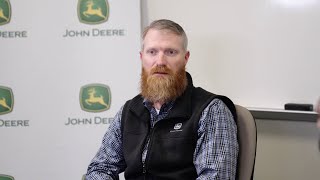
This is a YouTube video titled "John Deere Africa Middle East | From Factory to Farm | Interview with Paul Richardel" containing an English interview conducted on September 1, 2023. The content features Paul Richardel, a product marketing manager at John Deere, discussing the design and technological advancements of John Deere's sprayer cabs, lighting packages, fuel efficiency technologies, and the future of autonomous farming machinery. The interview includes multiple speakers engaging with Paul Richardel on these topics, focusing on product features and industry innovations.
Foreign? Absolutely, yeah. Paul Richardell. I'm the product marketing manager for planters and application for the region 4 market. I'm responsible for the go to market messaging for products that we produce at our factories here in the US So that's my primary responsibility. I've been with deere for almost 18 years and now I currently sit here as a product marketing manager for our planting and application business. Yeah, welcome Paul.
So today we just want to talk to you about the cab and the lighting of the new R series sprayers or the 600 series sprayers. Maybe if you can talk a bit on the cab and you know, the comfort and the benefits that you have from the new style cabs.
Yeah, so glad to be here. First of all, thank you for inviting me. I think it's really important for people to understand that John Deere Cabs has been on a long journey of evolution. Too many years went by where we were working individually in our product lines, delivering solutions in those cabs and maybe the experience wasn't consistent from one, one machine to the next and recognizing that through our customers that at the end of the day we found some were more comfortable, more, more relaxed, more accomplished at the end of the day than others. And I think the, the end result of that is that we recognize we needed to have a cab that was consistent across multiple products. We needed to have a cab that made you feel better during the day. And so you know, we, we, we went down this user experience opportunity and said how can we, we create creature comforts in the cabs that are delivering meaningful value to our customers. And so we targeted things like, you know, more headroom in the cab, better visibility. One of the things, footrests. It's amazing how just having footrests, getting your feet up off the floor, that kind of help the circulation in your feet and kind of help give you a better, better experience in the day just simply because the blood flow is doing better while you're operating. And there are a number of other things in the cab. You know, we improve lighting and some of the other things there that give you a perspective, a better awareness of what's going on. Because whether you know it or not, in a sprayer cab, there's a lot going on outside. You've got a lot of crop that's dependent on how well you go through the field. You don't want to run over it. You've got a lot of money tied up in the investment of the chemicals. You've got a lot of money invested in the machine itself. And so you want to make sure you're doing the best job, you're aware you're not tired, you're delivering on your job the same way that you want your machine to deliver on its job.
So I think, you know, the next thing to complement the cab and you know, talking about productivity is, you know, having that light package on the sprayer itself to give those customers a visibility while, you know, going that extra hours in the field.
Yeah, premium visibility was one of those. I know where I'm from and all the people that I talk to, you can never have enough lights, you can never see enough. And so offering a premium visibility package on our sprayers and even the cameras to get you in places where you couldn't see really well even with great lighting is going to give you an advantage. It's going to allow you to make sure that you can see at nighttime, to be just as efficient and as you can during the daytime, whenever the sun is out and it's, it's super bright outside. So again, productivity fatigue, we're trying to reduce visual fatigue. And with good lighting and being able to see far, it's going to keep you from making mistakes. It's going to allow you to see around the operation, prevent hazards, prevent mistakes, giving you the best opportunity again to be as productive in the day as your machine is. And so these lighting packages are really designed around customers who need to work longer hours, need to stay sharp, awake, alert and productive. And so that's, that's really our motivation behind delivering these lighting packages and visibility packages for our cabs.
Paul, how is the, the actual light technology evolved over the years?
Yeah, lighting technology, you know, goes beyond my capability. But I can tell you, as we had halogen lights and some of these premium lighting packages which generate a tremendous amount of heat, did not have the life expectancy that maybe we needed in the conditions that we were putting them in dust. You know, you need to be able to see through some of that dust and still be able to make adjustments, make reactionary changes to your operation. LED lights. The technology of LED lights has really allowed us to get more lumens out into the distance with less heat generation, more clearly visible at longer distances, and frankly, they last longer. So the technology has advanced tremendously over the last 10 years, at least in my lifetime in product development, LED lights has been a game changer in night visibility.
Thank you. The next one we want to talk about, you know, going back to technology and can you touch a bit more on the command drive, you know, benefit for a Customer fuel usage, if you can elaborate more on that.
Absolutely. Command Drive, this is kind of the limited slip for your, for your sprayer. It's going to allow you to get in the field. The value is in not spinning the tires and creating those ruts, allowing you to have the power in the, in the wheel where you need it so that you can get through those tough conditions. Command drive is going to benefit you in fuel consumption. So a reduction in fuel consumption is going to take the RPMs of your machine down when it's not necessarily needed. And then it's also going to give you a quieter experience within the cab. Right. So you don't hear any of the transmission wine, you don't hear the engine revving up at all the time. It kind of gives you a better experience. Again, just like visibility, if you're not listening to the loud sounds, it's not putting additional strain on areas that are not needed and allows you to focus on the job at hand and giving you confidence that you can get the job done with enough fuel, get the job done when it's a little bit wetter, maybe not ideal conditions and allow you to have the power that you pay for in your john, your sprayer.
It's interesting. I mean, we've got the autonomous driving. I mean there's the future. I mean, I guess on the one hand controversial to an extent that people see job loss or on the other hand, efficiencies.
Right.
So but I'm taking at the moment it's like this beautiful synergy almost between driver and machine.
Right.
And how, how do you see the future of that? I mean, it's this, it's a bit of a controversial topic, but at the same time, I guess at the end of the day, machine doesn't get tired. You know, this is a normal story.
Yeah, autonomy is a buzzword. A lot of people are talking about autonomy. Really. It boils down to efficiency. It boils down to how do you have enough skill, enough capability and enough time to manage all the things that were. We're being demanded on, on operations today and autonomy and even semi autonomy. So people in the cab still monitoring the gauges, but the machine doing a lot of the decision making on the go is allowing us to be there, but not necessarily have to have the skill set of maybe our predecessor because maybe we're skilled in a lot of different areas when we farm and we're multitasking, you know, as we talk with girls around the world, I think labor becomes something that is number one in a lot of their operations. But it's not necessarily just labor, but it's skilled labor. Skilled labor in the job that needs to get done. That the crops are expensive, the machinery is expensive, the chemicals you're putting down is expensive. And you want to make sure you give that machine its best step forward in its ability to do the job you bought it for. And so while a lot of the autonomy work is around trying to make that job better, it's around a consistent, reliable, dependable output to get you the best for the money that you paid for with the best outcome.
Do you envisage a situation? Because when I think about, I think in mining where you have these control centers, I'm thinking of security, you know, these centralized command centers that can monitor multiple areas, machinery and the rest, even drones. I'm thinking South Africa where we're training up drone pilots. And again, you can fly a drone, sit in South Africa and fly the drone in America. Do you see a situation where in the future where you have going to have these control centers, so to speak, to control the machine? But again, I don't have to be there necessarily.
Yeah, I think Deere is an innovative company. We're continually looking at ways to make the job of applicating or spreading our nutrient placement better. I can't speak to all the different things that we may or may not be working on, but I think it would be prudent for us to understand if that's a need for the market, it would be prudent for us to understand that we're in the business of delivering solutions to customers in and around the job of planting, spraying, you know, general farming, tilling. No matter the job, we're in the business of delivering those solutions and, and we're driving towards making the job better, making the job easier and returning some of that investment back to our customers pockets. And so if that's the direction the business takes us, then we'll be positioned well to receive it that way.
I like that question in the sense that, you know, you're forward thinking about it, but also we're heading in that direction. But we are somewhat there today where we, you know, as a dealer, you can monitor those machines, you can predict failures before they actually happen on a machine. But for a customer as well, he can monitor his whole operation using our operation center and the cloud. He knows exactly what machine is working in what field, he can see the fuel consumption. So we're probably halfway there, as you see today.
I guess. I think what's exciting, especially from a South African point of view is that it's, and again, I'm thinking way ahead that these control centres, that we might be in a situation where instead of our young farmers and talents, you know, working in the states, that they can be control center operators, you know, sitting on the farm in, in, in the free state, but operating on a farm in, in, in, in Mississippi. Yeah.
Yeah.
Yeah.
So, and thank you, Paul, for that informative information and for your time.
Yeah. Glad to have you come out and, and visit with us and really appreciate the time to spend with you.
Thank you so much, Paul. Really appreciate it.
Thank it.
More from Francisco




Desh Ke Superhero | Mr. Madhava Rao | Faster Pole Installation with GreenSystem™ Post Hole Digger



En CasaToro John Deere encuentras el respaldo que necesitas para mantener tu maquinaria lista



