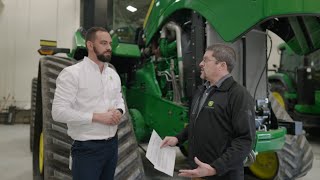
Ken Rosckes discusses the new 13.6 litre JD14 engine built for John Deere's 9R series tractors at the Waterloo factory. The engine was designed based on customer feedback and improves on maintenance and diagnostics compared to previous models.
We are here at the Waterloo factory discussing the new 13.6 litre engine designed from the ground up on the nine arches. Ken Roskins is going to tell us a little bit more about what has changed versus the previous engines and how it'll be a lot easier for customers to use the machine, as well as the benefits it'll unlock for our customers in their applications. So, Ken, with the introduction of the new 9R in 2022, John Deere made a significant change in having a new engine fitted, which is the new JD14 13.6 litre engine, which was designed from the ground up. Can you unpack a little bit more about the changes and the new benefits of the JD14 engine?
I'd be happy to, thanks, Hein. So, a few things that I should call out is beware that it's not just a redesign of the 13.5, it is a clean sheet design to move to the JD14 engine. So a couple of highlights in terms of like the sheer volume of the engine or its packaging size. It's about 14% smaller, it creates more horsepower and it's actually about 10% lighter in weight. So all of those things led to a better engine design. The 13.5that we know today came out in 2013 and the lineage goes back probably closer to 50 or 60 years. So it was really time to make a redesign to the engine. The 13.6, I would probably hit on two key areas. One would be improved components and the other that I would talk about is the integrated design. So in terms of improved components, the hydraulic lash adjustment that we see today in the 13.5 is recommended every 3,000 hours. In the 13. 6, that is fully automatic, there's no more need to adjust those lashers. Utilizes the high pressure common rail, much like our 9 liter does in the 8R family that people are used to. That creates more horsepower and saves fuel. Also, another one that people are going to notice right away is the use of the hydraulic fan drive. So that's a really popular thing. We can control with the ECU to maintain coolant temperatures.
And you say integration is also a big new add or new feature on the new 13.6. Can you unpack a little bit about that as well?
Absolutely. So as far as integrated design, we were looking to actually make a much improved diagnostic and repair time goal for this engine. So a couple things I can hit on there is one is the modular wiring harness on the 13.5 engine. The wiring harness went all the way around the engine to connect all of the sensors and electronics. The new 13,6 engine uses a three piece wiring harness so that it's much easier for technicians to diagnose problems. And then they do identify a problem, then you only need to replace a section of the harness rather than the full harness. Another thing that I could probably call out there is the what? The direct mounted EGR cooler. So no longer is it just bolted to the block, it's actually integrated into the block. The rear of the engine has some new drivetrain components, making the engine quieter to the operator. And I'll just kind of close with that. The electronic control unit, the engine controller is now direct bolted to the engine and we've eliminated a lot of external line routings and things to just clean up the engine, make it easier to work on.
So, Ken, listening to all of this and more on the new 13.6 L engine, it sounds like we've made improvements on what we had previously. So what has been the customer feedback to Deere after they've used it and implemented into their operations? Are they happy with the operational of the machine or what's the feedback?
Yeah, that's a good, that's a good question. Feedback has been outstanding. So it's one thing to tell customers all of these specs. On paper, it's a different thing to drive the tractor. So if they're used to our previous 13.5 engine, the new JD14 is going to feel like a whole different tractor. Power is better, fuel consumption is better, quieter. And one of the key things that customers notice right away is you can really pull this engine down into low lugging RPMs. It doesn't BOK and it doesn't downshift quite as readily and it really powers through those tough conditions which you see a lot in the 9 Series family.
So Ken, if I was a technician, what would I see differently in diagnosing this engine versus the previous engines that we had in the nine 0s in terms of ease of use, ease of diagnosing and getting this machine out of the shop and into the field a lot quicker?
Yeah, that's a good question. So, as I said, With a JD14 engine, our goal was to just improve that diagnostic time with new sensors, new harnesses. So whether you're an experienced technician or you're brand new at being a technician, it should take you less time to find problems and in turn get the machine out of the shop and back out in the field as soon as possible.
And obviously talking about accessibility, there's no need for unpacking the whole engine anymore. The components that is electrically driven is obviously a lot more accessible on the side of the machine. Apart from being within the machine.
That was. That was a goal. Right to clean sheet design. The components aren't just bolted on that we had to do with our previous designs. The components were thought through and placed in a position where they could easily be get at and do proper diagnostics.