
John Deere Africa Middle East | From Factory to Farm | Interview with Jason Abbott
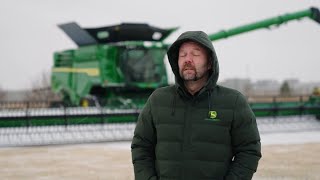
Jason Abbott discusses John Deere's combine harvesters and their latest innovations, including Combine Advisor, Harvest Smart, and Automation 4.0. The conversation covers how these technologies help farmers optimize machines, manage weather challenges, and improve operator comfort in the field.
In Tumi addition yellow Fabrika in Os Van Daj he's obeyed Struper Fabrik in Oskan Alice Struper Jason. I, I have to, I mean it, this is unique. It's snowing outside. I mean this is, this is special, right?
Perfect combine weather.
It's perfect combine weather. But you know, having said that, I mean let's, let's talk weather. And, and again, I mean this is harsh farming conditions.
Right.
So what's, what's different here in comparison with, with other markets or countries?
Sure. Well, just like we talked earlier when we put the seed in the ground to make sure that we don't get it up to five leaf stage or whatever and it freezes off because it's not uncommon for us to freeze the young crop and have to replant. Of course that just impacts our bottom.
Line as far as weather forecasts and technology. I mean it's one of those things. I remember speaking last year, one of my friends, he's a farmer in the free state and weather forecast, it's critical. You can get your timing wrong. So what, what's, how's the technology and how, you know, how does that play a role in the day to day?
Yeah, certainly we would love to have a crystal ball that can predict the weather, you know, very accurately. But I think if any of us had that then we'd be weathermen instead of combine experts. But you know, that's, I would say that, you know, the technology that we use today does enable that, you know, because we can run multiple scenarios, whether it's running things through op center, making, making changes on the fly, depending on what that weather looks like, whether it's plant more today because the rain's coming or no. We can go ahead and put our application of either fertilizer spray, you know, whatever. We can run through those just again to see what the impact or bottom line is and see how we can optimize our yield at the end of the season.
Luckily, John Deere made a good decision in terms of investing in technology. And one of those technologies that can make decisions based on conditions keeping on changing is something like Combine Advisor on our harvesters. Do you mind elaborating a little bit more on Combine Advisor?
That's a great piece of technology on a harvester. So we can, you know, set that machine and make sure that it's running at its peak performance throughout the course of the day. So whether we start in the morning, it's you know, a little bit tougher, a little bit more More snow or rain or whatever from the night before. Make sure we optimize it for loss, make sure we optimize it for grain quality. You know, from a human interaction standpoint, you know, it takes us, we like to think we're perfect, but it takes us quite a while to actually recognize an issue, adjust the machine, and then reevaluate to make sure that that machine is truly optimized. That's the biggest advantage of Combat Advisor at Auto Maintain is we set the machine. It is automatically doing that in the background. So every second of every hour of the day, it's analyzing am I doing the best job I can? And adjusting that machine accordingly. So. So it takes a lot of stress off the operator as well. There's a million things going on. Whether it's logistics, it's watching what's out in front of you. If you have adverse crop conditions, things like that, it's one less thing for the operator to worry about is just knowing that you can set the machine and let it optimize itself as we go through harvest. And again, we talk about peak performance and even shrinking that harvest window even more with a high capacity machine is exactly what they're looking for. And leveraging technology to make sure we get the most out of it.
Talking about technology and making changes on the go constantly, that's obviously data that's also feeded into operations center for customers to be analyzed the end of the day and seeing what the conditions were and what decisions were made to better plan for future weather conditions.
Let's pull that back to South Africa. I mean, again, what typically, again, what, what are, what are the benefits at the end of the day?
I mean, we've got, we've got harvesting seasons in South Africa where that can vary from either very dry conditions or very wet conditions. And customers need to make decisions based on do I start early in the morning, do I start late in the morning? And like Jason said, the harvesting window just gets smaller and smaller. And you need to make decisions faster and faster to get the crop off the field. When you do see rain coming in, you need to harvest a lot quicker. And that's the beauty of Command Advisor. It'll make the same decisions based on the conditions you are currently harvesting when you change from one field to the next. And that'll obviously get you the best performance out of that machine. Like mentioned, it varies. And you've got a wet morning that you start in and you can end off in a dry day. So obviously you can't harvest with the same settings that you started off the day with. So that's the beauty of combine Advisor, making those decisions and then also the conditions that you are harvesting. Whether it's on a hill, inclining or declining the combination Combine Advisor will make the decisions based on your losses and what's best for the combine at the end of the day in terms of productivity. Sticking to the technology part, if we look at harvest Smart, what is the benefit in harvest Smart for a customer when they use harvest Smart with the combines we see these days?
Yeah, so Harvest smart is one of those pieces of technology in the combine that really unlocks the full potential of the machine. So you talked a little bit about shortening the harvest window. We've got weather coming in, you know, customers need to get the crop out fast. And the harvest smart really enables a customer to drive that machine at its peak capacity all day long. Especially when you couple with auto maintain. You know, it for the most part is a self adjusting, self optimizing, self driving machine and takes a lot of, a lot of the stress off the operator. You know, you think about some of these customers are in this machine, you know, 12, 14, 16 hours a day. Keep that machine at peak capacity. It's a stressful job. You know, it'd be like running a race car that long, all day long, just to make sure that you're winning. That's where again, that technology really comes into play, not only in the bottom line, but also at the end of the day, you're not just totally spent.
I think an important thing that you touched on is operator comfort. I mean, a comfort operator means more productivity, more hours in the field. So with the comfort, we talk about the cabs where you get three different options in terms of cabs and lighting. Can you maybe touch on the different options that we've got on the cabs and the lighting options and how that affects an operator's productivity at the end of the day.
Yeah, so we do have our three options for cabs. Select, premium and Ultimate. We kind of laugh a little bit about holy smokes. We're really putting air conditioned, heated leather massaging seats in a combine. But you want that comfort. It's a long day and it's not just one, you know, you're doing it every day of the week. The light package, you know, when we get to the visibility side of things, you know, that full LED light package really does make it nice if you harvest into the, into the night. So if you think about harvesting in 10, 10 hours of darkness, that LED light package really, really Makes it nice not only for you as the operator to see what's going on in front of the head and around you, but also for, you know, other, other machines in the field to make sure that everybody is safe and can get the most out of their machine.
What's next, technology wise? I mean, we talked about the foot rests. I mean it's like this simple, very simple solution was so impactful. So it sounds like you've got less technology driven solutions like a footrest. And then of course we talk about lights and massaging chairs and all the rest.
You know, we already offer quite a few cameras on our machines, you know, so vision certainly, certainly is. I would see that as the next step or the next part of the evolution is not having to always rely on the operator to see it, but you know, have the cameras, you know, look around the machine like they do today, you know, from whether it's a safety perspective, but also to give you that full 360 view to make sure you understand, you know, where the cart's at, you know, where the other machines are at, what's happening on some of these big heads, things like that.
I mean, talking about technology, what's coming, but also keeping in mind what's already available. So if we look at the different options in cabs and lights, you also get a different technology suites available like Automation 4.0 with a lot of benefits in that. And how does that add value to a customer's operation and what benefits can they get out of Automation 4.0?
Yeah, so once you step into the ultimate technology package and unlock that, you know, automation 4.0, that gives you that Machine Sync technology and The AutoPath technology, two very, very cool features. You know, if I think about, you know, making your life easier when you're running the combine, those are two, two very, very nice features that do that. So, you know, we'll start with Machine Sync. So, you know, having the ability for the grain cart to pull up next to you and then basically lock into position and then having the combine operator, you know, manage or control the speed or location of that grain cart as you're unloading. You know, if you think about, especially in the X9, when you're running very high ground speeds, very, you know, productive machine, there's a lot going on. So whether, you know, you have to slow down for a waterway or slow down for maybe some down crop or things like that, you know, that grain cart driver automatically slows down. You know, if you think about when you're running 5.3 bushels a second unload rate. If you miss the cart, that's a lot of corn on the ground, you know. So again, it saves the grain, makes sure it goes in the grain cart, but then takes a tremendous amount of stress off there, off the operator. You know, talk a little bit about autopath, relatively new piece of technology, but again, especially for row crops, super nice. You know, if you think about as we plant crops with, you know, GPS and auto track and you know, there's no more guest rows. You know, when my grandfather used to plant, it wasn't a problem finding guest rows cuz you know, they got wide, they got narrow, we could find them pretty easy. Well now with autopass, especially if you're, you know, taking off across a large field, you can find exactly what row that you need to line the harvester up with and take off.
You touched, you mentioned the loss limit. Right. So, so expand on that. I mean again, historically, now, future what?
Sure, yeah. So you know, especially as you start into, and I'll just use corn as an example, you know, if I think back to, you know, 10 years ago, we didn't apply near the fungicides, we didn't, didn't typically harvest quite as green a corn or high moisture corn as what we do today. And as we start to harvest in those newer conditions, you know, higher moisture levels, you know, 25, 30, sometimes a little bit above 30% grain moisture. But not just that, that the stock is very green. And as you guys know, I mean it's very challenging for any color machine to handle some of those conditions and separate the grain from that green stock. Again, that's where the X9 really steps up with, you know, dual rotors, tons of separator area, tons of threshing area and tons of cleaning shoe area to make sure that we can handle the toughest of the high moisture corn, the toughest of the small grains.
We sometimes do forget that we've got an additional portfolio on the combines and we've got the T series combines as well.
So you bet.
If we look at the T series combine, how does that Differ from the S7 hundreds in short? And what's the main benefits in the T series versus the S series?
Sure, sure, yeah. We certainly don't want to forget about the T. That's still got a very loyal following and you know, in a conventional harvesting technology, you know, that that still produces, I would say a premium straw sample. So if you think about, you know, those customers that don't necessarily need to go above a performance group seven, you Know, that's that machine has phenomenal capacity, you know, the best conventional capacity in the market. But coupled with that, if it's a livestock producer, you know, that wants straw for bedding or things like that, there's, there's no competition when it comes to straw quality. A tee is hands down the best. You know, the S and the X will produce very good straw quality, especially in terms of competition. But the T is a step above best in class.
Taking everything we just discussed and I mean, obviously there's a lot of research and development that goes in designing these combines and making sure we get the best out of them. But obviously also keeping in mind that we've got a big engineering team that designs every day and that works on future products. What do we rely on when we do make decisions based on what's next or how do we improve? Can you elaborate a little bit more on how critical feedback from customers are in terms of designing and in terms of developing new technology?
Yeah, well, having been in combine development for almost 30 years now, as you mentioned, it is that feedback from the customer that is the number one, I would say, driver for what the future looks like in terms whether it's technology, whether it's capacity, whether it's autonomy, whether it's some far reaching thing. We are in constant communication with our customers, both large and small, to make sure that we develop those products that those customers need for the future. That also comes with working with some of the, you know, agronomy groups and whether it's, you know, seed producers etc, to make sure we also stay on top of some of the new hybrid trends. Yeah, you know, like we talked a little bit about, you know, the transition from dry harvest corn to more high moisture corn, you know, applications of fungicides, things like that. Just to make sure that as we start to see, you know, trends in agriculture or agronomy, whether it's, you know, tall corn, short corn, higher population corn, et cetera, we also have to make sure that we stay on top of that to make sure our products can meet those needs as well.
Are you moving closer to these other companies now, the seed companies and so on in comparison in the past?
Yeah, we partner with, you know, that's a tough question to answer but you know, we've historically worked with those companies in the past. I would say it's, it's becoming, collaborating a little bit better with them, just again, making sure that we develop the right products, you know, because they have, you know, needs on their side in terms of, you know, like I said, you know, changing plant characteristics, you know, changing, you know, yield, for example, you know, if you think about like, the average Yield, you know, 20 years ago, we have significantly more yield. So again, how do we make sure that we develop our machines to handle, you know, those changes that are coming through the within the market.
So it plays an important part of product development at the end of the day.
Thank you so much. Appreciate your time. And I'm looking forward to the future of John Deere's harvesters.
Sure. Well, yeah.
Thank you, Jason.
Sam.
More from Francisco




Desh Ke Superhero | Mr. Madhava Rao | Faster Pole Installation with GreenSystem™ Post Hole Digger



En CasaToro John Deere encuentras el respaldo que necesitas para mantener tu maquinaria lista



