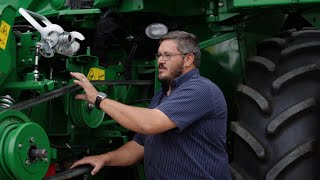
This is a YouTube video titled "John Deere Africa Middle East | Harvester Set-Up" created in May 2023. The content is a detailed instructional presentation by Heinrich, a technical advisor from African Equipment, explaining the correct setup and adjustments for a John Deere combine harvester to optimize soybean harvesting. The video covers various mechanical settings, maintenance tips, and operational advice to ensure efficient harvesting and machine longevity. The presentation is primarily a monologue with technical explanations and demonstrations.
When harvesting, to get all the seed into the bin, and to get the best out of your combine, correct setup is essential. And today we're going to set up this combine, let's take a look. Today we've got Heinrichje, Heinrich is a technical advisor from African Equipment and Heinrich will take us through all the basic settings and adjustments to get your machine ready for soybean harvest.
So the first point we're going to look at is our feederhouse chain en our feederhouse drum position. The feederhouse drum must be in the downwards position. You will see these arms on both sides of the feederhouse. The purpose of these arms is to raise the floating drum upwards or downwards. For soybeans we want the drum to be in the downwards position and we're going to adjust it here with these arms. You'll see on the right hand side of the combine you get these pockets. These pockets are two different speeds. The smallest pocket is for slow speed because we are harvesting soybeans, we want it at a slow speed and so we don't get the chance of getting separation already in the feederhouse before we get the material to the separating system. So you simply loosen these two nuts to get the tension out of the chain and then you take this key, this and you press it and you move this pockets inwards or outward on which speed you desire, you lock it back and you tighten till your tension is right on the chain. Tension on the feederhouse chain is very important. It doesn't matter which crop type you are harvesting. On the John Deere combine, on both sides of the feederhouse we have these gauge indicators that is telling you is your feederhouse chain too tight or too loose. If it's too tight we're going to shorten the life and if it's too loose we're going to get friction on the belly plates and start rubbing through on the belly plates which can lead to leakage loss. It's important to remember when you're adjusting the pivoting point that your tyre pressure needs to be the correct pressure and you are adjusting it on a level surface so you can get the right angle for which platform you are about to reach on to the combine. You get two types of adjustments. You get the manual adjustment like this one where you need to have spanners to adjust it or you get on the class 8 and 9s you get the hydraulic 4 after tilt and the procedure for calibrating and adjusting it is also in the operators manual. Please defer to operators manual when adjusting this pivoting point. Now we're on the left side of the feeder and I'm going to show you the variable belt and the adjustments needed here. Here we have the variable drive belt for driving the platform which is hooked on to the combine. It's important to remember when we operate and or we are replacing the belt and checking the tension to always have a 3mm gap between the two sheaves. If we don't have that gap and the sheaves are running against each other we're going to generate heat that is going to shorten the life of the seals within this gear case and also shorten the life of the belt. Please refer to the operators manual to make sure you know which variable you have on the combine. You get different sorts of variables and that will determine the sort of belt you are going to buy from your nearest branch. If you buy the wrong belt you're going to have problems adjusting this 3mm gap and also maintaining the right speed for your header. It's important to remember when we are greasing this forward reverser to turn the first grease zerk on 12 o 'clock and the second grease zerk on 2 o 'clock. Normal operating conditions you will probably needing to pump 10 to 15 pumps on this variable for heavier loads 20 pumps per zerk when we are finishing greasing this system to run this variable all the way to the fastest limit and back to the slowest limit. By doing that we are transferring the grease and the air so we can start lubricating all the systems and by running it on its fastest cycle we are filling the oil cooler with oil. On this forward reverser we also have a oil gearbox at the back. When we are checking the oil level it's important to know on this specific combine we need to pick up the header all the way to the top and lock in our safety lock system. We check the oil level by turning out this dipstick and checking and needing to adjust the oil level. Be sure you use the correct oil which is available at your nearest branch it's a VG460 synthetic oil. If you have an incorrect alignment on your concave systems we can get a pinching effect on our concaves which can cause splits in soy beans en give us a poor grain quality in our grain tank. We get two types of concaves you get the round bar which is the one that is inside this combine at the moment and we also get the large wire. For maize and for soybeans John Deere prefers the round bar concaves. Now we come to the separating system which is located at the back of the rotor system on the combine. If the conditions require you to stack your separating system you can use the spaces that is located on top at all these separating grids to stagger your separator grids like this combine over here. This sticker is an indicator of all the grease streaks that is located on the combine and the service intervals on which you will need to grease them. Inspection of the chaffer and shee system is important be on the lookout for the following problems paint louvers, cracked frames or broken louvers that is missing. It can have a negative effect on the grain quality. On the right hand side of the combine where I am standing at the top we have the air duct system which is located in front of our radiator system. This air duct system has three settings we've got the transport setting like this one which is closed we've got the high humidity setting which is wide open and we've got the high temperature settings. Be sure to adjust it according to your ambient temperature settings where you are harvesting. Located on the right hand side of the combine we have the clean grain elevator chain and also we have the tailings elevator chain. Inspection of the chains is very important for the condition of the paddles. It's also important to remember the correct tension on the chains so we don't shorten the life of the chain systems. There's a sticker also with the location of the grease streaks and the intervals for greasing them. On our clean grain elevator we have our moisture sensor it's very important to keep it in a clean working condition for optimal moisture and yield readings. On our tailing systems we have our tailing sensors it's very important to keep them clean and in a working condition for the correct tailings readings. Here we have the feed accelerator the crop you are getting ready to harvest will determine the speed of the feed accelerator. For example if you are getting ready to harvest corn you will put it on a slow speed if you are getting ready to harvest soybeans you will put it on a slow speed if you are getting ready to harvest wheat or barley you are going to put it on a high speed. The crop type will determine the speed of the feed accelerator. For example if you are going to harvest corn or soybeans you are going to put it on a slow speed which is the tortoise here and if you are going to harvest wheat or barley en we gaan het op een hoge speel, die is de rabit, die were de basic set -ups op die combine en als je die dubbele of volgende informatie hebt, geef jouw operatiesmanuil gelegat.
Met die combine kastamers, remember, alle combines zijn nie hetzelfde en die zijn georderd anders, so ensuren dat je die operatiesmanuil op jouw specifiek combine read. dankjewel hondrich, dankjewel jarg, het is het benne plezier, we appreciate your time en John Dea wil geluk om al die van ons kastamers, ekcesiebuilt in een geweldige alvastingseed.