This is a YouTube video titled "John Deere Combine GoHarvest: Hydraulic Feederhouse Fore/Aft/Tilt calibration procedure MY15 Combine" created in January 2018. The content is an instructional video featuring two speakers explaining the step-by-step calibration process for the hydraulic feederhouse fore and aft tilt on John Deere S Series combines, focusing on safety and precise operational procedures.
Performance, productivity and exceptional harvest experience.
Go Harvest.
Get the most out of your S Series combine today. Always follow safety instructions and understand all safety decals according to the operator's manual. Always use seat belts when operating the machine or riding as an observer. When parking and leaving the machine, disengage the header and separator, move the multi function lever to neutral and apply the parking brake. Shut off the machine, remove the key and lock the cab.
This video will clarify calibration procedures for fore and aft hydraulic platform tilt on S Series John Deere combines.
Before working near the feeder house or header, raise the feeder house completely and tilt it fully forward. Then lower the header lift cylinder safety stop into position. However, the safety stop must be in the raised position during the calibration procedure. Exercise caution to be sure all persons are kept clear of the machine during calibration procedures.
To deliver proper operation and correct display readings, the system must be calibrated when changes, replacement or adjustments are made to feederhouse position sensing components, the system controller, or with a change of tire size calibration will allow the system to capture the proper range of the fore aft position sensor and correctly set the zero point for the display readout. The operator will be guided through the calibration process by a series of informational screens seen on the display. Note that calibration should be performed on a hard level surface. If field conditions are soft to the point of leaving ruts, then the calibration should be done on a level location in the field with the machine running. Enter calibration from the Combine Home screen by pressing the calibration icon and select the feederhouse fore aft tilt range from the drop down box. A series of calibration screens will be displayed. Screens will display instructions to guide the operator through the calibration process, such as situations where calibration is required. Screens will also inform the operator of machine conditions or settings needed for each step of calibration. Press the next icon on the screen to progress through the calibration. An abort icon button will allow the operator to leave or abort calibration. Follow the on screen instructions to proceed when prompted, Tilt the feeder house fore aft frame to the positions indicated on the display screen. When the next icon is pressed, the position of the feederhouse fore aft frame will be stored.
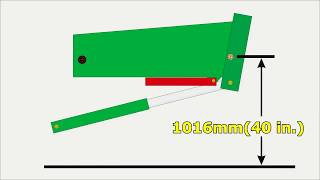
After the extreme fore and aft positions have been saved, the calibration screen will instruct the operator to tilt the front frame fully forward. Then raise or lower the feeder house until the dimension from the center of the fore and aft frame pivot pin to the ground is 1016 millimeters or 40 inches.
Then place a level on the flat front surface of the fore aft frame. Tilt the frame rearward until the level is at 0 degrees or perpendicular to the ground. Press next step to save this frame position as the zero position on the display screen. If a problem exists with any of these calibrated positions, the operator will be informed and prompted to repeat the procedure. If successful calibration cannot be achieved, contact your John Deere dealer.
The geometry of the feeder house lift cylinders and fore aft frame results in the feeder house height changing when the frame is tilted. Calibration instructions may call for setting the front frame pivot pin to ground dimension of 865 millimeters or 35.5 inches with the frame face perpendicular to the ground. Instead, set the height to 1016 millimeters or 40 inches in full forward tilt. The 865 millimeter feederhouse height should be observed when the frame is moved to the zero or vertical position.
This interaction between the feederhouse height and fore aft frame tilt also affects the feeder house lift cylinder safety stop. The stop can only be lowered when the header is tilted full forward and the feeder house is fully raised. For more detailed information, consult the operator's manual or your John Deere dealer.