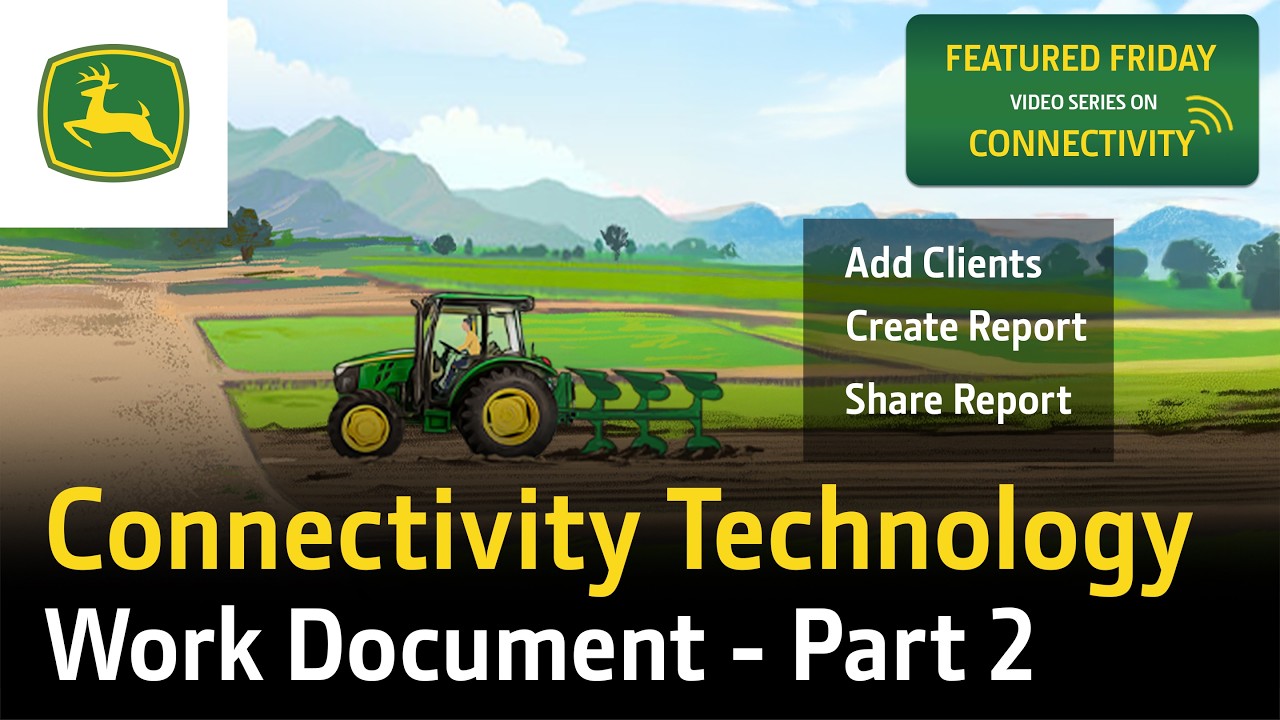
John Deere's work documentation records area, time, equipment, and field maps to help farmers optimize operations. Two identical fields show how lower tractor speed increased fuel consumption, and seasonal data reveals whether current equipment meets demand or if new implements could boost profitability.
Chapters
In previous work documentation video, we learn how to add clients, create report, and share it with customers. In this video, we will learn what information is captured in the document and how this data helps customers make better operational decisions. The work documentation captures details such as area worked, working time, equipment used, map view of work field and work note. This details help customer to track work accuracy and maintain records. Let's look at a practical real-world scenario that shows the value of this information. Imagine a customer who owns two fields, both of same acres. Both fields have the same soil condition, the same moisture level, and the same tillage operation. The tractor and the implement used are also identical. But after completing the work, the customer notices something unexpected. One field consumed significantly more fuel while the other used much less, even though all conditions were the same. Why? To understand this, customer opens Summary tab of both fields. Here, by comparing operational parameters shown on the screen for Field A and Field B, the customer can quickly identify the reason for the difference. Perhaps Field A took more time to complete because it was operated at a lower speed, causing higher fuel usage. Meanwhile, Field B may have been operated at an efficient speed, resulting in lower fuel consumption. With this data, the customer can identify the speed range where the tractor delivers the best of performance and efficiency, which the customer can educate operator to repeat same speed in future operations and reduce fuel cost. Work documentation doesn't just help with a single field, it supports long-term planning as well. By reviewing the total area worked by the tractor over the season, the customer can evaluate whether their current equipment is adequate. Ensure that each field is filled with detailed implement-wise work notes so that the total hours spent on each implement, such as rotary tiller, MB plow, planter, baler, etc., can be easily tracked for the season. Based on the data for implement hours, tractor hours, and any additional work requests, the customer can decide whether adding a new implement or tractor to their fleet for the next season will help increase profitability. Work documentation goes beyond a digital record, helping you analyze performance, save fuel, and make smarter farming decisions.