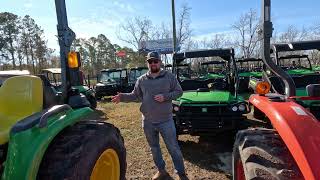
This is a YouTube video titled "John Deere & Kubota Compact Tractor Comparison" created in January 2024. The content features a single speaker, Trevor from Sunsouth and Foley, providing a detailed side-by-side comparison of the Kubota L2501 and John Deere 3e compact tractors, focusing on design, durability, operator comfort, and maintenance aspects to help potential buyers understand the differences.
What's going on, everyone? Trevor here at Sunsouth and Foley, we just recently took this Kubota L2501 in on trade. So I want to take the opportunity to do a side by side comparison against the John Deere 3e. So I want to start here at the front of the tractor. The first thing I want to point out is how far out the loaders go. John Deere is going to be significantly shorter and the advantages that's going to give you is going to give 2 foot tighter turn radius. It's also going to keep the weight of your lift closer to the tractor so you don't need to ballast as much. And it's also going to be safer as you lift those heavier loads up higher. Another thing I'm going to point out out. And we hear this time and time again, why do I want a plastic tractor versus a metal tractor? There's many reasons why. One of them is going to be durability. I can hit that tractor. Nothing's going to happen with it. It's not going to scratch, it's not going to dent, it's not going to rust. You hit a tree, tree limb falls on the, on the Kubota during work, you're going to get a scratch and eventually you're going to rust and paint's going to chip. Another thing, stepping around back to the front axle. I'd like to point out the steering cylinders and tie rod ends. You look at the deer, it's really clean across the front. Anything that you hit is going to be taken on the axle. Your cylinders and your rods are completely protected. Take a look at the Kubota. They like to, they put it right across the front there. So that's going to take any of the brute impact that you might hit from sticks, stumps. Anything else while you're out there doing green fields or small garden work, stepping back to the middle of the operator station of the tractor. One thing I'd like to point out, Deere is going to use the twin touch hydrostatic pedal. So you got forward in reverse, it's out of the way. And if you look across the operator station here, it's very open, comfortable, a lot of room to move around. Coming over to the Kubota L series, you've got the treadle pedal forward on your toe, reverse on your heel, brakes in the same area. You look across the Kubota operator station, everything looks real cluttered. It doesn't look that comfortable. So being on it all day could get uncomfortable. Coming to the back of the tractor. A lot of the things we hear, why do I want to cast aluminum rear axle? Deere is going to have a cast aluminum. Kubota is going to be cast iron. The benefits of cast aluminum is aluminum does not transfer heat. So your hydraulic fluid in a hydrostatic tractor constantly flowing through there, it's not going to overheat. It's that it's going to save your pump in the long run. Less maintenance, longer life for the tractor. Another thing I'm going to point out is going to be the clutches and the PTO clutches between these two tractors. Deere is going to use a wet clutch versus a Kubota uses the dry clutch. What the dry clutch means is the Kubota manual says it's supposed to be serviced every hundred hours. So higher service cost, more downtime. Wet clutch. Deere doesn't have a service service interval for it because you don't need to mess with it unless it's messing up. So that was just a quick rundown of the questions that we typically get between the two tractors. Come down and see us at sun south and Foley. Drive each of them for yourself and feel the difference.