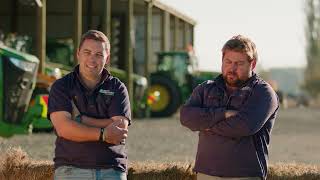
Jayden Drought, a dairy farmer, works with Phil and Tim May of May Brothers Contracting using John Deere equipment and software like Operation Centre and Harvest Lab to improve forage quality and farm efficiency in Methven, New Zealand.
My name's Jayden Drought. I'm a passionate dairy farmer. I understand the value of high quality forage and how that helps the profitability of my herd. Today we're going to meet up with Phil and Tim May. They run May Brothers Contracting and we're going to cut some corn silage and showcase how their cutting edge technology and their John Deere equipment is helping their clients send that white gold to the world.
You're good.
Good mate.
Y met the May brothers probably, probably two and a half years ago. These guys obviously spent a lot of long hours on the tractor, you know, to build the business up to where they are now. And I guess it's both a testament to their work ethic but also, you know, those loyal customers that they've been able to service and look after for all of those years to be able to, you know, become business owners of this size, which is fantastic.
Being locals in the area, in this area were born and bred here. Yeah. The people we knew and the support we got from customers over the past 17 odd years or something, I suppose it just, yeah, that's how I suppose it grows and being able to provide the right service to the clients.
Lots changed here. We didn't really think it would be this size back when we started.
So Timmy, here we are in the brains of the operation, mate. You guys have been using Operation Centre for a long time now, right?
Yeah, so we've been using the operations centre for a number of years now and yeah, it's really good to see all our machines out in the district and where they are, how far through paddocks they are, a lot of the machine data, fuel levels, any issues. So you can look at all your idle times per machine and it's working times and speeds and everything like that. So you can really fine tune I suppose the business, if you get right in depth with it to seeing the efficiencies and that from the operations centre here.
Are you using that work planner as well to send those jobs in which case you can kind of set some of the machine parameters before it even gets to the operator?
Yeah, yeah, for sure. You can put all that data in there and so the operators can see their jobs and that on the screens. Yeah, it's really beneficial to be fair.
Let's do a plan for Phil out there and that maze job that we're going to do today and we'll tell him how to do his job.
Yeah, no, so yeah, all you need to do is on the operations center is go into plan and then down to work planner. And then the job comes up here in front of us. It has all the inbuilt run lines for the paddock, the variety of maze. So I'll just click on the harvester there, send it to Phil and yeah, Phil, get to.
A work order come through from Tim. I'll accept that and we'll get you off. The brain's been good to us, it's been reliable, it's backed up well and it's the technology and it's awesome. You can take stuff out of one machine, put it in the other and it just all integrates. That's a big part of what we were trying to achieve.
Here. We're using machine sync, where the two MTGs in these tractors are actually talking to each other. And so what's happening is in the harvester by default, that set is a leader. So you've got a leader and a follower. The harvester is by default the leader. So what this is using is the MTGs over the cloud talking to each other. The transmission and the steering is all controlled out of the harvester and that's based on a home position that we set. And it just, I guess, decreases the amount of fatigue for both operators as the forage driver doesn't need to worry about what the trailer driver's doing. Are they getting too close to the head, Are they too far away? You know, all of those little things.
As far as the machinery goes, technology's come a long way and everything's so much more efficient and from our point of view, it's making the business more efficient too.
We probably can't control nutrition as such, but like we can control the quality of silage we make. And yeah, I mean, we're in a pretty tough area with nor' west winds and, you know, snow the next day and yeah, so it's very changeable weather. So it takes a lot of management to get things right and we just try our best to maintain that quality wherever we go.
In the last 10 years, people have certainly woken up to it more than ever, I find. It's just like an athlete, I suppose. Put the right nutrition as they'll perform and that's what you want out of your animals. And to get top quality, high producing, you've got to put the right things in, don't you?
Another cool piece of tech that I'm here to show you is rda. So essentially I log into operations Centre, I click into the 9700 that's chopping behind me and it's showing me exactly what the operator is seeing in there. This is also fantastic for service techs. They don't have to come out to the machine, they can log on, see any diagnostic trouble codes on the machine and then potentially fix it without actually having to travel to the machine. Not only is it fantastic from a logistics and operations perspective, from an ongoing servicing in the machine, there's also some cost savings with this John Deere technology.
You know, with all the information the tractors spit out these days, you see how much idle time and that's involved in it and you can see how much fuel's getting burnt, for example, for the charge out rates that we're charging and. Yeah, no, it's an awesome tool to have. Yeah. And it's right there on your phone.
It's good to see how we can become more efficient in that to be able to provide the cost effective service as well.
You know, any cost saving you can get certainly helps in the business, that's for sure.
If you don't have a harvest lab on the forager, we've also got you covered here. We've got a Harvest Lab 3000 as a bench tester. Really simple. You put a sample of the forage in here, the glass bottom then gets a reading from the NIR, which is near infrared sensor. In the harvest lab 3000 does a couple of spins and then spits out a reading here on the laptop. So for this sample here, I can see that it's 32.6% dry matter, it's 8.6 crude protein. We've got ADF, we've got NDF, we've got starch percentage. We can then also correlate that with the yield map from the paddock. That then allows us to then spread variable placement fertiliser and then correlate that back to the nutrient placement over the whole farm. In terms of traceability for compliance with the regional councils, we've got the traceability for the fertiliser and we've got the nutrition for the cows. It's good for the farm, it's good for the cattle. There literally is no down. We've come down here. Beautiful day. Look at this pasture that these cattle are in. Right. And you guys have just done a fantastic job of some maize silage for later on in the season. Right. I mean it must be, it must, you must make you immensely proud that you guys can be a part of, you know, this farming system.
Yeah, definitely. They're loving this high quality grass they're eating, but surely they'll be tucking into some maize shortly too.
Dairy farming has become a margin based game. There's, you know, it's super high input costs, you know, there's inflationary pressure all of the time. And so I guess getting any competitive advantage by feeding high quality forage that, you know, the exact components of, that's got to be a game changer.