John Deere explains how to break in a new track tractor during its first hours to extend belt life. Proper operation and lubrication during this period prevent heat buildup and friction damage to the belt, rollers, and wheels.
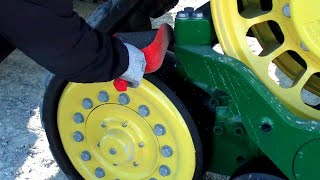
How your new track tractor is operated within its first 50 to 100 hours of life can greatly affect overall track belt life. Heat build up from friction in a track system reduces the life of belts, mid rollers and wheels. Heat is easily generated within your new track belts because their rubber is soft, tacky and wheels are not yet polished. Splash. All these factors lead to a higher coefficient of friction. Track tractors use soil as a lubricant between the rubber tracks and wheels. Be sure to expose new or clean tracks to dry and dusty soil conditions as soon as possible. One important detail in extending the life of your new track belts is to precondition these belts. Preconditioning must be completed before driving the tractor on the road, operating in heavy, moist soils, or operating in the winter on frozen soils and snow. Track belts are preconditioned by periodically applying dry and dusty soil to the area between the wheels and belts. If dry soil is not available, a clay based lubricant such as oil, dry and or talc powder can be used. This coating provides a dry lubricant to the track belt until it can be operated in a field with dry soil. Add this lubricant to the inside area between both front and rear idler wheels. These idler wheels are cupped inward, providing an area to store lubricant. Lubricant is then spread onto the track belt with each revolution. Drive the tractor slowly, allowing lubricant to spread and coat the inside of the track. Stop and repeat so the track is operating continuously in dry soil, oil, dry or talc for the first 15 minutes of operation. If transporting, lubricant should be reapplied after every 15km of distance travelled. Lubricant should also be applied if the track belts are cleaned, replaced and when operating on frozen soils, monitor tracks closely for build up of heat using an infrared thermometer or by touch. During this initial break in, drive lugs and wheels undergo a polishing process. Excess rubber is scoured away and fine dust particles are embedded into the rubber, thus reducing friction. If track belts are not properly preconditioned, excessive heat from friction can build up inside the drive lugs, track belts, mid rollers and wheels. Heat buildup in the mid rollers can cause rubber separation. This separation usually begins towards the inward side of the mid roller closest to the drive lugs. Another source of track system heat comes from driving track tractors on the roads. Friction between tread bars and road surfaces builds heat rapidly inside tread bars. Heat is slow to transfer out of these tread bars due to their thickness and lack of contact with cool soil, heat buildup in tread bar can reach a point where internal reversion occurs. This is when the rubber inside the tread bars returns to its original molten state. Then, as this liquid rubber cools down, air bubbles can form inside the tread bars. Early stages of this reversion can cause a distortion in the tread bars. In later stages, these tread bars can blow out looking as though they were exposed to some type of physical damage. If not corrected, heat buildup can reach a point where cables begin to pull out of track belt carcass.