Two speakers walk through adjusting droop settings and speed configurations to fix a tractor that bogs down under heavy loads. They cover gear shifting and engine load management for the e23/e18 transmission.
Do you find your tractor is not responding fast enough when operating at full load, and then that load continues to increase even more? After watching this video, you will be able to overcome this problem by adjusting the droop setting to maximize tractor performance and consistent heavy draft applications. You'll also be able to discover the right balance of gear shifting and tractor performance.
Operators can determine if the tractor is operating at full load by watching the power meter or or the percent engine load field in the machine monitor. Now, as heavy loads increase even more, some symptoms that you might experience include the tractor cannot maintain the desired set speed, or the tractor cannot shift down fast enough, or the tractor might appear to be low on power, or the engine is lugged down too far and cannot recover, or the transmission defaults to neutral in extreme cases.
Remember, if you are operating a nine family tractor, do not operate in gears one through five because the engine is DE rated to protect the drivetrain and you will not experience full power in full auto mode.
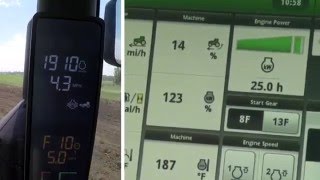
You can see this tractor is already operating at full load. And as the load increases even more, the tractor is lugged down, giving the appearance that it is low on power. To remedy this problem, we need to switch to custom mode. We are not all that concerned with the eco setting in this scenario because the heavy load is not allowing the tractor to shift up and throttle back. What we are more concerned with is the droop setting. Full auto has a default droop setting of 23% or approximately 1600 when FieldCruise is off. By changing the PTO off droop to the lowest setting of 14%, the tractor will downshift sooner at 1800. Now let's try this again. Notice now as the load increases on the tractor, it will not lug down to 1600rpm anymore because it is beginning to downshift at about 1800rpm instead. Remember, you likely won't see it shift exactly at these engine speeds because this is a gear transmission and it takes some time to complete the shift.
Keep in mind, having a lower droop setting will cause the tractor to shift more frequently. This won't damage the tractor, but it might be undesirable to the operator. So, as an operator, you have to balance the frequency of gear shifts with with the engine performance. Lower droop settings may cause more shifting and high droop settings may cause poor performance.
One other thing that you can do to reduce the frequency of shifts is to check your set speed. For example, if the conditions and size of the implement will never allow the tractor to go above 5 mph, set the set speed to about 5 mph. Having a set speed significantly higher than what the tractor is able to achieve may cause excessive shifting as it will shift up to achieve the higher speed to only find out that it can't pull it that fast. So then it downshifts and then the cycle repeats.
I am happy with the performance and the amount of shifting with this tractor, so I believe that I have found the right balance for this application. Remember, by adjusting droop and your set speeds, you can help your tractor respond faster when full loads increase even more.