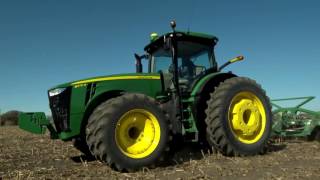
Two speakers explain how to set a tractor's transmission for implements that need low hydraulic flow. They cover proper ballasting and tire inflation, how Full Auto mode was designed, and how to test performance in the field to know if you need to adjust settings.
So you have your tractor hooked up to an implement that doesn't require a lot of hydraulic flow, and now you need to set the transmission before going.
Out to the field.
After watching this video, you'll be able to use Full auto mode for these types of applications and recognize the right balance of responsiveness and efficiency to confirm that those initial settings are correct.
Before we discuss transmission settings, I want to remind you of the importance to make sure your tractor is ballasted and the tires are inflated properly. Any tractor that is not ballasted correctly or has improperly inflated tires will not perform to its maximum potential regardless of transmission setting. An example of a low hydraulic flow implement would be a tillage implement that requires hydraulic flow to mainly raise and lower to complete headland turns. These would be unlike implements like planters that use oil flow to operate vacuum motors, variable rate drives and etc. For low hydraulic flow implements, we recommend starting with Full Auto mode because it is simple, fast and requires no additional setup. The ECO engine speeds, load anticipation and droop settings are automatically set for the operator in Full auto. Now, you might be wondering how John Deere determined these Full Auto settings. Well, engineers gathered and analyzed data through product development and testing in many applications. This information was used to determine the settings where the tractors perform best in most field applications and conditions. But when you consider all of the potential applications these tractors could be used in, it may not be a one size fits all solution. Having selected Full auto, I am done making transmission settings and it is time to confirm if these settings are correct or if they need further adjustment. As I make my first pass or two across the field, I am observing the tractor for any signs of performance related problems. For example, is the tractor short on power? Am I able to come close to reaching my set speed? Is it shifting too much? Is my wheel slip in the desired 8 to 12% range? Is the implement showing signs of not enough hydraulic flow? Is the PTO speed correct? Asking these types of questions will help you gauge if the tractor is performing how you expect and if it is not, they will help provide clues for adjustment.
I am happy with how this tractor is performing, which tells me that Full Auto mode is the best mode suited for this application. But what if the tractor is not performing as expected? In those situations we can switch to custom mode and make adjustments based on the particular symptom the tractor is experiencing, which we will cover in separate videos. In summary, because of its simplicity, we recommend starting with Full Auto mode or when operating implements that don't require a lot of hydraulic flow and when we go to the field, we can determine whether or not we need to adjust these settings further in custom mode.