
Seeding 360° walk around experience
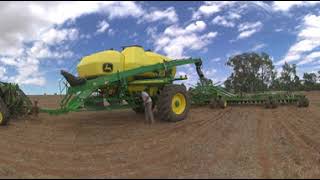
Charles Reynolds from John Deere walks through the 9470 RX narrow tractor, 1910 tow between cart, and 1890 seeding bar. He covers the display systems, track configurations, hydraulic features, and precision farming technologies that control modern seeding operations.
Hi, I'm Charles Reynolds from John Deere. Today we're in the cab of a 9470 RX narrow and behind us you'll see we've got a 1910 tow between cart and an 1890, 60 foot or 18 meter bar. So today here in the cab, I'm just going to run through quickly some of the controls we have here on.
The armrest you can see we've got.
Our Generation 4 display or 4600. And this display is common across multiple platforms, giving a user the ability to go from a sprayer or a combine.
Into a tractor and be very quickly.
Familiarise themselves with the controls having that common look and feel.
So as you can see above us.
We'Ve also got this extended monitor and what that is is essentially some more screen real estate. So when we're doing a seeding operation or a planting operation or spraying, we've got multiple things happening on that machine at one time.
We want to be able to see.
That the product that we're applying and the auto track type settings, we want.
To be able to see and interact.
With those and make sure that what we're trying to achieve in that job is actually happening.
So giving us that ability to put.
Different controllers or even Isobus controllers up onto multiple displays so that we can see what's happening.
And also you'll notice that this display.
Is very similar look and feel in terms of interacting with it, what you might be familiar with with a tablet thing.
So you can swipe through different pages.
To go through to different controllers. And you'll also see we've got an iPad mounted here as well.
So through this Generation 4 display, we're streaming data in near real time up.
To our operations centre.
So with this iPad, we can actually.
View that through some of our John Deere apps, see what data is going up and also do that remotely for.
That matter, as we go through, we've also got. I'll just change pages here and we can do that just by touching up in the right hand corner here.
You can see I've got a prescription.
Map happening here as well from a fertiliser.
So we're putting on some urea here at the moment.
And then if we go through a couple more pages here, what we'll see.
Is our blockage monitor. So we have a relative flow blockage monitor on this particular bar. So all the secondaries on this bar have individual sensors. So every row we're monitoring the rate. So as we go along applying urea as we are at the moment, we can make sure that the rate we're putting out is happening right down at the bar and getting to individual rows so we don't get any misses.
So a great little add on as we continue to go through.
We can have multiple run pages. So previously we've sort of been limited with how many run pages we can have. And as we change implements we have to overwrite those run Pages. With the Gen 4 display, we can set up as many run pages as we want and then at any one time we can have up to 10 of those run pages active. So rather than having to continually create new run pages, we can just set those up for the particular implements we're running. And then when we're not using that implement, we can just save them in the background. And then again when we come to hook up that implement, we can just pull those up and use those. And for that matter, we can actually export them and put them onto other displays. So if we've got multiple tractors or we're trading in a tractor, we can take those run pages and put them into another one.
So that pretty well concludes what we've.
Got here in the cab settings. And now we're going to go down and talk about the 9 Rx narrow and some of the changes we will see from the 9 Rx wide track that we've had in the 30 and 36 inch options through to this narrow track version for the more CTF focused type farmer or row crop operations.
Here we are now outside of the cab of our 9 RX narrow. We have this available in 3 horsepower models, the 9000, 420, the 470, and the 520. And this is specific to the 9 RX narrow configuration. So we'll focus on that narrow configuration which is essentially this track unit, as you see. So we've got three mid rollers here and these mid rollers are specifically matched to the track belt width. So in the narrow configuration we have two track width options that the 24 inch as we see here now, which is roughly 600mm, and then the 18 inch for more of that row crop type operation. So as I mentioned, these mid rollers here go right to the edge of this belt. And the reason we do this is to spread our load evenly across the full footprint of that track. And we also isolate these mid rollers to improve the ride quality and that ground pressure onto those tracks. So that essentially is a rubber mount that allows these mid rollers to get some suspension and also some slight oscillation side to side as we go over undulating country to keep even pressure across those tracks. And as we come through, also mention here that we have cab suspension and that also helps improve that ride quality for that operator as we're going over rough country for those long days. And then in this narrow configuration, as you can see here, we have the 120 inch centre to centre option which is roughly that 3 metre fitting in with our controlled traffic operations. And we also have it available in an 80 inch which is roughly the 2 metre for row crop operations and an 88 inch. And then if we look up to the roof here, you can see we've got our Starfire 6000 receiver with scalable accuracy. So we can as an entry level have that receiver with SF1 and then scale that up to RTK style accuracy for that more inter row type operation with that plus or minus 2 centimeter accuracy. That really completes the walk around at the front of the machine here. And now we'll go through to the 1910 cart. Here we are at our 1910 tow between cart and we have this available.
In a tow behind option as well.
This particular cart is our 430 bushel. That's just over 15,000 litres. So I'm just going to point out a couple of features on this cart. One of the main ones I wanted to show you first his section command. So I'll just grab a roller. So section command is essentially a bank of solenoids there, electro hydraulic and they actuate these little pins on the, on the bottom of the meter cartridge to close this flap. So essentially we're stopping the delivery of seed or fert to that particular primary as these close. And that enables us on point rows and those sorts of things where we've got overlap to not be doubling up on fert and seed. So we're getting the ideal rate that we want. We also have on this cart a hydraulic folding conveyor. So as these conveyors get bigger and heavier and sometimes on side hills and things when you're on your own trying to load can get quite difficult or awkward to manoeuvre. We have the hydraulic option. So with that we get a wireless remote and we also get a tethered remote in the event that the batteries go flat. So it enables us to be up on top of the cart, manoeuvring that conveyor right into the top of the tanks here so that we can fill on our own. We also have hydraulic drive on here, so that's great for being able to do variable rate or even just achieving consistent rate right up to our headlands as we change speeds coming in and out of. And then as we're doing prescriptions that really fast rate change between different zones so we get the right product in the right area as we go through the field. We also have an AirPower 2 option. So as we get larger bars, we need more airflow to get that seed and fert out to our wings. We can have an additional fan that pretty well wraps up everything on the cart, you'll notice. Probably.
Probably.
One final feature is this cart is also on 120 inches to fit in with that CTF operation. Now we're going to move through into the 1890 bar. Here we are at our 1890 seating bar. So as you can see, this is a single disc opener machine with our 90 series opener. And this particular bar is set up on seven and a half inch spacings. We have a range of different options for the spacings on the 1890 being the 7 1/2 inch, 10 inch, 15.
Inch and 20 inch spacings.
We also have a range of tine bars available being the 1830 and the hydraulic downforce, 1870. And on hydraulic downforce we'll move over to here. You can see this hydraulic valve block that gives us the ability to do hydraulic downforce on these row units as well. So through these lift rams we're able to put hydraulic downforce through the row units. So for varying soil conditions, we can set the right pressure so that we get accurate seed placement, getting it at the right depth. Because if we over or under apply on our downforce, we'll either be putting in the seed too tight or too far or too shallow if it's under applied. And if we look also back to the centre there, we can see that controller mounted in the centre there. And what that is is our relative flow blockage monitoring system. So coupled with these sensors on our secondary hoses, we're monitoring the flow of product out to our individual openers relative to each other. So as we have product flow out to the wings, if we get an over or under application on a particular opener, we'll get an alarm up in the cab to trigger us to go to that particular primary and have a look for that secondary hose that might be blocked. Then if we look also back to the centre here, you can see that Starfire 6000 receiver. And that gives us the ability to for one monitor the position of the bar. But also if we couple it with active implement guidance, we can then steer the bar separately to the tractor. So in an inter row seating type operation, we can actually steer the bar on a separate line to the tractor. So we might want to keep that tractor on our controlled traffic tram lines, but just shift over so that we can inter row so we can do that. And even just in side hill type operations where we've got quite a long machine and we might get that bar drifting off the line of what the tractor is running, we can steer that back on the line or coming through headlands with the long bar that we can sometimes have in our air sitting operations. If we don't steer straight onto that line, we get a bit of a tear drop effect. We can have that bar steer on more precisely. That pretty all wraps up everything I wanted to cover on the 1890. So for more information please contact your local John Deere dealer.
More from Francisco




Desh Ke Superhero | Mr. Madhava Rao | Faster Pole Installation with GreenSystem™ Post Hole Digger



En CasaToro John Deere encuentras el respaldo que necesitas para mantener tu maquinaria lista



