
Sprayer 360° walk around experience
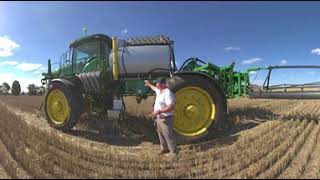
Anton Karlenko from John Deere walks through the R4030, R4038, and R4045 self-propelled sprayers, showing the cab design, boom options, nozzle systems, tank sizes, suspension, and GPS-based spraying tech.
Hi, I'm Anton Karlenko from John Deere and today I'm going to speak to you about three of the sprayer models in John Deere's self propelled sprayer range. The R4030, the R4038 and the R4045. So we're going to start today up here in the cab. This is a new cab for our sprayers, but for John Deere it's not a new cab because it's the Commandview 3 cab which has been used on our tractors, the 7, 8, 9R tractors for the last couple of years. So a lot of people would already be familiar with this cab. There are a number of new features in here which we haven't seen on sprays before. We've got a new command arm, a new multifunction handle. We can now use an extended monitor in here and we have a new seat in here as well. As you can see, with the multifunction handle, it is redesigned. We have programmable buttons on the side. Now. We also have this headland management button. And what that allows us to do is when we're pulling out of a headland, when we hit this button, it will activate auto track section control BoomTrack Pro and take us to a predetermined speed or with the press of one button. In the past, we would have had to press multiple buttons to do that. So it just makes driving the machine a little bit simpler. New Also on the command arm is the new display. So our 4600 command arm display, which is once again not new to John Deere, but new to spray. So we've seen these displays in tractors for the last couple of years as well. What you can't see in here is our JDLink diagnostics which is used. Our MTG, which is down under the seat, allows us to do things such as wireless data transfer so we can send data to and from the machine remotely. We've got remote display access which allows someone in a remote location to see what's going on on our screen. So they just need a computer with an Internet connection and they can access to see what's happening on your screen. We also have service Advisor remote diagnostics through that JDLink Connect. So that allows us or allows our technicians at our dealerships to access diagnostic information from a remote location so they do not have to come out to access some of that information that they may need when they're trying to fix problems on our sprayers. The last thing I'll talk about is this leather seat swivels 15 degrees quite comfortable. It is an option. We still do have the option for the cloth seat, but we have this premium option where we get a leather seat which is heated and ventilated, so it is quite comfortable to drive in, especially when you're in a machine for long hours during the day. Next, I'm going to go around the back of the machine and we're going to talk about the boom options and the new boom that this machine has. So we've come around to the rear of the machine now and we're going to talk about the boom and the boom options that are available on the three sprays we're looking at today. So, as you can see, this machine has a 36 meter carbon fibre boom on it. We still do have steel boom options on all these machines like we've had in the past. So if we go steel, we've got an option of 27 metres, 30 meters or 36 metres. When we jump up to carbon fibre, we've got an option of 36 like we see on this machine. Or we also go to a wider boom, which is 40 meters. So plenty of options there. In terms of what your farming system is, what do you need in terms of boom width? As you can see on the rear of this machine, we've got our swing link suspension, which is standard on both carbon fiber and steel boom. So swing link gives us a nice smooth boom ride through the paddock so that we get nice even application, even height across the boom to give us the best chance of getting a good result when we go spraying. So I'm going to talk about carbon fiber in a little bit more detail. So, as you can see, carbon fibre looks very different to steel. It's a lot simpler design. The main advantage why we go to carbon fibre is because of weight. So on this 36 metre machine, we are reducing the weight of boom weight by about 30%. So that's pretty significant. So what that means for the overall weight split of the machine is we take 3% of the weight off the back axle and we transfer it to the front axle, so we end up with a weight split of approximately 56% on the back, 44 on the front. So we've changed that has. We've improved that weight split with the use in carbon fibre. The other couple of advantages of carbon fibre is it will not fade and it will not corrode. So we all know the chemicals we use when we go spraying can be quite corrosive, so it will stand up to that corrosion a lot better. Than a steel boom wheel that's been painted. And it is also a little bit easier to maintain. Because it's that simpler design. When it comes to cleaning the boom. After you finish your spraying. It's a lot easier to get to it, get. Get to all the parts of it and give it a clean than it is with a steel boom. It's got a lot more tight sort of nooks and crannies to get into. The last thing I'll talk about is the exactapply nozzle system. So we still can get the standard plumbing like we've always had on our booms. Or we can opt up to go exact apply. So I've got a nozzle body here off the machine. This is the way it actually sits on the machine like this. It has an air aspirator. So this nozzle body has come from the end of the boom. Or the end of one of the sections on the boom. So what the air aspirator does. And this is also on our standard plumbing machine. Is it takes air out of that. Out of that plumbing. That the solution system is going down and purges it out through a nozzle. So having air in our lines is a real headache. And that's the way that we get it out. As we spray, it just sucks the air out and purges it out through the nozzle. So if we talk about some of the features of an exactapply nozzle system. And the nozzle body in particular. So when we go pulsing with this machine. Using pulse width modulation to control the output. We can pulse at either 15 or 30 hertz. And if we're pulsing at 30 hertz with pulsing very quickly. And that allows us to get a lot better coverage in the paddock when we go spraying. The other things that this nozzle body will do Is we can do auto A B switching. So in this example here, We've got an O2 nozzle and O3. This will be the nozzle at the front. So when we first take off, when we go spraying, we'll start spraying through an O2. We'll speed up. When we get to a certain speed and pressure, we'll switch to the O3 at the back. We'll then speed up a bit more. And both nozzles can come on. So it gives us a very wide speed range. But we can work within a narrower pressure range. The other things it'll do is we've got individual nozzle control. And this is probably, I think, the most exciting part of exactapply in the past on this berm, we would have had 11 sections. Now with exactapply we've effectively gone to 72 sections. So with the use of section control, when we put that activation on our machine, when we start turning that boom off, say when we come to an area on a map that's already been has coverage there, or we hit a boundary, we will turn each nozzle off individually. So that individual nozzle control means that we become a lot more efficient with the use of our chemical. When we go spraying, we are talking 2 to 5% increase in savings compared to the standard section control with 11 sections. So that's pretty exciting. The last couple of features I'll talk about is this little LED light gives us a couple of advantages. So it will flash when there is an electrical issue with this nozzle itself. So we get some diagnostics out of it. And the other thing it'll do, you can put it on for night spraying so you can actually see your spray pattern of a nighttime to see if you have any block nozzles. The last thing I want to talk about is in my pocket right here, which is this little key fob. So this allows us to turn our boom on and off remotely standing outside the machine so we can check nozzles. So whether that be just to check first thing of the morning when you go spraying to make sure you've got no block nozzles or for diagnostic purposes, what we do, we turn the pump on in the cab, we come down here, we use the key fob and we can either turn one nozzle on at a time and go right across the boom doing that, or we can turn a section on at a time and go across the boom doing a full section. So it makes checking nozzles a lot easier and also makes it a lot safer in terms of you don't have to jump in the cab or jump out of the cab, run around with the nozzles going, try and avoid spray drift. You can be in a safe position with before you actually use the key fob and get everything working. So that's all I want to do in terms of booms. Now we're going to go down the side of the machine and I want to talk about some of the features we can see down the side on this machine just here. So we've come down the left hand side of the machine. Now we'll have a look at some of the features we can see on this side of the machine. So the first thing I want to point out is our eductor so we have an eductor here so that we can put our chemical in, suck it into the solution tank. Avoids having to climb the ladder going through the top lid to put our chemical in. A lot safer, a lot easier doing it this way. The other thing that our eductor allows us to do is to rinse our empty drums and then that rinse is then sucked into the solution tank as well. So it just makes it a lot easier than going up the ladder all day. The second thing is our solution command system, as you can see just here. So this is an automated filling system where we can do everything from ground level. We still do have a system where we use taps on the side here. Everything's manual with taps, but we have this automated system as well. So solution command will allow us to operate our pump, operate our eductor, turn lights on and off, have a operate a rinse cycle, all while standing here. The other thing we can do is turn our nozzles on and off here from ground level and that allows us to go and check nozzles without having to jump up in the cab and run around and check them again. So just makes life a bit easier if we move to our tank. Now, this is a 4500 litre tank, or 1200 gallons. This is the largest of the tanks that we produce in this model range. We've also got a 3800 litre tank and a 3000 litre tank in this model sprayer. So there's quite a range of tank sizes there, so that we should have something there to suit what you need to do on your farm. If we look up on the roof of the machine, what we can see is our mobile weather sensor, which is in that white shroud. So that weather sensor, it sends an input down to our display. So what we can read then is temperature, humidity, we wind speed, wind direction, and it will also calculate Delta T. So they're all handy parameters we need to know when we go spraying. We can also put alarms in that mobile weather so that, say with Delta T, when it gets to a certain parameter that you set, an alarm will go off. So you don't have to constantly monitor it all day. When it gets to that Delta T, when you know you want to stop spraying, you'll get an alarm go off and then you know, hi, I've got to pull up spraying because my Delta T is not in the range I want it to be. So just makes spraying a little bit safer. The last thing we want to do is have a bad spray job because of our weather. Conditions. We'll move around the front of the machine now and we'll have a look at some of the features we can see looking from that front of the machine. So this is the largest sprayer in our sprayer range, the R4045. This machine has a 9 litre John Deere engine, 346 horsepower. In the smaller machines, the R4030 has a 6.8 litre engine, 280 engine horsepower and the R4038, 9 litre John Deere engine, 310 engine horsepower. So fair range there in terms of engines and horsepowers that we offer. All three machines are hydrostatic drive, full time, four wheel drive. So hydrostatic is a great way to operate in agriculture in the paddock, especially with where we have a lot of speed changes, whether we're going around trees, through washouts, turning at headlands. That ability to be able to slow down and speed up quite easily at constant engine revs just means the machine behaves very well and sprays very well at the same time. All three machines also have dual strut, independent suspension on all four wheels. Gives us a very smooth ride in the paddock and also a nice smooth ride in the road at those higher ground speeds when either we're traveling between paddocks or between farms. So nice and easy to sit up in that cab. Especially when you're in a sprayer for long hours every day. It makes a big difference the way you get off of a night time once you've finished everything. This machine here is on 305cm wheel spacings. We can adjust all our machines hydraulically from 305 out to 406cm in terms of wheel track. So fits in with a lot of different people's tram lines that they're using throughout the country in their paddocks. If we have a look up on the roof, the last thing we're going to talk about is that little yellow dome, that SF6000RTK receiver. RTK is a great system to use when we go spraying, especially with section control, because we really do want to have no satellite drift. Satellite drift in section control will mean that your coverage map will move. And we want to avoid that because if the coverage map moves, it will mean we also get misses or overlap when we go spraying. And the last feature I'll talk about is one that I could have spoken about at the rear of the machine, but I wanted to Highlight that with XactApply we have a feature called turn compensation. And for turn compensation to work we, we need a receiver, so it needs that GPS input. So what turn compensation does is it varies the output of the boom when we're pulsing across it as we turn. Because we all know that when we turn a big boom like this, the inside slows down and the outside speeds up. So, therefore, we get a varying output in terms of litres per hectare across that boom. So, in that pulsing mode, it will change the duty cycle across the boom to decrease the output on the inside and increase it on the outside of the boom. But we'll keep a constant litres per hectare across the whole boom, which is very good in terms of getting a good spray job when we go spraying. But we have to remember that we need a receiver for that to work. So that's all I want to talk about today. For any more information on our four series sprays, please visit your local John Deere dealer.
More from Francisco




Desh Ke Superhero | Mr. Madhava Rao | Faster Pole Installation with GreenSystem™ Post Hole Digger



En CasaToro John Deere encuentras el respaldo que necesitas para mantener tu maquinaria lista



