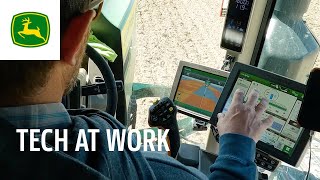
Brandon and Randy prepare John Deere equipment for spring planting season. They discuss data mapping, troubleshooting, and the teamwork needed to run efficient harvesting and planting operations.
Every spring, everybody's really antsy and wants to get back into the field. And that's always the way it is for springtime.
Our precision guys are very, very busy. I mean, 15, 18 hour days are very common.
When I first got together with my wife, I told her from spring to May, you won't see me.
It's a lot to handle, especially harder when the winter seems longer and we keep getting snow.
Being up in Idaho, planting, it's not a year round deal. We got to do it right when it's time. And when that window opens up, this year in particular, it just kind of pushed farmers back a bit.
Our winter's been very long, very wet.
It adds an element of stress, but it's something that we're prepared for.
Let's roll. Here we go.
Right now, it's crucial to have every piece of equipment up and running. If that's not running, it's just another day they get behind.
If they can have their farm set up on operations center instead of that operator taking time in the field, selecting the right client farm, field product implement guidance line, that stuff can be waiting in the display ready for them to go.
When we work with those customers to do that pre planned meetings and have all that stuff ready to go, once the snow's gone, they're off and running. They're off the races.
At the meeting at Hegler, he's really wanting to know that starch, how that starch performs. So if we can throw in some test blocks and see if that affects our starch, if that population increases our starch or decreases our starch but maintains yield, then we'll see how that affects can perform.
Welcome to Hagler Creek.
Kurt.
The thing that stuck out to me was when he was mentioning I'm more interested in quality over quantity when it comes to my corn silage. And if that means I have to lose some yield to get better quality, then that's I'm in.
I want a feed that can be consistent and have a good quality at the same rate, profitable by yield, because.
It'S going directly from their farm to their cattle. Of course they want the highest quality of feed for their cows. And one of the great things about John Deere's harvest lab is that it does possess the ability to tell you how the starch, the proteins are actually doing in field as you're harvesting.
I knew it could log starch and protein, but I never thought you could actually map that on our map. In theory, you put less plants, you should have a bigger ear because it's got a little more space to flex. I want to see if the yields drop significantly if we do get more starch. How much starch. That chopper can sit there and literally map it and actually get data that's that accurate. That'd be sweet.
I'll finish these up and we'll get some test blocks in there.
This upcoming season, we're going to be trying to map that protein, sugars and starches and overlaying those on our yield maps.
We're in the springtime planting spraying season, and we're trying to knock out some acres and we're having fun. The biggest thing for us at agros is efficiency. With this data, the more, you know, the better efficient we can be.
Having him in that sprayer and we're working on the back end, trying to make sure data is coming in clean. So everything's looking good.
Good dad in, Good dad out.
Moss farms is a big operation. We've been working with moss on their potato operations for several years. Just adding more technology to the operation.
It's getting executed. It's in the field running. We're not having any issues. That's the best feeling in the world.
It was awesome to see all five of those machines running out in the field. I mean, we're steering the planter, we're applying two different kinds of liquid. We're guiding the tractor. I mean, there's so much going on with each one of those potato planters. All of them were connected. They're all linked. They're all showing on the display. There's a lot of technology going right there.
So today we're in American falls and our precision ag tech, Brandon, got a call from Pilatus farms. They had a planter that the implement receiver was losing. Gps.
The potato planter had kind of making the rows really crooked.
That implement has an older Starfire 3000 receiver on it. The tractor has the newer Starfire 6000. So we think it's an issue with that older receiver.
Hey, Randy.
The role of a precision specialist within our organization, I mean, it's definitely a unicorn. I mean, you've got to be able to sit down and talk to a customer about their business. But also you've got to be able to go out there and do an install and help troubleshoot an electrical issue. There's many times where they're off the side of the road somewhere trying to remote diagnose. Utilizing the technology really helps the team get the job done.
Changing the receiver. We got that changed this morning and haven't heard of any issues or had any problems today yet.
So.
No. Dumb and dumber it.
Our game plan this season is to be as efficient as we can and move into harvest.
Now we got to get back down to Arizona so that we can start planting cotton. And at the same time that we're planting, we're actually harvesting some other crops. So it really pushes these guys to keep up with we're planting and we're harvesting all in one day. It just kind of whatever comes, we just. We attack it and we conquer it, so.