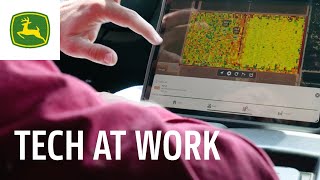
This is a YouTube video titled "Stotz Equipment Ep 4 – From planting to harvest and back again | John Deere Tech at Work" created on December 12, 2023. The content features multiple speakers including John Deere representatives, Bill Perry, Curtis, Blake, Cassie, Jerry from England Farms, and others discussing agricultural operations in Arizona. The discussion covers topics such as planting and harvesting cycles, use of precision agriculture technology, data management, and operational efficiencies on farms. It is an informative presentation-style content focused on modern farming practices and technology integration.
I really enjoy working with customers that try to think of something new or that hasn't necessarily been done before because I like to try to think outside the box. The best thing that somebody could tell me is, you can't do that. Hold my beer. Watch this.
Planting time is the most stressful time, but it's also the most exciting time.
There's just something in the air, the energy. It's just, it's an exciting time of the year. I think it's the most crucial part in our season. If we're not getting our right population, our right spacing, that dictates how the rest of the year is going to go.
You do that wrong, you're not going.
To catch up all of the nutritional values. It can get kind of hectic and kind of get kind of like, oh man, am I ever going to get a break. But you kind of just take it in strides.
Farming in Arizona is a little bit different than most other places in the country. Out here we're kind of 365.
There's almost always a harvest going on. There's almost always a planting operation going on.
That's a unique situation that we have here down south that they don't have up north.
In the spring, it grows much slower. We're trying to plant, we're trying to start our season, but we're also starting to harvest our alfalfa. And so we have both operations going on at the same time.
It's just a never ending cycle. It's not. There's never really downtime here.
But with that, it's one of the most productive ag systems in the US of the desert Southwest produces the most crops and kind of tonnage over the year. Just because the sun shines 300 days a year, might as well make the most out of that.
Is he planting that one with the job though?
The use of op center and other tools that Precision Ag has given us has really made it much more of a manageable situation. What's up, Bill? What's up, Blake?
What do you know?
Not too much one I knew yesterday.
That's a win.
Bill Perry. William K. Perry farms. He farms west of Buckeye and his main operation is production hay.
We farm about 4,500 acres of alfalfa. We've been Arizona farmers my whole life. I'm a fourth generation.
Bill has been a great customer to work with when we were starting to do anything new. I really like to find customers that really want to try to learn something. And Bill's always been that guy.
Oh, there we go, there's some of the yield data. With our cotton crops, we've always had yield data. And so you can go back and you can analyze and you can look at the soil type, and you can see, okay, this required more water or more fertility with the alfalfa because of the way it's harvested. We've never really had that data. Stoats has given us a new tool, our alfalfa yield monitor, which in the past we've never had. And so now that we have it, we can use that as a tool to really hone in exactly how much water we need, at what point it becomes excessive, and at one point, it's a deficit. Using the yield data that we're getting off of our balers, make sure that the moisture's in the right range. You want to be in the sweet spot of like, 13 to 15% is ideal. Deal. You start getting below 10, you start losing leaf content. You start getting over 15, you start to worry about the possibility of a fire. I mean, this is so it's running 13.6 right now. That's about as perfect as you get. We have all this data, and that's fantastic. But until you analyze it, you don't really know. You can't. You put it to use.
And the data belongs to them. That's something that Deere's made very clear. This data is yours. Now. Deere doesn't also say, now figure out how to use it here to help them know how to use it.
I can check this field a little bit harder. The biggest decision that I've been able to make from the data that we've analyzed is the way that we swath our farms. What we used to do was we would send both swathers out, go around, and they would all go to the same field. Cut over there, drive over here, cut over there, drive over here, cut over there. Well, Curtis showed me that our transport time on the swather was costing me about $40,000 a year. And so rather than putting them together, sending them all the way across the farm, we decided to split them up, send one to each location, and we cut our transport time almost in half.
We have a little meeting set up with Cassie and Jerry from England Farms. So we're going to go out and visit with them, see how things are going. Once we got out there, we did realize there is some varieties that aren't where they need to be.
We're having some trouble with the planting showing up properly in that system so that I'm able to document it.
Part of that was that one machine wasn't calling in.
Once we looked at the phone, it did seem like those jobs weren't sent to the machine correctly. So we set up a little game plan to go out to the field and address those problems while we were there.
Every year you have to report to the FSA for USDA purposes. And so the data from Deere gives me the exact plant date or calculating acreage of each crop. And that's stuff you have to have for every field. And when you have 150 something fields, like that's not an easy task if you didn't have that system in play.
We got the file sent over, imported to the machine, followed him to the field, watched him make his ab pass. There we go. We have a coverage map so we know it's documenting so we should be good.
And so the data from Deere, we have to be very precise. They were able to resolve that. So that worked out.
We're trying to help make sure that our customers here in Arizona that are dealing with all different aspects of the farm at the same time. If you can monitor and make sure that the job is getting done remotely, you know, we're over here planting, I can check on harvest. If I'm over here harvesting, I can check on planting. I don't think there's any other way to do it other than using technology.
We have fields that are 70 miles away from here, but I can get on OP center while I'm sitting in my pickup here and monitor what's going on there, you know, from here. So it makes a tremendous difference.
I know just by looking at the acreage that's been done that there is enough hay for us to load that one semi load. So right there I just saved myself about 45 minutes. It's nice to be able to see. Okay, well the baler is moving. Okay, well the planter is going and it's applying the right amount of seed and know for a fact things are okay.
It makes farming easier for you. It gives you more tools to make management decisions. It gives you more tools to make equipment decisions. And I think at the end of the day, that's ultimate goal is to be partnered with these growers, with these farmers, and to help them make the most out of their equipment, their farm, what they're growing and what they're doing.