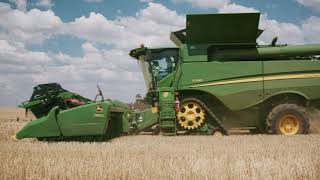
John Deere specialists and operators discuss the S700 combine harvester, covering weather challenges, operator fatigue, machinery capacity, and new remote optimization technology that helps manage harvest pressures and machine performance.
Foreign.
Boys.
Thanks for coming in guys. Appreciate you guys traveling far and wide. We're here to talk about headers and harvest and the new technology we've got out today and the pressures you guys are facing. So probably launching with a pretty straightforward, simple question. What's some of the biggest pressures you guys face at harvest time? Weather.
At the moment we seem to be finding that we're getting a lot more summer rain during harvest. The quicker we can get it off in the silo, the better.
Fatigue management, managing those people at that peak time and making sure everyone's kept fresh and they're working their proper hours and things like that. So it's hard to get good people to do every hour of the day. So how we manage that moving forward?
So how do you go about making sure those operators, those unskilled guys are doing a good job? Training? Yeah, big thing training. And that's time too. Like at the start, you know, you've got to sit down and make sure they know what they're doing. And whatever all these expensive machines are worth, you need someone on there that knows what they're doing and can be able to drive it properly.
So getting it off in a, in a timely manner. With shortening windows, how have you guys changed your operations to increase productivity? When you can go bigger machinery there.
More capacity, you can only get so much as you can out of each machine. I've actually got two older machines and we get pretty good capacity out of.
That because it's such a short window, everything's got to be right. So your header chase on the maintenance has got to be smick because if you're going to invest that capital it's got to be really efficient and we've got to try and get as many hours or as many acres done in that period of time. It's all capital management really at the end of the day.
Alright, well let's go and drive one then.
The concern is it's just going to be another header for me to buy a new harvester. Well, I'd go a second hand one.
The way to think of this display is that's your setup and then you can optimise it through ica. Yep. And then you can automate the operation. And that's the beauty of this technology is when you've got someone who's not as skilled, you can get them in there and get them either up to speed quicker. We can now optimise the machine remotely. So say for example, you've got an inexperienced operator on multiple machines across the Paddock. You can remotely view their settings from your phone from the My Operations app, send through an adjustment to the machine. Oh, here we go, Rick.
Yeah, so one of the boys is going to change something.
Remote View Manager would like to make the following setting changes so I can accept what a client I hit accept. In addition, that app provides a snapshot of what's happening across your paddock. So you can see yield logistics, handling. You can see where you upturn the paddock and you can start optimising where you're going to be moving to, how much fuel is in the machine. You've got the machine now connected to the cloud every 30 seconds.
Stream display the combine Advisor automatically adjusting the settings on the run is very impressive. The intelligence of that and the technology that takes to think like a trained, experienced harvester driver and adjust all them different things on the go. It's very impressive. Yeah, light camera.
That's my clean grain and see how it's highlighting. Oh, wow. From a sample perspective, that's quite good there.
It's quite good there.
Up here in the grain tank. That's active yield. So this system provides automatic calibration to ensure you've got an accurate mass flow centre, accurate yield map for consistent variability across the paddock and tonnage off it. These tracks are a great improvement in ground following and ground contact.
It turns quite well, doesn't it?
Through machine on tracks. Yeah. Doesn't pull the back end around at all.
Yeah.
You can see, see the blue wheel spinning there. That's active terrain. So that's adjusting fan going up.
It did everything I thought it would do and Bedax and it's very user friendly and it's just so much more than just a harvester. It's about the management of that harvester and it's about labour utilisation and it's a really compelling case to justify spending money on it. On a seven series. Really impressed.
What have you thought of today? What do you think of the machinery and the walk arounds and very informative as always. It's good to hear other people's views about what they're having issues with and it's always good to actually go somewhere and people know what they're talking about, like ubikes. Obviously your head of specialists. Where do you think you can improve at home now after spending your day.
With us and, you know, making sure we're getting these yield maps and using them collected so much data for the last eight, 10 years. It's just sort of putting it into practice now, I suppose.
And one key takeaway. What was something that sort of has burned a hole in your mind?
My operation has probably thought more about replacing two harvesters for one. That's what I've thought about a bit more.
It's not just the harvester, it's the whole package. It's getting that next 5 or 10% capacity out of the machine and refining it. And that all comes down to operators. And if I can't surround myself with key operators, that machine will cover me. That was really important for us.