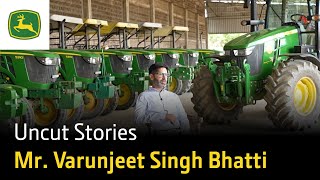
In this interview, Varunjeet Singh Bhatti, the second‑generation leader of Bhatti Farms, outlines the evolution of the family’s seed potato business over roughly five decades. The farm operates on about 5,000 acres in the Jalandhar‑Kapurthala belt, producing seed potatoes through both on‑farm multiplication and a dedicated tissue‑culture laboratory established in 2010, which also houses a diagnostics facility (including PCR) to guarantee disease‑free seed. He describes the progressive mechanization of the operation: from hand grading to imported graders, pneumatic planters, and a fleet that now includes 123 John Deere tractors, the latest being a 5130M delivered in June 2025. Bhatti details the family’s educational background—studies in Canada, a brother trained in plant pathology at Wageningen University—and how that expertise underpins the lab’s advanced virus detection capabilities. The business employs roughly 300 permanent staff and seasonal labor, supporting over 1,000 families. He emphasizes a culture of continuous technology adoption, participation in global forums such as the Potato World Congress, and a long‑standing partnership with John Deere, which he calls his "best savior".
Chapters
I am Varunjeet Singh Bhatti. I am a part of the family business and Bhatti Farms has been into seed potato production for the last approximate 50 years. We are located in the Jalandhar and Kapurthala belt, specializes in seed potato production over an area currently of about 5,000 acres. We are doing multiplying seed in about 5,000 acres and we also have our own tissue culture tissue culture laboratory which we set up in 2010, and we are multiplying seed. There's also a diagnostics facility in our tissue culture laboratory to maintain the purity of the seed, to ensure that we can supply, you know, disease-free seed to our customers. And I'm happy to be a part of this, the family business, and it's It's been— I'm pleased to be a customer with John Deere. We've had an association, companies had an association for a long time. It's been over 20 years. I think our first tractor we bought in 2003, and today we have around 123 John Deere tractors, out of which the latest one, we— the first delivery, we got the first delivery of the 5130M. Which was in June this year, and I'm a proud owner of the 5130M series. It's part of a family business which started in the 1960s by my grandfather. I'm the second generation. My father joined the business in 1979, and I took over the business in 2009. Sadaa kam seed production, large-scale seed production. Sadi production chari hai done from our own farming. Contract farming ho extra hai. And sadi ko apne stores ne satisfaya hai, tan de stores ne. Sadi ko apni tissue culture laboratory hai, jaydevi chhazee ensure karna hai, ke jeda seeds sadi customers no clever ho bhai, ho pura disease free ho bhai. Pure seed hobe and ude karki sada ek naa ban gaya business de vich, alu maal business de vich, alu bees de business de vich. Jede karki sada product demand de vich hai ka and asi indi growth ede vich kaar paya. Ya, jadatar ma'am in Nainital reha hai ka class 4 de vich ek boarding school hain Nainital hai ka Shewood College. Undergraduation was Canada. Graduation, BCom honors. And after that, I came back to India, family business joined. Post time, they started called Panchet Tractor. Cooker bits, and sunflower, 8 crops. And over time, for 1990s, which, uh, area, tractor fleet, see, around 50, 55 tractors. Around 70 tractors. Conditions favorable, growth was there, demand. You know, my father, he saw the opportunity activity in this seed potato business and the challenges that we were facing at that point of time. And he wanted that one of the family members should pursue, should actually specialize in this field. So my brother, he went and studied at the Wageningen University in Netherlands, and he specialized in plant pathology, and he came back We had a tissue culture laboratory. He set up a diagnostics facility there. We have the latest, you know, the technology for detecting viruses. We have a PCR machine. So right from the mother plant till the end, jatak multiplication include karda, mother plant to cuttings, lab de bhech, and ek plant jo over doote mein ya de bhech, azar plants ban jaande ne. So o step, ella step, oye, otho baad ono fir net house de bhech, like protected cultivation bhech, 100% protected cultivation bhech on the pellansal. Over time, since I've joined from 2009 to 2025, so I've been a part of this, this, the family business, and I've noticed that Change is ingrained in our system. It's an integral part of our business strategy. So maybe, you know, when we initially started with mechanized grading— earlier the grading was done by hand, by labor. We imported graders, and today it's a requirement of all the customers to have uniformity, to have that size that they actually want the grading. So it's become a necessity. Be it farm machinery, when I joined business, we were planting maize, planting corn by hand. Then there was a pneumatic planter that was introduced. So we adopted that and we got good results. That has increased the production, the yield. So, it's a very decent set of machinery. He got me my exact requirements. Over time, I'm seeing that he's getting more and more updated with the technologies. Then I thought, you know, over time, coffee is better. We have around 123 John Deere tractors. And over time, you know, there's been this pull from John Deere and You know, I noticed this even lately when I happened to visit the John Deere factory. Today we have around approximately 300 employees that are on our permanent roles, and there is seasonal labor that comes during our planting time and then during our harvesting time, and also for irrigation. So they, they are over 1,000 employees, and I think I'm proud that, you know, our organization is supporting in over 1,000 families. We at Bhakti Agri-Tech, we are always looking out for new technologies that are coming into the agriculture sector. My father, he visits the Potato World Confederation, the Potato World Congress, or, you know, it's held at various places around the world where they are talking about the latest research and the latest the technologies that have been introduced from the agriculture sector. With John Deere, I think I could say that John Deere is truly my zindagi ka best savior.