EP100. Celebrating 100 episodes
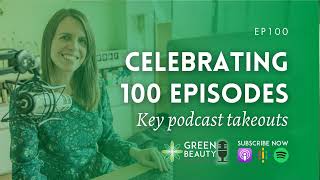
Lorraine Dallnayer marks 100 episodes of Green Beauty Conversations and shares three lessons: lesser-known guests spark the best conversations, sustainable beauty means making less and ensuring responsibility, and the show takes a team of 10 per episode. The podcast has over 500,000 listens across 90 countries.
Questions this video answers
Over half a million
At least 90 countries
50 countries
Thousands of students in over 180 countries
Chapters
Welcome to episode 100 of Green Beauty Conversations. What a milestone. The podcast has been running for four years now and it's safe to say that it's been a huge hit since we launched back in 2018. For that reason, I wanted to record this episode today to look back at the three main things that I've learned in managing and hosting the Green Beauty Conversations podcast. But before I do that, let me share some stats with you. In the four years that we've been running, the podcast has been listened to get this over half a million times and has had downloads in at least 90 countries around the world. We've hit the number one spot in the beauty podcast charts in 50 of those countries, so I want to give a huge shout out to our awesome listeners in Egypt and India and Ghana and Nigeria and Saudi Arabia and Indonesia, just a few of the countries where we regularly top the beauty charts. It's so humbling to know that this podcast reaches every corner of the globe and thank you for tuning in every week. So, having been involved with this podcast since its very inception and having hosted the majority of its episodes, I want to use episode 100 to share three things with you that I've learned in the last four years. So settle in to listen to my main podcast takeaways. Welcome to Green Beauty Conversations, the podcast that challenges you to think about how you buy, use, make and sell your natural beauty formulations. We tackle topics that will make you think and encourage debate about green beauty with your friends, followers or customers. I'm your host, Lorraine Dallnayer. I'm a chartered environmentalist, biologist and the CEO of award winning online organic cosmetic formulation school Formula Botanica. We have thousands and thousands of students in over 180 countries around the world who study with us to become organic beauty formulators and entrepreneurs. Visit our website@formulabotanica.com to try our free online formulation course. So I've interviewed about 50 people on this podcast since it started and all of these conversations are special to me and are very inspirational to listen to. And I've learned that everyone has an interesting story to tell. So I'm really grateful to everyone who shared that story with us. And when I sit back and think through all of these interviews and chats that I've hosted, I think my first observation that I want to share with you today is that the guests you've most likely not heard of before are often the ones who changed my views the most. Now, I've welcomed quite a few big names on this podcast and they've blown me away with their experience and their stories. I do not for one second want to diminish anything we've heard here, because all of my guests are incredible. But I have to say that some of the most thought provoking episodes I've recorded have been with people who haven't yet got a huge global following. They're quietly making change in their corner of the world and having been able to interview them has been a real privilege. So I want to challenge you to go and seek out some of those episodes and inspire yourself with them. Like episode 51 when Emily and Trishna and Victoria took part in a panel I hosted about disability friendly beauty. Or episode 65 when Nancy and Valerie shared what Africa can teach the world about green beauty. Or episode 57 when ADA of Naalakher took us on a journey through sweat and shame and deodorants. These interviews are incredible. You must listen to them, and they challenged me in how I think about the topics we discussed. They will challenge you too, which is why I thoroughly recommend you check those episodes out the second observation I've made in my time running this podcast is that sustainable beauty is not open to interpretation. Now, I know this is a controversial statement, but I'm going to make it anyway. I often hear people say this in the beauty industry, and I've even heard it here on the podcast when people have said, oh, but sustainability can mean so many things, which makes it confusing. And to that statement I say absolute nonsense. Sustainable beauty could not be more clear. We need to make less, use less, and encourage less consumption. And then we need to make the beauty industry as circular as possible, keeping resources in use as much as possible and regenerating them. And then we finally need to make sure that all operations are undertaken in an environmentally and socially responsible manner. We also need to encourage people to look more local and start to formulate for themselves. Now, I'm sure you realize as I'm saying these words that we are a million miles away from this at the moment. Which is why I'm not saying that any of this is simple and I fully expect sustainable development to eventually break the mainstream beauty industry. But we know what sustainable beauty means, and is, and it really isn't open to interpretation. Because we need to start making sustainable cosmetics that meet sustainable consumer demands without compromising the ability of future generations to meet their own needs. And that requires working on everything, every little part of this industry. It doesn't, however, require working on the definition of what sustainable beauty actually is, because that is clear as day. The Problem is that the beauty industry knows this too, and they keep burying their head in the sand over it because they know that it means they can't continue with their business model of aiming for infinite economic growth with finite resources. So they trivialize the conversation and they dumb it down. Even last week I saw a major beauty certification scheme post on social media about the fact that the future of sustainable beauty lies with waterless formulations. What total rubbish. We even debunked this in episode 83 on waterless beauty. So to that I say we have a few podcast episodes that the beauty industry needs to revisit and I challenge you to share them with people when you see the industry dumb down the conversation. I recommend starting with episode 61 in which Anna Green and I heralded the start of the age of skinimalism. Or episode 66 in which Anna and I picked apart what circularity means for beauty. Or episode 75 in which Dr. Sally Goldstone challenged all of us on whether we should even be using essential oils at all. I like to think that we've been leading the sustainable beauty conversation by actually talking about what it means, rather than focusing on tiny issues that won't have a long term impact. The final observation I want to share with you, which is something you're probably not aware of, is that it takes a village to run this podcast. Which is why I need to give a huge shout out to my incredible team for making this all happen. Now I also want to give you a sneak behind the scenes peek so you get a feel for how much work is involved in running the Green Beauty Conversations podcast. Firstly, what you might not know is that a large number of podcasts out there rely on people pitching to them to find their guests. Now, we don't work that way. All of my episodes are carefully curated and we reach out to people who I want to interview. We do have a pitch form on our contact page on the Formula Botanica website, so if you have a fantastic idea and you want to come on, please do head over there right now. But I will say that 99% of the pitches we receive there don't get taken further because they tend to be quite bland and boring and they're crafted by PR agents who don't read any of the instructions. So it all starts with a team wide meeting at Formula Botanica where everyone brainstorms ideas together and then I curate a list of what I want to bring to the podcast based on those ideas. We then have to come up with suggestions for guests and it takes several of Us combing through social media and our LinkedIn contact lists to find people with the right knowledge and background for some of these really niche topics. We also want to lift up as many diverse voices as possible. So it's not generally a case of just choosing the first person you find either. It then takes at least two people chasing prospective guests for weeks or months or sometimes even years before we can lock them down. Sometimes I have to get involved to ask for introductions through contacts of contacts. It's a Herculean effort, and that's before we've even recorded anything. So next up, I research my guests and the topics that we'll be discussing in detail and I ask my team for input. I've been interviewed on so many other podcasts where the host did no prep work at all, and it then really showed in the quality of their interview. Now, I don't work that way, so I do my homework and that takes time because I believe in a job well done. So once we're ready to record, there are a couple of people in the team who do tech checks with our guests to make sure that they're ready to go before I then jump into our recording software and then we finally sit down to record the interview. Now, once we have the recording in place, our editor goes to work and turns it around in a matter of days, which isn't always easy because what you don't hear is all the tech hiccups we still experience during recording. Even the other day, I lost my guests four times during the interview. But you will thankfully never know when you listen to the finished episode, and that's thanks to our editor. And then finally, the finished recording is picked up by our content, social media and community teams who write up show notes, design social media assets that they send to the guests a week before the episode goes live. They create posts that go out across our social media channels, and then they share, share and reshare the episodes within our communities to get people to listen. So that's at least 10 people involved with every single episode I record. And it's logical to see my name on the door as podcast host and think that it's as simple as me jumping on a call with a guest and then sticking some music at the beginning and the end of the recording. But as you can hear, it's a sizable undertaking and I want to give huge thanks to my team for making this happen every, every single week and helping us get to 100 episodes and over half a million downloads. Thank you also to you, our amazing listener. The fact that you continue to show up every week to listen to me, my team, and my guests is humbling and I do not take this for granted. I appreciate that you've helped us get to 100 episodes, and I sincerely hope that you'll be here for the next 100 too. Thank you for listening to the Green Beauty Conversations podcast this week. Remember to visit the Formula Botanica website at Formula Botanica to try our free online formulation course, and if you haven't subscribed yet to the podcast, please make sure you do so in your favorite podcast app. Leave me a five star review if you enjoy the conversations I host and I'll be back soon with my next episode. Sam.
More from AI








EP249. Why retailers are asking for proof—and what it means for your beauty products


EP247. How to build a heritage beauty brand - Evelyn Akande from Kanda Natural
