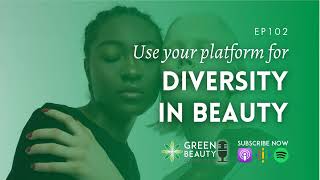
Lorraine Dallmeyer, CEO of Formula Botanica, argues the beauty industry excludes people of color in product design, clinical testing, and marketing. She cites underrepresentation in stock photography, myths about hair health, and skin-lightening products as concrete problems, and challenges listeners to use their platforms to demand change.
Chapters
I've just finished recording an episode with DJ Ayodeli, skincare expert, esthetician all round superstar and author of the excellent new book Black Skin, in which we explored many of the concepts in her new book. And by the time this recording goes live, you'll already have listened to our discussion in your favorite podcast app because it was released last week. Now, as you probably gathered from my interview with Deja, I think she's written a great book that the whole beauty industry needs to read. Deeja says that Black Skin is the guide that every black woman has been waiting for. But I think it's more than that. I think it's a guide for everyone who works in the skincare industry. And not only that, I think it again, reinforces the need for us to continue discussing the ways that the beauty industry needs to do better in terms of diversity and inclusivity. So for that reason, I wanted to jump on quickly record this super short opinion piece and and challenge you to join me in encouraging the beauty industry to change. Hi, it's Lorraine Dallmeyer, chartered environmentalist, biologist and CEO of award winning online organic cosmetic formulation school Formula Botanica. I host the Green Beauty Conversations podcast and these are my green beauty opinions in which I share my takeaways from the podcast interview we released last week. In this short episode, I put forward my main thoughts on the topic we last discussed, as well as setting you a challenge to make the beauty sector a better place. Inclusivity is a topic that is on everyone's lips. And as Deeja and I discussed, we are seeing improvement in the beauty industry, but we still have a long way to go. We have to erase hundreds of years of conditioning around the way we view black skin, brown skin, or any of the huge variety of skin tones that aren't white, European. And the same absolutely goes for hair. Now, to be honest with you, I initially sat here and thought, who am I to talk about the struggles faced by women of color when I have grown up in a world that favors my skin tone, my hair type, my culture? Surely I'm entirely the wrong person to record this podcast. After all, I could not be more privileged, thanks to my background, my upbringing and my platform, and the fact that the beauty industry's ideal images has been set exactly for me and my needs. But then I realized that it is precisely people like me who should be making noise and jumping up and down and waving their arms in the air to draw attention to the fact that the beauty industry perpetuates such an unfair bias to one particular body, skin and hair type. It can't possibly be down to people of color to change an entire global industry and everyone's mindset by themselves. That would be ridiculous. It's something we must all work on together. Not using my platform to speak up would actually be doing everyone a disservice. Now, the beauty industry has very successfully set the Eurocentric beauty standards that all of us have internalized and which we use every day to police our own bodies. And if you're not yet sure what I'm talking about, let me talk to you about just a few of the ways that the beauty industry continues to to shape the narrative around white skin and straight hair. Firstly, and we touched on this in last week's podcast, product design doesn't consistently take the needs of darker skin tones into account, and this filters through into clinical trials. Once you start to delve into the testing done for cosmetics, you realize that people of color are consistently underrepresented. There's a whole variety of reasons for this, but it's important that this is changed. We know many of the big players in the cosmetics industry are now starting to embed diversity and inclusivity into their business models, but we have a lot catching up to do in terms of cosmetics, which lies at the heart of the matter. Now. Secondly, and I won't be telling you anything that you don't know already here, but language matters. The way we talk about skin and hair needs to be more inclusive, and we highlight this in our hair care diploma too. Did you know that the shine of your hair has precisely nothing to do with its health? Now, shine is a measure of the amount of light that reflects off your hair. So the straighter your hair is, the more light it reflects and the shinier it looks. The coilier or curlier your hair is, the less light it reflects. And yet the narrative has always been that you must have shiny curtains in order to have healthy hair. This is a load of nonsense and it perpetuates the myth that one hair type is better than others. Finally, have you ever looked at stock photos? I have. In my 10 year career in formulation education, I have spent hours and hours and hours trawling through stock photo libraries for our course materials and social media platforms. When we were designing and writing our organic Hair care diploma in 2017, I spent hours ranting at literally anyone who would listen that there were hardly any photos of women with afro or coily hair in stock photo libraries. Things have improved in the last five years, but you'll still see many more photos of the white aesthetic. That means that the way we view beauty is often portrayed by white women and we can all get better at this. And indeed, here at Formula Botanica, we're going through an enormous project at the moment to redesign a all of our downloadable course materials to be more inclusive. It will take a lot of time, but we're determined to do better too. All consumers should see themselves represented and valued equally. Now that's just three ways that we all need to improve the beauty industry. I'm sure you can think of other areas for change too, such as the issues surrounding skin lightening products or the SPF advice given to people of color or better and more inclusive hiring policies. So that's my challenge to you for this week. Use your platform and speak up to make change. We all have a platform, no matter how small. The Black Lives Matter movement highlighted it for us loud and clear. We must speak up and call out the inequality and inherent racism that is still around us in the beauty industry. And it has to be an ongoing conversation. It can never be a one off campaign. We must all use our privilege to help people understand that black and brown skin is beautiful or in fact, that any skin tone that doesn't fit the Eurocentric model is beautiful. While the beauty industry has built stereotypes that span many generations, we have the ability to dissolve those stereotypes. So how will you be using your platform moving forward? Thank you for listening to my green beauty opinions. Remember to visit the Formula botanica website@formulabotanica.com to try our free online formulation course. And if you haven't subscribed yet to the Green Beauty Conversations podcast, please make sure you do so now in your favorite podcast app. Leave me a five star review if you enjoy the conversations. I host and I'll be back soon with my next episode. RA.