EP93. Innovation in beauty packaging is literally growing
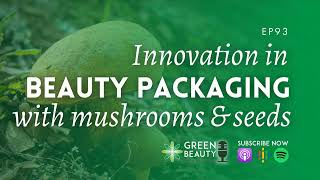
A Formula Botanica YouTube podcast (recorded Jan 27, 2022) about innovative sustainable beauty packaging. Host Lorraine Dallmeyer interviews Michael Stausholm (Sprout World) about plantable eyeliners/pencils that contain a cellulose seed capsule (non‑GMO, regionally sourced seeds) and are allergy‑certified, vegan, and made from FSC wood; Sprout holds a patent for plantable writing instruments and has sold over 40 million plantable pencils in 80 countries. Lorraine then speaks with Natasha Walker (Magical Mushroom) about mycelium‑based packaging grown in molds from a substrate (they prefer hemp), using mycelium/chitin, grown ~4 days in molds, 2 days overgrow, then kiln‑stabilized to make inert parts; Magical Mushroom is the UK/EU licensee of Ecovative technology, operates multiple factories (Essex, Nottingham, Bulgaria) and reports capacity ~4 million parts/year. The episode frames these innovations against industry-scale plastic waste (host cites ~75 billion units of plastic packaging/year and >400 years for a shampoo bottle to break down) and discusses materials sourcing, regional seed regulations, production scale, limitations (e.g., 10 mm minimum wall thickness, draft angles) and market uptake.
Questions this video answers
January 27, 2022
Over 40 million plantable pencils
In 80 countries
Cellulose (plant‑based) seed capsule
Wildflower mixes in eyeliners; other pencils use basil, thyme, cherry tomato, forget‑me‑not
Chapters
The beauty industry produces over 75 billion units of plastic packaging each year, and the vast majority of that ends up in our landfills or in our oceans. Every time I say that sentence, I still can't quite believe the words that are coming out of my mouth. This industry I work in is literally drowning our planet in plastic packaging. And when you consider that it takes the average shampoo bottle over 400 years to break down, you can see that something urgently needs to change. Luckily, the beauty industry is also full of innovators, people who have come up with fascinating solutions to our insatiable desire for endless consumption of personal care products. And if we can start to shift our beauty business as usual mantra and pair it with some of these packaging innovations, then we stand a chance of even vaguely pushing the beauty industry in the right direction towards sustainability. And I'm not just talking about recycled materials either. I am talking about using innovative, sustainable sources such as mushrooms or seaweed to form the basis of our jars and capsules or packaging that has a new function once you're finished with its use. I'm joined today by two different innovators who are going to show you exactly what's possible in sustainable beauty packaging. Make sure you listen to this whole episode so you see what the future holds for our cosmetics, jars, bottles and pencils.
Foreign.
Beauty Conversations the podcast that challenges you to think about how you buy, use, make and sell your natural beauty formulations. We tackle topics that will make you think and encourage debate about green beauty with your friends, followers or customers. I'm your host, Lorraine Dallmeyer. I'm a chartered environmentalist, biologist and the CEO of award winning online organic cosmetics formulation school Formula Botanica. We have thousands and thousands of students in over 175 countries around the world who study with us to become organic beauty formulators and entrepreneurs. Visit our website@formulabotanica.com to try our free online formulation course. I want you to firstly think about the way that packaging is disposed of. We talk a lot about recycled or recyclable materials, which in the case of plastics, I think most people now know are generally not recycled again. But what about giving your packaging new life after you're done with it? Well, my first guest on today's episode is Michael Staushholm, founder of Sprout World, the company behind the first makeup pencil in the world that can be planted and grown into wildflowers. Yes, you heard that right. Instead of throwing your eyeliner into the trash when you're finished, Michael and his team have developed an eyeliner that can be planted after use to grow into beautiful bee friendly wildflowers. Welcome to the podcast, Michael. It's great to have you here.
Thank you for having me. Looking forward.
So let's start at the beginning. How did you come up with the idea for turning an eyeliner into a wildflower sprout?
My company has the patent for writing instruments you can plant. We are mostly known for our graphite colored pencils that we sell to companies and private persons all over the world. And some years ago we were sitting down doing a brainstorm, how can we further develop on the patent four writing instruments you can plant? And someone in the company came up with the idea of why can't we make an eyeliner you can plant or a brow liner or a lip liner you can plant? I thought it was a terrible idea because how big is that market really and how many are used? But turned out I was wrong. It's a huge market. Billions of pieces of eyeliners and brow liners are sold and produced every year. So we decided to dive right into it and that's how it all started.
So how does the Sprout World eyeliner work? Can you please walk me through how the eye pencil is constructed and what materials go into it?
We spent several years developing the actual eyeliner and brow liner because we wanted it to be 100% natural. We wanted to be a vacant formula. We wanted the materials to be from Europe. We wanted to produce as we do with our normal pencils in Europe. So it was a very long process. In the end, we have developed an all natural formula which is not only vegan and not tested on animals. Of course, you're not allowed to do that in Europe, fortunately. But it's also allergy certified, which is a long process. Amazingly, very few liners or makeup that you put in your face is allergy certified. And that to me makes no sense. It's something you put in your face. Why shouldn't you want to develop that into something that is allergic, allergy friendly? All our liners are certified as allergy friendly, which to me is very, very important. And then of course, what is special about our eyeliners beside that is the fact that once you're done using it and you have the stop lift of the eyeliner, you normally throw it out. With a sprout eyeliner, you can simply plant the stop and you can grow beautiful wildflowers. And it works because at the end of the eyeliner is a small seed capsule which contains the seeds. The, the seed capsule is made from cellulose. It's plant based. All the seeds are of course a non GMO and they are all sourced from Europe. So once you're done with your eyeliner, you simply plant it. First time you water it, the capsule will dissolve in the pot and then you just have to take care of it like any other flower. Lots of natural, light, water and of course, love. And then in a few months you'll have beautiful wildflowers.
I love it. So what sort of seeds have you actually got in the cellulose cap at the end of the pencil?
In our liner, eyeliners, we have a mixture of wildflowers. We have decided that that makes most sense. You give back to nature by growing wildflowers. You do it in a pot first and then you put it out in your garden or wherever. But for our normal graphite and color pencils, we have have all kinds of seeds like basil, thyme, we have cherry tomatoes, we have wildflowers. And forget me not.
That's so cool. And I know that when you showed me previously, the pencil actually has the name of the plant on it as well, doesn't it? So that you can put the stick in the ground. Like the pencil is like your marker for your vegetable patch, I suppose.
Exactly. The stop next to the capsule has the name of the seat, so you use it exactly as a plant marker and you'll always know what kind of flower you are, you are growing.
And do you have the same seeds in every single territory around the world where you sell?
Some seeds are in Europe only, some seeds are in the US only. Because seed is a very stringent business. You cannot use seeds that are not native to a certain region because it will be invasive and probably do damage. So in Europe, we use only European seeds, European production and sales. And in North America we have production in Minnesota, we only use North American seeds that are non invasive to the countries.
But how is the Sprout World eyeliner then different to a mainstream beauty eyeliner?
First of all, it's funny to say, but it's all natural. And that's very important because you actually planted in the ground. So it's made from wood, FSC certified wood, the liner, of course, and that the formula is allergy friendly and natural. But most importantly, it's the seed capsule that makes it special. Because our mission is actually to inspire other people to think about how you not only use products, but also how you get rid of products after you're done with them. It's very, very important for us to make you think about how can we give products a second life? And that's what we do with our aligners. You literally give them new life by planting them.
Yes. And that is of course, what today's podcast is all about. And I absolutely love what you're doing. So what's been the uptake of your plantable eyeliner so far?
It's the reception from the consumers, from the media, everyone has been tremendous. The Times in the UK put it on the as one of the most sustainable eyeliners available. Others has called it the future of sustainable makeup because our eyeliners are of course for you as a person. You buy it for yourself to use, but it's also a gift item. And so especially during the holiday season, we have seen a lot of sales of gift boxes because it tells a lot about you as a giver, that what you give to someone is actually well thought of. It's sustainable, it's natural, it's something that should make you feel very good to give away as well, not only to use for yourself.
So I've got to ask this question then. Have you personally planted a whole garden full of pencils?
Trust me, when, when I founded Sprout eight years ago, I had no clue how to plant things. I, I had tried during my life, but I always killed the plants. So I did that in the beginning also. And then what happened was that of course, eventually I started to learn how to take care of plants and, and what happens now is that new seeds or new pencils, I'm the one who gets to test them first by planting them. And the saying by the people here is that if I can make it grow, anyone can make it grow.
I love it. So what in your opinion then is the future for sustainable beauty packaging? Do you think the future holds a lot of plantable eyeliners or makeup pencils for the beauty industry?
I think so. I definitely think that. And of course we have cornered the market because we have a patent for this. So I definitely think there's a big market for the eco conscious consumer to use sprout liners that you can plant after use instead of just using metallic eyeliners or eyeliners with not so natural formula. I think focus on that is only going to increase in the years to, to come.
Do you plan to have more conversations with some of the big players as well around this? Perhaps.
We are already in dialogue with basically all the big players, both retailers and brands. It's very important for us that this is a Sprout brand. We are never going to do this on a private label basis, anything. But of course, we are very open to collaborations with other beauty brands or with beauty retailers.
Well, I can't wait to see what you do with it, Michael. It is an incredibly exciting invention and I know it will go very far and I wish you all the very best. So thank you for joining me today. What's the best place for people to learn more about Sprout World and your sprout liners?
Thank you, Lorraine. The best places on our website, sproutworld.com where you can get all the information, where you can also purchase the eyeliners and brow liners.
Excellent. Well, thank you. We'll include all of the links with the show notes as well. It's been great chatting to you today. Thank you for coming on the podcast. Thanks.
You're welcome. Thank you.
So I'm sure you'll agree with me that Sprout World have come up with a highly innovative way of disposing of your packaging after you're finished with it. I should add that their product line extends beyond eyeliners too. And They've sold over 40 million plantable pencils, including writing implements, in 80 countries around the world. So, following on from plantable packaging, the next type of packaging I want us to think about is compostable packaging. After all, as we discussed a while back in our episode on Biodegradable Beauty, most packaging doesn't actually break down in the environment unless it's treated with chemicals or placed in energy intensive industrial composting facilities. One highly innovative brand called Magical Mushroom, which is even used by some Formula Botanica graduates such as Orn Ku Skincare, have created a natural alternative to fossil fuel produced polystyrene and other polymers at industrial scale in any size, shape or form. And theirs naturally breaks down in the ground. I'm joined by Natasha Walker, Business development Manager at Magical Mushroom, who's going to walk us through exactly how you turn a mushroom into a beauty container. Welcome to the podcast, Natasha. It's great to see you today. Hi.
Thank you so much. It's lovely to be here too, and I'm really excited to explain all about what we get up to.
Well, I can't wait to hear it. So let's start at the beginning. So I've obviously been reading your website and the Magical Mushroom website talks about solving our problems in the 21st century by looking to nature. In other words, by using biomimicry. So how did the company come up with this whole concept of mycelium based packaging?
Well, it all started in the US with a company called Ecobative, who are pioneers of products made from mycelium. Gavin McIntyre and Evan Baer are the co founders of this incredible technology. And as you said, it uses nature's way of recycling to produce amazing alternatives to packaging. So our CEO, Paul Gilligan basically took this idea and started the Magical Mushroom Company. He started this in Europe and the UK and now is the exclusive licensee, patent holder of this technology in this region. And it's all sort of gone from there at the Magical Mushroom Company.
Very exciting. So let's talk a bit about what the packaging actually is so that our listeners can start to visualize it a bit. How is it made and which materials form the foundation for the packaging itself and where do you source them?
Yeah. So as we said, and we've kind of gone back to nature, so we basically use mushroom, the texture technology and science of mushrooms. So we take mycelium, which is the vegetative tissue, so like the root of the mushroom, which starts to grow under the right ambient conditions and the right environment. So we kind of create a sort of cake mixture. So we use the mycelium, the chitin, which is the other magical part, part of the mushroom, which is nature's glue, which naturally is water resistant and flame resistant. And then we sort of create, as I said before, a cake mix. We use a substrate and combine it all. There are over 500 different types of substrates, but we prefer to use hemp, and we find that hemp produces the best finish. So we essentially use all those ingredients, put them together, and then under the right circumstances for growing. So, as I said, temperature and humidity, etcetera, our product is created. And I will explain that further later.
Amazing. Well, I have to say, one of our Formula Botanica graduates is actually using your packaging as well. So I have been sent some as well. And I have to say, it is incredible. Yeah, I mean, I'm always excited to see new packaging like this.
It's quite hard to describe until it's in your hand, but it's. It's amazing, really. Yeah, absolutely.
Well, building on what you were just talking about, then, this cake mix, your website says that you can grow the packaging to order in just seven days, which I have to say sounds incredibly futuristic. So can you walk us through the creation process?
Yeah, sure. So the creation process sort of starts with the product. So we basically have a design, we work with our designers to create CAD drawings for basically a mould. Imagine going back to the cake mixture analogy, we use a mold Then, according to what I just explained about all the substrate, the mycelium, the chitin, we fill the mold with that mixture. Once the tray of that mold is filled, we leave it for four days to grow in basically like an oven tray situation. We leave that mixture in the right temperatures and it starts to grow. So we then have to, after four days, it's grown and we pop them out of the tray. We literally call it popping. It's a really cool term and it's quite fun for the, for the people to do in the factory because you literally pop them out the tray. We then leave it for two days on a rack to overgrow. And that sort of is the time when we were talking about that unusual feel where basically the mushroom packaging starts to get a sort of velvety finish, which is absolutely lovely. And it kind of gives it a really soft, sort of smooth edge on it. So after that two day grow, we put it into a kiln and that kiln process basically makes it completely inert. So it's completely dead, for want of a better word. But it keeps. That means that it keeps exactly the right size and shape and it doesn't have anything living in it anymore, which is obviously essential for beauty packaging or any other fundamental packaging, because we don't want any further growth. Basically, that's the process. It's almost like an oven sort of situation.
That's absolutely amazing. So I suppose in theory you could grow absolutely any shape and size of anything, really, couldn't you?
Yeah, absolutely. So we are so lucky with this product because Almost limitless. Like there's so many amazing things in artwork and visual merchandising and packaging in clothing. It's just we're on a roll and it's really exciting.
That is very exciting. And I have to say, I mean, obviously our listeners can't see it, but the packaging that I was sent by one of our graduates on KOO in the UK has actually had their logo molded into it.
I absolutely love working on that one. That was brilliant. It's a beautiful design.
Yeah, very exciting. Well, following on from what you said, I mean, you said it's practically limitless. I was going to ask you, are there any limitations to working with mycelium based packaging?
Yeah. So I mean, as I said, that's the exciting part of it that we also don't know, like where our limits lie. It's so new. There are a few technical things to think about when you start the packaging. For example, we have a minimum wall thickness of 10 mm, and that's just simply just because of the structure. And the other thing to consider is, as I talked about that popping phase, we generally have to leave a bit of a draft angle, so the lines of the product have to have a slight draft angle so that when you actually push the product out of the tray, it falls out easily. But quite excitingly, your. Your imagination is the limit, really, and we are so open to trying different things.
That is very, very exciting to hear. And, I mean, obviously there's amazing possibilities there. What sort of uptake have you seen for this packaging in the beauty industry so far?
So that's kind of my area of business and there's just been a huge trajectory. It's so dramatic that we've opened three factories now. We've got one in Esser and Nottingham and one in Bulgaria. It's kind of. We've scaled up really quickly and people have been really excited. And I think we can produce around. We have the capac to produce around 4 million parts per year, which is. Which is super. So we are. We are dealing with the demand. Yeah.
That's incredible. And how many beauty brands have you seen actually use this type of packaging so far?
My client list is. Is really large at the moment, so let's just say that I'm struggling with it all. There's a lot of them coming in, lots of inquiries flooding in.
Oh, it's really exciting to hear what, in your opinion, is the future for sustainable beauty packaging?
Yeah, well, I think this is a really strong alternative to packaging. Fundamentally, we want to change and eradicate polystyrene. And I think government, the world, you know, just everybody that has any care of the environment wants to change, so. And we provide a real solution that works, that protects the product. A lot of people are using glass at the moment and, you know, that really works. And also it's got a really nice element to it. You know, it's. It's a beautiful product. It's. It's fun, it's interesting and the clients seem to love it. So I think. I think this is the future. Absolutely.
Well, thank you so much for joining me today. It's been really exciting learning more about what Magical Mushroom does and hearing about this incredible process that you have in terms of growing your packaging. If people listening want to learn more about Magical Mushroom, where can they find you?
We are at online on our website, which is actually being relaunched at the moment, which is exciting to show all our new case studies. And that's www.magicalmushroom.com. we also spend a lot of time on our Instagram so you can see all the upcoming projects and we do lots of case stud on that and obviously it's really good marketing for people and their products and that is you can find us at Magical Mushroom so MSH R O O M so without the U so on Instagram. So yeah, please give us a follow and see what see what we've been up to.
Will do and we will include all of those links in the show notes. Thank you so much for coming on the podcast today, Natasha. It's been really great talking to you.
Yeah, no, it's been fun. Thanks for your interest and yeah, hopefully you'll be buying more mycelium and mushroom packaging.
I hope so too. Thanks. As we've seen, there are many innovative ways that we can reuse the containers that our beauty products come in or clever materials that we can incorporate into packaging that breaks down quickly and efficiently in the environment without causing harm. It goes without saying that the whole world of beauty packaging needs to change in the coming decade as we simply cannot go on the way we currently are. I for one, feel heartened to know that there are brands such as Magical Mushroom and Sprout World who are thinking about the packaging problem and trying to come up with innovative solutions. And I can't wait to see what other packaging suppliers and beauty brands invent. I hope you enjoyed this episode and I hope it's made you look at beauty packaging in a slightly different way. I would love to hear what you think about the whole topic. Please do come and leave us a comment on our social channels as we love hearing from you and make sure you take part in the sustainable beauty polls and chats I run over on my Instagram channel. Lorraine Dharmer, thank you for joining Michael, Natasha and I for this latest episode of Green Beauty Conversations. I hope you enjoyed it. If you did, please do leave us a five star review so that other people can enjoy these conversations too. Make sure you subscribe to our podcast on itunes or Spotify or whatever your favorite podcast app is and stay tuned for the next episode. Follow Formula Botanica at Formula Botanica on Facebook, Instagram, Twitter, YouTube or LinkedIn. Visit our website at formulabotanica.com and sign up for our free online formulation course today.
More from AI








EP249. Why retailers are asking for proof—and what it means for your beauty products


EP247. How to build a heritage beauty brand - Evelyn Akande from Kanda Natural
