How to Build A Lean Competitive Intelligence Program
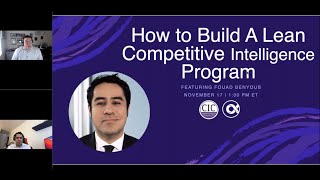
Fouad Benyoub, Director of Competitive Strategy at Everbridge, outlines a lean approach to building a CI program in 100 days using a "what / so what / now what" framework. Start by learning your business and stakeholders, then build prototypes like battle cards and competitor profiles, test them with teams, and launch with feedback loops. Use Kanban and OKRs to manage work, measure impact with NPS scores, and prove value before asking for budget.
Chapters
Hello there and welcome to the SLA Competitive Intelligence Community webinar for November. And I'm Jim Miller from Ottawa, Ontario. I'm on the Board of Directors of SLA and with Connect Public Affairs here in Ottawa. I'd also like to thank to thank Aurora WDC for sponsoring today's webinar as they have so frequently before and always a great support for the SLA/CIC community. Next slide, please. So today's webinar is How to Build a Lean Competitive Intelligence Program, and it's featuring Fouad Benyoub. Next slide. But before we begin, I want to just, uh, with Fouad, just want to remind everybody about some important upcoming dates. Uh, so we have a call for content for SLA 2022, um, which is, which is again, I believe, in person in Charlotte, North Carolina. So it's, uh, with a deadline for submissions is December 3rd, um, and there will be some more information in the chat box as to how you can submit. And also, we're going to take a break for December, so our next CIC webinar is in January 2022. Next slide. I just want to remind everybody that, you know, the SLA and the CIC is a volunteer operation, and we're always looking for new leadership opportunities, providing new people to provide the support to keep the programming going and also to make sure that everyone gets connected. So we have some open roles for 2022. So the chair-elect, so that would be the chair for the following year, communications lead, membership chair, and also a newsletter author/editor to help to put out a newsletter so that we can keep our members informed. Okay, so also just for those of you interested in live tweeting today's event, we have our own hashtag. It's #CICwebinar. So hopefully we can share some ideas and share our comments about Fouad's presentation with the webinar and get some more awareness of CI in our community out there. So again, it's #CICwebinar for today. So I just want to begin by introducing Fouad Benyoub. He's a competitive intelligence professional known for his passion for building intelligence-driven organizations. He is usually qualified as a bridge builder between intelligence and business decisions. He is currently Director of Competitive Intelligence— sorry, Director of Competitive Strategy at Everbridge, where he is leading competitive and market intelligence efforts. For critical event management solutions. And just, just before Fouad begins, I just want to say how great it is that I'm here in Ottawa, Canada, and Fouad is in Montreal, Canada. So we have two Canadians here presenting for you too. So Fouad, take it away.
Yeah, well, thanks, Jim, for this intro, and thank you to SLA for, for giving me this opportunity, as well as Aurora WDC for giving me this opportunity to share some thoughts and some experience about how to apply lean to competitive intelligence. This is very a topic I love, and this is, how to say, what I think we need as a CI community and CI professionals to make sure that we are providing the most value possible from our program. While minimizing the efforts we are doing. So for today, this is what I will be talking about. So about me, maybe some of you already saw there is a book out there about, well, building and managing and optimizing CI programs. And this is one perspective, and I would love to have any feedback and other experiences that will help the community overall. To build their CI program. So let's dive into it. The first question maybe we will ask ourselves, why lean CI programs? And I maybe mentioned that just before, and the thing we all know is about information overload. And this is basically when, where we say that we reached the point, the tipping point, where information can't be handled by a human. The pace of creation of intelligence and information is just too much for, for, for us to, to be handling. But, uh, the other thing that is also very important is work overload for CI professionals and market intelligence professionals, everyone working with intelligence. Because, um, as soon as you start and if you do a good job, you will, you will have a lot of requests. Coming from everywhere inside the organization. And as you might know, it's always needed for yesterday, right? And it can be overwhelming for any CI professional and any CI team. So how to deal with that? I would say we have to take into account information overload plus work overload for CI professionals. This is the reality, not just for us, but for us because it seems easy to get that information and analyze it. And we need to educate a lot of stakeholders to make sure that they understand what's involved into doing our job. And sometimes in some places, well, everything is a priority, right? You have to do a lot of things. And, and once again, you can be overwhelmed unless it is organized and prioritized. And prioritization is really something important that we will talk about. Here, and Lean can help with that. So what we want to do as CI professionals, we want to cut through the noise of information and priorities. We want to make sure that we're not putting all, let's say, intelligence requests at the same level, because simple reason is we will never have the time to do everything. That's for sure, that's asked of us. but we will always have enough time to do what's most important for the organization. So the most important thing, always keep in mind that this is what we need to focus on, and this is what it is all about for, for the Minimum Viable CI program. And we know MVP for a Minimum Viable Product, and the notion of minimum viable is important to see. Let's say as a CI professional, if I want to start to deliver value, what does it take minimally to do that? And the first one, as I mentioned, value. Value is the most important word. If you have one thing to do, make sure that you're working on the most valuable item for the organization for any period of time, because this is where you can make an impact and influence the decision maybe, and maybe help the organization to avoid some mistakes. And I usually call CI professionals the silent heroes because most of the time they bring a lot of value to the organization, but it's not, how to say, they usually don't take the credit for that. So, value. As I was mentioning, start with strategic priorities. That's the first. Transform business needs into key intelligence topics. Business needs let's say, what they want to achieve in real life. It's not just about informing people. And it's nice to have when you have information, when you have some news about the competitor or something like that. But we can bring a lot more to the table. So the next thing I would say is go beyond insights, provide recommendations. It's not just about the information. It's not just about intelligence routing. We have to, to be a part of that decision making and bringing value to that. And it starts with the problem, which kind of problems we are trying to solve and how the others are doing that. And after that, it comes to business, what business model we created or what business we created to solve that problem and how others are articulating their businesses to solve the same problem. And we want to beat them at solving the problem, not just copying what they are doing or being similar. And from the business you have the product, so we're talking about capabilities and features and things like that. And this is, uh, I wouldn't say it's, uh, by order of priority, but usually even in the business world it comes in, in, in this order. You have a problem to solve, you create a business to solve that problem, you create a product to, uh, to, to, to solve the problem, and then you go to market with that product. And you have your sales. So we will talk about sales enablement and battle cards and things like that, but don't forget this part here when we're talking about the problem to solve, the business and the product, because it comes up front when you're building the product. It's important to know what's, what's happening out there, because once you ship the product and you have feedback from the customers or sales, well, it's kind of already late. And we have to adapt if we know that our feature, for example, is not that great. So, and when we're talking about value, just a reminder for me and for everyone, it's always around what, so what, and now what. So the what is the information, and unfortunately sometimes we just stop at the what level. So we ship that information, we say this is what happened, and that's it. And the question we need to ask ourselves all the time is so what. Why is it interesting? Why is it important for us? And even with that, sometimes it's not enough. It's to go beyond that. Now what? What, what can we do about that? Now the question you might have is that we, we are not marketers, we are not product managers, we are not salespeople, etc. But the interactions we have with all those people and the awareness we have of the company landscape help us to just start this conversation about what actions we have to perform in order to face the competition. Sometimes the know what is just to keep monitoring that competitor because it's an emerging threat and we will see what they will do. Sometimes it's to create a competitive campaign or something like that, but we have to go that extra mile to help different teams to highlight what we should be doing as an organization. So this is about know what. And the other thing we'll talk about, about when we're talking about the minimum viable CI program is the budget. And let's face it, usually we don't have a lot of budget. And if we're lucky, we have some budget for tools and things like that, and events, which goes through expense reports and things like that. But my advice about that is start with, start with where you are. Let's say we've been in situations where there was no budget whatsoever and we were just using free tools and we still delivered intelligence and we have the organization. Let's not forget that the most powerful tool for the organization to deliver that value is the team, is us, beyond and before the tools, let's say the platforms that are provided. So start where we are, where you are, show the vision early on. And when we're talking about vision, What's our vision for SEI? What do we want to bring to the organization? How we want to organize the program? How the teams will benefit from that program? And this we can do really early on, first week, second week. When starting, we can start to talk about that. Make sure that you create, let's say, a platform to talk about that, to tell people, hey, we're starting something and we want to help you guys. So we will articulate how we will do it And this is what it can bring to you. So the next thing, maybe the other advice is deliver before asking for dollars, for money. And one thing I love to see again and again, it's when the promise is clear, the price is easy to pay. And the promise becomes clearer when you start to deliver value. So we have to deliver before. So the outputs we have, it's not, let's say, casual outputs just because someone asked us to, let's say, gather some intelligence or just share what we have on such and such competitor. We have to go beyond that. We have to own it to make sure that we are painting a good picture of what we can deliver so people will start to trust us. And it all depends on the speed of trust and credibility we build in order to get more money, let's say, and more investment. Investment in the team, in our tools, in our research, and things like that. So start where you are, let's say, paint a clear vision and approach for your, your CI program and deliver first, then ask. You don't forget to ask, by the way, because at some point you will need money to go to take your program to the next step. And there are very powerful tools out there, so you have to get some, some of those tools. Time to value. I was saying, uh, when you start— and this is something I, I added, uh, to, to just, uh, just put a timeline, let's say the first, uh, 100 days when you start somewhere, whether there is already a program and you want to optimize it, or you're starting from scratch. Let's say you say to yourself that you have 100 days to, to make it up and running and to start deliver value to people, uh, different stakeholders. And it's a human— when we don't see the results coming our way, we start to question what's happening and the value of what's done. And if it's, let's say, just useful, not important and strategic, after a few months, well, you're already in trouble with your program. So the first month, what I would say, the first thing to do is to learn. And 2 weeks to 4 weeks, just take the time to learn about stakeholders, about how the intelligence is flowing inside the organization. Example, people from sales are sending details about, let's say, a competitor showing a new offer or something like that, but it's not getting to the right people. It's just getting to the inner circle of those salespeople or something like that. And this is something we need to learn about in order to make sure that it's shared with the most important stakeholders in the cycle. Build— when we're talking about that, we talk about templates, for example, the reports the comparisons we want to build, etc. So we build them and we test them with, with stakeholders, whether it's marketing, whether it's sales, product, etc. So it's always a co-creation with the people we're working with. So these two, I would say you have a month, a month and a half to do that, and you have to do it fast. And you, you put the hours to learn. When you start to test, uh, you have to do it this one in the first month because this one can take time. Because it's collaboration with stakeholders and they can be busy, so it can drag for 4 weeks. So once you test it with, with the first, let's say, output with, with the stakeholders, you, you launch it. Let's say if you have a weekly report, a weekly competitive brief or something like that, you launch it, let's say, to, to, to be presented to different teams, and you iterate. You iterate over time, you get feedback, and you optimize. So all these steps, you should have— you should be able to, to, to, to go through these steps in, in, in the first 100 days. Let's say 3 months. I would say 3 months, uh, and, and 10 days buffer, holidays and bottlenecks and things like that. So that need to be, to be managed. Um, yeah, just get your CI program up and running, uh, in, in 100 days.
Fouad, just one quick question for you on that slide there. Where would you put the most emphasis on with the learn, build, test, you know, as far as if you were to break that down into sort of days per step, where would you put the highest emphasis?
Yeah, well, look, learn, I would say 2 to 3 weeks. Just spend it to talk with people, to learn about the organization. And for learning, you have 4 major things to learn. Business— learn about the business itself, let's say how it's organized and its goals, BHAGs, OKRs, etc. Second, learn about the product. We need to know our product, let's say, as good as we can. Maybe even if you can get to the level to product managers from another standpoint, do it, because it's really important if you want to compare our products with competitors' products, we can't do it if we don't know our product. The third thing is the industry, and it's our role, but the quick, how to say, overview of where we're operating, what's the demand over there, what are the customers or the profile, the user persona or the buyer persona, for example, the customer journey, what it looks like, and the offer side, let's say, If there is already a knowledge inside the organization, by learning you get to the right people to get whatever has been produced before. And studies about the market, about the competition, get it to just have an idea about where we are operating. And the fourth thing, which is most important thing, is learn about stakeholders. So BPIs: business, product, industry, and stakeholders. Really important to have your strategy about stakeholders. You will have people who will help you open doors for you to do that. Others will be just busy and they will not have time for you, and it's okay, it's life. But this is about learning, and you have to spend the 2-3 weeks to do that. Don't, don't try to just jump into doing things and delivering things. Learn first. Second is build. When you have the conversations, you build the outputs. Let's say you have 10 types of outputs. Maybe you start with one output that people are needing the most. Maybe it's battle cards. It's tactical, but maybe this is what they need. Maybe it's an overview of the market because they say, look, we never did that, so we have to start somewhere. Give us an idea about who's the competitors, the top 10 competitors, their profiles and things like that. So that's building, let's say, the templates of those competitor profiles, building the templates of battle cards or, or, or side-by-side comparisons for products, capabilities and features and things like that. So it's a lot about building what kind of outputs you're going to, to, to ship. And this one, it shouldn't be taking a lot of time because, uh, it's, it's template you will have to, uh, adapt. So don't try to get something final, it's not gonna happen. Just come up with the, with the, let's say, a mock-up or prototype and test it with stakeholders. And this is the next step you have. Let's say I give myself usually a month to test this one with, with the stakeholders to make sure I have the template, I have the prototype, I put some content inside for comparisons and things like that, and then I discuss with, with people to say, hey, is it enough or is it too much for you? Because sometimes we are providing too much information and too much intelligence to people, so we have to scale down the level of depth of what we are sharing. So this is what I call test, and it depends a lot on the availability and the conversation we will have with stakeholders. So I will give it a month. And the third month is launching. When I say launching, is a lot of communication, awareness about the program, what we are doing, how it can benefit, and show the first result. Let's say if we build just a side-by-side comparison, we'll say, hey, this is the first thing we did and you can see it here. So it's also to get the feedback. And this is the third month. So the third month you will be able to launch it and iterate in same month. And after that, all the time you will iterate to say Maybe some people will say, no, this is not enough for us, we need more. Okay, let's discuss it. And this is what I mean. So these two, I would say, two weeks, three weeks. This is the first month. The second month is to test with stakeholders. The third is to launch the program officially with some communication campaign internally, and you iterate. So it gives you an idea.
It's not like day by day, but It gives us a good overview, that's for sure. That's great because I think that's important. Yeah, thanks.
And outputs, the other thing for the minimum viable PI program outputs, and it's always the question about strategic versus tactical. And sometimes we can be dragged into the tactical very quickly because there is an urgent need and it can be overwhelming. And my advice is always to take a step back to concentrate on what's really strategic for the organization. And strategic is not only for the hierarchical level or something like that. It's more about what is the most value that, that this output will bring to the organization, not to one team, not to one individual, not to one deal. And sometimes it's about one deal, but most of the time it's how it can enable the decision-making across the organization. And always Keeping that, how to say, big picture of what's most valuable for the organization. The team, very important. If you're lucky, you will have a team. If not, you will be alone. But how to say, be patient. Over time, you will have to build a team to do CI. And the statistics we see are about increasing the number of headcount for CI within a different kind of organizations. So organizations are becoming more and more aware of the need for competitive intelligence and market intelligence, and they are investing more. Investment goes also through headcount. So what I would say, skills— you look for curiosity, analytical skills, critical thinking. And sometimes there is a confusion about between the two, but I would say critical thinking is going beyond the processing the intelligence, but also how to say, being, let's say, having the other point of view. That even if you have a group thinking the same way, you always have to take the other assumption and think if it makes sense, not to fall into group thinking and wishful thinking and things like that. We can explain it more in details if needed. Communication skills, really important in competitive intelligence, and I think Traditionally, this is what lacked, communication skills, because we do a lot of intelligence gathering, intelligence analysis, processing, and things like that. We build good reports, but when it comes to presenting, sharing, having the conversation with stakeholders, I think we fall short into delivering from a communication standpoint most often than not. And this is really, really something as, as CI professionals, we need to be, how to say, good communicators. And it's simple. We need to have something good to say, and we have it, intelligence, and say it well. So how to convey the message without being too technical, without being too high level, to make sure that people understand exactly what's at stake and what we can do about it. The next one would be business outcome orientation. And it's, yeah, it's a lot. Once again, comes back to business needs and the value we can bring to the organization. I'm coming from the, let's say, the business side of things, working for companies. So what, yeah, what value for the business and how we can generate not just growth for ourselves, but how we can deliver value for our customers to generate growth, to generate revenue. That's We have to keep it in mind when we are doing our, our competitive intelligence activities. And domain expertise, I did— I said here, not a big deal. In some fields it's really important, it's crucial to have an expert in the field. But, um, from my experience, CI professionals, you have a lot of demand, not, not that many CI professionals available. Especially when you're looking for someone who knows perfectly your industry or domain of expertise or something like that. So I would say if, let's say, the person has a growth mindset and they are willing to learn, which is, I mean, a prerequisite for intelligence people, the person can learn over time. And this is what happened to me. I worked for so many in so many industries, and each time a few months and you start to learn. It takes some time to learn, but you can learn it because you have that openness to learn new industries, new products, new domains. So that wouldn't be a big deal for me, let's say, when looking for someone doing CI. What I look for is more curiosity, analytical skills, communication skills, and business orientation because we're working for a company. So for the team. And the other thing about CI, uh, the CI profession, we CI professionals are more, uh, most of the time analysts. And I would say there is a time where we need to move from analyst to strategist. It's a lot about strategy also, uh, and, and, uh, how to keep, uh, CI or team members evolving and developing. First, you have the purpose why we are doing that. It's not just to ship the latest news about a competitor. It's not fulfilling, at least not for me. I don't wake up in the morning saying to myself, hey, I'm going to ship a new Intel. It's not that. Autonomy. We need a lot of autonomy to do our work and mastery. And it's not from me, it's from Daniel Pink in the book, let's say, Drive. It's a really good book. I advise you to read it. But I learned from that book that We are all knowledge workers and we need these kind of elements to feel fulfilled and to develop. So we have a clear purpose, what we want to do, autonomy to do it, and mastery. And we develop that mastery over time. So this is what we need to give to our teams, CI teams, to allow them to develop and to stay in the team, not to look for another job. The other advice is don't keep them busy, keep them challenged. And the difference is crucial between busy and challenged. Busy doing tasks that we don't like to do, I mean, we will not do it for a long time, especially new generation, millennials and Gen Z. Good luck to keep them at work if it's just the same recurring, not interesting task. So it's more about challenging, it's not about the project, it's not about going beyond just sharing. So the thinking of the so what, the know what, and building their confidence over time. And there are techniques and ways to do that. So, and the conversation most of all with the team members to make sure that you understand their purpose and what is their purpose and what is it for them, not for you or for the organization at the personal level. BHAG, when we're talking about the purpose, and BHAG stands for Big Hairy Audacious Goal. And I think most of you are familiar with this, but that applies to competitive intelligence also. And what we want to do is to define a clear, ambitious, compelling target for competitive intelligence team to strive for. This is what I was saying, I have, I have to find something that will, that's meaningful for me, a purpose. And I want to do that for my team also, to make sure that we are all working for something bigger than just sharing intelligence. And I like this one: shoot for the moon, even if you miss it, you will land among the stars. Yeah, make the organization or make our organization an intelligence-driven one. And this is basically— I shared it a few times to say, look, I'm here to help you build an intelligence-driven organization. And this is basically what we want to do. So I want to make sure that each team will be enabled to make decisions, not just business, not just product, but it's both of them plus marketing plus sales plus finance. So I want to help enable the organization's decision-making process with market and competitive intelligence. And this is what I share with the team also. We're not here just to share intelligence. We want to enable decision-making in the organization and make it an intelligence-driven one. Why? Because the more we're building that collective intelligence inside the organization, the more we'll have, let's say, smarter conversations about the market, about the value we provide to customers, and about the competition, what they are doing. We're not going to just have a high-level idea of their offering. We will know and learn continuously about what they are doing, and this is how we can lead the competition. Next one, it's beautiful when it's a high-level BHAG and you have aspirational goals, but in reality, because most of people will say we try to connect that with reality, how it translates in reality. And the OKRs, once again, probably you already know that you have objectives and key results. And objectives are the what— what do we want to achieve, where do we want to get. And key results are, let's say, I will put it this way, the how— how we can get there, let's say, in, in a practical way, in the everyday life, how we can get there. And this is one of the ways I, I found to Let's say measure the success of the team or the performance of the team, because it's not once again compared to competitors, but it's always betterment, self-improvement and the team betterment. So each time we are improving the process, improving the outputs, improving the value, we are improving the CI program overall and we have control over that. So objective can be build and maintain the deepest knowledge possible of the competitive landscape. Yeah, it can be, let's say, a bold one, and why not? It's not just about sharing intelligence once again. And the key results, it can be, let's say, 3 to 4. The common practice is to keep your goals, let's say, or key results at the limit of 5, because beyond that it will be too much results to get to, and you segment your goals specific to each area. So Here are just examples to show you. Build or deliver one side-by-side competitive analysis per week. And believe it or not, I did it in the past. It was once a week, there was a presentation. I set it on the calendar and I brought stakeholders to the presentation. And each week I was presenting, let's say, a side-by-side competitive analysis. And this is how in 10 weeks we covered the top 10 competitors. Feature for feature, capability for capability, and we were able to say we are better than them in this, they are better than us in this, and we know exactly how. We know it's not just we have an idea or maybe something like that. So you can build competitor profiles when there is a need to know more about competitors, who they are, and things like that. Update on a quarterly basis your competitive landscape analysis. It can be one of them. And the other one, and I will talk about that later on, is to get the feedback and get NPS scores. Let's say you can set the key result to get 100% of my CI outputs to have an NPS score and feedback. And I can track that if I made a presentation or a team member made a presentation, the simple conversation the following week is to say, do we have the NPS score? Do we have feedback? If we don't have feedback, well, How can we improve over time? We can't. So it's really important to have feedback about CI outputs. And I would say define habit-forming OKRs for CI. And one habit I love and I deployed over time is the daily CI or the daily, how to say, CI alert. So each day, and I don't know if you folks are doing, already doing that, but each day spending half an hour an hour and you set it in your calendar to, let's say, starting of the day, you go through your CI tools or the sources you have and you make sure that every day you have an eye on the competition, what's happening. That's one habit. Delivering week in, week out. So you have one deliverable per week for the teams. That's a habit. Imagine how to say at the end of the year, if you have every week a deliverable, That's 50 deliverables a week. I think it's good for a company to have, or any organization to have, this kind of pace. And you can measure these OKRs. So the conversations you will have as a team, CI team, it can be about the objective. Let's say I will say I'm at 50%, and the KRs, I'm at 50%, 30%, 20%. And here's the explanation. From 10% to 30%, we failed to make real progress on this key IT, key intelligence topic. Here is we made progress but we didn't complete it. And from 70%, sorry, we can consider that we delivered. And the goal is not to get to 100% all the time, but just start to bring it to 70%, and it's already very good if you can, if you can do that. So this is how we use OKRs. And not just this, but this is just an example, but one way to use OKRs for CI And for sure it helps. And you have quantitative OKRs as well as qualitative OKRs, and we need to quantify. It's also about volume. I know the question about the impact or how to measure the ROI of CI program is difficult, and we don't need to take it that way about ROI, let's say, in terms of dollar invested and things like that. It can be about quality also, but there are volumes, let's say, how the outputs we bring out there and the impact it can make on some decision-making. We can link that. Next, quality over quantity, value over volume, because we can be faked out by doing, let's say, I deliver 50 reports a year, but if those reports have no value or little value for people, I mean, I can't consider that I'm successful. I need to make sure that value for people is there. So over time you will develop more value OKRs. Let's say the impact that your insight or recommendation has on the decision making. And there are ways to measure that also. Obviously I can't share a lot. We have still a few things to see here, but I will be more than happy to discuss it and to share more on that. With you guys if needed. So design thinking in CI, and maybe you are familiar with design thinking, but I would say all organizations are not created equal, all CI programs also are not created equal. So basically what we want to do is we want to make sure that the CI program is tailored or adapted to the organization needs. If we have a list of outputs and we just start pushing those outputs, maybe it has no value for the organization, and they will just say, well, it's not, it's not, it has no value for us. So, and the idea behind, uh, uh, now, uh, design thinking is first step is to empathize. And the keyword here is seek to understand, understand stakeholders, how the existing CI function, uh, is working, uh, feedback loops in the organization where thinking about system thinking. Intelligence flows from team to another or across the organization. So you have a lot of interviews and discussions to have with people, one-on-ones or group interviews, and always no judgment about what has been done before. If you have, if you find any output that is not that great, well, it's still an output and it was used, so no judgment for that. Second is to define the problem, what we say, the pain point, the challenges, the influence dynamic, because it's not just about the hierarchy, but it's more about influence inside the organization, who's calling the shots and things like that. And you want to identify the path to decision and action and to identify those challenges and roadblocks that you will face. When doing CI. The next one is ideate. So you generate ideas about the outputs, their formats, the frequency of delivery. Is it a weekly basis? Is it maybe a daily basis? I've been in projects where it was on a daily basis and some projects where it was, let's say, 3 times a day, 3 reports a day, one in the morning, one in the afternoon, and the other one in the evening. So it all depends on the organization. And if you tell them, oh, I don't work this way, I just have a monthly, this is how we do it, a monthly report. Well, I mean, you're not bringing the value the organization is looking for. So the frequency, the collaboration platforms, and the sharing platforms also, because you can have plenty of platforms, but where people are more comfortable to get that intelligence or to share that intelligence, that's important. And field intelligence from teams, from people across the organization. How it's flowing and how we can build, let's say, a network inside the organization to make sure that that field intelligence is shared at the right place. That's important. Next one, and I was mentioning that before, prototyping. So you co-create with CI stakeholders the output. Yeah, starts with the minimum viable CI program, as I mentioned before. This is your prototype. Agree upon the CI outputs and formats. And you iterate, fail, you improve it over time, and you test it. When you test, you have the feedback. And it's really important because sometimes we have— we have— we present and we don't know if people liked it or not, if it was useful or not. And people sometimes don't talk unless you ask them to. And it's simple to ask, what do you think about that? And if it's better to ask them one-on-one, well, do it. But it's our objective to make sure that what we deliver has value for people and Maybe one of the ways or the best ways to do it is to ask people about it. Lean principles in CI. And lean, what's the goal of that? Is to maximize value while minimizing waste. And for CI, I would say create more value for customers with fewer resources. For CI, what I would say, the customer is the internal customer, so stakeholders. And this is what we say all the time. You are our customers inside the organization. We are going to build a provider-customer relationship. So we will sit with you and treat you like a customer with some needs, and we will try to fulfill those needs. And sometimes we will not be able to do it, and we have to be transparent with people, and we have to be clear about that. And here's the, let's say, the principles for Lean. The first is identify value. So what are, or which competitive intelligence outputs provide the most value for the organization. Second one is to map the value stream. We're talking about Kanban to create, let's say, to organize where it starts and when it's— where it's finished. The third one is create the flow, the flow of competitive intelligence value delivery. So you have— we want to make it, let's say, week in, week out, we deliver and develop that reputation as a team that we always deliver. And it's like It's not dependent on the weather or something like that. It's like, yeah, a robust machine of intelligence value delivery. The next one is establish the pool. And there are two things to consider here. If we build more intelligence than what the organization can absorb and learn about, and I experienced that personally in the past, I was building more intelligence, more reports, more recommendations than what the organization was able to absorb and to use. So it was more work for me, but the value was, let's say, limited because the organization was not able to use it anyway. And on the other side, if the organization had requests and needs and we are not capable to deliver as a team because we struggle, we are overwhelmed, we have too much to do, That's a problem also, because stakeholders will be frustrated and maybe they will disconnect from the program. So WIP management, or work in progress, we'll talk about that later on, uh, but that's very important. And the last one, the most important one, continuous improvement. Once again, it's all about feedback and learn from what went well, what went wrong, and improve it over time, and to make sure that we are just doing what people, what the organization mostly needs. So Kanban, let's talk about that. It was, if you see here, it was the organizing the value stream, and maybe you're already familiar with that. And the goal is not to give a course on agility and lean and things like that, but just to show you, to give you hints about how we can apply it to competitive intelligence. And the goal here is to create a continuous flow flow of intelligence value delivery. This is my goal all the time. And over time, what we created is, let's say, 3 types of items in our Kanban. You will understand why I'm talking to you about that. You have, sorry, VOCs, Voice of Competition. It's like vitamins. You keep the system healthy by providing intelligence all the time, let's say. And it's not just intelligence, it's what's with so what and know what. It's healthy. It's not like we have a real problem right now about a situation and we need to fix it, because this is KIT or key intelligence topics. And usually, just to have it in mind as a picture, it's more we provide an aspirin for a headache. And when you have a real problem with one competitor, competitive threat, or something, emerging threat or something like that, we need to have something specific about that, how to face it, how to prepare a competitive response, or how to innovate in order to beat them in, in, in one market or something like that. So this is KIT, and usually it's more important because it's, uh, it's usually urgent. I don't like the word urgent, but it's, it's important and strategic. And the third one we created is CIP, or Competitive Intelligence Performance, and it's all about competitive intelligence program optimization. And we wanted to create something specific to the program to make sure that all the time we have something to improve that program. It's not just delivering, It's about improving all the time. So this is what you will see here in Kanban. This is just an example, a fictive example, it's not real. But Kanban is organized about 5 columns, and this is what we use. You can find better ways to do it, fine, do it. But the funnel where everything that we receive, we put it here. Let's say we have a conversation and there is a new intelligence need, we don't commit to it, to commit to any of this. We have to discuss it in, in the team and prioritize here in the backlog according to the business value. Once again, value is the most important keyword, and we classify this. The first one is the most important, the second one is the second most important, etc. So here people from the team can pick the, the key intelligence topics or VOCs that they are the most comfortable with and start working on that. And in progress is the work we are actually doing for any period of time. And this is maybe the most powerful tool I, I, I know to— for, for the team management or effort management, to make sure that we're not falling behind, we're not overwhelmed. Because here you can see work in progress, uh, we keep it at less than 10, let's say, for 2 people or something like that. But we can't have too many items to work on 3 to 5 items is already— can be a lot. So it depends on your team, it depends on your capability and beating a button average, or, or, or capability of delivering. And yeah, we have to limit it because we can't work on everything. We must work on the most important things. So prioritization here, and, and, and you pick from the first elements, the most important elements to work on. Next one is ready whenever we complete the work and it's ready for, let's say, review by outside stakeholders or other teams, conversation with the subject matter experts, or it's just waiting to be presented to stakeholders. We put it here so we know all the time that this one maybe it's ready. Competitive threat is ready to be presented, and even if it's presented, it stays here until we have the feedback. So once, once we have the feedback, let's say it was good or not, was it valuable or not, then we can push it to done. And this is basically how it works: funnel, backlog, in progress, ready, and done. And, um, next one is, uh, for management perspective, you can see the lead time, let's say from the beginning to the end, how much time did it take. It's important. And, uh, the cycle time, let's say from one step to another, how much time did it take. And how much effort. If it's stuck here in the backlog, sometimes maybe it can tell us that we have a problem in prioritizing and spending enough time to make sure that we are prioritizing the most important things. If it spends too much time here in progress, maybe we're spending too much time working on something that maybe it can take less time. If it's ready and it's not moving to done, Maybe there is a problem or bottleneck with stakeholders. Sometimes you don't— they don't have availability. So you build everything that you build, you put it here, but you stay— you spend weeks waiting for this. So go back to what I was saying about lean principles. If we build more intelligence than what the organization can absorb, that's a problem. Doesn't mean that we don't need to build that intelligence, but maybe to have the right conversations with people to make sure that it gets to stakeholders on time and they are maybe work on their availability to make sure that they absorb that intelligence. That is important. And you have some tools to see that visually. You have the community flow diagram to see the work in progress here, for example, what's to do, what's already done, and all kind of calculations you can do. It's just to tell you that there are many tools we can use in CI. Don't forget, value dictates flow. And it's not because we have a good flow, let's say we are delivering every week, that is valuable. We have to make sure that we prioritize all the time to make sure that the most important thing, this is what we are working on. And this is one very simple tool to, to, to, to do that. There are way more sophisticated tools to do that. I'm not going to get there, but if you need to, you just let me know and we will talk about that. But One of the tools is, let's say you have urgency here and important, and you know that sometimes everything is urgent and everything falls here. And the best place to be and the best items to work on is in this area when it's not urgent and it's important. Sorry. And why is that? Because you have enough time to do the analysis work and to define your recommendations. Usually when you're here urgent and important, you feel the pressure, and sometimes it's like we need it for this week, and sometimes we can't do it in a week, it has to take more than a week, and we have to be clear about that because we want to give ourselves enough time to do a good job, not to cut corners and or to stay too high level because stakeholders will not happy, would be happy anyways. So we don't want that. So one key learning is to learn to say no. And I learned that from product management and I use it in competitive intelligence. And sometimes, let's say, people like transparency and even if they are frustrated at the beginning because they want it now, they will learn to, how to say, to respect that, that we can't deliver everything overnight. That's not going to happen. So learn to say no, and it's okay. There are ways to say no, a gentle way, not to antagonize anyone, because it's important to have a very good relationship with the stakeholders. Nonetheless, we need to say no. Kaizen in CI, and I would say it's more than a sushi restaurant, and basically it's a change for good. And how it works, you sort or you identify anything you want to improve. You organize it or you strengthen it, and when you iterate, you clean it. So you remove whatever is considered as waste. You systemize or standardize that work. So let's say for a weekly competitive brief, you identified that there was a need there, okay? You organize how you will deliver it and what content will be inside. You clean it because sometimes you have a lot of content that people don't need and you don't need because it's just taking more time. You standardize or you systematize the creation of that, that report on a weekly basis, and you keep sure— you make sure that you keep doing it. So you sustain with discipline, so you keep building that no matter what. Even if you have one person attending to your presentations, you keep doing it week in, week out. I think I went through the content. And for last thing, I would say, from 1 to 10, how likely would you recommend this presentation to your boss or your colleague? And this is part of what I love because I spent a few minutes talking to you about Lean, but it's really important for me to know if it was valuable for you, if it was useful for you, and would you recommend that to your, to your boss or colleague if we can help them with that. So how it works, the first question was from 1 to 10, and second one is why. And this is what we call NPS. Maybe you are already familiar with that. And it's— I saw it firsthand, 2 questions, and it's so powerful because there is no 10-question survey or something like that. Each time you do something, did you like it or not? Would you recommend it? Well, this is just the question: would you recommend it and why? And, uh, yeah, for each output, ideally we want to have this NPS score, so from 1 to 10. And here's how it works. Detractors, you have from 1 to 4, so people who didn't like it. And it's fine because it's an area where we can improve and I can improve as a presenter, as the presentation, the content. Not likely at all, passive from 5 to 6, and promoter from 7 to 10. And the score is simply calculating the percentage of promoters minus the percentage of detractors, and it gives you the number you're looking for. And over time, as a metric, we can use it to improve any output If we have an NPS at 10, we want to bring it to 20, we want to bring it to 30, and it can be a metric for a month, for a quarter, or something like that. And it becomes more concrete for people. So this is what I had to share with you today. I hope you learned something from it. I would be more than happy to discuss it further. If you have any questions, well, just let me know. I will be Yeah, I always love to share these kind of ideas and to have a conversation because we are all learners. I still have a lot to learn, so I would be happy to learn from you guys. So back to you, Jim.
That's excellent. Thank you, thank you very much, Fouad. And we do have some questions actually already, so hopefully you have some— we have a bit of time to answer those questions.
Yes.
Um, but what are the quick questions? I know you, you spoke about prioritization And that was a theme throughout. And one of our viewers here said, say, said that it'd be interesting to know how Fouad prioritizes the requests to keep the quality and the value when requests surpass capacity. So it's sort of, that's assuming that the requests coming in have a value for the organization.
So how would you, Yeah, yeah, yeah, it's, it's a very good question for the simple reason that the reality is sometimes the organization will have some needs and multiple needs and it's urgent, it's important, so you can't— there's no way around it. But most often than not, you can find this kind of, let's say, requests that are coming not from the decision makers, let's say, but from a team member or something like that. So you have your list of requests, and most, most of the time these are not at the same level. So what I would advise is anytime you receive a request, never accept it until you have the conversation with stakeholders. Go back to the conversation table and ask them what's really needed, what's really the timeline, because sometimes they say we really need that urgently, and when you discuss with people, uh, they say, oh no, never mind, finally this, this conversation or this deal is not, it's not that important. But when, when you get to the conversation, you, you discover that if you just receive, let's say, a request by email and you jump into working on it, you will not have this kind of information. So this is one advice, uh, for sure sometimes it can be frustrating because you have a long list of requests, but all the time what we want to do, we put it on the funnel and we book some time with the stakeholders and to say, look, we want to understand the context, the urgency, the timeline, and we want to explain to you how it works also. Because if it's not urgent, we want to have a realistic timeline because there are other urgent matters and important matters we need to work on. So it's always about the conversation, and what helps is what over time when you build your credibility and trust people will trust that you have the best interest of the organization at heart and you see your deliverables, you see that you're working hard to help them. So they will give you some slack and they will not pressure you to deliver on some requests. But let's face it, in reality sometimes we will have to deliver multiple requests and the judgment is— not judgment, but the assessment is always about how important it is compared to other requests for the organization. Hope it helps.
Perfect, thank you. I mean, that's excellent. I think it's so important to always keep in mind and remember what the stakeholders' priorities are as well. Just with regard to your question about recommending the presentation to their supervisor, I've got a response here that says, "Tofu at 10 because my supervisor would find the Kanban example interesting to compare to what they're currently doing. So I think it's a new approach, and I think that's great actually that you're able to do that. And I want to thank everybody for their coming to a wrap here for this hour. And I would like, really would like to thank you, Fouad. I mean, there was a lot to take in there, and I thought that was a great presentation. A link to the presentation is going to be in the handout section of the GoToWebinar panel on the side there. So that will also provide you with information as to how to connect with Fouad and also about his book, which I think everyone should check out as well. I know we have a lot of great authors within our SLA CI community, and this is just another one of the great handbook— great book to take a look at. I just want to wrap up with a few housekeeping items. Once again, I want to thank Aurora WDC for their for their sponsorship of this webinar, which is great. And I want to say thank you to everyone who attended today's webinar as well. And just to let you know that one lucky attendee will be getting an email from us telling them that they're a winner of a $25 gift certificate. And I'm not sure where that's from, so just Just look out for your email and you may be a lucky winner. Again, as I said, the handout is available in the GoToWebinar, and as well, this is going to be— this has been recorded and available on the CICC's YouTube channel. Oh, so I've just been informed it's $25 cash, so you can spend it wherever you want, which is great. That's excellent. And just to let you know, again, we're taking a break for December, but we're going to resume programming again in January of 2022. So again, I want to thank everyone again for joining, and we'd love to stay in touch with you following our social media channels that we have created, whether Twitter, LinkedIn, so we can— everyone share ideas and have any questions. And again, reach out to Fouad. He's got his contact info on the slides there. So thank you again for attending. Thanks very much.
Yeah, thank you everyone. Thank you, Jim, Liz, SLA, and Aurora WDC. And thank you for attending. It's always a pleasure. So any questions, just reach out and we'll discuss it further.
Perfect. Great. Thanks, and bye-bye.
Thank you. Bye.
More from Fouad







Quand l'intelligence économique rencontre la prise de décision! (video éxplicative)


