Trump Didn't Kill Solar, He Shifted it To Your Rooftop
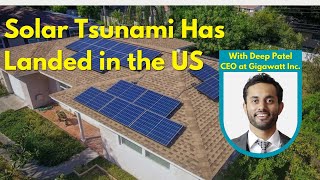
Deep Patel, CEO of Gigawatt Inc., explains how falling hardware costs and rising utility rates are making rooftop solar plus storage financially competitive without subsidies. The 30% tax credit expired, forcing the industry to cut soft costs like installation and permitting. Utility prices keep climbing in California, Hawaii, Massachusetts, and New York, making solar the cheaper option.
Chapters
Over the past year, I've interviewed 3 or 4 companies that are in the business, in the solar business, and it appears that there's a step change. The technology, cost of the technology is no longer the big issue. Solar panels, wind turbines, battery, uh, batteries and digital controls and so on and so forth. They've all come down to the point where they're affordable. Now the cost is in integration. It's maybe installation, it's permitting, it's all sorts of soft costs. So I'm going to talk to Deep Patel. He's the CEO of Gigawatt Inc. They've got a rather unique business model down in the States and see how their company deals with it. So welcome to the interview, Deep.
Hey, Marcum, nice to be here. Thanks for having me.
So is my argument reasonable that this is a step change and now we're ready for another boom, if you will, in solar, both residential, commercial, industrial?
Yeah, absolutely, Markham. The grid prices in the US have just been accelerating very aggressively all across the United States. And, you know, especially after COVID, you know, the prices have pretty much gone parabolic for energy from the grid. And that's due to 3 reasons. We have an aging infrastructure here in the United States. There's been wildfires and things in that nature which have created liabilities that have been passed on to ratepayers. These climate-driven events are stressing the grid out, so they have to figure out a way to modernize the grid. And how the grids work here is when they put money into it, they rate base the costs, so that gets all passed down to the ratepayer. And then on top of that, the AI data centers have just been building, you know, massive amounts of data centers. And these data centers use a lot of kilowatt hours. So they're also, you know, there's a supply and demand problem for kilowatt hours right now, and the prices are just even accelerating faster. So what I see is going to happen to the grid is going to become like the next health insurance crisis in America, where, you know, people's home bills could be $1,000 a month or more in certain markets. And, you know, that's going to really drive people to look for energy independence. And the number one way you can do that is put solar on your rooftop and a battery at the side of your home, and you can generate and store your own electricity.
What I'm hearing is that a lot more businesses are interested in this because there are any number of types of businesses that require always-on electricity or pretty close to it. And for them, it's a matter of lost revenue or extra costs and restarting, that sort of thing. Are you finding that?
Yeah, the businesses, you know, especially the ones that operate during the day where, you know, they're operating from 8 to 5 or so, they can put solar on the roof and self-consume all of that electricity and just basically avoid any grid power during the day. Energy storage for commercial projects, it's still a, you know, kind of a newer space, and, you know, more technologies are coming online, but we don't really have the technology yet to, you know, make it cost viable on the commercial side yet. It's coming. More options are on their way, but I would say in 1 to 2 years, we're going to have way more options for the larger commercial customer for energy storage.
Now, you and I were talking before we started recording and you were saying that your company lives in the delta between the price charged by the utility and the price that your systems can generate electricity for. Could you maybe explain that for my viewers?
Yeah. So we help our clients build solar and battery storage systems. And at the end of the day, once it's installed, it generates a cost per kilowatt hour. They're basically becoming a power generator. And we help them see what their cost per kilowatt hour is going to be. And then they have to compare that to what they can get that from the grid. So the larger the delta, the more viable case we have as a company. And, you know, there are certain states where the delta is very large and there are certain states where it's very narrow. So if it's very narrow, then there's got to be another reason for them to do this. And, you know, grid reliability is another very solid reason.
What about which states? Maybe could you give us a few examples where they have very high— where they have high prices? I mean, we've interviewed folks in San Diego and they talk about, you know, peak use, it's $0.40 to $0.50 a kilowatt hour, which is very high. So California would be an obvious example. What other states are there?
Hawaii, a lot of the northeastern states like Massachusetts, New York, those are like really high cost of energy states.
You know, parts of Arizona, they have a lower cost per energy, but then they have so much sun resource, the Delta still makes a lot of sense as they can get So it sounds like they, as this industry develops, uh, and then that's just, you know, if you study technology adoption at all, uh, this is always the way it works, is the technology comes in, it gets, finally gets better, it's competitive, and then it starts picking off those, those market niches where it has a solid competitive advantage. It might be, it might be price plus other kinds of value, you know, like reliability and whatever else you can imagine. And it sounds like, if I understand you correctly, is that your products, the solar plus battery and so on, is really now becoming, moving out of small niche markets and they're becoming kind of mainstream.
Yes, correct. And then, you know, places like California where the price is so high, you know, the business case makes a lot of sense for the end user. So it's like, people are asking for it. Places like Texas where reliability is a concern. They went through that big ice blizzard, you know, a few years back. Like, people are asking for batteries there, you know. So yeah, certain markets are really— the demand is like just there and it's accelerating. And in certain markets where prices are really low and, you know, you know, reliability is very high, You know, people are just doing it because they like the technology and they like the feeling of being energy independent.
Right. I mean, this is one of the issues we have in Canada. We haven't seen the explosive growth that you're seeing in the United States. You know, we're 3.5%, 4% growth in demand every year. And we have a lot of hydro here and nuclear. Hydro is 60%. Nuclear is like 70%. 17%, 18%. So it's very reliable, it's very low cost, and that removes the incentive to do the kinds of innovations that your customers are doing. So I imagine we're going to be, you know, a lot slower getting up on the, on that curve, and just like some of the markets you, you talked about. What are some of the other benefits that customers are talking about when they, you know, when they decide to— oh, and especially do-it-yourselfers. That I find that fascinating that people are now installing their own solar systems. Mm-hmm.
Right. Yeah. Some of the benefits are just, you know, being able to have energy independence and be grid independent, meaning they, you know, can generate and store their own electricity and then use it however they want to use it and be shielded from future cost increases. And our customer base is, you know, do-it-yourselfers, which, you know, we really call it do-it-your-way solar and storage. And what that means is some of our customers are tradespeople, for example, Markham, and they, they can actually take our kit and our services and fully install it on their own because they're completely capable of doing so. Some of our customers, they're project managers where They'll buy our kit and services, they'll get their projects approved, and they'll bring in a contractor to install it for them. And the reason they do this is they save several layers of markup, you know, because the traditional solar and storage companies, you know, it goes from a factory floor to a, you know, a manufacturer to a distributor to an installer to a sales group to then the customer. And there's all these little markups along the way. And those are like major soft costs we can cut out. And if we shorten the supply chain between the factory floor and the end user, we can deliver a more cost-competitive solution.
There's been a lot of discussion about President Donald Trump's sort of anti-renewables bias and changes that were made to the Inflation Reduction Act and so on. So there's fewer subsidies and incentives for renewables. How has that affected your business?
You know, last year was a boom year, Mark. What happened was it created, you know, a fear of missing out, right? So the tax credit was going to go away, especially for the homeowner that's paying cash. It basically went away on December 31st. So they would have to have their systems installed by then. So that created an unprecedented boom across the entire industry where everyone was trying to go solar by that date. And now we're in a territory where there's no tax credits anymore. So, you know, we have to bring the demand back by letting people know that there's other ways in doing these projects where it can still make financial sense. So the industry has to do an educational campaign to get interest back. And the good thing is people are still calling in. You know, we're having appointments set up. You know, they're talking to our advisors. So there is still demand, but people just want to make— be certain that this makes financial sense for them.
Is the industry sharpening its pencil and innovating and figuring out ways to lower that cost in the absence of incentives?
Yeah, absolutely. This— that's one of the themes for this year is, you know, everyone is trying to sharpen their pencils and figure out how they can lower costs and pass those savings on because we have a 30% gap we have to fill. So yeah, that, that's going to be new supply, you know, better permitting and interconnection faster and cheaper. More automation, customer support, you know, automated customer support. So companies are going to have to really be scrappy to figure out where they can cut costs in this delivery chain to be able to provide this product to the customer at a lower price so they can still move forward.
What about workers? This is something that I've talked to a number of companies and they're, you you know, there's been a bit of a boom and bust cycle in the renewable space, particularly in the residential solar. And you, you know, you train up some staff and you get a team, and then the incentives go away, and then they— these folks wander off and get employment elsewhere. Are you, are you able to find enough qualified, trained workers?
I mean, solar and storage is very specialized, Markham, so it's very hard to, you know, just find people and bring them in. It takes a certain skill set and it takes, you know, a year or more for someone to really catch on. So, you know, it's always challenging with these booms and busts because, you know, you train these workers and then they're, you know, you got to lay them off or, you know, there's a period where sales are not, you coming in. So it's a hard business due to that reason, because it's hard to retain really good people over the long term because of the government policies in place.
Deep, look out over the next 1, 2, maybe even 5 years, and what do you see in your industry in the United States?
Well, I think, you know, in the next couple of years to 5 years, this market is going to be unstoppable, Markham, just because there's no more tax credit, there's no more government support. The, the concept of solar and storage has to stand on its own now. And I think that's really the most powerful thing is now it's going to be unstoppable and the price of utility power is just going to continue to go up. So, you know, we believe the value in our product and service So we, we're very bullish in the long run. It's just the next year is going to be very challenging for companies.
So your company and others basically have to make the transition so that you can accommodate or you can find a way to reduce the impact of losing that 30% in the incentives.
Correct, Mark. That's the biggest challenge this industry has this year. Is how do we, you know, soften the blow for our end user on the 30% credit.
Deep, this has been fascinating. Thank you very much for this. Really appreciate it.
Yeah, thanks, Markham.