Gabriel Birnbaum, 2023 SJA Fellow, End-of-Year Talk
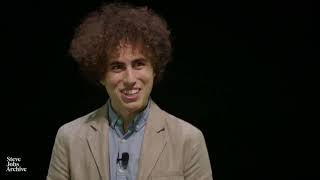
Gabriel Birnbaum built Kenna Soup, an AI app that lets friends create personalized images together. He left Substack to start the company, raised money, got media attention, and was invited to dinner by Lady Gaga. He sees AI as a new language for expression, especially for young people, and wants cameras that augment real moments instead of replacing them.
Chapters
Gabriel, take 1, mark. I'm Gabriel Birnbaum, and I'm a product designer. I'm working on an app called Kenna Soup. It's an app where you can make AI photos of you and your friends in imaginary situations. What we do at Kenna Soup is like a new way for you and your friends to live your own fiction. In a world where I can say anything, whatever I say is an expression of who I am. And as we get to express who we are, we get to create new cultures. So this is my app, Kenna Soup. Where you can make these AI photos of you and your friends. And so for example, this is me wearing a pastel colorful fur in the colorful fur room. This is me in a bubble bath with many kittens. I'm sorry you had to see me in a bubble bath. It gets worse. So I had a really strange year. When it started, I was the first product designer at this writing company called Substack. And I also had this strange hobby of doing plasma physics research at Berkeley. This is me talking about that. Then I quit to do Y Combinator with my best friend Eric. Back then we had this simple idea, like, would it be fun to make these AI photos that you just saw? But with you and your friends. It'd be kind of like a new photo sharing app and perhaps a new medium of expression. So I could text Eric something or I could call a romantic interest or I could make this thing which we called a Soup to fit the name of the company, Can of Soup. It turned out to be a hit. Within 3 months, we were running this up-and-coming social media company. First, Silicon Valley got on the app, and then somehow colleges found it and started to spread it around to hundreds of colleges around the US, and then high schools. I was talking to the New York Times. We had one of the craziest fundraising cycles of 2023. I had to deal with random insane internet drama. I was invited to dinner with Lady Gaga. I didn't go. I know, it's— but worst of all, now I'm some sort of executive, and I had to deal with that, which is very strange. And I know that the commotion of all of this sounds very exciting, and it was. And still, everything about this year feels like a work in progress, like quite literally. I'm every day figuring out exactly what it is that I'm creating. Like, sure, we started this basically as like a personalized AI photo generation app. And I spent a lot of time trying to figure out like, why is that fun? Like, why do people come to us? Like, what's the deal? And when we got to about 100 colleges, I figured that the actual photos like the content, are not what makes this fun. But rather, when I get to embed my face, I am able to express something that I otherwise could not. So my jokes, my affections, all these things that I otherwise couldn't have said, I found a new way to say it. And that made me really happy. Like, I saw these college students, like, of laughing. I saw these like 15-year-old teenagers like crying and coming together about this app. Like it really made them like— it was wonderful to see. And this brought me a lot of joy because I grew up in Brazil and for a lot of reasons I didn't quite have the language to communicate with the people around me. And media kind of saved me. There was, you know, it said things that I couldn't have said and it really put words in my mouth. And some of it, sure, was like high media, the things that we all talk about like music and, you know, film. But a lot of it and the most relatable parts of it were these emerging forms of media when I was a teenager, like Snapchat or Vine, if you remember that. It was a good time. So yeah, I wanted to create this like new form of expression that is relatable, that we can all participate in. And still the first thing that we built with Kenna Soup, super fun, but I think it fell short with that. Like if we look at these photos sort of like here to the right, these real photos, this is just, you know, it's a photo of me prepping for a marathon, one of my best friend's graduation, my last party with Substack. All these photos were taken within a 5-mile radius. And they're pretty mundane. I'm just hanging out. But each pixel has so much meaning to me. Every little thing, these moments that were captured, they really touch me. And I'm not very nostalgic, but these photos sure make me nostalgic. And on the left, you see these can of soup photos. And you can see that there's a lot more variance. In the sense that, you know, maybe I make a really mean Muhammad Ali, or, you know, I look good in a spaghetti bath this time. I'm sorry, I like baths. Or as a Pokémon trainer. But, you know, it turns out that there is more than just my face and my imagination that I want to embed. I want to embed my friends, my life, the places I inhabit, the things I think about. All of that needs to be accessible. And in the first soup world that we created, you couldn't bring all of that. It's like, we all have cameras, and cameras are these amazing inventions, like probably one of the coolest things that have ever been made, and we invented this new thing that was more like an anti-camera. But actually, what I think we should have invented is the next camera. So that's what we're working on now. To me, the next camera isn't about you type something and you get a photo. And it's funny, but it's more about enhancing the photos and enhancing the moments that we have. So for example, my friend Vivian, maybe she's feeling a little extra, so she takes a photo. She says, give me a new pose and maybe a new outfit. And she gets it. This is a Canasoup edit. It's, it's like a completely different photo derived from a real moment. Or, you know, you can see that I like neon. And it's great. And maybe I can say, okay, let's add more neon to my selfie. And let's also trim my eyebrows to see what that looks like. It looks bad. This means a lot to me because I feel like you could say, well, this isn't real. But I would ask, is it not? There's something really real about what we want to express as well as what we love. And there's more that you can say. And I think there's a lot that we all want to say. And we can live in a world now where computers let us say it. And we can also live in a world where they prevent us from saying it. But no one wants that. So let's not do that. Let's do the thing that is expressive. And then I hope that with this new camera, I get to contribute to that. Thank you. [APPLAUSE]