The Ultimate Sleep Optimization Challenge Day 1
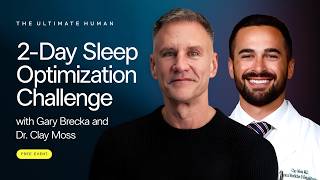
Gary Brecka and Dr. Clay Moss outline eight biological levers that control sleep, from circadian rhythm to blood sugar stability. Morning light exposure triggers evening melatonin release. A concrete morning protocol includes consistent wake time, immediate light, breathwork, delayed caffeine, and protein.
Chapters
Hi guys, welcome in. Welcome. There's so many of you joining. You're just pouring in. So hello. If you're watching this right now, I want you to know something. The fact that you signed up for this sleep challenge today tells me everything I need to know about you. You are someone who refuses to accept that feeling exhausted, wired, and waking up at 2:00 in the morning is just normal. It is not normal. And over the next 2 days, we are going to prove that. Drop your name and where you're— oh, drop your name and where you're watching from in the live chat. Let's see how many cities, how many countries we've got in here today. Sometimes I have people getting the distance award from all over the world. Wow. Look at that. This is the ultimate community right here, guys. This is the ultimate human community. I'm seeing Florida, California. Wow. Over in London. Hey, guys. All right, so let's get into it because I have a lot to share with you today, and I do not want to waste a single minute. I want to start with one sentence, one sentence that if you actually let it sink in, is going to completely change how you think about sleep for the rest of your life. Are you ready? Your body doesn't feel safe enough to shut down. That's it. That is the entire problem. Not your mattress, not your age, not your hormones, although those do matter. The root of almost every sleep problem I have ever seen in 20 years of studying human biomarkers comes back to one thing: your nervous system does not feel safe enough to surrender. You're wired, you're tired. Sleep is not just rest, it's an act of biological trust. When you sleep, your body drops its defenses, your cortisol falls, you go out of that fight or flight state, your heart rate slows, your body temperature drops, your immune system actually goes to work, your brain literally washes itself. Here's the one thing, your nervous system will not allow that to happen if it thinks that you're in danger. In fact, I talk about this all the time. 82% of all autoimmune diseases found in females. Why? Because many of them don't feel safe in their own bodies. And the problem is your nervous system does not know the difference between a tiger chasing you and a stressful email at 11:00 PM. It responds the same way to both. So how many of you have woken up between 2:00 and the 4— 2 and 4 in the morning this week? Okay, drop it in the chat right now. Wow, look at that. It seems like almost everyone, right? And here's what happens. Your cortisol, your primary stress hormone, follows a predictable 24-hour rhythm. But when you eat late, you look at screens at night, you drink alcohol, you live under chronic stress, you disrupt that rhythm. And at 2:00 AM, cortisol spikes when it's actually not supposed to. Your body interprets that spike as danger. Wake up, something's wrong. Nothing is wrong. Your biology is just dysregulated. And over the next 2 days, we're going to regulate it. So now your sleep is governed by what scientists call Zeitbergers. That's a German word that literally means time givers. These are the 8 biological levers that your body uses to decide when to sleep and when to wake up. I want to walk you through all 8 of these, because if you understand these, you understand everything. So number one is your circadian rhythm, your 24-hour internal clock. Every cell on your body runs on it. Light is the master signal. Then there's adenosine, your sleep pressure molecule. It builds up while you're awake. Caffeine works by blocking adenosine receptors that make you sleepy. It doesn't give you energy. It hides your tiredness. There's cortisol timing. This should peak in the morning and slowly fall throughout the day. That falling cortisol opens up the door for melatonin. Melatonin release— it's not a sleeping pill, a darkness hormone. It tells your brain the sun has gone down. Screens after sunset suppress melatonin. And number 5, your core body temperature. Your body temperature much— must actually drop for you to fall asleep. A cool bedroom is not a preference, it's It's a psychological, physiological requirement. And then there's your nervous system balance, sympathetic versus parasympathetic, fight or flight versus rest and digest. Everything I'm teaching you is about helping your body shift into that parasympathetic mode at night so you're in that beautiful rest and digest state. Blood sugar stability. This is number 7 and can't be overlooked. When your blood sugar crashes in the middle of the night, cortisol spikes to bring it back up. That spike wakes you up. What you eat and when you eat is directly connected to whether you wake up at 2 AM. And then there's the environmental toxicity load. The chemicals in your mattress, the EMFs from your phone, the light pollution in your room— all of it affects how deeply you sleep. Pull the right levers, your body must sleep. That's what we're going to do over the next 2 days. So today, day 1, It's all about the morning because there's something most people don't realize. Tonight's sleep is determined what— by what you do tomorrow morning. So the— actually, tomorrow night's sleep is due— is dependent on what you do tomorrow morning. So the way you wake up, the light you get, the breathwork you do, what you eat, when you have caffeine, all of it sets a biological domino that falls 12 to 16 hours later. Right at your bedtime. So day 1 is about building the morning anchor. Day 2 tomorrow is about the evening protocol. All right, so stay with me, everybody. I'm heading to the whiteboard and I'm going to show you exactly.
Here is a sleep study that was published in Sleep Science and Practice, and it focused on sleep hygiene and the foundations for sleep hygiene. And what is sleep hygiene? Sleep hygiene is a good sleep routine. And we come back to this time and time again, you know, what are, what are the best practices to do before you go to bed? What are the best practices to do within the first 30 minutes of waking up? But what's really critical, and it's highlighted in this study, are the, the hygiene, the routines, because we are creatures of habit. We're circadian creatures. We have a biorhythm. We've talked about that 24-hour clock, that biological clock that shows when cortisol rises and melatonin falls, and then when cortisol falls and melatonin rises, so go into a sleep cycle. We talked about how hormones are secreted at different pulsatile times during the sleep cycle. Growth hormone secreted during the very early stages of the sleep cycle. Memory being assembled during the REM phases of sleep. The glymphatic system draining during the deep phases of sleep. In fact, this, this study highlighted, um, the impact of the glymphatic system draining during the deep phases of sleep. So this was Sleep Hygiene Foundations and some implications and strategies for enhancing sleep health. And I want to just go back and highlight this section of the study because it talked about waste clearance and brain restoration, restoring the brain by subtracting the waste— histamine, cytokines. Our cellular biology is very dirty, and in the normal metabolic cycle of a cell, it creates waste. This waste accumulates in our brain tissue, and at night, studies have shown that slow wave sleep— this is the deep wave of sleep— cerebrospinal fluid pulsations. That's that clear fluid that flows up and down your spinal cord. It actually flows all over your, your surface of your brain, and it flows in through these channels within the brain. So the cerebrospinal fluid pulsations that move the glymphatic system's ability to wash away waste materials. This means that by Going into the deep wave of sleep, these channels open and they allow waste to clear. Sleep deprivation may encourage the growth of tau and beta amyloid proteins. These are the proteins that lead to neurofibrillary tangles that lead to amyloid plaques, which is a classic sign of Alzheimer's disease. And these happen in the late stages. And so we know that there are a lot of early triggers for Alzheimer's— type 3 diabetes, insulin resistance in the brain, having a very high glycemic profile, being insulin resistant, having very high blood sugar over time. But now there are strong links between sleep deprivation over a long period of time also accelerating the growth of tau and beta amyloid proteins, which are the hallmark of Alzheimer's. Early onset cognitive decline, early onset neuroinflammatory conditions all have a link back to poor rest— restful sleep. So we talk about a lot of the ways to engage in good sleep hygiene, going to bed at the same time, waking at the same time, but making sure that we have enough time to get into that deep wave of sleep. You know, the deep wave of sleep tends to be parked towards the tail end of our sleep cycle. If you've ever had your alarm go off at 3:30 in the morning or 4 o'clock in the morning or 6 o'clock in the morning, an hour or 2 hours before you normally get up— maybe you had an early flight— and you wake up in the middle of that deep sleep inertia, wake up in that deep phase cycle where you're just exhausted and you're foggy and it's really hard to get the motor going, that's because you're in deep phase of sleep, and your brain is involved in deep glymphatic cleaning of the brain. So it also mentions that while we age, obesity may negatively, may negatively affect cerebrospinal flow. One other thing that I wanted to point out, I love how the researchers comment in plain English in here. Thus, it may be worth contemplating that establishing a regular sleep-wake schedule, so that's the time we go to bed and the time that we wake up, may act as a preventative form considering long-term brain health, meaning preventing things like neurocognitive decline, Alzheimer's, dementia, um, memory loss. These things are happening because the brain loses its ability to communicate, not because there's anything particularly wrong with the memory. You've heard me say very often that in Alzheimer's disease, patients are not losing their memory, they're losing access to their memory. And the clearance from these glymphatic pathways is critical to that access remaining open. So another area that I talk about and that was also highlighted in this study was the immune function. Remember, your immune system, it acts when your body feels safe. So the autonomic nervous system, the, the part of your nervous system that you don't think about— your respiratory rate, your body temperature, your heart rate— The autonomic nervous system has the two states that it exists in: the sympathetic state and the parasympathetic state. The sympathetic state is the state of fight or flight, and the parasympathetic state is the one of rest and digest. The body heals, repairs, detoxifies, eliminate— eliminates waste and regenerates in this area of the central nervous system called the parasympathetic state, where the body actually feels safe. So Immune function is reliant upon sleep, which may regulate both adaptive immunity and innate immunity— the immunity that you're born with and the immunity that you acquire over time. Sleep, in particular slow-wave sleep, deep sleep, which you can measure on your Whoop, enhances the communication and function outcomes between T cells. T cells are the natural killer cells, the SEAL Team Six of the immune system, and these are influenced by how much deep wave sleep you get. And antigen-presenting cells. Antigen-presenting cells are those cells that find pathogens in your blood. They find the enemy and they go present that to the immune system and they say, here, everybody that's wearing this uniform, you need to go kill. And those presenting cells are influenced by the deep wave of sleep and provide supportive background for antigen-presenting and T-cell proliferation. T-cell proliferation means how do we make more of these T-cells in our immune system that actually can go out and protect us against pathogenic invaders. So natural killer cells and T-cells, this is the SEAL Team Six of the immune system. It is enhanced and influenced by deep wave sleep. So we know that the brain not only detoxifies and eliminates waste and repairs and regenerates, it also impacts how strong and how reactive our immune system is. Okay, so I want to go directly into some of the evidence-based benefits of sleep hygiene that were highlighted in this study as well. Um, sleep hygiene practices have been shown to have clear physiological, psychological, and cognitive benefits, including cognitive performance Decreased anxiety, stress, and depression, better emotional regulation, and decreased risk of mood disorders. So in other words, we're now benefiting from deep and REM phase cycles of sleep in ways that we never thought possible. Things like our emotional regulation, mood and mental disorders, our cognitive benefits, um, our stress, how well we're able to respond to stress, and even depressive episodes being linked to sleep deprivation. And so this is only— this, the only intervention that was used in this study were timing of going to sleep, how consistent you were with bedtime, and how consistent you were with wake time. These are all things that are within our control. So in the tail end of this study, in the conclusion comments, which I'll just take you to really quickly, they talk about sleep hygiene being an essential element in developing and sustaining optimal sleep health for the remainder of our lives. So sleep hygiene, just being the sleep timing. Sleep hygiene consists of aspects related to maintaining fixed sleep-wake pattern. Again, this is something that's in our control. We talked about setting an alarm to actually go to bed, not just setting an alarm to wake up. Doing the same thing within 30 minutes of waking every single day, like getting light to influence our, our Zeitbergers. Limiting screen exposure, in optimizing our sleep environments. All the things that we've been discussing, all summarized in the declaration of this study. So while 9 of the last 10 practices that I suggested were all— are all free— cooling your room down, darkening your room, getting morning light— adding hydrogen-rich water to your morning routine is something I do every single day. I'm a huge fan of hydrogen-rich water. I just wanted to alert you to one study in particular. This was in the Wiley Journal of Food Science and Nutrition, very respected journal, and it was actually looking specifically at— and I think just about everybody fits this category— hydrogen-rich water and caffeine for alertness and brain metabolism in sleep-deprived habitual coffee drinkers. So that probably sounds like you. And what was interesting about this study was the main aim of this randomized controlled crossover interventional trial was to assess the acute effects of taking a single dose of hydrogen-rich water and comparing it with caffeine. So they did one group that was hydrogen-rich water plus caffeine, and there was one with just control water, no caffeine and no hydrogen, for alertness, brain metabolism, and, uh, brain and oxygen saturation, and self-reported adverse events in healthy men and women who were habitual coffee drinkers and were sleep deprived for 24 hours. So that probably sounds like just about everybody watching this. It was a very well-conducted trial. They did brain scans, um, on different regions of the brain to look at these, um, choline ratios and the choline, uh, to creatine ratios. I just want to take you to the conclusion so that you know that we're standing on solid ground when I actually recommend that you put a hydrogen-rich water tablet in you. If you're a coffee drinker, you don't have to stop drinking coffee. It actually had cumulative effects because it worked on different pathways. So the conclusion section of the study just said that the attention Uh, the attention enhancement driven by hydrogen-rich water appears to go with notable changes in brain metabolism illustrated by higher choline to creatine ratio levels in the frontal and paracentral brain. Being generally recognized as a safe intervention by the Food and Drug Administration, hydrogen could thus be recommended as a novel intervention that upholds attention in stressed conditions. All of us are waking up stressed. So how do we relieve that stress in the brain, improve circulation, improve these choline to creatine ratios in the areas of the brain where it really matters? You might have actually seen some of my studies and some, some of the talks that I've done on creatine and what a big fan of creatine I am, especially for women over 40. With its metabolic footprint likely different from caffeine, which means that you don't have to stop drinking caffeine and replace it with hydrogen-rich water, you get cumulative and separate effects by the combination of the two. So if you're somebody that is chronically stressed, you're regularly sleep deprived, you rely heavily on caffeine, which is probably 80% of the people watching this, hydrogen-rich water does have benefits to add to your morning routine. It is something that I never, ever, ever miss. It is less than a dollar a day, so it's something that I really do recommend quite often. Just the Elemental Magnesium tablet in a glass of water. I also add something called Baja Gold Sea Salt that and Perfect Aminos. So I get all 9 of the essential amino acids, I get all 9, uh, all 91 trace minerals. We are so mineral depleted. But the hydrogen-rich water does have a role in your morning routine. It can help wake the brain up, improve that circulation, improve focus, concentration, short-term recall, processing speed— all those things that we want, especially when we're stressed and sleep deprived and caffeine's not having the same kick that it used to. So my favorite way to improve our sleep is to just get into a really, really good circadian rhythm and have really good sleep hygiene. The vast majority of what I suggested, as I always do, are free interventions, you know, reducing your mealtime to 2 hours before bed, reducing your screen time, cooling your room down, maybe investing in a $12 cotton eye mask, keeping the room as dark as possible, also not consuming fluids or liquids within 2 hours of bedtime if you're someone that gets up and frequently urinates. And we talked about all kinds of ways to help you stay in sleep, to fall asleep faster, and to wake up more refreshed. And then what we do in the first 30 minutes of the day, mainly light exposure, grounding if you can, sunlight on your skin, sunlight, natural sunlight into your eyes. All of those things are free, they're accessible, you can do them anywhere in the world, they're portable. Um, when we talk about some of the modalities that I like to implement into a really healthy sleep hygiene, something that I I do on a regular basis is I mouth tape. I don't care which type of mouth tape you use, but there's an interesting article published in Healthcare on the impact of mouth taping. This was in sleep apnea patients, but a lot of us have some mild form of sleep apnea. Either we snore, which is a form of sleep apnea, we actually have obstructive sleep apnea, which restricts our airway. So they looked at the impact of mouth taping on mouth breathers with mild obstructive sleep apnea. Okay, and this was a preliminary study. What, what I find really interesting about this one is they, they used two indexes. Um, one was the median apnea hypoxia index, this AHI. And what that is is the index of sleep apnea, which usually restricts your airway by your tongue falling to the back of your mouth and cutting off the airway, makes you hypoxic. It makes you low on oxygen. That's what exhausts you. It also keeps you out of the deep phases of sleep. Remember, your brain, even though you're sleeping, is constantly monitoring blood oxygen. It's its primary responsibility. That's why if you got up right now, went for a brisk walk, your heart rate would increase, your respiratory rate would increase. Your autonomic nervous system would automatically make these adjustments for you because your blood oxygen level is dropping. A lot of you wake up exhausted, foggy. Sometimes you have a morning headache. These are all signs that you have mildly suffocated throughout the night. Sometimes you'll say, I don't like, uh, taking Tylenol PM or some other kind of sleep medication because it's still in my system in the morning and I feel groggy. That's actually not true. That medication has been out of your system for hours. You're feeling the effects of having suffocated for 6 or 8 hours. Low oxygen over that prolonged period of time, which is called hypoxia, is what causes those effects in the morning. So they measured something called the Median Apnea Hypoxia Index. So sleep apnea, or mild sleep apnea, leading to hypoxia—decrease in blood oxygen, um, in the blood. They also, uh, use something called the Median Snoring Index. There are lots of wives out there that would love to have their husbands pay attention to the median snoring index. And so both of these were improved, one by 47%, which is a pretty significant improvement. The median hypoxia apnea— the apnea hypoxia index decreased significantly as well, from 8.3 to 4.7. So that was a 47% drop. I found this really fascinating. They show a nice diagram in here of how sleep apnea affects you. I hope you can see that diagram. So this is what sleep apnea looks like in a cross-section. So, you know, you have the tongue moving back here into this glottal fold. You actually have this area of restricted breathing through your mouth because this, this airway is getting more and more and more narrow. And then where the tongue relaxes, especially if you're laying flat on your back and your head's not elevated 15 degrees, the tongue slides to the back of the mouth and it restricts this airway. By directing the air through the nasal passage, you completely circumvent that. So that's part of the reason why nasal breathing works. If you look at the, um, uh, initial part of this study as well, it talks about how people preferentially— people breathe through the nasal route for its physiological functions. What are those? Heating, humidifying, and filtration during the daytime and while we're sleeping. Um, during sleep, the resistance is lower in those breathing through the nasal route than those breathing through their mouth, meaning there's less airway resistance. Your respiratory volume is already low, so when you add rest— you add resistance to low respiratory volume, the outcome is low blood oxygen or hypoxia. So the conclusion was very clear: And in this one, I think they used a 3M version of mouth tape. So, uh, I'll link this study if you want to read the, the details on the study. But it provided a simple and effective treatment modality using— they used a 3M mouth tape. I've never used that one. There's all kinds of mouth tapes out there, um, but they use 3M mouth tape for mild obstructive sleep apnea patients with open mouth breathing. The, um, apnea hypoxia index and the snoring index were reduced by nearly half after mouth taping during sleep. The more severe the baseline apnea hypoxia index and the snoring index, the bigger the improvement. So the greater, uh, the improvement after mouth taping. So if you are someone who snores and keeps your, keeps your spouse awake, that's a sign of sleep apnea or restricted airway. If you're someone that wakes up foggy with a headache, it's hard to get out of bed in the morning, you have a little bit of confusion, sometimes that mild sort of all-over sort of global headache, it's easy to push through and you just go straight to the coffee maker or straight to the bathroom, straight to the coffee maker, you really might want to consider mouth taping for mild obstructive sleep apnea. Mouth breathers, mouth taping could be an alternative treatment before CPAP therapy or surgical intervention are tried. That is a pretty big statement to come from a clinical study that actually measured the breathing patterns of these patients while they were asleep, with the only intervention being redirecting the airway through the nose. So you're not dealing with that restriction. I wanted to end by showing this circadian clock cycle so that you could see that during different phases of sleep and during different times of the day, The body has a circadian rhythm to how it regulates our hormonal cycles, to how it regulates our growth hormone, our thyroid, our body temperature, our immune system. These are actually regulated— these are actually regulated on a circadian clock. So if I was to just draw the day into four corners and we were sleeping from about 10 PM here until about 6:00 AM, and we look at the critical functions that are happening during these hours. These are things like leptin secretion, and, you know, leptin is, is involved in how we are mobilizing and metabolizing fat. It's also involved in insulin signaling. So eating too close to bedtime throws off the cycle. Thyroid stimulating hormone, which is actually regulating our thyroid, either upregulating or downregulating our thyroid. This is the pituitary acting like a volume knob to increase the production of hormone T3 and hormone T4, less T3 than T4, but actually increasing or decreasing our body temperature, raising or lowering our metabolism as we go into sleep. Growth hormone secretion, you know, we, we were able to get up to a 10x, a 10-fold increase in growth hormone just in our 3-day water fast. But if you looked at how growth hormone is secreted in a pulsatile manner, you have the largest pulse of growth hormone right as you are easing into your first phases of sleep. Melatonin, obviously, which is going to, um, uh, help us get into a deep phase of sleep. And then all of these cellular activities related to our immune system. So our antigen-presenting cells taking pathogens and showing them to the immune system. T cells, how sensitive they are to other pathogens that are protecting us and policing us. So all of this is happening in a regulated cycle. The reason why men experience erections during, uh, the first hours of the morning if you have healthy testosterone levels is because our testosterone levels actually rise in the morning. Our cortisol levels rise in the morning. Epinephrine, dopamine— these are all signals that are actually based on our circadian rhythm, our biological clock. So imagine when we start shifting our sleep and wake cycles, we're actually asking the body to do all of this production at different hours of the day, at different times of the night, earlier or later on, on different days. So this is why consistency in our sleep cycle, getting as close to matching this biorhythm, our heart rate, our blood pressure, all of these different physiologic aspects that are actually related to the circadian time of the day. So sleep is just not just our human superpower. It really is a biological necessity. It really is something that the body, that the immune system, that the remodeling system, that the waste elimination system uses on a timing basis. And that's why it's so critical to manage your sleep-wake cycle.
All right guys, let's bring on our day one guest. This is someone I had on the podcast recently, and I'm telling you, this guy blew me away. He's a medical doctor. He's completing his residency in physical medicine and rehabilitation. He's doing a fellowship with the American Academy of Anti-Aging Medicine, and he's one of the few young physicians I've actually met who really gets it. He's not just writing prescriptions. He's looking at root cause. He's looking at metabolic health. He's looking at strength, recovery, sleep, all of it as one kind of integrated system. So he helped build the VA's first inpatient metabolic rehabilitation program. He bridges conventional medicine with functional medicine. And when we talked about sleep hygiene, he and I were literally finishing each other's sentences. So please welcome Dr. Clay Moss.
Gary, thank you for having me, man. It's great to see you again.
No, man, thank you so much for joining us today. And, you know, we're helping thousands of people change their sleep. So let's kind of get right into it. All right. What do you feel is the single biggest mistake that you feel people are, are getting completely wrong that destroys their sleep? Sleep?
Yeah, I feel like one of probably the most undervalued things in terms of sleep that we don't talk about enough is sleep consistency. So I think, you know, there's plenty of studies now showing that actual sleep consistency, so the actual timing of your sleep, matters more in some cases than the amount that you're sleeping. So, you know, people will obsess over things like supplements and blue light blocking glasses and all these other aspects, but they're going to bed 10:00 PM on a Tuesday and they're doing midnight on a Saturday and 1:00 AM on a Friday. And so their entire circadian rhythm is just completely off. It's like flying from New York to Denver every single weekend and wondering why your Monday kind of feels off. So I think a lot of people are not putting enough emphasis on when they're going to sleep and especially when they're waking up every day.
So let's talk about what's actually happening to the body when someone is chronically sleep deprived. Sleep deprived, so not just tired but truly sleep deprived over months, maybe even over years. I mean, what's that doing to the heart and to the brain?
Yeah, so I, I would think about it in those two ways as well. The neurologic system as well as the cardiovascular system is where we see probably the most detriment in terms of getting poor quality sleep. So in my field of PM&R, you know, we talk a lot about the glymphatic system, which is basically the brain's way of of cleaning itself. It's like the brain's dishwasher per se. And so it primarily runs during deep sleep. It's these channels in your, in your skull that allow yourself to flush out metabolic waste, including, you know, tau protein, beta amyloid, these things that we see accumulate in pathologies like dementia and Alzheimer's disease. So when you're chronically short on sleep, then you don't really clear waste as well as the average person. So It can be really detrimental to your neurologic system. And then on the heart side, you know, we know that chronic sleep shifts you from a parasympathetic response to more of a sympathetic overdrive. So your parasympathetic system is what, you know, drops your heart rate. It improves your heart rate variability. It allows your body to kind of recover. And when you're not sleeping appropriately, your body stays in that fight or flight response 24/7. And it really does some damage on the interior lining of your arteries. It speeds up your, your resting heart rate. So that can do damage over time. It raises blood pressure, it increases your risk for stroke. So there's so many different ways that sleep plays into your overall health and preventing chronic disease.
Yeah, I mean, I'm in total alignment with you on that, that lymphatic system that everybody's familiar with in the body, like when our lymph nodes get swollen, when we have a sore throat. The upper axillary lymph nodes, that system that drains waste from the body. We have that glymphatic system in the brain that drains waste from the brain. I think that's why, you know, people are so foggy when they wake up, um, you know, after not sleeping well or not getting that deep phase of sleep. The brain fog and that sort of fogginess and that kind of sluggishness to get out of bed. Do you tell your patients to maintain a consistent wake time on the weekends?
100%. I think that's probably the hardest thing to follow, right? You know, we're all on a set schedule Monday to Friday, and then we kind of let ourselves go on the weekends. And like I said, you know, it's hard to really get back on track if you miss a day or two of, you know, shifting your entire circadian rhythm by 2 or 3 hours. So the way I think about it is that your circadian rhythm is basically anchored to two things, and that's when you wake up and when you first see natural light. So you can't fully control when you fall asleep because it's kind of driven by your overall sleep need, your keep pressure, but you can control when you wake up and you can control when you go outside and get natural light. So I think that having the same wake time every day within, you know, maybe a 15 to 30 minute gap really builds the foundation that everything else come goes on top of. So, um, I think that I, like I said, I think that sleep timing is something that we need to focus on almost more so than sleep amount.
Yeah, I, I, I I agree with that too. So let's, let's talk about supplements. Magnesium, I'm a big believer. What's your clinical take on magnesium for sleep and like what's your preferred form?
So magnesium is huge. You know as well as anybody, 50% or more of the US population is deficient or at least insufficient in magnesium. And it works in so many different ways. And like magnesium to, to make it, you know, plain and simple, magnesium It calms the excitatory nervous system. So we think of NMDA receptors in our brain is what excites our brain. And then it kind of facilitates GABA, which is the inhibitory neurotransmitter in our brain. So it really promotes this calming state. It does the same thing in your muscles. It allows your muscles to kind of let go of all that tension at the end of the day. So it also helps with things like melatonin production. It lowers cortisol. So it hits sleep from so many different angles. You don't need to take it right before you go to bed. I mean, I think it's great if you just have higher levels of magnesium in general, but most people, including myself, do tend to take it about an hour, hour and a half before bedtime.
Yeah. And it can even help with like leg cramping and things like that sometimes too, right?
Yeah. And in terms of forms, um, I generally recommend to patients and people that ask me to start with magnesium glycinate. This is kind of like the general go-to. It's highly absorbed, it's easy on the stomach, and glycine itself actually has an independent calming factor on the brain. Um, I usually aim for somewhere between 200 and 400 milligrams of elemental magnesium. This is not medical advice, obviously, you know, work with your doctor, but for most people taking that 30 to 60 minutes before bed helps. If that doesn't help, or patients or people that I know are not getting the desired effects that they want, I recommend they go more towards a magnesium threonate. Which is a little bit more expensive, but it allows it to cross the blood-brain barrier. So some people see that, you know, it gets rid of that, that thought when their head hits the pillow and their, their thoughts are racing. Magnesium threonate can kind of alleviate that.
Yeah, that's the one that did it for me too. So morning light therapy, there is a 2024 study that showed that 10,000 lux in the morning reduces sleep onset latency by 52 minutes. So that, That can either be natural light or one of those 10,000 lux light boxes. I've never personally used the light box. I prefer the sun. But why is morning light so powerful for evening sleep?
Yeah, I think of it kind of like pulling the pin on a hand grenade for melatonin in a way. You know, when you wake up, there's really two major pathways that morning light affects your sleep at night. So first one is the cortisol pathway. As soon as you get morning light in your eyes, your cortisol actually spikes above baseline and it allows it to drop back down over the course of the day so that by the time you're, you know, getting ready to go to bed at night, it's lower, um, than, than if you didn't get morning sun. So basically if somebody is just waking up, they're not going outside, they're not getting morning light, they're not getting a 10,000 lux, you know, light in their eyes, they kind of stay at this baseline, you know, midpoint of cortisol and it ends up being higher than they want it to be later in the day. And so they're not able to go to bed. They have that wired but tired feeling where, you know, the entire day you could fall asleep at your desk, but by the time you get in bed at 10:00 PM, you just can't get your mind to calm down. The second pathway that it really impacts is, is obviously the melatonin pathway. And so basically what happens is that when you wake up in the morning, you get bright light in your eyes and the cells in your retina contain a protein called melanopsin that detect light. and it signals your master clock in what's called the suprachiasmatic nucleus. This is all Andrew Huberman talk, who's much smarter than I am.
Yeah, he was the first one that told me about the suprachiasmatic nucleus. Exactly.
And so it's basically your master clock and it tells you, okay, this is morning. And it starts that 14 to 16 hour countdown. It pulls the pin on that melatonin hand grenade. And by the end of that countdown, your pineal gland in your brain starts to release melatonin. So bright light at 7:00 AM. Pretty much contributes to melatonin onset at around 9 or 10 PM.
That's so perfect. Um, so if someone says, uh, I wake up at 2 AM and I just can't get back to sleep, I just lie there, I ruminate, I think, um, what are the top 3 things you would tell that person to do?
So contrary to popular belief, I would say if you're sitting there for 15 to 20 minutes and you just can't get your mind to calm down, get out of bed. I would say, I think Matt Walker talks about this too in his book, Why We Sleep, which is an amazing read for anybody that's wondering. But, you know, get out of bed and go to a different room, keep the lights dim and do something boring like read a book. Don't be on your phone, sit in a chair, fold some laundry, and then go back to bed only when you feel sleepy again. So, you know, in the short term it might feel weird that you're quote unquote getting less sleep. But it really does train your brain to only associate your bed with sleep. And I think that's another thing too. My second thing that I would recommend is no phone in bed and no television in bed. This is one that I struggle with too. Yeah, but you know, this is a practical hack that most people are not doing. They're scrolling, they're on Instagram, they're kind of going down those rabbit holes in bed. And the thing is, is that your brain doesn't know what to associate your bed with at that point. So if you're constantly scrolling TikTok, if you're watching a show, if you're watching like a true crime documentary and you're stressed, and then you turn all that off and you try to go to bed and you're doing that over and over again, your brain hasn't associated bed with sleep. It's associated it with stress and the news and murder on the show that you're watching and all of these different things. So I think just trying to subconsciously train your brain to only think of sleep and sleep and sex with your bed, then that's the best case scenario.
You know, I, I've actually read some, um, behavioral studies on, you know, people that have their work desk in their bedroom. And so like when they walk in their bedroom, they immediately think, this is where I go to be productive, this is where I go to engage, and this is where I go, um, you know, to actually work and communicate and connect. And, and just that one you know, item actually, just like you say, it dissociates us from thinking of our, our bed as our sleep environment where we go to rest, where we go to relax and recharge. And so, you know, really thinking about that, the architecture of that environment makes, makes so much sense.
Yeah, I think in the core of our physiology, we're all, we're all Pavlov's dogs, you know. I mean, if we start associating a bell with food, then when we hear that bell, we're going to think food. But if we're ringing a bell every time we watch TV, scroll on our phones, eat food, go to the bathroom, then we're not gonna know what that bell means. And I think the same way with getting in bed.
Yeah, such a great analogy. So sleep trackers like Whoop, Oura Ring, Apple Watch, do they actually help people sleep better or do you think they create sleep anxiety?
So it depends on the person. I mean, for myself, I think my Whoop strap has been amazing. For understanding sleep habits. I don't think that people need to use them indefinitely, but I do think that in certain people who don't have anxiety around tracking every single detail, it can be really beneficial. And if you drink alcohol, it'll show you how much alcohol has a negative impact on your sleep ASAP. And it was a huge reason for me cutting down my alcohol intake tremendously just because I would see that I would have like one glass of wine and go from regularly getting 96% recovery to 7% recovery and feeling like crap the next day. So in those cases, I think it's amazing because you can track what really helps your sleep and what doesn't. But in some people that do have that, you know, anxiety, we call it orthosomnia, where you get too anxious about your sleep score that your sleep actually gets worse because of the tracker, then I think those people should avoid it. Okay, so last one.
So let's make it good. One thing someone watching right now could do tonight that will meaningfully change their sleep?
So I'll, I'll incorporate this into one area is, is to get your bedroom atmosphere correct. And the easiest way to do that is turn the thermostat down, get it in the 60s if you can. I know some people that sleep with it at 75 are gonna hate that, but it does a great job of getting your core body temperature down a couple degrees because you need that to go to sleep and stay asleep. Another thing is try to get as dark as humanly possible. I mean, if you can order some blackout blinds, to keep that natural sunlight from coming in or that natural moonlight or the streetlight or whatever, that really goes a long way. I mean, just a little bit of light can really wreck your sleep. Cover all the little, you know, lights and things like that. The LED lights that are blinking on the, you know, fire alarm and all that. Cover those with little, you know, like black pieces of tape so that you have no light pollution. And then, um, you know, for travelers especially, I think a sleep mask is is such a non-negotiable for sleeping anywhere except for your home where you can't control the environment. And it's annoying to do. People will do it for a couple of days and they'll give up on it. It, it really takes a week or two to get used to, but I think once you get used to that, it will pay off dividends on the end of just how quality of sleep you get for the rest of your life.
Yeah. And then it literally becomes like your blankie, like you can't sleep without it. I, I got a really inexpensive all cotton eye mask off of Amazon. They're really inexpensive. And it even has these little sort of cotton balls that kind of fill in your eye sockets and it blocks all the light. Yeah. And now, and I wrap it around my head. It's got a wide strap. I don't like those ones that have like the Velcro and the little thin straps because after a while they actually start to wear.
Yeah. Like I have mine right here. It's got like the wide strap on there. Yeah. That's not as— I don't like the— yeah, the bands. Yeah.
That's great. So guys, we're going to take a couple of questions from the chat for Dr. Moss. So drop your questions right now with his name and our moderators are going to pull out the best ones, and we're going to throw them by Dr. Moss before he gets off. All right, so there they go. Okay, uh, so Dr. Moss, I do everything right during the day, but I still wake up at 2 or 3 AM every single night. From a metabolic standpoint, what's my body actually doing? What's my body actually doing at that hour, and how do I fix it?
So there's a couple things that could be going on if you're waking up in the middle of the night and having trouble going back to sleep. One of them being tying into kind of the whole theme of metabolic function. You know, if, if you're waking up between 2 and 4:00 AM, that's when your cortisol is really supposed to be at its lowest point. And let's say somebody ate a really high glycemic dinner. So like a plate full of pasta or a bunch of rice or a potato, or they drink alcohol or they have some sort of underlying insulin resistance. That low cortisol can actually cause your blood sugar to dip too low and your body panics and it dumps adrenaline and cortisol as a rest response, and that spike is what wakes people up. So if, you know, if that were the case, I would focus on really honing in on a high-quality, maybe, maybe low-glycemic diet to really get that insulin control so that you're not having those low lows in the middle of the night. Another thing that I think is really underdiagnosed, and we didn't talk about it before, is sleep apnea. So, you know, if you're sleeping with a partner next to you and they are telling you that you're constantly snoring or you're waking up gasping for air, or it sounds like you stop breathing in the middle of the night, you know, sleep apnea can cause so many different issues including heart disease, stroke. I mean, it raises your risk for literally everything, Alzheimer's. And that's something that I would definitely go and work with your physician and try to maybe get a sleep study done because, you know, if you stop breathing in the middle of the night, your cortisol's gonna spike. You'll partially wake up, you might not even know what's happening. And especially for people who, who snore, who have a thick neck, or who wake up with dry mouth. Like those are kind of those signs that might tell you, hey, we need to go and take a look into this. A couple of other things that I do want to mention, one of them being restless legs. So if you notice that you're getting in bed and you just can't stay still and your legs really feel like they're almost itching and you're, they, they want to run off by themselves, that can be a sign of, of low ferritin or low iron, especially in women who losing more blood through their menstrual cycle. So I think that's something important to work with your clinician to, to get tested. Um, typically, you know, anywhere below 100 for the ferritin level can kind of drive this restless leg periodic limb movement syndrome. And so, uh, working with a clinician and being able to fix that might help. And then obviously anxiety's a big one too. So if you're waking up at 2:00 AM, uh, and your brain is just wired and it keeps going, I think working on real good mindfulness meditation and things like that before going to bed could help.
That's great, man. So next question is, as a physician who looks at labs and root causes, what is the one biomarker or lab value most people are not checking that directly impacts their sleep quality?
So for women, I'll say the ferritin, the one we just talked about. Ferritin is, is your body's storage form of iron. And if, if that value is low, then that can really cause some discomfort with sleeping, like restless leg. Generally, across the board, I would say, you know, fasting insulin can just check on your overall insulin sensitivity, and I think that helps pretty much everything. And then also getting a red blood cell magnesium. You know, if you get a regular magnesium from your typical panel, it misses about 99% of the, of the magnesium that's in your body since it's stored in the blood cells. So I would get a red blood cell magnesium and make sure that you're not too low in that aspect.
That's great. That's Great advice. Um, so I'm someone who's been a poor sleeper for years, maybe going on decades now. Is this damage reversible? Can you actually build— can you actually rebuild deep sleep and REM over time, or is some of that lost?
No, I think it is reversible. I mean, your brain wants to recover. It might take some work, um, but it has a built-in recovery mechanism. You know, after years of chronic terrible sleep, it still prioritizes deep sleep first. So there's, there is a measurable rebound where slow, slow, slow wave sleep increases and REM sleep will rebound. So yeah, it's tough, but when you start putting one foot in front of the other and start tying all of these things together, I mean, all of these little baby steps really compound on each other and you can create a completely different sleep environment than you've been with for the last 20 years. So, yeah, I mean, I think, I think it is definitely worth looking into and I wouldn't get too discouraged if you've had had, you know, bad sleep going on for years.
That's awesome. That's more great advice. I love it. I'll tell you this too.
I think exercise really plays into that. So if you're trying to rebuild your sleep architecture, you know, moderate aerobic exercise, especially in the morning, consistent morning schedule, controlling the temperature in your room, addressing all these underlying conditions like magnesium deficiency, ferritin, all of those. You want to, you want to really piece together all those things and then obviously you can use some supplementation on the back end to really help encourage a deep sleep.
Yeah. So, Dr. Moss, where can people find you and find your work?
Yeah, so right now I pretty much just put, uh, educational content out on, on Instagram. So you can find me at @DrClayMoss, D-R Clay Moss. Um, that's probably the best. I'm pretty responsive on there. So if anybody wants to reach out and chat, I'm happy to do so.
Man, thank you so much. Everybody, please go follow Dr. Clay Moss. My team is dropping the link, um, in the chat right now. Dr. Moss, thank you so much for taking the time out of your busy schedule to hop on and join me to impact so many people and their sleep challenges. All right, guys, um, thank you, Dr. Moss. You're the best, brother. Appreciate you, man. Okay, guys, here's your day one mission. I want you all to do this tonight. Set your exact wake time for tomorrow. Lock it in. Get outside within 10 minutes of waking. 10 minutes minimum. No sunglasses, Do 5 rounds of the 4 in and 6 to 8 out like this. In through the nose, out through an imaginary straw. Do that breathwork upon waking. Delay your caffeine. I know this is a tough one. 60 minutes after waking. Hold on and delay that caffeine 60 minutes after waking. Eat 30 grams of protein within the first hour and set your caffeine cutoff. Bedtime minus 8 hours. Post in the challenge community, "I'm in, day 1." So there are 6 habits, 1 day. If you do all 6 tomorrow morning, tomorrow night will really be different. I promise you that. For the free community, thank you guys so much. What you learned in the last hour, most people will actually never learn. Most doctors won't even tell you this. Most sleep articles online don't even cover half of what we just went through. You now have a framework, you have the biology, and you have an assignment. So please do it tonight. Do it tomorrow morning and come back for day 2, because day 2 is the evening protocol and it's just as important as this one. Come back tomorrow, same time, same place, and bring someone with you who needs to hear this. Now, if you want to go deeper, I need to tell you about my VIP community. What we did in the last hour, that's just the free education. That's the foundation. But inside the VIP community, we go completely to a different level. You get monthly live coaching sessions with me. These are actually live on Zoom where I answer your questions personally. We're going to do it right now. There's my Ask Gary Anything AI, and this AI I'm so proud of because I intentionally did not let it crawl the web. We let it watch every stage talk, podcast, lecture, interview, white paper. It's read every book draft that I've ever written. VIP members get it for free. You even get my 10-month university coaching called Becoming the Ultimate Human. This is the ultimate human version of yourself. You get my complete protocols. You get exclusive podcast content that never goes public. You get member-only discounts, and you get a community of people who are doing the work just like you're doing right now. There's no contracts, there's no commitments. You can cancel at any time. The link is in the chat right now. I really hope you join us. VIPs, stay on. We're going to go deep. I'm going to walk you through the complete supplement stack for sleep, the EMF protocol for your bedroom, and we're doing live personalized troubleshooting. So stay right here. VIP session's about to begin.










