3 Key Tasks For These Times—Living Between Worlds 5.12
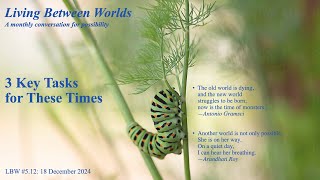
Gil Friend leads a conversation on living with dignity during political and environmental crisis. Three tasks emerge: resist power grabs, build community locally, and invite others in. Participants discuss mutual aid after disasters, bridging generational divides, and practical preparedness.
Chapters
Welcome, Everybody. This is December 18, 2024. This is the last session of the fifth year of living Between Worlds, a series of conversations for possibility, exploring together the experience of living between worlds. If there's any doubt that that's what we're doing, we know that now. Living between worlds with grace and dignity and power. We are about four and a half weeks from a moment in history. The worlds that have been changing these past month or so will change formally. We'll see what happens to the 250 year project that is the United States of America. We'll see what happens to 50 years of social progress that most of us have lived through and perhaps taken for granted and will now find that we cannot take for granted. So today we wanted to explore this moment, these times, how we are doing what we're doing, how we're orienting ourselves to this moment. Next month, probably we will dive more specifically into what this means for the realm of sustainability, sustainable business, regeneration, climate, and the larger project of belonging to the living world, which all of which are dear to many, if not most of us. On this call. This morning, I was in a study group reading the teachings of a guy named Kalman Kalanimos Shapira. He was the rabbi of the Warsaw Ghetto. 42 years ago, in January of 1942, the Nazis began closing the game down, closing Jewish shops. In the middle of the year, they started deporting people to Treblinka. Eventually, 80% of the population of the ghetto was deported. And Rabbi Shapira continued to teach week after week, teaching from Torah, grappling with the ground, moving out from under him, moving from a sense of divine justice in the world to a world that didn't look like that at all. Struggling to find a way to maintain his connection and his contribution to his community, he declined several times offers of being rescued and evacuated and taken out of the country because he felt a commitment to his community. In the teaching we were reading today, he talked about the challenge of, of generating grace, of not just, not just being uplifted when you have a divine intervention or some blessing from outside of yourself, but the challenge of finding, finding resources, resourcing yourself in the face of enormous challenge. Kevin Jones, who's often one of our participants here, I think is not with us today, lives in western North Carolina in the area of Asheville, the Swannanoa River Valley, which is, as you know, was devastated by floods just recently. People complained at them, like, why did you move there if it's hurricane zone? Well, it's like 300 miles from the ocean, 3,000ft elevation. It's not hurricane zone, so it's. So it's the world that's turning on its head that we're in. And Kevin observed that in the face of the massive disruption, loss of power, loss of water, loss of sanitation, loss of transportation, loss of communications, there was a remarkable experience of the community pulling together, providing services that FEMA couldn't provide. By the way, FEMA was not absent, as some news people reported. It was quite present, but the community Voluntary Collaborative association was able to do things that, that FEMA couldn't do. And Kevin has reported a great sense of blessing in being there in that disaster. In fact, it was even joked about developing a disaster tourism industry so people could come and visit and see what was possible in community. And that's kind of the direction that we want to go today. Looking at us here and now in this time, in this time when there is for many people a mood of what I'd call premature surrender, a despair that is partly, you know, partly based on personal interpretation of what we are seeing around us, partly a despair that is very in, to my mind, very intentionally manufactured, generated for us by the media as willing accomplices to more purposeful political despair generators to, you know, to, to. To propagate a sense of helplessness in the realm of sustainability. There's been very selective reporting. Many of you I know have seen the reports of backsliding on ESG and climate commitments, companies who are either shutting down diversity programs or restating their climate goals. And that's all the news. But as someone posted just a couple of days ago, 450 out of the Fortune 500 have not done that. That seems to not be news. Quiet, continuing, staying the course, doing the work is not the kind of stuff that garners headlines in the land of if it bleeds, it leads. And there's good news in the mix here. The Montana Supreme Court just, I think this morning or maybe yesterday, held that the state constitution, Montana right, red state, conservative state, state constitution, protects the right to a stable climate system and struck down a state law that barred consideration of greenhouse gas emissions when permitting new fossil fuel projects. So the news is a mix, and it's important that we pay attention, that we pay attention to what we pay attention to and understand our sources and where we're turning our attention. Joel McCower just published a survey of sustainability professionals, kind of where we are in this moment. Only 8% are folding. 92% are, with varying degrees of stress and enthusiasm, staying the course. I got A remarkable letter last week from a colleague of mine who's a senior sustainability executive at a very large international company, really in considerable pain, not just at the. At the. The shifting landscape of strategy, but the message that he was getting loud and clear as well as subtly, to not engage in politics. And I asked him if they told him what politics was, and he said, no, they didn't. So it's basically a message. Just, you know, the message was, keep your mouth shut, just do what you do. And he said, well, what I do is generate business value for the company by paying attention to these issues that some people are calling political. So what do we do? And had a long and interesting conversation about that. Representative of, I think, the conversations that a lot of people are having these days. You know, the Sarah Severn, who used to lead sustainability at Nike some years ago, used to talk about the story of the Shambhala warrior, the. The myth of the Shambhala warrior or something in the Tibetan Buddhist legend. The warrior who invisibly embeds themselves in the palace. They're not seen as who they are. They don't speak out about what they believe in. They quietly go about the work from the inside. And that may be the job for some people in these times. We are all acculturated to performative action, and we're in a time where strategic action is going to be increasingly important, may be separate from what we say publicly. We'll see what is required of us there. My cosmologist, astrophysicist friend on the call this morning reminded us of the importance of thinking in fighting fascism. One of the things that fascism thrives on is getting people to be afraid to think. So it seems to me, and this is part of my provocation for this call, is that we have three key tasks in these times. One is to resist the power grabs in court, as they did in Montana at the ballot box, of course, in our information diets, as I spoke about a moment ago. And in our minds, resist the attempt to take over what we think, how we think, what our moods are, how we communicate with each other, where we place our hope and despair. Second, the job, as it's always been, is to build the world that we want, wherever we can, wherever we are, in community, in workplace, in our relationships, in ourselves. Which means what? Which means in our moods, in our interpretations of what we encounter and the conversations that we have in the commitments that we make. And with that, it's to inspire and invite people, to find common ground around common cares, to join together in what's in the many things around the world that are already working, that don't make it into the major news headlines to protect what's already under threat and to nurture a world that works for all. To me, that's the baseline agenda for us all in these years to come. So let me ask you, what does this provoke for you? We'll take a few minutes, we'll take about 10 or 15 minutes talking together in plenary. Then we'll go into some breakout rooms so you can talk more, So that more of you can have a chance to talk with each other and break out. Then we'll come back together and harvest. So shell first hand up.
There we go.
Kegs.
Yeah. So I have been hearing from a number of sources the importance of not prematurely giving in. And we just saw a really, really bad example of prematurely giving in in ABC's total capitulation to a lawsuit that Trump was not likely to win against them. I did read, I think with Scott Dworkin might have been Mark Elias, one of those, like election gurus who gave some reasons why they might have wanted to do that, largely having to do with Disney, HBC's parent company, having many interests that would be vulnerable if Trump went against them. So even though they were positioned well to win this lawsuit, they decided to the hell with it, we'll just pay him. It's chump change for us. $15 million, very bad precedent, obviously, but this, the key to the resistance is, is not giving up, is, is not saying, oh, he's going to make us do this, so let's do it. First. Christopher Ray, why is he resigning already? Why doesn't he wait, get fired, collect unemployment, fight it in court, you know, make life a little rough for Trump. So when we bend over backwards to appease the dictators, it doesn't work with schoolyard bullies when you're five years old and it doesn't work when you're grown ups and your voters in this republic of ours. There's also a lot of under the radar organizing going on. People have no idea, if they only rely on the mainstream media, that the movement has not crawled into a hole and gone away just because we lost the election. There's tremendous stuff going on with various indivisible groups and swing left and asclu and on and on and on and on and on. Groups involved with the Palestinian cause. Lots, lots of stuff going on. Feminist organizing around abortion rights here in Massachusetts, we've had the state government step in and I think you have as well in California to try to protect some of these rights that are at risk now on a federal level. Just today, our local sheriff in this county, who is not particularly progressive, said, well, it's against my state law to cooperate with ICE on this, so I'm not going to do it. So yes, and the other thing is, if people haven't read Daniel Hunter's 10 Things to Do, I don't remember the exact name because now that we've lost the election, go, go look it up. They're organized into basically four categories and it's well worth a read.
Thank you. Thank you. Shell. You may not have answers, but maybe tell us something about your mood in this moment. How are you navigating? GEORGE and then David.
I've been through this before and serve most of you. The 1980 election, Reagan, this feels very much like that. The 1979 energy plan of Carter called for 20% of our energy from renewables by the year 2000. And a variety of other things, some good, some bad, some good was he was also talking about insulating homes to higher standards, 90% of them by the year 1986. So when Reagan got elected, all of that stopped dead right in its tracks. And we went through that. We don't have I believe that because of that, Reagan killed us in terms of climate, among other things. And of course with Trump, we don't have 30 years left to waste. We don't have a day left to waste. However, my reaction this time around is very different than in 1980. My reaction this time is get to work. And for me, a certain amount of things are breaking open now in ways that they haven't for the last five or six years. Whether anything comes to that is another question. But for me, this feels like adding iron. Right. Adding more to what I already feel and to make it fiercer to do what I need to do to continue my job.
Right.
George, can you any perspective on why your reaction is different this time than that time?
I think it's experience. I also over the last few years, and also because of my character, I've always been more interested in direct action than in, in, in legislation, regulation, politics. And if you know the book Democracy in America question mark by Paige and Gillens, there's a 20 year study from about 1980 to the year 2000 of nearly 2000 public policy proposals. And what they discovered was that you can have a public opinion of over 90% for a public policy and that policy will get enacted 60% of the time, maybe. Right. So there has to be something different from electoral policy, from. From electoral politics. And some of that is the community that your friend found in North Carolina in response to devastation, which is what normally happens, as we all know from Rebecca Solnick's book. But we need that kind of mutual aid, we need those kinds of organizations and to focus only on Trump, to focus only on electoral politics, to focus only on what the media is doing. And telling to me seems to be a dead end. Do your work, do your work as well as you can, reach out to others. One of the things that I did since the election is calling friends and checking in, you know, has nothing to do with politics, has nothing to do with advancing any kind of idea. It's just, how are you feeling? Here I am. If you need me, this is where I'll be. Right to do those kinds of things together. You know, that seems to me to be the difference now.
Very good. Thank you, George. One thing that strikes me in the resonance of these elections, I remember coming back after a day of doing get out the vote work on election day in 1980 and coming back to headquarters where people were in despair at the landslide, at the Reagan landslide and something seemed off to me. And I found an old desktop calculator, plug in Monroe desktop calculator and ran the numbers and realized that the landslide was 17% of the eligible voters. I thought that was awfully interesting. Clearly a victory, but hardly a landslide, hardly a mandate. The other thing similar to what you're pointing to is that the work on the ground didn't stop. California continued. California was 10 years into its energy initiatives and continued continues to this day. Massachusetts, New York and others, cities around the country, grassroots organizations, all that there, different context, different capacity. But you know, and it took a while after the shock of the election to regroup and refocus. I particularly appreciate what you said about the deep value and power of the personal connection, about staying connected to each other in a world that is trying to atomize us. So thank you, David and Jan.
I'm less activist and less connected to activist communities than you guys. Pardon me, I've been ill and I'm most surprised by an extraordinary reluctance in mostly sort of suburban upper middle class milieu of people even willing to think or entertain the hypothesis that like Orban 2.0 is the game plan, you know, and to actually take seriously that there are very plausible risks of severe destructive action against their institutions beginning January 20th at noon. And that lack of thinking seems to be not so much engineered. And I'm really curious about your comments as some kind of echo of the response of like Hakeem Jeffrey saying, well, we're not going to be loud right now. We're going to see what happens. So there's a. But I'm very disturbed by how stupid social media discussions have been and also conversations I've had with like my partners, friends and associates in suburban East Bay. So that's just sort of checking in from the field, from the citizens citizens group here.
I would be careful, David, about generalizing about social media. Well, depends where you hang your head.
There's, there's pockets of excellence on Facebook for sure. X seems now to be a political influence operation dominated by tools to make people stupid and not think. So that is a more precise response.
John Ballard. Thanks, David.
Yes. Hi everyone. Happy holy days and holy nights. Just a couple of thoughts. One is just in context. We've got a hundred years of propaganda now since the book Propaganda came out. So the conditioned stupidity and lack of thought has been, you know, 100 year project so far, I think. I also just want to ask, I mean, I guess just say that if you want to understand what we're up against. The Washington Post magazine, Times magazine, did an article by Jonathan Greenberg. I don't know if any of you know that name. Jonathan was the person who put Trump on the Forbes 400 list that Trump convinced he was worth. He tried to join it saying he was worth 400 million. Jonathan figured out that he was down, got him down to 90 million. Turned out, years later, he was actually worth less than $5 million. And then he used that membership instead of bank statements. But the other thing that's really important and the reason I recommend this article is because Jonathan gives a blow by blow description of how Trump basically uses the same models that are used in the Beltway, which is control files. If you want to understand why Ray and what's his name, the AG who, Garland and all these people. What Trump does is he basically finds the family members of these people that are vulnerable and threatens them. And so if you want to understand why people are caving, that's often what's happening in the background. There's a whole world of this. And I really know about that because I spent 18 months rescuing Catherine Austin Fitz from her enemy of the state status. And in that process, I learned how things really work inside the Beltway, which is, which is this whole layer of, of, of it's called kompromat in the Russian language. So we need to understand that these kind of pressure tactics are, are what, you know, the mob boss from Queens has been doing all along and that, that's, that's underlying things. I guess the only other thing I would say is that the last three or four months I've been absolutely blown away by the Internet Archive and what the Archive does and has been doing. I really had no idea that there were a hundred people with a $20 million budget, basically being the library of humanity and being the, the brain of the whole human race. And fascinatingly, the Internet Archive is quite famous outside the United States, but not that well known inside the United States. Although literally I walk around with this branding on the last few months and people walk up to me almost every day in a public situation and say, oh, I didn't know the Archive, what had a data center in Canada. Oh, I use it every day. And, and I have people walk up to me who've never heard of the Wayback Machine that use the Archive constantly. So if you all are not aware of this organization, I feel like it's the most integritous existing Commons on the planet. And I just encourage everyone to learn about it. If you don't know, use it, tell people you're using it. The Archive has been under massive attack. And so that's, that's, that's just the direction I've chosen to go in the last few months. For those of you that live in the Bay Area, if you call on a Wednesday, they'll feed you lunch and you can sit in on the staff meeting at 300 Funston on Fridays. It's one of the most impressive organizational things I've ever seen. So I don't if how many, I don't just poll of hands. How many people know what arXiv.org is and what it does? Yeah, not, not too many. So I, I just encourage that. The last thing I'll say is that at this point in, in the digital reality, many people are not aware that it is actually impossible to send a message with an attachment and know that that message came from the person that says it came from and that what was attached actually is what they intended to attach. There is no digital verification or authorization possible in the market today. And just for me personally, that's what I've been focusing on is solving, solving that problem and hopefully having some things to say in Q1 about how we're going to solve that and give a digital address, digital name and a digital birth certificate that's validatable digitally to anyone and everyone. So that's, that's the direction I've chosen to go with commons.org in the last.
Three or four months given.
Thank you for that, David. Coming back for another round here, let me. Before you speak, let me just invite anybody else who'd like to speak. Just pop your hand up and take a turn before we go to breakouts. No. Okay. Ken over you.
You know, I, I am in a altered space these days. Sure. It's a little bit psychotic, you know of. Oh, I gotta focus on what works and oh my God, what's coming down the pike here. I mean we have a man who's documented. What amazes me is, you know, documented lies of over 30, 000 times went off as the first time and yet people bought the lie that he's gonna bring the prices down. He's like, well you know, once they're up there, it's hard to bring them down. I'm probably not going to work on that, you know and wait, you can't go back on your promise. Man doesn't know how to keep his word and yet people voted for him. I still don't understand why, how he got in there. I'm really. It boggles my mind and I can see a lot of reasons why it did happen as well, so. And you know, with regard to. I am one of the world's great appreciators of appreciative inquiry. I constantly work with clients on what's working already. What are your strengths, how can we build, do better here? But I think we all need to take a very hard look at ourselves and what's happening on the planet right now and say the billionaires have won. They are controlling all the big levers of power and we now have people in there who do not give a shit about anything. You turn me on to Bruno Latour's down to Earth where he says, you know, the, the elites of the world decided in the 1980s there's not enough to go around in order for them to maintain their lifestyle. So starting with Reagan, they said we're going to shred the social safety net. We're going to fund a very sophisticated campaign of climate denial. We don't care if there's an explosion inequality because we want what we have and we're going to keep it going. And the more I study that and the more I look, the harder it is to refute that. So I think we need to realize we're up against some very nasty ass shit that's coming down the pike. And how do you prepare for that? I posted a Jonathan Haidt article from a couple years ago in the Atlantic called why the last 10 years have been uniquely stupid, which breaks down what's happened to social media and why, why things have gone the way they are. So I'm like connecting with people. I'm, you know, as, as George said, I'm, I'm talking to people. I'm not spending my. I've resigned from social media except LinkedIn and I go on there maybe a couple times a week. I'm reaching out, I'm talking to people, I'm talking to friends. I'm saying, how are you doing? You know, what can I do to help you and how can you help me? When push comes to shove, it's going to be, as Kevin Jones discovered in Asheville, a disaster economy. You're going to have to rely on your neighbors. You have to rely on people that you've not had rely on before. I'm a member of the, I took the community emergency response team training several years ago and I tried in my neighborhood to go around and ask people, would you be interested in joining a emergency response team? And I. Door slammed on the face. I don't want to talk, I don't want to talk to anybody, you know, well, you know, I live in earthquake country. I may have to come and pull you out of your wrecked house. Don't you want to know who I am? So community building to me seems to be a core theme for what's coming on the next few years and working locally. And I have the most influence locally. I know my politicians, I go to city council meetings. I know a lot of people here, so I work with them. And I'm like, what are you going to do? And they're like, we're going to work as hard as we can, local level. And we really don't have a lot of influence at the, at the federal level. So that's what we're going to focus. And you know, when I, I'm practicing the Serenity Prayer a lot, what are the things I can change? What do I have to accept that I can't change? And how do I know the difference? And then working on what can I actually do? So that's just where I am these days. That's, that's my mood. And I don't know if that's the best strategy. It's certainly not a grand strategy for fixing things, but it's what I have available to me.
So with, with that in mind, let's, let's go into breakouts. Let me just add 1, 1, 1, 1amendment, Ken, to what you said. The Billionaires have won for now. If we look at the sweep of human history, we see that none of these victories are permanent. Tides change, power topples. We don't know how long, we don't know how much damage is to be done. But I want to want to be careful about the Billionaires have one, therefore surrender, which is actually not what you said. You said, therefore, let's focus.
I didn't say surrender. I just said prepare, you know, strategize. What are you, how are you going to handle what's coming? Don't surrender by any means.
So the questions we want to invite you to discuss in the breakout are, you know, what's your, what's your, your stance now and your strategy for coping and for contributing, as several of the people who spoke already have said, what's important in the groups that you're involved in, whether formal groups or informal groups of relationship? Where do you go for support for yourself? What can you contribute to the people you have associations with?
Welcome back. I hope you had good and stimulating and productive conversations. Anybody care to share anything they heard or something that delighted them, surprised them, made them think more deeply about something they hadn't considered before?
Gil, you're muted. Let me just add to that. Ken, I really want to encourage you to share what you heard, not what you said, but what you heard.
Well, I heard Joni talk about living in a purple area of a red state and looking for shared values. And I think that's something that we can all benefit from figuring out how to do.
Thank you, David.
I think both breakouts I was in, the other five people were all focused on local things that they can see and do in person for the most part, and a certain lack of venturesomeness about how coordination across larger geographies might be a good use of their time at this point in their lives. And I we're talking about reporting, but I couldn't but think of the concept that I learned from Michael Lerner of surplus powerlessness.
You want to share just a line or two about what that is?
Well, you'll hear it in different forms, but it's basically that it serves the interests of the powerful of a system for everyone to think that they have even less power than they do. But we're in fact, in a democratic republic, there are plenty of examples of incredibly insistent minority movements. Best case would be anti abortion rights, doing a long, long fight and basically winning through determination and completely owning the limited power that they have.
George, there's also pluralistic ignorance. The idea that you're the only one who holds that opinion when actually there are a lot of people around you that agree with you that you don't know about. So that sort of dovetails. The thing that I heard was how many people are involved in emergency and disaster response, getting ready. Yeah, Brad, you know, and, and Ken talked about it as well. And I, I think that's very important, especially when you start doing that within the context of how do we mitigate and adapt to climate. And there are many, many practical and profitable things that people can do in order to carry that forward.
One of which is having people surface their assumptions. I've talked to people who say, well, I only need water for two or three days because then they're going to come around with water trucks. Right. It's like, you know, I live in Marin County. There's, it's, it's huge. It's a tinderbox. And we have a lot of little narrow roads up mountainsides where as soon as somebody panics and drives into a ditch, everybody behind them is blocked. It can, a fire starting at 101 can reach the top of Mount Tam in 45 minutes if the wind conditions are right. So that means a whole lot of people have to shelter in place. They're not prepared for that. People don't have the supplies they need and they think, oh well, they're going to come for me in a couple of days. No, they will not. You're on your own. You talk to fire chiefs right here, they're like, make sure you have two weeks worth of water on your own. So just, that's one of the basic things you do is, is get two weeks worth of water and two weeks worth of food. Then you have a little bit of cushion. It's not enough, but it'll be enough to at least see you through.
And if you, how much is one.
Person, two weeks of water for 1, 2, 2 gallons per person per day. And that means not bathing. That's basically cooking and drinking. Okay.
You want people in western North Carolina were still getting water packed in by mule train two months after.
So, you know, one of the things we have is we have a shared, we have a neighborhood association that's got a bunch of shared stuff. We have a shed in the local park with a bunch of generators, with blankets, with, you know, water, not food, but you know, work with, set up little co ops with, with people, you know, get a bunch of households together and make sure when you buy your mercy food, you put some stuff in there, you want to eat, you're going to get tired of sardines and pasta really fast. So get some chocolate in there, have a few things like, okay, tonight we're gonna actually have something really good, right? Because it's gonna get very boring if you're eating the same old stuff every day for a month.
But boring is better than starving.
Boring is better than starving. You'd be surprised how long you can go without food, but water is key. Water you can go 10 days without food, but water you're gon to. You're going to need that within two days for sure.
Two to three.
Yeah. Brad.
Yeah.
So in, in our group, David had sort of recapsulated things at the end or synopsized and he said something about a feeling of resignation. And I didn't have time to respond to that because I needed to look up the definition of resignation to make sure I understood exactly what that meant. Number one, an act of retiring or giving up a position. But the one I think he was referring to, number two definition, the acceptance of something undesirable but inevitable. And I'd have to say, David, I'm not resigned. Yes, undesirable, I don't like it. But it's not inevitable that everything that Trump said he's going to do is actually going to happen. In fact, if you want to be really rosy about stuff, I see a resurgence, resurgence of 60s style, you know, protests people in the street who never were in the street before. My daughter, 32 year old daughter, who's never done a whole bunch of political stuff, even though her mom and I are very 60s hippies. She might get involved in that kind of putting your body out there like she's never had to do before. Because in my opinion, it's the young people that are going to start to have to make the difference here. Us old folks, and there's a few quite older folks and quite a few of us on this call. We've been trying for 30, 40, 50 years and look where it's got us. So maybe we're not doing it right. Maybe there's other ways that will emerge out of what's happened. Maybe getting Trump elected is the best thing that could have happened because it will spur so many new people to realize what a jerk the guy is. And finally their eyes will open and they'll go, oh my God, I can't believe I actually voted for that guy. I had the wool over my eyes, it's been removed and now I see things. Who knows? So inevitable. Nah, nothing in my opinion is inevitable. I like to think that I'm going to wake up every morning when my alarm goes off. But it's not inevitable.
Thanks, Brad. Please. Yeah, go ahead.
Can I just jump in for a second before you speak that. Okay. I think what you said is really important, Brad, because the, the mood of resignation that you're talking about is not just the, you know, the feeling. It's not just about something that is, that is what you said, undesirable and inevitable. It's saying that something is undesirable. It's believing that it is inevitable. That's what resignation is. And as soon as you start to make a different assessment, like you just did, well, it's actually not inevitable because then the resignation shifts and something else opens up. And what you talked about, about the work of the last 30, 40, 50 years, I would not say that we've accomplished nothing. I would say we've accomplished an enormous amount. I mean, the transformation in this society of the women's movement is huge and may be taken for granted now, but for those of us who've lived through the arc of it, we see that it's huge. Race relations still problematic, but huge shift. Climate change in a mess. But, you know, we're in more trouble than I thought we would be in 20 years ago. But we're further ahead than I thought we would be 20 years ago. Renewables out, competing fossils everywhere on the planet. Coal plants being run by solar. There's like a little picture of the economics and enormous backsliding ahead of us. So lots of accomplishment. History goes in waves. It's up and down. And even authoritarian regimes don't last forever, nor do democracies. Aristotle warned us about that. But it's a dynamic game. It will move. And let's see what our role is in it moving. And I thank you for your patience.
Let me throw a quick quote from Tom Alley in here. Everything is getting better and better and worse and worse, faster and faster and slower and slower. So if you Venn diagram that, where's the place to stand? Where do you go on?
So what I heard from several people in the two groups, this, what Ken talked about, the. The return to a sense of what can we do locally in community. I am also mindful how difficult it is for some people to start showing some signs of solidarity. And my sense is that if times get a little more difficult, including on the material side, maybe some solidarity is going to emerge. I don't wish it, but it may happen. My sense also is that as I was listening, there have been examples of societies that lived in a different relationship both to each other and to to nature, such as the indigenous tradition. So how can we rediscover a sense of kinship both around us, in the nature we live in and the and with the other people? And my sense is that we. Probably needed this period coming up to shake us up more. And it's going to be very costly and very painful. But my sense is I've been living in a bubble myself, a liberal bubble, progressive bubble, and I'm going to try to connect with people in Portland who are thinking differently and viewing things differently. And that requires an effort. So that's a couple of things I want to say. And in the Elders Action Network in which I belong, we are promoting the art of difficult conversations or living room conversations, if some of you are interested. They do an excellent job in helping people connect to others that are of different opinions than they are. And we're going to need that so much in the next few years.
And could you put a link in the chat?
Yes.
That's very valuable for people to know about you. Also, I was reminded, listening to talking about about examples of different societies doing different things in different ways of the book the dawn of Everything by David Graeber and David Wingrove. If you're not familiar with it, people, I really encourage you to take a look at it. It's long and challenging, but it's a very different interpretation of human of the last, what, 50,000 years of human history and the experimental nature of human societies, the enormous range, the enormous variety of the ways that we had organized ourselves and played different games at different times. It's, for me, it's an enormously heartening book and pocket a very different interpretation of history than what I was raised on.
Will you put that in the chat.
Deal as well in the chat right now? Thank you, John.
Yeah.
Two.
Two things come up. I. Thanks for the everybody's thoughtfulness. One is that I'm reminded that in the organic learning process, regression is always a part of it. And it seems like that's kind of what we're dealing with here is a, you know, it's been a century almost since FDR and Wallace. They plowed under a million acres of cotton and slaughtered a million piglets in the south to restart the U.S. economy. And people have been pissed ever since. So we're seeing this back and forth. But the regression is critical to the full learning getting instantiated, it seems like. Anyway, the thing that I wanted to say that I haven't heard yet today, which I think is crucial is the whole notion of how we move from silos by age into multi general multi generational circumstances. And I'll just share for myself personally, I've actually found a couple of people to work for. One of them's 25, the other's 32. And I am on the steepest learning curve of my life from an emotional literacy point of view. And I'm just personally as a 70 year old, you know, sort of classic WASP person who, I grew up outside the US which gave me some advantage. I am just so impressed and amazed by the emotional literacy and, and just the way that people in their 20s and 30s are interacting with the world. And I'm, I'm, I'm just, I'm, I'm restarting therapy. I'm doing a bunch of things to actually be able to be a part of that and really function in a multi generational context, which, you know, if you look into any workplace, the siloing of people by age and their worldviews is pretty horrific. And I think it's an underlying pattern here that we tend to talk to people who are more in our range. And I just encourage all of you to get connected with 18 year olds and 25 year olds and people in their early 30s, because they're really in a whole nother place that I want to get into. And I'm, I'm giving myself six months or a year to kind of catch up, if you will.
John, I'm so glad that you're bringing this up. You know, none of us is as smart as all of us, you know, and it's not just the, the divisions that you're talking about, but, well, you know, you see it in the social media. You see how much we're being divided by age. You blame it on the boomers, blame it on the millennials, blame it on the other. Blame it on the people who are not like you, who are going through the same stuff that you're going through. Because if you shared that you were going through the same stuff, you might be a different kind of political force than if you did at each other's throats. Yeah, yeah, older people are more powerful, but it's not all of the boomers who are more powerful. It's a very small subset.
Right.
Political power, economic power, and so forth. Most are in the same mess as everybody else and so careful for the game. The opportunity to, to be with others is huge and to find common cares and concerns and different interpretations about the same stuff. I think we talked last time about how AOC discovered there were people who voted for her in her district who voted for Trump. And she was astonished, but didn't stay astonished. She went out and had conversation with them to learn about what they did and why and how they interpreted things. And these were not, you might expect, you know, knee jerk, racist, misogynist responses. These were not that. Yeah, they're thoughtful people who cared about people and their families and different ways that they saw the game playing. The conversations were rich and powerful.
And I'll just.
I'll just wrap up by saying that I've been really sort of perversely enjoying feeling like the youngest person when I'm interacting with someone who's a third my age and. And just really appreciating how these younger generations have. Are mature in a way that I'm.
Not yet and want to be. Before you go, I just want to throw a little thing out to the group. I know we have a few people who are not based in the US Here, and it's a pretty US Centric call so far. So I invite you, when Shell is done, to please speak up and throw your perspective in so we can get to know what's happening. People who are looking from the outside. If you would. If you don't mind doing that. Please, Shell, please.
Yeah, I want to echo what Jan said. I have always in my life had intergenerational friendships. I actually was friends with Dave Dellinger and some other prominent peace activists who were 20 to 40 years older than me. Now that I'm almost 68, I have friends in their 20s and 30s, and my friends who are 20 years older than me have mostly passed on. But I did have a couple who made it to 100. And I've also. I think it's important to get out of other kinds of silos. As a Jew, I have participated in dialogue groups with Muslims and Arabs on Middle east issues. As a white person, as a male, as a person who identifies as lgbt, but who from the surface, looks to be a typical heterosexual. I'm always looking for ways to have conversations with people who are not in the same set of boxes that I am. I am in the two activist groups where I'm really involved. One is Clamshell alliance, the old anti nuke group from the 70s. We're back. And the other is a group called Jewish Activists for Immigration Justice. I'm one of the youngest people, and in J. The only one younger is my wife, who is six months younger than me. And we've not had much success reaching out to the younger people, Clam is a little bit more diverse, diversified, but still most people are in their 70s and it would be good to break out of that mold, especially as the people who were a generation or two ahead are dying off. So we have to look the other direction right now.
Any non US based folks want to speak up, you don't have to, but it'd just be lovely to hear. Perspective, Please, Michael. No man is an island, but every community is essentially an island. We're all in little isolation. So those of us who are outside America, usa, feel like we're outside there, just like we're outside that and we're outside the other and we're outside everything because it's always about inner and outer. Right? What is my affiliation, my association, what can I rely upon.
That hopefully goes.
Beyond the social identity, the learned experience, the extended family? We've got to come together in numbers of thousands rather than numbers of hundreds. So it's about learning to be together without knowing how and why. And I think that's the same everywhere that's on our island anyway. Run my world. Thank you. Thank you, Michael. Thank you, Alistair. By the way, Michael, he may not. He might sound like he's from somewhere far away, but he's actually living in Canada, so. Alistair, please.
Thanks.
Yeah, someone thought about being in a liberal bubble, and I am in a somewhat liberal bubble. I'm also in a comfortable bubble, you know, where I'm personally comfortable, you know, not living in a war zone or even poverty or anything like that. And it's not just me, but the people around me are also comfortable with the sage as well. Yes. We've have thoughts about how to get out of a comfort bubble and go beyond just talking about getting into action. I'd be happy to hear from you. Yeah. Get your perspective about that. Thanks.
And Alistair, you're in Malta, is that correct?
Yes, yes, in the Mediterranean.
And can you give any kind of sense of what people are saying over there, like what happened to America or, you know, what, what's the mood over there when it, when it comes to what's going on here?
Well, the people that I know, yeah, many of them, because I'm in a liberal, probably, I can say, well, you know, you know, the, you know. Yes. That Trump, you know, is terrible, you know, and this is not going to be good for the US or for the world. And I also know people who, you know, Maltese people who are celebrating Trump's victory.
So.
Yeah.
Thank you.
Thanks.
Bill, you want to take us home here?
Yeah, let Me just quickly tag on. I'll be, I'll be super brief but because I'm also over here in Switzerland and just to echo Alistair. Yeah, basically what you, what you shared at the start that people here being comfortable and, and you know, the status quo is. I mean, but I don't want to go too long here, but I mean, Switzerland is in Europe but not part of the eu, so. And I'm also not a voter here, so I don't follow so closely the local politics, but we are sort of more literally in the shadow of some. Some things brewing further east. And I just, you know, I thought to bring. Bring in within the last six months or a year, this just appeared in the mail and in my, in my post box and it's iodine tablets just in case of emergency. And there was not really any much more communication or there's a kind of instruction sheet but, you know, nowhere's really, you know, we got the mountains here and maybe we won't deal with sort of the, the rising waters or the. I mean, the glaciers are melting here anyway, I'm going to yield the floor, but I just wanted to bring in a few things from, from where I am.
Charles, good to see you.
Thank you. I don't have a tidy ribbon and a bow to wrap this up with. I have real gratitude for this last round of conversation and what you've all shared about, what you've heard and the perspectives that that reflects for me. And there's a lot. I want to go back and listen to this recording because there's a lot to harvest here. I'm just looking at my notes. Some things that jump in, you know, listening for shared values, getting beyond the bubbles and the islands that we're in. Very present question for me as somebody who lives in a bubble. In a bubble, in a bubble. And so I make efforts to listen beyond that, not just as reconnaissance, but also to open up the possibility of actually being affected and changed, which is scary. You know, it's not just let's have living room dialogues to speak with the other to convince them that we're right, but to find common ground which might involve all of us moving in some kind of way. That's, for me, it's a, it's a. It's a scary and uncomfortable and intriguing thought. A number of you have talked about the importance of local action, local solidarity, local care, which, whatever your interpretation of what the political landscape looks like, is not a terrible idea. Yeah. Like, you know. Well, you know, here in the San Francisco Bay area, We know to be prepared for earthquakes, although most of us are not.2%, according to the Red Cross, in a situation where the risk is clear and the. And the strategies are absolutely clear, 2% ready. That's not even counting the tornado warning that we got last week and the tsunami warning that we got the week before that. So there's that. George has often talked about civil defense. And, you know, I noticed you may have seen in the chat, George talked about from a martial arts perspective, resistance may not be the right word because resistance doesn't get you to safety, but neither does passivity. It's a. There's a dynamic non resistance. It's not. It's not a surrender non resistance. It's not a passive non resistance, but it's not, you know, not feeding the conflict head on. Although, you know, there may be times where we need to gird our loins in the next couple of years and have difficult, difficult conversations and difficult places to place our bodies. And Elaine talked about the importance of solidarity and examples of different societies, how different human constellations have fostered sense of kinship and collaboration and possibility. I think those are all important for us now. We've got. There's a lot of resources in the chat today. Encourage. If you haven't done that yet, download it now. Use the three dots at the top or bottom of your chat window to grab that. We won't share that. We will share the recording probably within the week. And that's it. We will be back a month from today, third Wednesday of every month at noon Pacific time. That's January 8th. What is the date? January something or other. January. I don't know the date.
15Th.
Thank you. You're welcome. Five days before a moment in history. Let's regroup and continue this conversation and see where we are then. And as our usual closing reminder for people who are living in times of turmoil and hurricanes, before I go to that.
Is it okay, I'll read a poem.
Sure.
This, this popped up because somebody said, yeah, we have to remain calm. And so I immediately thought of this poem by David Ignite called the first on TV. A first on TV. For Walter Cronkite, this is the 20th century. You are there preparing to skin a human being alive. Your part will be to remain calm and to participate with the flare in his work. As you follow his hand the slow, delicate way, the knife between the skin and the flesh and see the red meat emerge, tiny rivulets of blood will flow from the naked flesh over the hands of the flayer. Your eyes will waver and turn away, but turn back to witness the unprecedented, the incredible. For you are there, and your part will be to remain calm. You will smash at the screen with your fist and try to reach this program on the phone like a madman, gripping it by the neck as if it were the neck of the flare. And you will scream into the receiver, get me station XYZ at once. @ once, do you hear? But your part will be to remain calm. So stay calm no matter what you see on tv.
And remember.
Go ahead.
Yeah, go ahead. You got it. And you can dance in a hurricane? But only if you're standing in the. You can dance in a hurricane? But only if you're standing in the eye.










