Diagnosing Capital-ISM—6 STRUCTURAL defects—Living Between Worlds 5.8
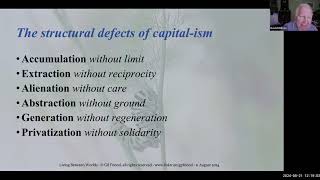
Gil Friend identifies six structural defects in capital-focused systems: accumulation without limit, extraction without reciprocity, alienation without care, abstraction without grounding, generation without regeneration, and privatization without solidarity. Participants explore what nature would do and connect these defects to accounting practices, financialization, and water management in California's Central Valley.
Chapters
All right, I'm gonna let people in. Yeah, let them in. Foreign. I'm Gil Friend, and this is Living between Worlds for August 21, 2024. We're well into the fifth year of these monthly conversations for possibility about. About living between worlds with grace and dignity and power. And delighted to have you here with us today. As some of you have seen in the emails and posts that I've published about this session, we're going to talk again about capitalism, which I hyphenate. I'll come back to that in a moment. Capitalism is back in the crosshairs in ways that we haven't seen, at least in the US in my lifetime. You know, disaffected younger people, of course, but even the editorial board of the Wall Street Journal seems to be inadvertently quoting from Marx from time to time. There's been a rising momentum for reform. Democratic capitalism, stakeholder capitalism, ecological capitalism, conscious capitalism, multi capitalism. How many others? You've probably got a long list of those. But it has seemed to me that all of these fail to rigorously address the structural defects at the heart of capitalism. And let me be clear. When I say capitalism, I don't mean markets, I don't mean commerce, I don't mean trade. Those have been around as long as humans have been on the planet. Perhaps capitalism as a system is, what, 500 years old? And a particular kind of system. Where's my Wikipedia definition here? It went away. You know, an economic system based on private ownership of the means of production and their operation for profit. Yeah, but not just that. Central characteristics include capital accumulation, competitive markets of price system, private property and the recognition of property rights, voluntary exchange and wage labor, decision making determined by the owners of wealth or property. And more on that in a bit. So. More. More questioning about this system that so dominates our lives that, as Slavojo Zizek and others have said, it's easier to imagine the end of the world than the end of capitalism. It's such a pervasive part of the taken for granted background, or what Chauncey Bell would call the clearing that we live in. Yet, you know, in the times that we're in, we find more and more people actively imagining the end of the world. So I think that makes the topic live and relevant for us to look at right now. Brad Warren has reminded me over the years that prescription without diagnosis is malpractice. And a lot of prescriptions are out there about what to do. But I've been thinking deeply for the last several years into a rigorous diagnosis of Capitalism. Examining the structural defects, as I'm calling them, and seeing what prescriptions might emerge from that. So I'd like to do something differently today. I'd like to put you all to work with me. Buckminster Fuller, my mentor, used to say, famously, never show incomplete work. And my wife, Jane chastised me last night for preparing to do just that. But it strikes me that there's a real difference between showing incomplete work in an engineering design, which is the realm that Bucky was operating in, and incomplete work in the realm of human conversations and agreements, which only become complete or develop their completeness or enrich through the conversations we have together. So I want to take a chance with that and explore that with you. So why the hyphen? Why capitalism? Not just capitalism? Well, because of the fetishization of capital at the heart of the way that we play the game these last hundreds of years. Capital is one of the factors of production. Capital, land and labor is the classical formulation of it. But we live in a system that privileges capital, some would say fetishizes capital, elevates it above all other factors, and orbits all decisions around that which may be a problem. Right, Hang on. I'm just trying to get you back on my screen so I can see you all. So the reform efforts are band aids. They're attempting to mitigate the problem. But it's like. It's like renovating a house, remodeling a house, and you change out the windows, and perhaps you do put on a new roof. But what's the state of the foundation? If the foundation is crumbling, you're not going to put an enormous investment into fixing what lives above the foundation, because the whole thing may fall apart. You lose your entire investment. So. And yet we know that foundations can be rebuilt. We know that buildings can be designed to actually succeed in the conditions that they are placed in. So let me go through these six briefly. And what we're going to do here is I'll introduce these, we'll talk about them a bit, and then we're going to put you into breakouts and actually do some work around them. Okay, so, Ken, why don't you bring up the. I think it's the second slide. One of the things that I'm looking for with you is a sufficient is a minimal and sufficient list. I think, and I think this covers the basis fairly well. May not be final. So one of the features is accumulation without limit. I learned from Jan Honhart some years ago. He used the metaphor of a pride of lions on the African veldt. Going hunting and bringing back. Taking down the gazelle and bringing it back to the pride. And the lions will gorge on the gazelle. And what do they do next? Sleep? Yeah, they go to sleep. Do they? I mean, they don't go out and catch another gazelle and drag it back and catch another one and drag it back. They hunt, eat and sleep. Hanhardt called this the phenomenon of satiation, which is one of the characteristics of living systems, One of the ways that we find in nature. We don't see accumulation without limit. And we're going to dive into why in the breakouts, why and how. Second, extraction without reciprocity. This is a system that takes, does not renew. There are transactional exchanges of value, but not the kind of reciprocity that Robin Wall Kimmerer talks about in Braiding Sweetgrass. Third is alienation without care. And for the Marxist among you, this is a familiar one. But it's not just alienation of value from labor, as Marx classically talked about, but the alienation that people feel in their lives without the fundamental of care between human beings. Care is excluded. It's one of the things externalized in the capitalist framework as something that we don't care about, not caring about care. And yet care is fundamental to human beings and the relationships of human beings. And from a, you know, a purely. Well, from a capitalist perspective, it actually matters because care can add value if it's understood well. Fourth, and this is where a lot of my attention has been focused since the work with Fuller 52 years ago is abstraction without grounding. We live in a price system where prices don't reflect real costs and real value. We deal in the. In the exchange of abstract value, human interpretations of what's valuable. While in living systems molecules fit together or don't very direct. This is a system of generation without regeneration. We build stuff, but we don't reinvest adequately or sustain the fundamental source of value that enables the system to regenerate and continue to produce wealth ongoingly and privatization without solidarity. Some would say that one of the characteristics of modern capitalism is that it privatizes profit and socializes risk. And so what Doris Lessing called the substance of we feeling the we in this together, the taking care of each other, the that we understand fundamentally at the level of family and tribe and clan, but seem to lose in our larger formulations of humans is there. So that's where I am with this. Tell me, what does this provoke for you? What do these generate for you? What ideas come to you in terms of either how they resonate or what they're missing. Actually, let me ask the question a different way. Any insights that open up for you, any opportunities that you see that open up from thinking about these. And I'll, and I'll say, you know, we could spend a full session on each of these and we might do that at some point in the future, but today we want to kind of go into a high level and ask a particular question in the breakouts for you. So raise your hands if you're moved to speak, sit quietly if you move to sit quietly and cogitate for a while. And George, thank you for adding Gandhi's seven sins. You'll see some resonance. Okay, Alex, please welcome from London, But we will need your mic on. Sorry, my screen just went blank a second ago. I only offered to speak because I think there's a lot more to say about this. But when I was listening to all this, I got the feeling, and we. It's not part of the discussion today, but I got the feeling that we can talk about this and this might be that perhaps seen as the detail of what it is. But there's a whole plethora above capitalism of the, the state, political regulatory systems way over the top of it. So talking about capitalism in those terms is, is slightly sort of a microcosm part of it. But I was only going to say that because nobody else was talking, but okay, that's it. Thank you for putting that into the mix. Dave Wilcox These are all defects and there are many more. And there are positive aspects that are perceived as offsetting the defects. And so a capitalist basically is a net, net person. And the capitalists tend to essentially like to make the argument that they are benefiting society whilst taking advantage of these defects and presenting what they're doing without even mentioning them. And so you end up with this continuous stream of arguments about the positives of capitalism. While in many cases the advantages to the individual putting forward those arguments are by leveraging the defects. So it's a completely disingenuous system. And that's a real problem because it means no one is telling the truth. And if you look at subcomponents of capitalism, you'll find exactly the same thing happening in smaller components. And let me give an example. So right now if you ask the question, and my expertise is scale, so I'm always asking scale questions. So if you ask the question, what activity in capitalism is receiving the most attention and the most resources and resulting in the largest spend of human and intellectual effort, it's entrepreneurship, that's the big winner. Now you got to look at that and say, well, what is it about entrepreneurship that's advantageous to the capitalists? Well, it creates a hero mentality that everyone aspires to, and it creates this sense that anyone can be the hero. And it doesn't discuss the impact of the defects on preventing people from being heroes. And so you end up in a situation where the entire entrepreneurship system is built on this same lie. So how does it work? I come up with an idea. I go to the capitalists for money. I tell them I know how to implement the idea, which is a lie. I don't. And then I get the money from the capitalists who agree to play like they believe me because I'm somewhat more smart about making the lie than the other people that have lied to them. So they agree to give me the money. Now I. I go forward with their money whilst they watch to see how good I am at continuing this fraud. And at some point in the process, the truth of this situation has been branded, and it's been branded in a way that it's also viewed as being positive. It also doesn't mention the defects. It enables the charade to continue. And that brand is called the Pivot, and the Pivot is a branded recognition of the original lie. David, thank you for that. Yeah, presented in a positive way that obscures the defects. There's a lot there in what you said, and I'd like to return to that in another conversation. I'll just note for now a couple of things. One is that. Well, one is that capitalism has strengths as well, and it has value contributions as well. And it's been an incredible engine for innovation and some would argue, significant rise in standard of living, life expectancy and so forth around the world. Your model. True. All true. Yeah. And your model of you taking an idea to the capitalist to raise to. To raise money for your venture is one way to play. Another is that you just go ahead and do it on your own, accumulate value on your own and succeed either as an entrepreneur, as a capitalist yourself. So that too. So the. What you started off about, the net net of the benefits and defects is an important conversation, but not the one that we want to have today. Today we want to not try to adjudicate that equation, but to look specifically at the defect. So thank you for that contribution to this. And let me go to David Grossoff, and next will be on Ballard. Yeah, I'll just say that the structural defects list you have here can apply to Very heavy state planned economies as well as. Yep. More classic capitalist ones. Only the interpretation of privatization distinguishes it. And that's where you're sort of hiding class relationships as classically defined by Marx. Yeah, I think it's a good point. If you look at the history of the Soviet Union, they you know, ostensibly address the privatization and solidarity issue, although that's arguable. But walked into a whole lot of the rest of these. Right. So state capitalism was still capitalism. Jan. And then Tracy. Yeah, thanks very much for surfacing this conversation the way you have Gil. Just note that on my screen I can't see the whole slide. It's like it like expanded in size. So I'm only seeing like the, the right two thirds of it just in my. You may have come in late Jan. At the top of your screen you should have some Chiclets where you can choose the, the, the. The zoom view or the, or the slide view. Fiddle around. I'm, I'm choosing both. I'm just saying that in mine the, the, the, the slide is. Sorry, can't help, can't read the whole thing. It's all good. Help you there. The, the point that I wanted to make is based on my experience as a facilitator using the technology of participation since the mid-80s that the institute of Cultural affairs has been doing across the planet with tens of millions of at this point. And one of the things we're always looking for is what we call the underlying contradiction. So when we look, when we do, we do an analysis of what's in the way, what the issues are. Then we analyze the issue, try to figure out what the underlying conditions are that are driving those issues. And I would suggest that the fact that US generally accepted accounting principles are an almost hundred year deep fake that purport to provide useful information to internal and external states stakeholders, but in fact leaves out all the most important information. And I would say and John, that's what I'm, that's what I'm referring to when I say abstraction without ground. We have these exactly made up numbers that represent certain things. Right. And represent other things. And one of the things they don't represent is physical reality. Exactly. And so I would suggest that the entire conversation we're having because transparency is not practiced and in fact is actively suppressed in all cases. And I can give many examples where people have real. Is that not having the truth. This goes back to what's true. Not having access to the truth as a shared conversation about the facts in the technology of participation, you can't proceed with collaboration if you don't have agreement on the facts. And so the. By having systems like, for instance, an accounting system that no business in the United States gets a financial statement with collections on it. So nine out of 10 businesses go out of business in the first five years, even though nine to 10 of them have customers because they can't see the truth about their bank account until it's too late. That's just one example. But I would say of many. You know, you have the fact that everybody knows every. Every modern business person knows the catechism that your. Your most significant asset is your people. Right. Everybody will say, where are your people on your balance sheet? They're booked as. Liabilities are expensive, biggest asset booked as a liability. Makes no sense. Well, exactly. So. So I would just suggest that if you agree that the lack of transparency at every level means the real conversation can never be had. The biggest issue we're dealing with, the fact is that the conversation about what's true cannot be had with the existing structures. Which is why I've spent 25 years as the uncompensated skunk works for the AIC and I've put in place a balance sheet that has people in gross fixed assets, which is. Which is a good. I love to have a breakout of this conversation because I think if you simply went and looked at all the disclosure requirements that have been put in that nobody does so the truth is still obscured, this conversation would be transformed and still not. Not where we're going to go today. I just want to end with saying until the truth of the actual facts of the objective situation are available for discussion, none of this shit's going to change ever. That's my assertion. I'm. I'm for truth. And let's. Let. Let's talk about having another call that maybe dives deeper into that stuff today, we're going to go in a different direction. I think it's the underlying contradiction. Thank you. Okay, Shell. And then we're going to go to breakouts. Y. Are you still wanting to stay? There we go. Yeah. Tracy, she was actually in line ahead of you there. Oh, I'm sorry. Thank you. I missed that. Thank you. Tracy was. Yes. Plus it's really nice to hear from a woman. Right. Plus, hi, thank you for hosting today. Gill and Ken. Basically, let me just say we love hearing from women. I noticed that the women don't raise their hands as often as the men. So unless you want me to just call on women unannounced, I encourage Women, raise your hands. Yes. Okay, go ahead. So, again, thank you very much. I just want to add my 2 cents to the idea of structural defect. And I think you've got a great start here with your list. But what's missing for me is both the inequitable valuations and missing valuations. And there's inequitable valuations within humans and within the universe of life and capitalism. Right. We don't value all humans and all life, and then we're missing valuations in capitalism for a number of capitals. The two that are most frequently discussed, I think, are natural capitals and social capitals. So that would be my additions to your slide. Thank you. And those are very richly addressed in the multicapitalism work of Mark McElroy and a bunch of others. So, yeah, thank you for bringing that into the conversation. I will argue that those are important and valuable and not addressing the structural problems. Huh? Okay. Yeah. Shel. Yeah. So, number one, I want to say that the gap, if you will, between socializing problems and costs and privatizing benefits and revenue is, I think, a central point that activists can organize around. And number two, I'm going to be the counterweight to David Wilcox. He works on scaling companies. I work with tiny little organizations that often have one to 10 people, most of which do not need outside funding, so they can step out of that entire equation. Equation. And I think it's important to see that. And. But interestingly enough, I worry sometimes that in consulting on how people can start and run successful tiny businesses, I am in some ways removing a portion of the labor force available to do the work we all rely on workers to do. And I have grappled with that, not in a serious way for a number of years, but interesting to hear other people's thoughts on it. Shell, thank you. And we're going to just break the agreement that we just made about going to Breakouts and take Jane and Catherine and then go to Breakouts. Jane, are you still there? Okay, I'm here. I'm here. I wanted to add, there's. I don't know where it fits in the hierarchy of your list, but I think we're talking about nested dolls, like Russian dolls are nested. I think capitalism is nested within something that we can call the financialization of everything. And as a defect, it might be called a defect in human thinking and the difference between how nature works and how humans think, to quote Gregory Bateson on the issue of where human problems come from or where problems of the world come from. So maybe it's a bigger issue that this conversation fits inside of perhaps. Thank you. Thank you. Jane. Katherine, welcome. Yeah, thank you. I was just going to comment directly on your list of six potential structural defects as entrepreneur, founder, CEO. I actually find this list quite useful. With any list, any framework, we can all find fault or omissions. But I find each of these categories very meaningful in terms of what I have found as someone running a clean tech company. And so accumulation without limit, I mean that's a current issue that I think all of us are familiar with. CEO pay is a thousand X compared to frontline workers, 500X. That's a real problem. Companies are contributing significantly to the inequality in wealth. And as a company that I founded, trying to rectify that. Thinking about the ratio across compensation as a real issue that we need to look at throughout the economy. Extraction without reciprocity. I mean, think about oil, gas, other natural resources, the externalities that are not built into the cost of natural resources. That is a significant issue that plays out in markets. Alienation without care. And I can say a lot about that. But the value of labor and the fact that frontline workers typically don't benefit from the value they bring on the manufacturing line, on logistics, I've seen that firsthand abstraction without ground. Yeah, Prices. If you look at SPACs or valuations of companies that are so far and beyond what the true value of what they're bringing. And how do you quantify value generation without regeneration again, going to extraction, how do we keep extracting and there isn't an obligation in terms of regenerating the resources that we extract and burn through. And then privatization. Yes, that there needs to be limits on privatization and accumulation of wealth. And the fact that we do privatize profit and socialize risk, I mean, I've seen that firsthand in the clean tech energy sector. So I just wanted to give you feedback that each of these have a very practical role in what I considered as I structured company and I look at the economy as a whole. Catherine, thank you so much for that, both for your perspective and for grounding it in the experience of not just business, but of a capitalist. And you're detecting, as I do, that each of these defects implies a possible remedy. Right? I mean, if it's accumulation without limit as a defect, then something about limits is what we might need to be thinking about. And that's what I'd like to invite us to do together. I've been, I've been work, as I said, working on this for some time, doing some writing, diagramming Building a matrix, thinking about, well, like, you know, what are the, what's the direction? What are the, you know, policies, regulation, legislation, business practices, et cetera, that could address these, not at a superficial level, but at a structural level. And the question that I found myself in this week as I was preparing for today's conversation and the question I'd like to invite you into is this with a premise. The premise that I've been living with for my entire professional life is that, is that nature's ecosystems have 3.8 billion years experience in open source free R and D that is available to us about how to have resilient, adaptive, production, productive and sustainable systems. Right. You look around us, there's the evidence in the world. So my question for you is what would nature do? What would nature do about these defects? Or more exactly, what did nature do? What has nature done about each of these? So we're going to invite you in breakouts to ask and explore that question. We're going to divide you into groups, kind of what, I don't know how many people we have here. Like probably groups of four. We have groups of, got 12 rooms. So there's going to be groups of three or four people. And I'm going to put a link in the chat. But before I do that, I wanted to describe what's going on. So there we go. Okay, so you're going to go to. There's going to be a Google document and since we happen to divide into 12 groups, there'll be two groups each for one of the six points. And let me just say there, you'll see, when you go into a breakout group, your breakout groups are numbered. So if you're group number eight, go to the place on the Google Doc for group number eight, which would be. Yeah, exactly. Extraction of that risk prosthetics. So it's pretty clear. And then there's the questions. What would nature do about it? What can humans do? What's the business practice? What's policy, regulation, culture, personal behavior? Please, as you're talking, take some notes on that and when you get there, decide within the first couple minutes who will be your spokesperson for the group so that each group can come back and have somebody to summarize what you've come up with. Any questions on that? Let me just add one thing. So this is a process called brain writing that we got from Ralph Thurm at R3O. Rather than just speaking about it, take notes live as you're working in your group section, you can also scroll up and down and see what other groups are typing and then we'll do a harvest together. So it's an interesting way of getting a lot of thinking together. Pick a spokesperson, have your conversation make some notes and then distill something to bring back to the larger group. Is everybody ready? Anybody not ready, please give a shout out now. Okay, so click on that link now. Join your room, the breakouts. Off you go. I, I call that a good provocation. Welcome back people. Thank see more in about two seconds. We see signs of your activity on the Google Doc. So thank you for that. So we have 25 minutes and we have 11 breakout rooms. So if everybody takes two minutes a piece, that'll work. But I think that might be really tough. Is there somebody really has got something burning that they want to, they want to bring out that they discovered in their group. And let me suggest. Yeah, doing a pop up sounds like a good idea. Let me suggest for all of you if you can go through your notes, your own group's notes and bold or underline or italicize or color highlight the things you think are the most important things in there. So even if it doesn't get to be shared live in the room, we'll have that as a kind of on the, on the page summary from you. Okay, I see. Versus with a hand raised, Take, turn on your mic and take it away. You and your, you and your crew. Someone might have just highlighted like the whole dock or something. I'm not sure. Somebody did highlight the whole dock by accident. Yeah, it's gone. No, it's still there. So looks we were speaking about a lot of things. Yeah. And we started with generation and regeneration and it stemmed as generative being an act of the mind. And if we can accept mind as an emergent phenomena, can we accept AI as a emergent phenomena of life and nature? Can we see AI as nature? If we can see the mind as nature, ourselves as nature and then it goes on from there to seven generations. Yeah. Vs, I'm going to duck the AI conversation for today. I know, but, but I, but you know, I think you, you could certainly say that anything that human beings who are living beings in a natural system produce can be called natural, but kind of not in the sense that we're talking about it here. I get your point. Yeah. So why am I calling it out is because of. Because I'm calling it out. Because I'm calling it out because it was part of the conversation. But then there it went to seven generations and how what today capital is. And what seven generation consideration would account to. And then it came up to thinking about 500 years or really long term thinking. Yeah, but there was a fracture in that thought process because however further you like to think, you would want to think even further then, if that is the point and if what is present right now is offsetting, how do you make home in what is today rather than aspiring for 500 years that you are not going to be present for good? Thank you. The matter of time frames is not explicitly on my list, but it's clearly an important one. Thank you for sharing that, Dave Wilcox. Please. So Musan and I kind of did the talking and I have to say his work with the Lakota got us to answers really fast. And I don't know how to highlight. So the bottom line is. Tell us the bottom line for you. If you send a group of people out to hunt buffalo and they all shoot their arrows and spears and only one buffalo dies, there's no way the guy who killed the buffalo is going to get to keep it. Right. So that is such a incredible object lesson of the way the world worked when we were directly connected to nature. And we've spent centuries unconnecting ourselves from reality. And the example you're giving, it's not just about being connected to nature. It's very much about being. Being connected to each other. Both. Both. Absolutely. But they were interactive in that sense. Absolutely. I would push it a little farther because the question that I've been living in lately is not about connected. The question I've been asking is what might be possible if we did call it business and everything else, as though we actually belonged to the living world and belonged to each other. Let me finish and then I'll hand it back. Go ahead. The key word was containment. And he said the Lakotas understood because of their social relations and friendships that each of them had to be contained and had to exercise containment in their lives and in their living with each other. Right. So. So let me just give you a very quick example of what I would call a real world situation that I'm working with that has many of these aspects. The largest agricultural valley in the United States is just south of you to go. It produces 15% of the food. There has been no containment on the amount of groundwater that farmers could pump for the history of the country. In California. All other states created containment. California did not. And. And you can see place for people who don't know. You can see places in the California central valley where the land has subsided several feet yeah, extraction. So. So the experts estimate that out of the four and a half million acres, somewhere between a half million and one and a half million will have to be removed from production. So 12 to 32% of the valley out of production. The state, because it's a blue state regulating red valley, they gave them 10 years to solve the problem. And the northern count, the northern counties did because they're only 35% groundwater dependent. But the southern counties failed because they're 80% groundwater dependent. And so the state is taking over those counties and putting in the containment systems to force that land to go out of production without an actual solution. Got it. Thank you. So California, we went to California and proposed a statewide energy planning approach that had nothing to do with water. And they sent us to the San Joaquin Valley and said if you can fix those problems, we'll pay attention. So we've designed a solution to that problem in the valley which can be implemented immediately and uses nature based approaches at scale to get somewhere between 700,000 and 1.4 million acres in a treatment process. David, I'm sorry, I'm sorry to cut you off, but I want to take it off. Take it, take it, take it into the detail. If you could put some link in the chat where people can learn more about this. Well, I put the email that I'm sending out to people that's in, that's in the chat and I'll, I'll, I'll, I'll, I'll put my email in our website number eight and a reminder to people that you can use the three dots at the top of your chat to save the chat at the end of the call. Okay, Jan, please, if you could please be brief. Want to hear from other people in the time we have remaining one in particular other groups than what was spoken so far. I'm just reporting that we don't have a spokesperson. I was in group number four. Okay. This suggests that. I think a better question would be what can humans do in concert with neighbor nature? And I would like invite to invite anybody else in Group 4 to share their perspective because I don't feel confident to say anything further. Yeah, thanks so much for that, Matthew. Sorry, I was in group six. Sorry, not group four. I'll just quickly go over what we talked about. We had privatization without solidarity. Do we just quickly define that the privatization is accumulation for oneself being antithetical to the principle of solidarity, looking out for the benefit of others. What would and did nature do about this? I don't think we really understood that nature would have any notion of privatization to begin with in the same way that it doesn't have any idea of solidarity in the sense that you adapt or die, you know, as a single species. Business practice could be caps on profit, increased taxes, giving back in ways that are commensurate with what you extract. Building society more on actions versus words and tracking those actions. Which basically implies that there needs to be some type of standardization instead of an unregulated opt in model, something akin to the legal mandates like CSRD and CSDD in the eu. And that's all we had. So saying you have to pay attention to each other through these mechanisms. I would say that solidarity does show up in nature, at least the way that I would interpret it, in the care that mammals take of neotenous offspring that cannot survive on their own. Right, right, understood. I was just thinking there's a caring that happens among some living creatures. That would be one version of that, but perhaps others. Shell and Lynn and Matt. Yeah, I was in group number four and I went and highlighted some things in that. But one thing I particularly want to highlight was Judith's comment that we need to make our communications accessible to people who may not be native speakers of English, who may only have a fourth grade reading level, et cetera. Our meaning hour in this call or hour meaning all of us in the work that we do in the world, or what's the. The work we do in the world and that. I. I don't think there are too many people on this call who only have a fourth grade reading level somehow. And. But to, you know, to make things accessible in seven word sound bites, to. To reach parents through their children, to really look at engaging levels of society that are too often marginalized. And I think that was a really good insight. Okay, and are you hooking that to any of this structure or is that just a thing that's. It's in group four. In terms of the. In terms of the structural defects, are you tagging it to any of those or are you just saying it's generally the primary one we looked at is this idea of socializing cost and privatizing profit. Okay, very good. Thank you. But I think it could apply to a lot of. Thank you, Shell. Lynn McDonnell. Welcome, Canada. Hey. Hi. I just thought it's in the chat, but I wanted to just give it a kick in this. In the, in the, in the room. And it has to do with abstraction without ground. And it was about nature sort of being everything is real at the end of the day. It has to be based in sort of sun and photosynthesis. Everything builds off that. And we had a good agreement around just the importance of genuine wealth being multi capitalism. And the last bit was, which was interesting, Mark was. He's not here now, but he was in the room with us, was about that. Our job around policy, law and regulation, which is a very difficult one, is to create conditions for these aspects to involve and using sort of these principles and patterns as like a compass to. And then developing the capability to act from them in sort of an embodied way. So I'll leave it at that. It was a good conversation. Thank you, Lynn. Matt, before I call on you, just one second. Reminder to everybody, if you can go through the document for your group in the document and highlight, if you haven't yet, highlight the things you think are most salient in your discussion that'll help us in harvesting from all this and sharing things. Back with you. Matt Stone, welcome. Hey, Gil. So we were group three, alienation without care. And I just queued off of what you were saying a quick moment ago because that was our discussion about care in nature. Okay. And can you guys hear me? We basically said that care exists throughout biology, not even just in advanced mammal species, but we had a member, Donald, talking plant biologist, talking about how plants can share resources amongst themselves. So it manifests in different way, but there's this intrinsic sort of impulse or, or drive within life which is caring for others, right. Having a connection at solidarity. And, you know, when we're alienated in capitalism and disconnected from people, you know, that care can kind of go away or we can't connect to it. And then in terms of what nature would do, I think we're a little more on kind of proactive recommendations. So one was B corpse from a policy standpoint, should be prioritized and there should be incentives. There should be, you know, preferential treatment for B Corps. They should be raised higher than sort of the regular corporation because they can represent, you know, caring, right? And help us bring caring back against that sort of disconnective tendency. And from a social human standpoint, you know, there's the notion of social prescribing in medicine. The idea that to be healthy, we have to be connected to other people. So, you know, just, we all have to kind of build connection in our lives in various social contexts, and that can help us fight the alienation and connect back to, you know, we all have to sort of live together in order for the system to work. That's what I have. That's what we have. Okay, thank you. So I'm hearing, I'm hearing connection and the containment that Dave Wilcox was talking about earlier as resonant themes here. Anybody else, Other groups that we haven't heard from yet? It's a fascinating chat today. I don't know if you haven't had a chance to look at the chat. Please do, please save it. There's a lot in there that's, that's very stimulating. And there are resources that people are pointing to. And Remc, let me go to you. We were a group 7 accumulation without limit. So the nature, what would nature do about it? Nature is obviously self regulating. It's thermodynamically bound. So it's. If we mismanage nature, that's on us. What could humans do? Well, we could, you know, stop fighting over who gets to own nature, the common resources and extract that and convert that into currency and credit. And so we could then manage the resources collectively so that we're no longer warring and fighting. And then that can be accompanied by distribution of the currency in a different manner rather than through exchange of the stuff which requires constant, you know, fighting over ownership, the privileges of ownership, an accumulation without limit. Then the currency could be directed in a different way and then simply delete when it's used. Since we're no longer, you know, playing this circulatory game of capitalism of exchanging capital with one another using the fake unit of capital called currency, which comes from credit. Let's see here. What else do we have? That's pretty much the gist of what we got. Thanks, Ramsey. When you talk about a different mode of distribution, did you talk about what that might be? Oh yeah, my own new proposal that I've just gone public with. I call it creditism. And it's essentially a new monetary system where we distribute the credit directly to individuals as UBI for participation. And then new profit metrics that measure sustainability, renewability, reusability, you know, reduction in energy, reduction in labor, like the things that actually are good and important. Rather. Please put a link in the chat to your work. Thank you. David Schonbron, welcome. Or welcome back. Not, not sure how my hand got raised. Well, you can take it down or you could speak up to you, I'll just say that in our group, what jumped out at me is an economics based in caring. What group was this? That was 11. What was the theme of 11 generation, which I never really understood, but you talked about an economics based in caring and that's, that's one of the resonant questions. And the mystery, of course, is how do we get to that? What might that look like? How would we know? Well, I, I pointed out that it, it starts with spirituality and connection to others. And my fellow group members describe themselves as atheists. And, and to me that meant that they were more likely to be stuck in their minds, which is inherently disconnecting. Yeah. And this is obviously, so I was in Group 112 and I was one of the people who said I'm an atheist. But that does not mean that I don't have deep seated feelings about connection to people, to the environment. It's just that I don't ascribe to a traditional, organized notion of religion or God or Jesus. But in terms of spirituality, there's so much to be found in nature itself. And if we look at native people all over the world, that is very true. So I'm not trying to denigrate anything. I just think that there are different levels or understandings of what is spiritual connection. So one of the issues that we talked about though was the question, how do you engender a type of connection in children, in communities, families, et cetera, if that is one of the critical elements that we are missing and engendering that sense of connection? And then also speaking to this issue of generation without regeneration, nature regenerates. Whether we pour a tar parking lot, plants ultimately start to reappear. Nature finds balance, humans do not. When we tear through and generate food from agriculture practices, water, et cetera, so much of how do we think about regeneration? From my perspective, stop looking at externalities in terms of toxins, pollutants, et cetera that come from business practices. Build that into the business model and what companies, manufacturers, need to do to account for those costs and reinvest in regeneration for the next crop, for the next body of water, et cetera. Yep, yep. Capitalism for all. Let's talk about free markets is a highly subsidized system. Yes, it is. Yeah. And, and if, and based on research I've seen, if the subsidies were gone, most of the leading corporations in the world would not be profitable. Yes. And especially if they had to be accountable for the destruction that they create in extracting and generating and selling their goods. Yep. So, you know, you, you, you pointed to the, what you're seeing as the difference in how nature does these things and how humans do these things. And I'm on a hunt for the mystery of why and how that is, hence this conversation. So thank you for contributing to it. On atheism, I'm reminded of the story about the guy who goes to his rabbi in enormous anguish. He says, rabbi, I've been faithful, I've been dedicated, I've been coming to services. I just don't believe in God. And the rabbi says, well, the God that you don't believe in, I don't believe in either. David Gr over to you. And I think you might be the last one. Okay. The God you don't believe in doesn't exist. So I was from. We were in group one, like group seven, accumulation without limit. And I think we, we were noting right away that nature sometimes really does hit the reset button. So it's not like everything is so balanced forever within this world of nature that somehow mysterious and, and holy in that way. It's really how. How are things stay within bounds for long periods of time until the next asteroid hits or there's geological things that cause the atmospheric gases to run away or whatever. That was one point. The other point is like there's nothing special about humans and humans are part of nature also. Then there was some wrestling with the idea of. On the one hand there's this. Jane emphasized that there's this expansion of nature into all possible niches almost without limit. You can find microbes figuring out how to reproduce and use resources there in all niches that you can even imagine or not imagine. Volcanic vents under the water without sunshine. Humans are part of nature. And what does it mean to co design with nature? It seems like a good idea. And we were sort of just getting going, wrestling with that. And Jane emphasized the extension of kind of mammalian curiosity into everything. And my view is science is an incredibly unnatural activity. And yeah, you have to apply it creatively to harvest everything we can from natural systems. So that's a different perspective than what Group 7 was describing. And I thought I'd throw that out there. It's a great perspective and thank you for that. And the comment you shared about nature moving into every possible nook and cranny imaginable is one of the reasons that I'm not comfortable with the degrowth movement. Because growth is part of the game fundamentally. And that's a conversation for another time. Thank you all for this. This is as rich as we imagined and hoped that it might be. I hope just show a hands, you know, hands like, you know, up, down. Yeah. How is this process for you? It's a good process. Not generally like some, some mixed. Okay, great, great. And let me ask you, are any of you interested in having. In working with me further on this small group? Not. Not not in the big living between worlds conversation, but a small group of, you know, three or six or eight people. If you're interested in doing that with some rigor, please put a note in the chat to that effect and I'll come back to you individually. Pan you want to pop up the last slide. I'll be speaking at a number of venues over the next couple of months, so an opportunity for live and in person conversations. So if those fit with your geography or interest, please join me there. So it's the third Wednesday in September. At this time, please invite other people. Diversify the group. I would love to do that. Those are the registration links for the future, the archives of prior calls. My AI bot, which is generating some controversy on LinkedIn this morning. The hint with that one as well as with other AIs is treat it as a conversation, not as an oracle. Don't go looking for the right answer, but for an interaction that gets you to somewhere interesting. Let's go out on our usual note with little Brandy Carlisle here, because this is the message behind the message for this whole thing. You know, all these little things that can just drive you crazy. Okay, here we go. Someday we'll have a production team of six. Well, she's not joining us, it seems, so I'm just gonna say what she says to me and really landed for me is that you can dance in a hurricane but only if you. You're standing in the eye. So may we do that together? Thank you, everybody. We'll see you next month. Thank you. You can dance in a hurricane but only if you're standing in the eye.










