How do Minds Change? — Living Between Worlds 5.6
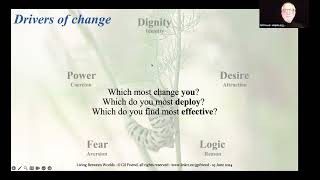
Gil Friend explores five drivers of change: logic, fear, power, desire, and dignity. The session uses live polling and audience examples from ranching to civil rights to show how mixing these strategies works better than relying on logic alone, and how listening for mood shapes what people are ready to hear.
Chapters
Foreign. Welcome, everybody. Really glad to see everybody here. It's a rich topic today. Look, all of us live in assumptions about how change happens and how minds change, our own minds and other people's minds, and, of course, how they don't. We have assumptions about how behaviors change and how they don't. And as Ken mentioned, mind, behavior, and culture are three interpenetrating realms. The work we're talking about, lives in all of them. I'm willing to declare that we are all of us, obsessed with getting other people's minds to change, whether it's, you know, kids or spouses or political leaders or the people on the other side of the political divide. Whether we're concerned with climate change or regenerative business or poly crises and things like that. This is something that we all think about, maybe explicitly, maybe implicitly. I mean, you know, look, have you ever tried to change someone's mind? Have you ever tried to change your own mind? You ever trying to change a habit, someone else's of your own? You know, again, spouse, a child, co workers, a dozen co workers, 100 co workers, 100,000 co workers, several hundred million countrymen and women, you know, billions of fellow earthlings. It's not easy to do, clearly, and yet it does happen. And we know this in our own lives. We know this in history. So, you know, I've been obsessed for, frankly, for decades with the question of how do minds change, how does behavior change, how do cultures change? Been thinking about that since long before the theory of change emerged as a thing in the 1990s. I was actually kind of surprised in the, I don't know, aughts or teens. I was sort of late to the game, hearing everybod talking about this thing called theory of change that I had never heard about before. But, you know, for me, I'm. I'm frankly frustrated with a lot of the conversations I encounter about change. I find the theoretical palette that people are drawing from is puny, thin, limited. The language is sloppy, which suggests to me that the thinking behind the language is sloppy as well. I hear I'm talking particularly about the realm of climate these days. A lot of wishful thinking. It would be good if we should. They should. Somebody should. Which of course begs Ken Homer's perennial question of which we are we referring to when we say we? A very useful question to keep in mind because we tend to be a little loose on that. Ken, bring up the slide, if you would. There's, I hear, way too much reliance on logic, as if facts ever changed minds I hear too much reliance on fear, as if fear ever durably change minds and behavior. I hear not enough invitation into the world we want. Yeah, power. Lots of talk about power, a lot of confusion about power. A lot of aversion to power, frankly, from the likes of us to the opportunity and need for recognizing power, accumulating power, wielding power. We get confused about our aversion to power over as it's wielded in the world today with power in its many other forms. The fundamental physics is the capacity to do work or the capacity to make something happen in the world world. Clearly we want it, even if we're averse to it. So I've been thinking into that a lot and developing some theories and a kind of initial diagnosis that suggests some key pathways to both understand the mess better, the mess that we live in, and to engage it more effectively. So in addition to those three, I. I'd say there's a fourth that I'll call desire. We struggle with the name for this. A longing for a world that could be for the world we want. For some of us, it feels like a calling into that world, an imagination, the calling forward to the future we want. Not just opposing the world that we, that we are in and don't like, but, but the, the invitation, the solicitation, some would say seductional. That word's got, you know, negative connotations in many ways. Something that pulls someone forward into a future. And, and fifth, and this is just sort of, it's just sort of forming in my mind is what, let's call it dignity. Back, back up a bit and want to have identity with dignity. Because there's something about dignity that is saying this is who I am and something is out of whack with who I am. There's a, there's a disjunction, that's attention that ties in with these others. Give me the next slide, Ken. You know, just to put them all up on together the arrows. You, some of you recognize the co cycle diagram from Chinese five element theory, but the suggestion here is these all interrelate in some kind of way. Our palette has been limited. We've lived toward the bottom of this. And I think it's worthwhile to explore the broader landscape that these suggest of how change happens, how minds change, and perhaps how, you know, how cultures change and of course, how behaviors, habits, practices, what we do in the world, how that changes. Ken, you want to add anything to this or should we go to a quick poll? Yeah, I'd like to add, I Just Gil and I have been talking about this for a week now, and we've been all over the map with this and it keeps morphing and changing. So this is, this is not cast in stone by any means, but it's really interesting to me to take this and say, what am I listening to and listening for out there in the world? When I think of what's going on politically, when I think of going on into climate or economically, these suddenly put a very different lens on it. That helps me see things more clearly. Like where are people really relying on one of the other piece and. And how effectively are they using them? So that's the only thing I want to say about this. It's just how I personally use it as a lens for, for both listening and working. Good, good. So go to the next slide, if you would. Nope, back one. Sorry. So let's do a quick poll. Which. Which of these most change you in your experience, Which tend to affect you and have change show up, whether in your personal life, your social, political life. Where. Where do you say you should have a poll on your screen? Do anybody not see a poll? You do. Okay, there we go. Let's take about 30 seconds, get some votes up here. What. Which of these drivers most change you? I see a poll, but I'm not able to access it. I mean, I, I see one person who voted, so something's working. Somebody's working, but I'm not. Anybody else having trouble getting in there? There we go. We're starting to see stuff coming in now. And this doesn't have to be the ultimate right answer. You know, what, what comes up first in mind? What feels most, most recognizable as what moves you into action? Or I could change your behavior. Can you put the poll back up for me? I just closed it by accident. I don't know how to do that. It's all good. I just, I just did the first question. Sorry, no, yeah, we're just at the first question right now. Oh, I see. Some of you are going ahead to the second and third question, so you can scroll the poll and get to those. There are four questions here, Gil. It looks like question two and three are the same. Well, there you go. That's true. They are. That's an accident of my zoom editing. It's a multiple choice quiz. You can choose twice on that one. I have to laugh because I used two different answers for the same question. Perfect. Well, that's how it is. See, your minds are changing already. Okay, so we've got, we've got about half of you have answered the first question. About quarter of you, third of you have answered this last question. So let's give this another 30 seconds and then hopefully this will show us the results. For those of you who just joined us, we're doing a quick poll about drivers of change. Have a vote. Okay. All right. Got 80% participation. I'm going to end the poll. Last call. Three, two, one. Okay, so here's what we said. Share results. So what do you, what do you observe? I see it's a very strongly desire driven crowd here today. Dignity too. This is not a group of people who are mostly motivated by fear and logic, although we tend to use logic more than we find it effective. Interesting. So let's open the room. What do you all see here? Either either on the poll results specifically or our opening comments. Sarah, you get your hand up. I would say real change comes from within. I mean, looking at this, desire and dignity both come from within or the feeling of dignity and definitely the feeling of desire come from within. It's not something people can impose on you. Well, yes, and they can be evoked by how people relate to you. You know, if someone treats you with respect or disaffect or disrespect has impact on your sense of dignity. Some people crumble in the face of that. Some people, you know, take a deep breath and rise up and step into it. So all of these are inner and outer, aren't they? Great question. What else, people? What does this provoke for you? Well, I just, I, first of all, it's just a great tee up and context setting, Gil, and thank you very much for framing this so clearly. And I just think the answers to question two, which I closed mine by accident before voting, but it just, the logic and the alignment of logic and desire seems, seems true to me. Okay, which would you have voted for, Jan, if you hadn't closed the poll? You know, I probably would have voted for logic, but, but, but desire is really where I should be focusing and it's, it's where my strong suit. I mean it's I strong with both. So it's, I feel perfectly sp. Basically it's a 50, 50 kind of thing. Okay. And look, we're not in the realm of right or wrong here. There's certainly wrong answers and this is not even necessarily the right map, but this is an exploratory for us. We're, you know, kind of, you know, we're finding our way through this landscape and this is how it looks at the moment. And one of the things we're looking for from you all is is this a useful framing to invite people into this exploration? Does this provoke something alive and generative and useful for you that adds something to how you stand and move in the world? Definitely. For me. Thank you very much. You're welcome. Others. Sarah, is your hand still from last time or did you want to speak again? Sorry about that. I think it's still up. Thanks, Jeffrey. So I think I'm next. So yeah, I think that in a sense the responses to drivers of change that people have given as almost aspirational but also reflects our level of comfort in the world. For most of the people who are attending a webinar of this sort or a meeting of this sort, I think fear is probably what most changes people. Except that a lot of us have arranged our lives so that we don't have a lot of deep seated fears. We're not afraid that we're not going to have enough to eat, that we're not going to have a shelter over our our heads. Those kinds of fears which were we exposed to them, I think they would become the most important drivers of change for us and they are for probably a very large percentage of the people in the world. Fortunately, we have managed through luck and efforts and a variety of things to reduce that. So that desire has become very important for us. Thank you. Yeah, jonathan, I'll need your mic on Jonathan. There we go. This is Jonathan Gilbert from Conservation Value Solutions and I added this in the comments, but there's a great book called Switch how to Change Things When Change is Hard by Chip and Dan Heath. It's a fun read, it's a quick read and they talk about why logical mind strategies are not effective for driving change. And they liken the logical mind of people to the rider of an elephant and the emotional mind to the elephant itself. The point being that if you don't convince the emotional mind, and that's where I think emotion is missing from that last diagram, you're not the writer's not actually going to go anywhere. And they the book tells the story of different types of strategies and how they can complement each other. Both logical mind and emotional mind strategies. And the classic emotional mind strategy is one that Robert Cialdini has become famous for, which is peer influence is what motivates people to change is they see other people doing that new behavior, you know, working with ranchers as I have to improve management. One of the most powerful things that gets ranchers to change is they look over the fence at their neighbor and they see their neighbor has a shiny new pickup truck and it's a drought year and their grasses are healthier and their cows are fatter, and they're wondering what, you know, what they can do to achieve those types of positive results. So it's. It's very important to not only focus on logical mind strategies for, but also to understand emotional mind strategies. Another one is shrink the change. Big changes are very intimidating. That's why there's a martial arts belt system. The idea of going from a white belt to a black belt is just kind of mind blowing. And the belt system shrinks the change into a series of confidence building wins along the path. And that's an important emotional mind strategy for driving change in sustainability within organizations, companies, and so forth. Very nice. Thank you. I like that you shifted. At the beginning of your comments you talked about not logical mind. And at the end you were saying not only logical mind. It's not that any of these is not. It's not that any of these don't belong, but the flexibility to move across this palette and use what's appropriate and have the different kinds of stances within us, I think is part of the suggestion here. What you're talking about of the rancher looking over at the next guy's lush meadow and pickup truck is part of what I would put in this bucket of desire or a calling to a future, a sense of a possible future. For me, this has been, you know, before I knew the term theory of change. This has been the theory of change for me and my work at Institute for Local Self Reliance and the Governor's Office of Appropriate Technology and at Natural Logic has not just been to sit, not has been, not just to say, theoretically this is a great idea, but to say, here's an example of something different that's actually working. And you can see it. You can not only see the numbers and see the numbers are good, but you take the case of the early, the earliest green building movement, walking people into a lead platinum building where they feel different in their body. Why? Because, you know, the light is different, the air is different, the air is cleaner, the spaces are proportional. People actually feel something in their body. It's not a logical response, but it's a visceral response to something that's there. And you can't say it doesn't exist. You can't say it's not possible once it exists. And so that's that calling from the future kind of strategy that's very much aligned with you and the ranchers thank you for that, Jonathan. Who else? Yeah, Glenn here, if I may. So the way I'm looking at this, so you have these five drivers of change. The way that I'm seeing it, I think could help to further define the framework is you have empowering drivers of change and disempowering drivers of change. For example, dignity, desire, logic are more empowering. And power, as in something else or someone else having power over us, could be disempowering as well as fear, depending on, depending on the power, whose power, how it's deployed. Isn't it correct? Yes. On the civil rights, Civil rights movement, accumulated power. Right. So it's still a power over someone else. And that's something like, even if we look at Trumpism in this country, is why do those people, why are they so fervently loyal to this man? And many of them, as research has shown, are people that feel disempowered. And so that disempowerment is being sort of co opted for political serving purpose. And along those lines, Jonathan kind of spoke something very interesting with regard to looking over the fence of another farmer's land and noticing a nice new shiny truck, like another driver of change that I found that's very strong, that would be implied in that or inferred in that is egoic need or ego desire. So for example, you know, the FOMO here, missing out the beautiful shiny new truck, not necessarily really healthy lush grass that's growing more lush than what's on my side of the fence. And I'd like to know what he's doing so that I can have better grass. So that would be more about desired. But then there's the fomo, which is more egoic, which is like, that's a really cool truck. I want one like that because I want to see cool like this guy. And I think that he goes. Egoic desire is something that is very powerful and could definitely enhance this framework if we look at that. Thank you, Jane. And then Robin, I'd like to point out that dignity may not be what we think it is casually on this chart. Seems to me that fear of shame is really underlying what we think of as dignity and that human peer pressure is, is very, very strong. I think it's a close second to fear as a biological. We're social animals and I think peer pressure is extraordinarily strong in shaping what we go for or what we won't. And peer pressure is a, is a metaphorical term of a physical encounter. What is what? How does that show up In a being a sense of other people's opinions and judgments. Okay. And we, you know, we live in a national. We, we used to live in a national media bubble that had us sort of unified around simple news broadcasts. And we're in a mosaic now of, of news and entertainment and information sources that can result in very unique bubbles and peer group awarenesses that provoke a great sense of disunity. So, and I just, I want to harp on this as a woman that I think the male world perhaps does not realize how thoroughly drenched in fear the female population of the world is, how much that's a motivator in marriages and in social relations and in politics. And women's opinions are so powerful and important in life that the control of women seems to be the ultimate strategy of the fascists. And things that are designed to provoke men in war have a lot to do with cruelty and abuse and torture of women in front of their men. So there's, there's a lot going on there. Thank you for that. I don't really, I don't want to be an advocate of fear, but I think we in the comfortable West, I mean, we're growing less comfortable, but we have kind of a naive position with respect to looking at this topic because of how we're insulated from the gut wrenching fears that provoke most life around in other places. Thank you, Jane. Got a lot of thoughts, but there's so many hands up. I want to keep moving through the room. Robin and then David and then Doug. Hi everyone. Thank you. I wanted to make a couple of comments just from what I've heard so far, and then dig into the question I have around dignity. So, you know, working in corporate settings for 25 years, you know, I was trained and encouraged to use logic. Being an ethnographer and, and a researcher generally, I leaned into, you know, storytelling and, and emotion, as the other speaker said about, you know, the Heath book, to, to evoke that desire. And I think a desire could be, you know, unpacked. Maybe desire is, is more of an outcome than a strategy for driving change. Because, you know, Gil, you spoke to a vision or, you know, the somatic experience of walking into a future that is possible. So, you know, in, in design contexts, we build, you know, prototypes to evoke the vision that something, you know, could be possible. And, you know, either those, those prototypes are higher or lower fidelity, depending on the kind of feedback or the kind of influence that, that we want them to have. And one reason I was attracted to come to this particular call is the Name of my consulting company is called Ubuntu Culture Company. Ubuntu Culture Company. And the, the word dignity continues to come up for me as, as a, as an embedded concept through a lens of what's imbalanced. One thing about the elements, and I'll close with this, is that when there's imbalance, the question is never to reduce it. The question is what element is missing that's needed to restore it. So I just offer that and some dimension and I'm complete. Yeah, thanks for the dimension. I, I hinted at Chinese five element map a moment ago. We didn't try to do the mapping and you've just done a version of that, so thank you very much for that. And I invite people to play with this. This again. This is a, this is a sketch. This is not a proposition. I will say, Doug, though, you said your power ends at your skin, and that's patently not true because my neurophysiology, physiology, biochemistry shifted in listening to you. We affect each other with these words and with these things that we do at very visceral levels. That's a gift that we have for each other. Stuart and then Michelle, thanks for your patience, everybody. Got a lot of folks in the queue here, which is great. Yeah, you got lots of folks in the queue, Gil, because it's such a provocative topic at so many, so many different levels, and it's, you know, many things, many things triggered. So I learned in part in practicing law, which is always about advocacy from an appellate court, and it's made up of individual people who have all these other, the power, the fear, the logic, all of those things in there, but comes down to basic desire. Thanks, David. And it reminds me that one of the opportunities for practice in here is learning how to listen for these, in the people that we're interacting with. Whether it's one at a time or a group at a time, is where, you know, where is the person who you're speaking with? What's the mode that they're going to be receptive to? How do they orient the world? What do they care about? And can you start to, you know, match up with each other and open a different kind of communication? DOUG and then. Stuart. Yeah, I, the, what strikes me about this is, is that it's framed in terms of nouns and the drivers of change. Without, you know, requires sort of, I think the idea that I have the ability to change anything or anybody, and my authority and power stops at my skin. So on an elemental level, sort of doing a verb, transform the the, the domain of desire and attraction is actually fire, which is about metabolism, about transformation and over expressed. It's the world we live in. Endless consumption and appetite, more, more, more and never satisfied. And logic is the mental body and the function of thinking, clarity, discernment, dignity. I think the closest I could come to would be space, which is the spiritual domain, connection to source and transcendence of individual ego. And power and desire are really both encaps encapsulated in, in fire and, and fear is water, which is emotions, which is that mechanism and viewing the world through a lens of what's imbalanced. One thing about the elements, and I'll close with this, is that when there's imbalance, the question is never to reduce anything. The question is what element is missing that's needed to restore it. So I just offer that dimension and I'm complete. Yeah, thanks for the dimension. I hinted at Chinese five element map a moment ago. We didn't try to do the mapping and you've just done a version of that. So thank you very much for that. And I invite people to play with this. This again, this is a, this is a sketch. This is not a proposition. I will say, Doug, though, you said your power ends at your skin and that's patently not true because my neurophysiological physiology biochemistry shifted in listening to you. We affect each other with these words and with these things that we do at very visceral levels. That's a gift that we have for each other. Stuart and then Michelle. Thanks for your patience everybody. We've got a lot of folks in the queue here, which is great. Yeah, you got lots of folks in the queue, Gil, because it's such a provocative topic at so many, so many different levels and it's, you know, many things, many things triggered. So I learned in part in practicing law, which is always about advocacy from an appellate court judge once that you need to. You always have to act in integrity there, there are Greek words for these and you always have to prevent present logic to enable someone to decide in your. In your favor. And you must present emotion. Eros, you have to use a poem or a story or something that moves the heart of another. So I think I burned out on, on advocacy a while ago in terms of trying to, trying to change or persuade people. And so where I am now is just I, I do my best to share information and I don't seem to be attached to outcomes anymore because as I look out there and, and I know, you know, the broader context of this is there's just a lot of stupidity, so why bother, you know, wasting one's presence? That being said, there's a wonderful Zen saying. You know, actually, it's not Zen, it's Leo Tolstoy. Everyone thinks of changing the world, but no one thinks of changing themselves. So in some ways, if you really want to create great change, I think you've got to start presencing yourself in a certain way such that people want to model that and create a vision of being pulled forward, as all great religions in the past have done. That's enough. Thank you. Thank you. Michelle. Welcome. Thank you. I was drawn into the conversation also by the word dignity. This is an unusual one for social change, for climate change, and it was provocative and enticing. Feels important and like a doorway into something powerful. As I listened to you describe the five forces, I couldn't help but overlay onto a way that I have of thinking of how life works. And I interpreted dignity as the self, as the inherent power and divinity and access to source, to deep knowing. And I think of that as kind of the roots of a tree, that we have access to something profound within ourselves that is ours to express and offer. And so in appealing to dignity, in creating the conditions for us to exist with dignity, we're. We're allowing that to flow through ourselves. And then I imagine as the. The offering of the. The tree, the. The leaves and the. And the fruit, this is sort of the pull of desire and calling. I think of that as the larger potential. What in the world is calling to us that wants to be made manifest? And how can we in our dignity express that? And everything in between? The trunk seems to be methods and means. We can use power, we can use logic, we can use fear, and we probably use a whole mix of them to navigate and negotiate our own sense of what we are here to do and what is needed in the world. The other thing I wanted to share is we've talked a lot about the very personal access to change, and Stuart in particular. Start with yourself. I often notice that wise, effective action is an emergent property of a connected, cohesive community. So maybe we need both. But I would be curious how. How that would show up in this conversation. I know there's the. The saying, where there's a will, there's a way. And so that sort of implies desire, you know, the will. And if that's the end of the story, then we're doomed because we haven't found the way to address climate change. So clearly there isn't the Will. But I think the bigger version of that is where there's a life aligned worldview that says that way. And this will makes sense. Right now we don't have that. We have a story that says only productivity and profitability matter. So we need a bigger story. We need also the choir. So we need a we. And then we will find the will and the way. So all of that came up as I was listening to everyone, all of that. Thank you. It's very rich. So much there, Michelle. Boy, you know, there's, like I said, all of these things have valences. And the desire piece, which you spoke to very much, of course, the Buddhists will tell us that the, you know, the Bodhisattva vow that desires are inexhaustible. I vow to vanquish them. You know, we know that desire is dangerous. We know that desire is generative. I like your image of the roots of the tree and the opportunity we have, you know, to, to, to embody dignity, to model it, to observe it in others, to invite it, to evoke it. The, the, the, the, the word emerged for me in this exercise, remembering a conversation I had with my teacher Fernando Flores last year. And I was talking about my anger at some situation in the world. There are many to choose from. I don't know what it was, but I was, I was conveying a mood of anger. And he said, you're not angry. I thought, well, how are you to tell me what I am, you know, Right. So I was even more angry, said, you're not angry, you're indignant. And it stopped me in my tracks. And something opened that I hadn't ever seen before about this, this rootedness as you're talking about and the, what's the word? You know, the gap between who I am and who I want to be. The gap between where we are and where we want to be that had very different flavor to it than anger and a very different power, if you will. Not in the sense of power over, but power as generated. The power, you know, the roots of the tree, the, the, you know, the, the green sprout that drives through the concrete is a kind of power. So again, there's a, there's a palette here for us to work with. Thank you so much for that. Gil. Gil, before you go on, I just said, Michelle just highlighted this. You just said something. The difference between anger and indignance. For me, anger is something very personal. I'm, I'm upset about something, but when I'm indignant, it's because I feel a shared sense of there's a, there's an injustice going on that affects people. And it makes me indignant because it offends my sense of soul. So I just want to point that out and I don't know if anybody else has resonated with that, but there's a really big difference between. To me, indignation has a tremendous power to. For change that anger does not. Anger evokes fear, but indignation evokes dignity. An anger evokes opposition. And indignation has an aspect to it that can invite perhaps the instinct, and I hear it echoed in this call is that there's something there, frankly that's, that's at some levels of motivation for everybody here on this call in the work that we do in the world. And that's worth surfacing and talking about. So thank you very much, Michelle, for that provocation, Jan, and then David and let's go. Yeah. And I also just wanted to say, I think it was Stuart who spoke before Michelle, but I loved, I loved everything he was saying. I thought that was very profound. I'm just in a kind of interesting. It's just, I just love what you're doing here, Gil, and, and everybody's contributions. And I, I realized that I, I grew up outside the US So I came back here to observe the insanity of, of American culture really since I got back here. And what I call Persistent Institutional Stupidity Syndrome is the. Don't make an acronym out of that is kind of the theme for me since I returned in the, in the mid-60s and observing, you know, what goes on with the propaganda conditioned society. And I, I did a dissertation for my bachelor's degree because my dad did one and I didn't know that there's only one school in the country that requires. But I did one. And in my dissertation I was amazed because Paul Krasner and Scoop Nisker got given the CO quarterly issue in the fall of 1977 and they chose to feature Jean Youngblood's article the Mass Media and the Future of Desire. And that really organized this interactive newspaper that I published a 16 page proposal for Reciprocal Media in 1979. And I just presented it yesterday for the first time. So I'm just going to read you this one quote from, from Youngblood on the mass media and the future of desire. Desire is learned. Desire is cultivated. But we cannot cultivate that which isn't available. We don't vote for a candidate who isn't on the ballot. We can be neither for nor against. An issue that hasn't arisen. We rarely select what's scarcely available, seldom emphasized, infrequently presented. We participate only in what's easily and repeatedly available. We select what's there for selection, quite in spite of the fact that we may hold no genuine distinction, desire for or belief in any of it. Today, it's essential that we program innovation, schedule it on demand. But the problem is desiring to program it, which requires that perceive the need and understand the possibility. Last paragraph, last two sentences. The challenge of modern times is that of learning to need another way of life. We must increase our necessity so we can increase our perception, so we can mobilize our desire. But we can't cultivate, that is, increase the necessity of what's not available. We can't really desire that which we can't vividly imagine. Beautiful. Thank you. Thank you very much, David, then, Alan, thank you. Yeah, I'm gonna. I don't mean to be flipped, but I'm gonna put in a word for fear. Okay. So fear is famously not able to be sustained when people are afraid of something that seems very overwhelming. So that classic example is activation activism for nuclear disarmament or limiting nuclear weapons. The nature of the threat freaks people out. And it can get people into Central park for the largest gathering of human beings in America in June of 1982. But it tends not to be a sustained movement. And that's what it is that people are afraid of. But on the other hand, another technology issue with another kind of fear that seems to be amorphous. It's a fear of poisoning from fluoride is actually the most contentious issue in local politics in the United States. For 15 years, 1950 through 64, every single time it was up for election, people wait. Well, there's this risk of something really bad. And then there are these benefits for a small group of children for whom there'd be a dental benefit. And every time they're sort of rational, but fear based, depending on how you flavor your sociology, every single time it went down. And so it was a very effective strategy to whip up fears of an unknown poisoning risk from fluoride. And you won every time. But you couldn't sustain a really big long movement beyond particular tactical demands around particular legislators when it came to nuclear disarmament. So what the fear is what your goal is in using it as a tactic. It's complicated. And then on the other hand, the resistance of Negro civil rights movement seemed to be entirely about fear. They're going to do. My daughter was at the core of what I heard growing up over and over again from scaredy cat, scaredy, scared white people. So anyway, so my point is fear needs a lot of texture and the time over which it's active. And I wouldn't want you to underestimate the power of fear. Noted. And you know, I'm very clearly not trying to rank these five in any sort of priority order. They're all there, as I said, they all have multiple valences. We would not be here evolutionarily without fear as a protective response against danger. We also know that if we physiologically stay in fear the whole time, our bodies fall apart. So it has its place, it has its dangers. Yeah. I also grew up in a dangerous neighborhood and it got more dangerous as I grew up. And the memory of that and this weird, surreal sense of relief when crime rates dropped drastically is really part of my constitution. So it's different when you've been in an insecure environment and, and built to be wound up all the time. Yeah. Yeah, okay, thanks. And we, all of us, I'm going to speculate, have felt fear, perhaps have used fear, perhaps have been afraid of fear. But it's part of the constitution that we're, you know, that we are made up of here. Thanks for that, David, Alan, and then Mark. As I invited Mark Wageningham to join this and I'm glad he's here, eager to hear what he has to say. Myself with that, when I first heard this question in my simple minded old way got all these things I said, love is all there is. It is an attraction, it is a desire, it is sometimes free in the heart. And later on in the conversation the heart and the soul are also mentioned. That part of these guiding words. And then I thought it's really a matter. Are we free actually to move toward a change from our love or are we unfree like we are in this system of war and domination where in some way we're trying to deal with a power structure and we're trying to heal from the injuries caused by that. So anyhow, I just want to put in for love and the alignment of oneself with a larger vibrator race of the society that move on to greater beauty and appreciation. And as someone said, looking at the African culture, when we see us as all as related, we are all connected and that we change when we align ourselves in a beautiful way with that sense of connection. Anyhow, thank you always Joe for this and eager to hear from Mark Wagner and a buddy from Ann Arbor. Thanks for those thoughts, Alan. Hello Mark, welcome. Thank you. Thank you very much for putting this on. This is a wonderful gathering from what I've heard. The high fidelity of the dialogue is just wonderful and very, very welcome. Thank you. Well, I wanted to. We meet every month, the third Wednesday of every month in this time slot. So you're all welcome to come back. Bring your, bring your friends. Mark, back to you. Yeah, I immediately when I watched a couple of your videos, Gil, I just signed up for all of the Wednesdays till October. I think it's like I said, good to have rich dialogue about these things. And I want to just start by saying I think the language itself has many layers to it. There are different definitions for terms in how we relate to this and the meaning or the fidelity of meaning. How clearer are the relationships? There was somebody said about imbalance. Well, if we look at how this, how to change minds, I think it's a matter of uncovering the mind with too much experience that covers it up. Right. So for example, experiences that come in too much too fast get recorded in the body because we haven't processed them. So shock ensues in. In very many cases there's a lowering of consciousness and, and a recording of the body. I refer to that as the subconscious mind. And we then look through that as a lens. Say it's a field like we have a field around us, many fields around each organ. Even that field contains the experience because it went through that field to hit the cells and that becomes the field through which we look about 95% of the time. It's a, that protective mechanism, that survival mechanism. If you haven't processed an experience, well, we're going to go on automatic for that experience. We react instead of act. I think this is important only because what that type of experience does is it covers up some aspect of consciousness that is a change of mind to a, a less limited mind or a more present mind. And that is think is another aspect of changing minds is can we uncover the minds that have been covered up by trauma, by experience? Yes. And when we get to that richness, I included in the chat a link to a diagram called the spectrum of Consciousness. It comes out of a multi dimensional psychology known as the gene keys. If, if you haven't heard of the gene keys, I highly recommend is a how to uncover consciousness. And that I think changes the mind in a beautiful way. I apply this in my field which is cybernetics. My definition of cybernetics is design in harmony with how nature works and there's no need for war we don't have the or. Either. Or is just a subset of always both. And, and I think when we change minds, I think we start there because both values are important. But what can we get when we combine the two. And one more point and then I'll. I'll finish, which is. Nature tries to find dynamic equilibrium. Nature also tries to find a flow state, the path of least resistance. And when we think of the whole evolution of what's happening right now is that we have an ability to start finding these flow states with artificial intelligence, which is where I have been working since, well, since the 70s. But I'm also a deep nature connected being. I. I'm out in nature 5 to 20 miles a day tending to forests, and the rest of the time I'm on zoom calls like this. And I designed things in, especially in artificial intelligence to be the solutions to come out in harmony with how nature works. It builds in ethics and it builds in scalability. And that's how I think we can solve so many of these problems, is we can have an extension of mind, an expansion of mine. Thank you so much, Mark. I. Sorry to cut you off. We've got. I just want to add one note here. This just to note, this conversation is filled with metaphor. Most of the words we use are metaphors for something, even the word mind. We should have word mind in quotes, because mind isn't something that's happening in my head, maybe not even in my body, but maybe in this conversation, maybe in the culture that we live in. You know, you talked about processing experience. That's a computer science or an industrial metaphor on what's going on physiologically, neurologically, psychologically. Not that it's wrong, but it's a metaphor. And if you, you know, if you go back and listen to the recording of this conversation, you'll see that all of us are speaking metaphorically about phenomena that we don't know how to describe or point to in any other kind of way. Not to say there's anything wrong with that. That's what we do as human beings. Maybe illuminate something, maybe open something up. Mark. Thank you, Warren. And then Jane, and then we're going to shift a little bit. Yeah. Hello, everybody. My first time on this call. I'm so happy it's happening. And everybody's really, you know, super engaged on this. Michelle was talking earlier about the choir, and I'm thinking, you know, as we're herd animals and we really need to work with collective action and purpose and desire. Jan Ballard and I have started what we're calling the people's company commons. And this is a for profit that would organize us in like an organism to really have collective action and incubate companies that are really doing the regenerative work and that we'd all own a share in. So that's seems to be what we've come up with is, and there's about 20 of us working on this now, very early stage to actually put what we're talking about into motion and create also a scoring system that would help represent our values, a filter. So everything we see in the Internet, every action we do, would actually be regenerative as much as possible. And so politicians, companies, products would all have a people score that would be the higher, the better and the no upper limit. So would create the positive feedback loop for us to express and actually move things forward. So more on that later. How has this conversation affected your thinking about that? I think, you know, the motivations of myself, which I put down desire and then, you know, the dignity and logic that those are driving, you know, at least this choir that is singing today here together because we're really looking, you know, for like minded people that, and that really want to make this happen. You know, we have the potential to really do collective action now. And so this is, yeah, this conversation's very profoundly influencing our work. Thank you, great, thanks for being here. I hope you'll come back again. Shane Bird over to you need to unmute. Shane. Okay, first thing is I wanted to put in a plug for desire. I, I think Buddhism is often misunderstood on this point. We think that Buddhists want to vanquish desire. I think the actual relationship there is, there is a vow to extinguish attachment to desire. Desire is the juice of life. You know this. It's a mistake to dismiss desire as something to be extinguished. The second thing is artificial intelligence is a sad misnomer. I think at best it's a simulated intelligence. And beyond that it's possible that it's an extended intelligence of ourselves. And I really, really love the idea of maybe focusing some of our future conversations on the cybernetics, of finding those flows and harmonies, because change is always happening, change is a constant. But our understanding of how to ride and how to surf, Forgive me the religious language, but how to surf, the desires of the God or the passion play that may be the universe, evolution does seem to be a learning curve and finding our way in relationship to that seems to depend on some degree of contrast in our experiences. And may they be less and less brutal. May we find more and more subtle experiences of contrast so that we can be more compassionate in our learning on this curve. Thank you. Thank you. Thank you everybody. What a, what a wonderful conversation. So many gems offered from so many of you and so many different flavors. And I know those of you who haven't spoken are very alive in this conversation also. So thank you for that too, Ken. So this has been really wonderful and rich and, and sitting here going, I could just talk forever on any one of these points, but I'm trying to learn and not preach, so I'm being quiet. Let's take this in a slightly different direction. Let's look at moods as related to this. So it's a slide Gil put together. You know, we've talked on this call a lot about moods and moods are sort of the climate in which our emotions occur. They're long term feeling tones. And moods very much color the way we see the world and they very much color the kinds of assessments we make about the worlds which then open on core colors, possibilities. So here's something from Bob Dunham, just very basic four moods of life, interpretations about the future. When you think, let's take a climate, for example. We've talked a lot about climate on this call. We think about the climate conversation. What moods do you find yourself in? Are you resentful? Are you ambitious? Are you accepting? Are you resigned? Where do you find yourself and what do you listen for? Let's take a minute and think about that. And while you're looking at that, the reason that we're offering up this map in addition to the other map is that this is a kind of a little, little window into, into a way that Ken and I have learned to stand and work in the world of these many years and the ontological work that we've been doing. We've found that paying attention to mood, both our own and those of other people that we encounter is really valuable. It opens something, just observing that, noticing how the moods are intertangled with assessments that we have of the world. Things are good or bad, they're this or that. The moods shape the assessments we're able to make. The assessments we make shape the moods. And again, opening a window into that opens enormous possibility and freedom of movement and potential, both personally and in interaction with others. So it doesn't, doesn't exactly map onto the five star we had earlier, but somehow these things relate. So we want to kind of step into this with you for a moment. I just want to say one other thing about this is you may Find that you. You are not in you. You don't have to choose one. I'll put it that way. You might find that you. You need to have a couple of different moods. I notice over time my mood shifts. So. Okay, Shell. Yeah. I'm looking at this chart and I think we need maybe a different term for ambition because ambition is so colored for most people with the color of greed. And yet what is being talked about here is the future holding possibilities. And that's much, much broader than financial success. So, I mean, when I see the definition there, the future holds possibilities, and I like it. That to me, sings to the part of me that has been an activist since age 12. But when I see the word ambition, I think of people who are mostly working on bettering themselves and not necessarily paying attention to others. So the wordsmith part of my brain seems to be asleep at the moment. I don't have a term to suggest, but it's something I think we might all want to think about. Let's do think about it. I want to caution the wordsmithing game. We played that for several days on some of the words on the star earlier. All of these have different valences. They mean different things to different people in different cultures and different contexts in different parts of their lives. And I don't know what the right word is, but I would invite you to take the word as just kind of a headline and look at the, look at this descriptive underneath it. That's what we're asking you about us. Optimism. Optimism is part of it, I think. Yeah. So you, as a lifelong activist, are drawn to the future, holds possibilities, and you like it, and you're alive in that. And you feel a sense of, of identity and maybe dignity in that other people don't live there. Right. You know, I mean, what's the, what's the characteristic mood of most organizations in North America? Generally pessimistic, I think. Resignation. Nothing. Nothing can be done. There's nothing I can do. Any of you are consultants are walking into that all the time. You know that. So I don't care what you call it, but there it is. And I've put, put up another poll is sort of. Where do you characteristically find yourself on this map? It's not all the time, but, you know, the way Bob Dunham would say it, the mood that you live in or the mood that's living in you is the one that's there when you wake up in the morning before your feet even hit the floor. It's an orientation to Life, an orientation to the future. It's an already existing interpretation of possibilities for the future. Where are you, characteristically, would you say? And I would point out, you need ambition to actually have your feet hit the floor. I'm sorry, Ken, that was not very audible. Ambition to. I said you actually need ambition in order for your feet to hit the floor. Sometimes we lay in bed on the weekend and go, oh, God, I'm totally lacking ambition. I didn't want to get out of bed, you know, so just thinking a little play on words there. But, Stuart, you guys see the poll? I would push back a little bit on putting acceptance in the negative column. The negative aspect of the chart. It's not. Okay, I guess I misread the chart. I'm sorry. No, it is, it is. It's. It's listed as a positive passive. So positive negatives is that way and active passive is that way. And. And actually, Gil, you. You, you didn't make your update yesterday. Yesterday, going on one of these slides we changed when you forgot to put the words in. We. We're calling it restrictive and expansive rather than positive and negative. Okay. Have a value connotation to it. It's not that one's worse, they're just different. Yeah. One points to possibility, one points to no possibility. Right. Okay. Yeah. I mean, what. Just what popped up for me is the notion of before you can change things, I think you have to see the reality, whatever that word means, and accept where things are, and then you can move on from there. It's kind of like Joanna Macy's, you know, active hope, which is a. A wonderful, wonderful term. Yeah. And someone posted Rebecca Solnit in the chat as well. She's done some brilliant writing on this matter, as has Vaclav Havel and a number of others. This is an interesting poll. This is, for me, not surprising, given who's here in the room. This is an indication of how not representative a sample group is. Right. This is a group of people who are oriented around possibility, around possible futures, and are alive in that possibility and challenge much. But this may not be what your family or your friends or your neighbors or your clients would map as. And listening for that in them, how they speak, how they hold their bodies, what they do, what they say is a very powerful toolkit for learning how to dance, for listening for what people care about, and being able to engage them about what they care about. This is, for me, this is one of the places where logic falls short, because what matters to me in a logical argument may not Touch on what really matters to you. And if I don't touch that place, no amount of logic will do any good. We see this in the work of organizations like Living Room Dialogues and Search for Common Ground who are bringing people together from opposite sides of very polar and fierce conflicts, whether it's, you know, Northern Ireland or the Middle east or the abortion body autonomy fight in the United States to bring people together who are at each other's throats to find places where they have common concerns and cares and possibility of common language and a possibility of inventing something new together other than just going to war. So any reflections on this? What. What were the two words that, Ken, that you were supposed to have replaced in there? Again, instead of positive and negative, you're going to have restrictive and expansive. Expansive and restrictive. Replace positive by expansive and replace negative with restrictive. Opening of possibility. Closing of possibility. Mr. Mckay. Mccrae. Yeah. You put this up on Facebook, I believe, a while back. And my response. Yeah, and my response there was that they're all related. So you accept what's there. You know, that it's been created by people who are not you, who have power, to a certain extent, have power over you. You have the ability to. To work with what is there within the power structure that is in order to make a better future. And then I forget what the fourth one was, but all of these are wrapped up in each other, in the reality of what. What is here. And then in your experience of working with, trying to do something that makes sense to yourself and the others around you. So I've not found this to be all that useful for me, because it's all there and you cycle through them. The reality is, is that we live in a world that we didn't make. There's the key, George. You cycle through them. Some people tend to be characteristically more in one place than the other and don't move. Some people move fluidly across them. Some people can learn to dance with that. Let me give you a story. I had a client, a coaching client I was working with yesterday. It was funny because it was almost the same conversation as with another coaching client a couple of weeks ago. This person said. He said something about other people he's working with. And I said, so it sounds like you have an assessment about the assessment that they have about your assessment about them. And he cracked up because of course, that's what was going on. It was. No, it was. It was opinions about opinions that had not even been spoken. He was in a mood of resentment because of these Unspoken statements, simply turning a light on that the mood lightened. His mood moved from resentment to acceptance and then into ambition and possibility about, well, what. What can I do here with these people? How do I enrich this relationship and take us both to somewhere we want to go? He could have been stuck. He chose not to be. Some people live their lives in resignation. Nothing I can do about anything. Look at the American political landscape. There are people living their lives in resentment. It. It's their fault. It's all about them. It's all their fault. That's a place to live. There's the opportunity to move across this map if you start to see the pieces and start to dance with them. So, you know, as always, George, your mileage may vary. Dale. Thanks, Gil. And thanks, everybody. I. I really relate to that cycle through the others, because when I answered it for myself, and I think I took Ken's advice and I took two, even though the survey could only do one, I cycled through the other two. But what I did is I said accepting headed toward ambition. And I mean accepting. And someone mentioned this a little earlier, almost in a kind of Buddhist sense of being able to accept what is happening in this very moment as a way. I think somebody did say this as a way to be able to. The only chance we can move beyond it. And so then the. The only other quick note I wrote is I said, you know, there's this kind of doom, delusion thing that happens. And the note I wrote was oscillation, I should say is earth overshoot. I don't want to freak you out, but neither do I appreciate your snoring. Okay. Yeah, thanks, Dale. That's. I find myself schizophrenic on this. There's some days when I'm. And I'm like, okay, I know things are really bad. I've been studying ecology for 37 years now. I. I could name. I could sit here and talk for an hour about how horrible things are. Also. That's just going to freak people out, and it's not going to stop them from snoring. So when I find myself really stuck in that, I think, what can I do to put myself into a. Into acceptance of that is the way it is. And from there, what can I actually do about it? Which puts me into the mood of ambition, you know, and then I get into wonder and curiosity. And some days I'm just stuck, and other days I'm like, okay, I've been stuck here for a week now. I got to get out of this. Usually I Go for a walk in the redwoods. That helps a lot, you know, and then it's like, okay, now what can I. What is actually possible here? And so this ties into. We're not going to have time to go into today, but this ties into the assessments that I make if I'm in resentment and resignation. And I know a lot of people in my age cohort who say things like, well, I'm just glad I'm old and it's. And I'll be dead by the time shit really hits the fan. And I think, what about the people who are coming after you? What about your children, your grandchildren? Even though not yours, don't you have a responsibility to them? What do you mean? You're just glad it's. It's gonna happen when you're dead. I mean, come on, wake up, you know, So I found myself being resentful. Like, okay, that's not gonna work either. How can I. How can I gently wake them up? And there's an old saying, you can't wake someone up who's only pretending to be asleep. So then we have the folks in the denial, right? And how do we wake up people from denial? It's a whole different story. But I make assessments based on my mood of what's possible today. If I'm in a resigned place or a resentful place, my assessments about the future feed that mood of resignation and resentment. And if, if I can shift to, there's always things I don't see, there's always possibility, there's always something else. Then I can. I can actually start to have some agency and feel like I'm effective and, and do something that makes me feel like, today was a good day, I got something accomplished. You know, I had a great conversation with somebody and they saw things differently. I'm not trying to change anybody's mind. I just want to help people see things differently. Let them make up their own mind for themselves when they have new perspectives. And here's the joke about all this. You know, you always have a mood, or, you know, as some would say, the mood always has you there before you are. And you're always making assessments. And it's not that making assessments is a good or bad thing. It's what humans do. We engage the world through our interpretations of the world. And what we're suggesting is that it can be valuable to take a look at both of those phenomena, shine a light on both of those, inquire into the mood and inquire into the assessments, and look at the Tangle and, you know, ask some questions, make some moves. Sometimes the move is to change the assessment and see what happens to the mood. Sometimes, as Ken said, it's to go for a walk in the redwoods, which will change the mood because physiology and oxygen and trees and, you know, tens of thousands of years of experience of walking in forests that will change the mood. And then lo and behold, the assessments open up and different possibilities emerge. So we've, it's an exploration we've been doing for some years. It's one we invite you to play with. We'll talk about more in forthcoming calls and we are close to time. What to say by way of wrap up. I'd just like to say thanks. I mean, if we had time, I'd love to know what, if anything, shifted for you as a result of this call and if we were to come back and revisit it, take some time, send us a note, you know, if you're going to revisit this call, which I'd love to do, what would you change next time? Where should we aim ourselves? You know what, what else could we do? We'll send out an email and maybe link to a survey or maybe just an email to prompt you on this. We'd love to hear back from you, as Ken is saying. So please, you know, don't, don't be shy about that. It's, it's private communication. Not, not posted in the chat like here. So be frank, be specific, tell us how this can be, how we can make these calls better. We're back again a month from today, 4, third Wednesday of every month. There's the date, there's the registration link. Archives. This video will go up in the archives maybe late this week, probably early next week. We've got, you know, five and a half years of archives there at your service. And new for some of you, you can now talk with me. Talk with me in quote. It's an AI simulation of me trained on these calls. All my coaching conversations anonymized my writings, my speakings. I offer that to you both as something to have fun with, may be useful for you and I'd also welcome your feedback on Is it useful? Is it valuable? Is it stupid? What possibilities do you see for tools like that? Ken will give us our musical outgoing reminder. And now without further ado, little Brandy Carlisle. Because this is the, this is the message that I hold in my heart all the time. You can dance in a hurricane. But only if you're standing in the eye. You can dance in a hurricane. But only if you're standing in the eye.










