Interventions & Leverage Points — Living Between Worlds 5.7
Gil Friend hosts a conversation on systems change and Donella Meadows' twelve leverage points for shifting how the world works. Participants explore nervous-system regulation during crises, Gandhi's economics of local self-reliance, and concrete actions like voter mobilization and postcards to bridge political divides.
Chapters
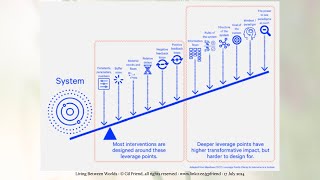
Foreign. Welcome everybody. This is Living between Worlds for July 17, 2024. We're in the middle of the fifth year of these conversations in unbelievable times. I think the naming of this was pretty apt. It was inspired by the my looking at the intersection of the COVID crisis and the climate crisis and seeing similarities among them that were challenging to how we stand in these times. And was inspired by the observation of Antonio Gramsci, the Italian revolutionary hundred or so years ago, that we are living between worlds. The old world is dying and the new world is struggling to be born. And between those is the time of monsters. And you can think of monsters as fire breathing dragons or as primal forces that we can't name. But clearly we're in deeply unusual times. So we thought it would be good to explore together living between worlds with the possibility of grace and dignity and power. The name is more apt than I could have imagined then. The turmoil that we all feel is almost physically palpable now, with so many things unsettled, with temperatures off the charts in places around the world, with the energy center of the United States brought low by a relatively modest hurricane, almost 2 million people without power for days, half a million for a week this year, elections for billions of people around the planet, decisive swings to the left in England and France, and a potential swing to the right in the United States, which will trump them all, if you'll pardon the expression. We're not going to handicap the election in this call, but in the spirit of Scoop Nisker's wonderful suggestion that if you don't like the news, go out and make some of your own. We'll return to that topic before the end of the call. So before we start, let me just ask you about your mood these days. We've talked about mood in several calls before. Mood as a kind of orientation to the future. Not moods that we have, but moods that have us. Ken, you want to take us into this little moment? Sure. You know, I think about I was born the same year as Sputnik launched, and at the time the country was in an amazing mood of wonder and ambition and curiosity. What can we do? We can do anything. You know, we're going to go to the moon and all this stuff. And the moods change for both people and cultures over time. I think my, my parents lived through the Depression. That was a very different mood. And I think about younger people today who were born in the 90s, the early 2000s, and what they've known. And they've got a very different mood. They're dealing With. And right now, after the presidential debate, you can feel the mood of the country shift radically to oh, my God. And mood matters very much like consumer confidence in terms of how we are facing the future, the way we orient ourselves to it, and the actions we take. If we think that things are hopeless, we might find ourselves both resentful and resigned. I may as well not even do anything. I'll just party and enjoy myself. If we feel ourselves outraged, we might say, hey, I've got to speak up and take action. If we feel ourselves empowered and having agency might say, wow, I'm going to make something happen. I'm going to join people and speak up and speak out. So right now, there's a lot of different moods out there, and that's the framing of mood. How your mood is today very much affects the way you orient yourself to the future and the actions that you will take, which is why moods are so important. And nervous system regulation is also important in moods. If you find yourself fully up, upset and fearful, breathing deeply and grounding yourself can bring you back to a state of. Of centeredness and an ability to connect with your own agency and not feel like it's hopeless. So the other thing I'll say is hope. Excuse me. Action leads to hope, not the other way around. If you take action, you will find yourself getting more hopeful. If you're waiting for hope to come along to motivate you for action, you're going to wait along. Jo. So let's just do a quick cascade in the chat. Get ready to type into the chat. Don't do it yet. We want to have everybody type in the chat, but don't hit return. One or two or three words of your characteristic mood both today and these days. Give everybody a few seconds to put some words in there, and then we'll all hit return at the same time and we'll see what shows up. This is a trick I learned from Mr. Homer, and I think you can also. You can be schizophrenic. You can have moods that are not necessarily aligned. You can be bouncing around so you don't have to go, I'm this. Because sometimes I bounce around. Yeah. And. And give us more, more nuance than good or bad. Give some description and flavor to it. Hold up. Get. Get yourselves ready to type one or two or three words. Okay, ready? Everybody hit return. Boom. So there we are. And while you're looking at that, let me just. I want to do a quick poll also. Just. Just want to get a sense of who's Here in the room. This is a multiple choice. You can choose more than one. How do you identify? Where do you work? What's your primary focus at this point in your life? Okay, three quarters of you in. Let's get a little bit more. Yeah, Melissa. I am many things, too. I think many of us are. Just thought it'd be interesting to get the. Get the shape of this for us. Okay, 80%. I'm going to end this in a couple of seconds. Anybody else? All right, let's see what we got here. Share results. Can you see the results? Can you see the results? Yes. Okay, good. Okay. Yes. All right, so I think you can scroll it. I'd like to know who the poets are. Will you raise your hand if you're a poet, please? There's one. All right, there's more. Some. Some are poets who didn't identify themselves on my list. I see. I see activist and entrepreneur as the biggest categories. Not surprising. Some people, I think, are both of those together. So. Thanks. Okay, let me take this down. So, look, we're in. We're in the midst of massive meta crisis. We all know this. We're not going to go through the list of it. One of the things that happens to me in times like these is that my thoughts return to Denela Meadows. Meadows, as many of you know, was one of the authors of the Limits to Growth report more than 50 years ago, which predicted, not precisely, but directionally, some of the messes that we're in now, certainly the ecological ones. Meadows also famously proposed a list of nine leverage points, now 12 leverage points, which he characterized. Ken put up the first slide there as places to intervene in a system arrayed by influence from lower influence to higher influence, from easier to do to harder to do. This bears a bunch of study. We'll put a link in the chat that will let you read into this in more detail. And let's go to the next slide. Ken. And we spoke of these at some length in Living Between Worlds a couple of years ago. But here's a quick summary of them. And you can see this is going from least leverage to highest leverage at the bottom, moving things that change. Quantity, volumes of stuff, amounts of energy and so forth, the buff and stabilizing stocks. You can. I'm not going to read these through you. You can read down the list yourself. They're grouped in the column on the right into, you know, four categories. Some of you are very, very familiar with this, some of you not. Ken, if you could give them the link in the chat for that. That would be great for people to follow up in more detail. But take a few moments to look this over and let's. I want to give you another poll, and this time the question is, where do you characteristically find yourself or your place in the world or your work along this trajectory? How would you characterize what you do currently on this spectrum? Okay. I'm not sure you can put the poll up if I'm sharing my screen. Oh, really? That would not be nice. No, it looks like I cannot. So let's leave this up for another. For a minute to let people look it over and then we'll take it down. And while you're doing that, I'm going to get the link to the article. Melissa, thanks for that other one. So there's. There's Meadow's article explaining how it came about and how it's used. So there you go. So, Kelly. Yeah. Let's take down the share and I'll pop the poll up. If I save the chat, will that text still be there? Yes, yes. Everything is savable. Okay. I no longer have polls. Why is that? Check under more. Yeah. No, no. Okay. It moves the button as it always does. There we go. Okay. Back place to intervene in a system launch. Go. So where do you tend to focus? And I realize this is. These are short names for the things you saw. We were hoping we could show you the chart at the same time. But do your best to think about where you are. Don't answer question two. We'll come back to that. I did put the chart, a screenshot of the chart in the chat so you can open it up and look at it in parallel. Lovely. Thank you. Brilliant. And feel free to comment as we're doing it if you'd like. If you have something to say about this. Where. Where do you find yourself focusing or working now? Okay, I'm going to end that and we'll share the results. And this is an interesting group because I don't think you'll find in most groups, most people focused on the highest leverage points. Let's do this one more time. Same questions we just asked about where you are currently. Where do you think you should be or ought to be or want to be? There we go. So scroll down to question two. Same question, but make answer this time aspirationally or strategically. I see some people already did that. They answered both, but let's. Yeah. And I might have wiped out the first answers, unfortunately. That's right. We'll just. We'll go with it. Yep. Carter actually was the other way around, she initially had nine, and she expanded it to 12, as I understand it. And, and, and, and 12 is the version most operating in the world these days. Well, it looks like I cleared number one by accident. So answer number two, if you would. Where do you want to be focusing or should be focusing or think you would be more effective in what it is that you're trying to do in the world? So, okay, again, three quarters of you in I'm. We intended to be able to show the comparison between the first round and the second round, but that may have failed. But pay enough attention to detect any shift in the answers, and let's just open it up to conversation. What. What, what are you seeing? Both in the. In the leverage points as Meadows lays them out and in how you responded to these questions, both current state and aspirational state. So the, the number one answers are flawed. Sorry about that. The number two answers were what you just did. Well, maybe not. Maybe those are the number one answers. If people answered question one again just now, then it would show up. Yeah. Dave Weitzel, you want to go ahead and unmute yourself? Yeah, I was just wondering, I don't know if anybody's done kind of a critique of Meadows with more of a Living Systems frame, and I'd be curious to see it. I've been, you know, trying to. I think Gil and I, we were talking about a little bit more earlier this morning, but trying to translate some of my Carol Gillig, Carol Sanford stuff. And to me, the big message she had was, you know, first you need to sense the system. You know, we need to be doing what the system needs. And so you, you know, you kind of invert, I think, some of this, where do I. Where do I live in the system? Into a what does the system need? Question. And so I feel like, you know, probably Meadows has got a kind of a mechanical framework, and I'm. I'm not sure how to apply a Living Systems framework. I'm still trying to figure that out, but I kind of feel like it would be valuable to do so. The first step should be sense into the system, which is a great, which is a great point. Why, why would you. Why do you think that Meadows is more focused mechanistically? Well, I mean, she comes out of that, that era, the Forester era, kind of where the, the, the modeling was very mechanical. It's very mechanistic. You know, things like feedback loops and stuff like that are, are mechanical devices, system structures. This is a very, you know, you break the system into pieces and put it back in together kind of model. I was going along with you till you said that feedback loops are mechanical devices because feedback loops are characteristics of living systems. You know, this, this mechanical interpretation. They're a mechanical interpretation of what happens in living. Maybe that's, maybe that's a little bit better. Carter. Thanks, David. I think it's also important to remember that she wrote a, a follow up article to this called Dancing with Systems, which really points out that people tend to take this list and figure out, okay, how am I going to apply this list to the world right away? And, and she sort of cautions against that and says it's a little more nuanced and complicated than that. What I, what I, what I, what I love about the article mostly is how it points out that we spend most of our time in the least leveraged place. In other words, not necessarily people in this room, but in general. And overcoming that is a challenge. And to her credit, she was a farmer. She was a sheep farmer in Vermont. Yeah. So she was pretty immersed in living systems. I think the apparent difference is something worth us investigating a little further too. But yeah, Carter, thanks for making that point because that I think was one of the reasons that she raised that. The link I gave you, she tells the origin story of this and I'll give you some perspective on her perspective in this work. So, Kimberly, let's go to you. Yeah. First of all, I'm really excited that we're talking about Janelle Meadows. And I did a deep dive with her work in my grad school program that I just finished the MBA in design strategy. And so I just, I love that her work is being integrated more. And also, have you heard the phrase, and I don't know who said it, all models are wrong. Some models are useful. Right. And so it's like anytime, sure, we have a feedback loop and we make this whole system model. Okay. It's not going to be 100% accurate to everything in the complexity of life, but it can be really useful for our human understanding and relating to complex systems and to life. And so feedback loops, everything she talks about with stocks and flows is sort of helping our human brains relate to complex living systems and be in better relationship with those systems. Thank you. Good, Klaus. And then Jan. Yeah, I see, I see this as an inverted pyramid where you, you start with narrative, the idea, you know, the belief, and then you translate that through the stages of the economy. And it's mechanistic in that sense. So an engineer needs. Let me just interrupt For a second. I'm a organic, holistic, not mechanistic guy as much as I can be. But mechanistics getting a bad name. Yeah. So sequential maybe is not the same as mechanistic. Yeah. So maybe that's a bad way to describe it. But if you are in a large organization, whether you work for Tesla or for Disney, so maybe create a new project. There is an overarching design that drives this project and then within this design you have many components, many moving parts that need to be put together. And everyone participating in this process needs to understand the design objectives, the larger objectives. And so the narrative that we have is hotly contested currently. Is climate change real? Is it not real if it was to come? Think about the mobilization during World War II where a factory converted from producing cars to tanks in a six month period. How did this happen? It's because everybody understood down to the engineer on the line, the line mechanics, everybody understood what the outcome is that they're working on. And they're working on different parts of this system, but they have a common understanding we need to do tanks. Thank you. And for me, one of the really rich things about her 12 layer, her addition of the top layers, is that the pinnacle was mindsets. And we all understand the importance of mindsets, but she talked about the move of shifting mindsets and the recognition that mindsets are something that can be shifted. That in itself is a huge step in the process. For Jan, let's go to you. And then Alan Haber. Yeah, Just fantastic conversation. I just appreciate the reference to Carol Sanford and remembering that we were on the same page about everything except one thing, which is that Carol would always wait to look at the transaction information till the very end because of the politics around financials. And I tried to convince her that she should look at that first because that's the foundation of the facts. Or not. That was one place where we didn't align, but everything else. She's amazing. I just want to say, I might just remind you I had a chance to meet Dan. Let me interrupt you for a second. You get a little closer on your mic, it's hard, at least for me to hear you. Okay, sure. Is that better? Yes. Anyway, I had a chance to meet Dana a few times and I just. I don't know how many of you had that privilege, but she was just one of the most down to earth present, available and receptive people maybe I've ever met. And so I just. She was so, so impressive as just a human. But the thing that I Wanted to say is I'm so much reminded of Janine Benyus work on the living systems principles. And I'm. I'm curious actually now. And in my copious spare time I want to do a similar thing with the 12 things and look at Janine's principles. Because those principles and 3.8 billion years of processes I have found to be extremely thorough and extremely useful as a sort of reference point to Dana's training. So I offer that if any of you aren't familiar with it. Biomimicry.org I think it is. Or biomimicry.com you can attach. Yeah. There are various instances of the biomimicry work. So track that down if you're not familiar with it. Thanks, John. Alan Haber. Welcome. Thanks. Good to see you, Gil and all. Likewise. Yeah, I was. I didn't read this article. It seemed very interesting the person you're talking about. So that's. I gotta follow up on that. And so the. The framework of this gradations of focus I didn't quite get. But I focus on systems. That's because in some way. And when I was first a student in 1955 I joined volume one of the society for the Study of General Systems Theory. And so that whole group has been kind of in my mind from which I first. From when I first got conscious. But I think the problem is the human need is we need to change the system from my war system of domination to a peace system of cooperation. That sense of what. Of seeing that what we are in as a system and as a system that can be changed. That's what has my focus. And we are in a war system of domination. We need cooperation. As I probably said before. Thank you, Alan. Thank you for that. No, you're clear on your commitment to that theme. And I think for that modest challenge of transforming more system to P system. I think you'll find Dana's work extremely rich and fruitful for you. So do have a look at that. Thank you. That's in the chat somewhere. It's in the chat, yeah. Save the chat. Scroll up. It's all in there. We'll be putting a bunch of links in the chat this time. Okay to take the poll down? Sure. Is it not down? Sorry. Let's get that down. Should be down. Okay. Is the poll still on screen? No. Okay, good. Thank you folks. Jane Bird. Welcome. What's up? Hello. Thank you. In terms of sensing into the system, there are a number of things I want to refer to. One is that Donella must have sensed an awful lot about living systems by dealing with sheep. And the political references are not lost on us. There's a process of losing democracy and growing into autocracies and dictatorships and monsters. That is a tendency of terrified human beings. And there's a woman whose name escapes me has written a wonderful book that's called Strong Men. It's the history of, of, of how dictatorships get rolling and how they're maintained. And it seems to me that that is the system we have to sense ourselves into is understanding very well how Trump is trying to recast himself as the, as the creator of peace and harmony in the society and how he's attempting to recast Biden as a source of chaos and political violence and all this other bullshit. And it's very typical of how strong men operate to crumble a country and grow it into their own autocracy. So I feel that the living between worlds needs to understand we're living between democracy being challenged and a dictatorship coming on us hard and fast if we don't respond quickly enough to help the people who generally are checked out of politics and generally don't vote, who are completely innocent really of what's coming at us. And we have to wake them up and inspire them without completely terrifying them into submission and ourselves in the process. Yeah. Thank you, Jane. And that's I think relevant to the conversation that we had last month about drivers of change and the place of fear and logic in the constellation of factors that drive changes. Parallel book to the one you mentioned. Ruth Ben Giott, I think, is the author of that. Is Gene Sharp's book From Dictatorship to Democracy a little premature for us perhaps. This was the handbook for many of the color revolutions around the world. Nonviolent overturning of authoritarian and dictatorial regimes. And it might be useful to do a little pre reading and see what we might learn from that about this pivotal moment. So change your hand back up or still up? I guess it's still up. I'm sorry. Okay, thanks, Jane. George Mokri, Gene Sharp and almost everyone who has studied Gandhi and nonviolence since Gandhi, I think has missed the point. And the point is that Gandhi was not talking about politics. He was talking about building a non violent society, a non violent economic system, a non violent government. And the heart of that was a daily practice which had economic value. Swadeshi, local production. I've had the privilege of talking with some of the veterans of the American U. S, American civil rights movement, people like Bob Moses. And I've asked them did they ever study Ghanaian economics while they were studying Ghani? Non violence. And the answer has always been no. And we've left out the heart of Sadiagraha. Soul force, truth force. By not practicing Swadeshi, by not thinking about a daily economic and social and meditative practice that allows you to have the strength inside yourself to put up with the violence of those who would be violent and face it with non violence. Now I think there's a very simple. I think solar is not only civil defense, but it's also by definition local production Swadeshi and means something. And I also believe that we don't really understand what that, what that means, what happens economically, socially, politically, basically when the cost of energy goes away, right? The, the cost of energy in a renewably powered society is the maintenance of the wind turbines, the solar panels, the hydroelectric facilities, the biogas facilities, which is 5, maybe 10% of what we, what we spend on fossil foolishness now. And I don't know of economists and social thinkers who are taking that into account and I don't know of people who are looking at non violence and including the idea of Swadeshi. So I would advise people to look at that kind of stuff. I've, I've read a lot about Gandhian economics and all, all of that is@hub events.blogspot.com and people can get in contact with me and I'll send them the URLs, but there's a lot that's there and there's a lot that's already happening. One of the core concepts in Ghanaian economics is the idea of trusteeship, where the quote owner, unquote of a business sees it as a trust for the workers, for the customers, for the suppliers and for the community. And I'm sure that there are many people here who can think of businesses which are run as trusteeships. Patagonia, for instance, in New England a few years ago, the Market Basket supermarket chain endured a quote strike, unquote, when the board of directors got tried to get rid of a CEO who was a trustee. All right? And the management, the workers, the customers and the suppliers all struck to bring the CEO back. So there are things that are there that we're not paying attention to because we've forgotten what Gandhi taught us. George, thank you so much for that. It is forgotten. I myself have forgotten it more times than I care to count. Although I've known this work well all the way back to my work with Institute for Local Self Reliance. This was some of the foundational sourcing of that work, but in the world that I live in, I forget it again and again. So I appreciate the reminder. I put your, your website into the chat. If you have any specific books or references about Gandhian economics that you'd like to share, I'd invite you to, you know, share that with people here because not everybody's going to make it to your site. One that comes right to mind, of course, is EF Schumacher's smallest beautiful from back in the 70s, another foundational book of this movement that many of the contemporary generation hasn't read and draws on that Gandhian tradition as well. And as I listen to you George, I'm sort of mapping you on Dana's 12 leverage points and seeing many of them struck, resonating with what you've laid out. So thank you so much for that. I just want to endorse your invitation to people to step into that work. It's profound and it will shake up your being and your game. And with that we'll go to Melissa and that back to Jane. And a reminder once again, if you'd like to speak, we'd love to hear from you, even if you're new here for the first time. Just put your hand up and we'll get you back in queue. Melissa. Yeah, sure. I, I just put something in the chat because I, I think that for those who how many just show up hands like real hands? How many are familiar with the work of Otto Sharmer, the Presencing Institute Theory U Some so his work, his life work has been when large scale shift happens, what ha. You know, what is the anatomy of that, what has happened in, in order for that to occur over time and looking at the same, you know, sort of the human dynamics of change as well. And so for us, many of whom identify as activists or change makers and have gone off and started our own businesses by the sounds of it, I think it's useful to think about how we show up in the world because when we're trying to work at those higher leverage points to shift mindset, how we present ourselves can make a huge difference in whether or not our ideas are heard, are able to be heard by others. So in the world of spiral dynamics and or Frederic Laloux, different reinventing organizations, different sort of memes or mindsets when we're trying to speak from a, you know, I don't want to use the word higher but a different mindset, you know, green or teal meme speaking into orange. A lot of times we come across as greater than or self righteous And Orange, the mainstream business that still hasn't fully embraced what we're talking about here at all. They don't hear us. They can't hear us. They can't hear our language. It doesn't resonate. We. It's like speaking a foreign language. And so I think that it's also helpful to just realize that when we want to change the system, we. And this, I think, goes along with Samford's, you know, some of this. We first have to sense the system. We first have to open our minds and our hearts to, and our willingness to, to really see the system and realize where it is and what is needed, what intervention is it ready for. That's kind of what I, I think is an important. And there are so many different leverage points in the system. And I do like Sharma's work on the leverage points in the system as well. Thanks, Melissa. Just one reminder, just for the record, there is no the system. No what? There is no quote, the system. Right. The system is a name. That system of systems, a bunch of stuff that we observe in the world. It's not like there's a thing. I guess back to David Whitzle's point about mechanistic There ain't no system. There is no nature. There's no. None of this stuff exists as a thing in the world. This is how we orient to it, how we categorize and relate and name things. So that invites a little bit of softness in the boundaries that we draw. Jane and George, back to you in that order. Melissa, I feel that what I have to say fits very well with what you just gave us, But I don't exactly know how it does, but how we deal with differences as human beings, differences that are privately felt but not publicly seen even or shared. I had a thought while people were speaking. I remembered from the conversation, remembered from the podcast of listening to this woman who's studied strong men, that around the world, Putin and, and Orban and other dictators are promulgating this notion that democracy itself is the source of conflict among human beings and it needs to be destroyed and that will bring peace. And the hallmark of democracy as it's in its native idea is a tolerance and allowance and use of differences, a sharing of differences. And I saw Bernie Sanders during his campaign for the presidency, go into a town hall meeting in West Virginia full of Trump supporters and I watched him deal with the extreme differences between his campaign and his positions, so called and what the real concerns and full of Trump supporters and I watched him and positions were of the supposed right wing audience he was addressing and he actually won them over to his positions by a process of mutual discovery of what they had in common about what they want as human beings. So we're different and yet so many of our immediate needs are so similar for air and water. And what happens to us when we've been betrayed and fooled and tricked and then those lies and tricks are found out and how we recover ourselves psychologically from that abuse is people flip into a stage of denial where they're denying that all these lies have happened and there's all these betrayals of our political hopes when we elect someone politically and they don't fulfill their mission for us. I think that's what we're up against in the current political campaign of this discovery of difference and this sort of knee jerk self protective reaction against discovering the truth wherever it lies. The truth has become the enemy that terrifies everyone. So it's some kind of spiral we're on. Right? I really get the spiraling of it. History doesn't repeat itself, but it resonates. It rhymes. They say it rhymes. Yeah, that's the spiral. Yeah. Thanks, Jane. George. And then Shell, one last thing. On economics in. In Buddhist economics, there's a term called appomatta, A P P A M A D A and this is right livelihood. So a Buddhist can become wealthy if they do it with appamata, if they do it through right livelihood. So the idea of being poor makes you more virtuous is not necessarily there in Buddhism. And wealth does not necessarily make you more virtuous either, as opposed to the Protestant ethic. So there, there is this idea of being able to live an economic life and still have moral value and to try and use the dollar in order to reach the goals that on economics in, in Buddhist economic the Buddha laid out. So it's there and there's a whole tradition at it. A P P A M A D A appamata. George, please put it in the chat, if you would. Thanks very much. Shell. Can't hear you. Shell. There we go. Oh, can you find your mute button? There you go. Okay. Yeah. Sorry to be late to the call. A few things that may sound like they're not related to each other, but I think are. The first is as Jane was talking, I flashed on hearing Van Jones in a portion of a speech talk about how he talks with tea Partiers. And it was again that looking for common ground. I have tried a few times to find that in the. It's for some reason doesn't show up easily in the search, but if you ever get to hear him, ask him for it. I had this this weekend. I was in Florida because my dad died on Thursday and we had to go down for the funeral and the first day of the Shiva. And my sister, who is a conservative, put me up with a friend of hers who described herself as, quote, unquote, slightly to the right of Mussolini. And we thought she was joking, but after staying with her for two nights, we weren't entirely sure that she was joking. But she and I had some pretty far reaching conversations. And at the end when I was leaving, I said, you know, thanks for being open to dialogue. She said, I'm not open to dialogue. I'm trying to change you. And I said, well, I'm trying to change you too. And speaking of change, this is if I can take us out of the very lofty plane. And I, I did. Thank you. Rick Botello. I was able to read your AI notes and see what's been said before I got here. I think the Democrats have a moment right now and they're not seeing it. And that moment is on gun safety. I mean, here we have just proven that even the invulnerable Trump, even he whose life has been paved with Teflon and who Supreme Court justices lick his toes and make legal what is illegal on his behalf, even he can get shot and missed by about 3 inches being killed. And isn't it time that we recognize not just the freedom to own a gun, but the freedom from being shot arbitrarily? And I think the Democrats should really be organizing on this very loudly and strongly right right now, just as they have been on the Dobbs decision. Well, let them know. Yep. Wouldn't be the first time Democrats have missed opportunities. Oh yeah. It wouldn't be the first time that Democrats and act, frankly, Republicans and all the rest of us have missed the opportunity to listen to what each other actually cares about, which I imagine was going on in that conversation with your Mussolini fans, friend of relative, whatever she is, is that, you know, she wanted to change you and you wanted to change her because you both deeply cared about certain things and your cares express themselves in different interpretations and different, quote, ideologies and different political strategies. And we can fight about those, you know, but we can also find places where we agree and there were many. We can, we can, we can get really fierce about the fight at the level of the, you know, several lay out from what the care really is at the heart. And to Jane's point about Sanders in 2016. The reason that there was such an overlap between Sanders voters and Trump voters wasn't that Sanders voters were racist. It was that Sanders voters were working class people being spoken to by Sanders and Trump. Hillary never spoke to them. They felt heard by those two guys of massively different values, sentiments, political strategies and so forth. But they both were either actually or giving the appearance of listening deeply to the cares of people who felt unheard. And if you. That was one piece, Gill, and the other piece, I think was also that they were both presenting themselves as agents of change and that too. So those two things together, listening and being willing to change, I think is a very powerful combination. And it didn't surprise me that there was crossover. Yeah. And I would just say that Shell saying that you're an agent of change is real easy. Listening to people, easy listening to people who you're uncomfortable being with is not so easy. And the great Bernice Reagan, founder of Sweet Honey in the Rock, the Acapella group, and remember the Freedom singers in the 60s, used to say that if you're, if you're in a coalition, important for the Democrats, the Dem. The Dems are a coalition kind of party, a broad, highly diverse coalition, many issues kind of party. If you're in a coalition and you're not uncomfortable all the damn time, coalition's not big enough. And that's challenging. That's really challenging. Live with and be able to work the commonalities, respect the differences, find common ground on certain issues. This is what the folks did in France. You know, there was enough of a fear of Le Pen and the right wing winning that they formed a popular front with a very alive memory of the Popular front in the 1930s that was formed by diversity first political coalition to try to stop the fascists in France. And they formed that and they pushed back on Le Pen. So there are possibilities there. But you've heard me often talk about this, you know, the. How to say it, the strategic choice, I guess, between learning to listen to each other across the gulf of differences and find common ground and build strategies together and recognizing that sometimes you don't get to do that. Sometimes you got to go to the barricades or, you know, do. Do what you have to do to protect your family that, you know, those options may be diminishing in this country. We don't know. We don't know. We know we're at a delicate time. We don't know where this is going to turn out. No matter what anybody tells you about their certainty about this election. And we'll come back to that in a bit. Jan. The, the shooting event was not just an attempt on Trump. It was a group shooting. It was another in. In the daily uses of AR15s to kill multiple people. Sure. Often by young men on a suicide mission. And Biden gave a speech yesterday at the NAACP that was just incredible. And he laid great emphasis on guns and gun control. Thanks, James. That, you know, those options may be diminishing in this country. We don't know. We don't know. We know we're at a delicate time. We don't know where this is going to turn out, no matter what anybody tells you about their certainty about this election. And we'll come back to that in a bit. Shall the, the shooting event was not just an attempt on Trump. It was a group shooting. It was another in. In. And how the Democrats articulate that message for people who have guns as a part of their life, who are not crazy teenagers ready to suicide is really politically really critical about how that's done. So I want to, I'm, I want to stop and let other people speak. I've got Jan and then Klaus and then Ken. And again, I want to invite those of you who haven't spoken before to step in the daily uses of AR15s to kill multiple people. Sure. Often by young men on a suicide mission. And Biden gave a speech yesterday at the NAACP that was just incredible. And he laid great emphasis on guns and gun control. If you'd like, no pressure, but we'd love to hear from you, Jan. Go ahead. So two, two aspects of response to this great conversation. First of all, your sound is weak and boomy. Come on in closer, please. Okay. Sorry. I'll try. Maybe I should turn up my. Is that better? Can you hear me now? A little bit. Go ahead. Okay. So I, I just. And how the Democrats articulate that message for people who have guns as a part of their life who are not crazy teenagers ready to suicide is really politically really critical about it. For those of you that live in San Francisco or the Bay Area, I put a link in just now for the second time. I also put it in the very beginning. Www.secondbyte.net how that's done. So I want to stop and let other people speak. I've got Jan and then Klaus and then Ken. And again, I want to invite those of you haven't spoken to before to step in that. And I just had an experience on Sunday of immersion in over 13,000 images of powerful women that's playing as an immersive experience at the Internet Archive in the great room and I just Anybody who's around in California tonight at 5:30 or Tuesday at 2 the exhibit's closing and going down if you'd like no pressure but we'd love to hear from you you Yan, go ahead so two. Two aspects of it's one of the most talk about a mind shifting paradigm shifting experience like an open eye respond to this great conversation. First of all your sound is weak and boomy Come on in closer please. Okay sorry I'll try Maybe I should turn up my. Is that better? Can you hear me now? A little bit. Go ahead. Okay so I I just station with thousands of images of women in their full powers I I was not prepared for how much it impacted me. Thanks so I offer that anyone that's this afternoon 5:30 and then 2:00 clock on Sunday during the archive which if you don't know that the mission is universal access to all knowledge and then just reflecting on Jane's thing on the truth I realized that I I actually inflate truth with for those of you who live in San Francisco or the Bay Area I put a link in just now for the second time I also put it in the very beginning www.secondbite.net and I just had an experience on Sunday of immersion in over 13,000 images of powerful women that's playing as an immersive experience that's facts and that that I'm really talking about people who are afraid of fact and I I'm going to put in I I did a pilgrimage to May I drove from Connecticut to Maryland back in one day last fall to go to Lou Molly's archives and pick up all of his records and I found a video from 19877 of of my mentor and best friend Lou Internet Archive in the great room and I just Anybody who's around in California tonight at 5:30 or Tuesday at 2 the exhibit's closing and going down it's one of the most talk about a mind shifting paradigm shifting experience like an open eye. I'm going to put it in the chat if you look at the first two minutes of it you'll get a of this person station with thousands of images of women in their full power I I was not prepared for but you know the the United States generally accepts accounting principles have been a deep fake for almost 100 years and we are all suffering from the fact that this fundamental fact of activity and transaction are not accessible in enterprise to virtually anyone and that know how Much it impacted me. Thanks. So I offer that in the Bay Area, that's this afternoon, 5:30 and then 2:00 clock on Sunday, which if you don't know that the mission is universal access all knowledge. And then just reflecting on Jane's thing on the truth, I realized that I, I actually inflate truth with Entrepreneur in America gets a financial statement with collections on it. Which you know, you might think collections would be something that we would give business people, you know, that number on a financial statement. So there's a very, very deep process built in to keep the collective from being able to discuss objective facts and verify them across, you know, worldviews and my backs and that, that, that I'm really talking about people who are afraid of fact. And I, I'm going to put in. I, I did a pilgrimage to May. I drove from Connecticut to Maryland back in one day last fall to go to Lou Molly's archives and pick up all of his records. And I found them text and I just want to that throw that in. Underneath everything else is the mistrust of these numbers. Anyway, thanks. And I want to invite you as your, as your volunteer spare time activity is to. I'd love to see you map the converse, the thing that you just said onto the 12 leverage points. Maybe that's a discussion for another time. I think that would be intriguing to do. Thanks. Let me go video from 1987 of my mentor and best friend Lou, who I'm going to put it in the chat. If you look at the first two minutes of it, you'll get a, of this person. But you know, the, the United States. Let me, let me move on. Generally accepted accounting principles have been a deep fake for almost 100 years in the chat. But I got a bunch of hands stacking up. I want to keep moving here. Thank you. So Klaus and then Ken and then Rick. Yeah, I wanted to come back to Donella Meadows here and focus on the difference between Republican and Democratic mindsets and narratives. So unfortunately, and we are all suffering from the fact that this fundamental fact that in the Democratic narrative there is no cohesion versus in the Republican narrative, right or wrong, there is really a unified mindset and transaction are not accessible in enterprise to virtually anyone. And that no entrepreneur in America gets a financial statement with collections on it, which you know, you might think collections would be something that we would give business people, you know, that number on a financial statement. So a unified mindset is an extremely powerful thing because it transfers through the entire pyramid. So it says the mindset or paradigm out of which the system, its goals, structure, rules, delays, parameters arises. And we can't get our act together on the so called liberal or Democratic side because we can't agree on anything. I mean there are fundamental agreements on yes, climate change is real. Yes, we need there's a very, very deep process built in to keep the collective from being able to discuss objective facts and verify them across worldviews. Now the social structures, the support of the middle class economy and so on and so on. And I just want to throw that in underneath everything else is the mistrust of these numbers. Anyway, thanks and I want to invite you as your. But there is no we are the Democratic Party is comprised of multiple interest groups that so far haven't been able to strike a common platform. Right. Until that happens we can't really move. Klaus, it may be that the Republicans have learned from Dana Meadows better than Democrats. As your volunteer spare time activity is to I'd love to see you map the conversation the thing that you just said. I have but I want to push back on what you said because there's truth onto the 12 leverage points. Maybe that's a discussion for another time. I think that would be intriguing to do. Thanks. Let me get a. Let me, let me move on. Put stuff in the chat but I got a bunch of hands stacking up. I want to keep moving here. Thank you. So Klaus, in what you said but to say that the Democrats can't agree on anything. There's a lot of absolute words in the way you speak about this. And the Democrats under Biden's leadership have passed the largest climate investment in history, not just the United States but of anywhere in the world. And the Infrastructure act and a bunch of. There's a, you know, in a split Congress, lots of stuff got through. So I think can't agree is an overstatement and it would be worthwhile to be a little bit more nuanced than where we aim the the critique. That's fair. That's fair. But we have. And then Ken and then Rick. Yeah, I wanted to come back to Donella Meadows here and focus on the difference between Republican and Democratic mindsets and narratives. So unfortunately been able to pull together the components that are important to the Democratic platform. In the Democratic narrative, there is no cohesion versus form into a common narrative. It's echoing differently within the population and the determination that the Republicans are showing to express their opinions is missing on the Democratic side. Well, let's see. They did pull it together in 2022 when everybody expected they wouldn't. In the Republican narrative, right or wrong, there is really a unified mindset. And a unified mindset is an extremely powerful thing because it transfer. It. It transfers through the entire pyramid. So it says the mindset or paradigm, out of which the system. Well, you know, I'm not going to go debrief all that stuff. Let's go on. We've got Ken and Rick and scolds, structure, rules, delays, parameters arises and we can't fill as next, hands up. Up. I'm wondering how many people here were on the Zoom call with Heather Cox Richardson two nights ago. Anybody here I know? Jane and. And Gil were anybody else? About 50,000 of us, right? Yeah, there were. Well, there were over 70,000 people registered and about 35 to 40,000 people showed up. It was quite an interesting call. And one of the things they talked about was who not to talk to. And there are people out there whose sole job is to distract you. They will argue with you forever. And the minute you realize that, stop talking and walk away. You're wasting your time. So I'm going to put a link in the chat to the video if anybody wants to watch it. It's quite inspiring. It was all about Project 2025. And the scary thing is that 70% of voters do not know anything about Project 2025. So the point is, get talking. There's an explainer in there, there's a toolkit of how to talk about it. But I actually raised my hand for something different. I was very fascinated by the results of the poll that we haven't talked about is I saw a whole bunch of people in this group who are working on transcending the paradigms and they're working at the very highest leverage points. I would like to hear from those who self identified as working at that level what specifically you're doing, because I think that would be really useful for the rest of us to hear. So if anybody is brave enough to step up and say, here's how I'm doing X or Y, please let us know. Thank you. Thank you, Ken. That's a great invitation. I hope people will do that. I'm curious too. Just, just one word on the, on. On the, on the calls. I've been on several election action focused calls the last few days. Tens of thousands of people on each of them. There's an enormous grassroots swell happening that we'll invite you into some details about in a couple of minutes. Let me go to, to Rick and then Phil and then Jane and Alaina. Yeah, thank you very much. I arrived late, but I was getting the gist of it. Just one frame that I just wanted to bring up. We talk about common ground, but I, I find middle ground is a. I find it a more useful frame because it allows a place where we can significantly disagree. And in terms of, you know, the notion of, of wasting your. Don't waste your time with people who strongly disagree with you. I would challenge that assumption too, because I'm not gonna, I'm not about to change somebody else, but I can certainly understand them. And I'll give you a brief example of this. I was staying with an Italian family in Rochester. Two sisters living together. It's a long story short, but one's Republican, the other's a Trump supporter. The Trump supporter is an 84 year old woman, remarkable, who's a retired tennis coach still playing tennis three times a week. She told me a story about her being inducted into the Rochester Coaches hall of Fame. And I said, could I have a look at your speech? And she did. And I said, would you like me to make this into a song for you? Which I did. And she was blown away by it. And she actually listened to the song before she went on the tennis court with her friends and people commented on us, what happened. You're playing so much better. What made a difference? And so I would say, you know, we have to. I'm not going to change her. I tell you, I've had some fascinating conversations just understanding her and the process of understanding her made her more open minded to different ideas. So we have to create that space, that middle ground where we can find the, the things that we sort of agree with but understand where our differences are without changing the other. And lastly, Gil, you already know this, but I've been playing around with Suno and writing songs. I tell you, I'm having a blast with it. And I put two songs in there. One I just composed this morning about Sing the Hypocrite Song. And the other one was about the assassination attempt called Lucky don't. And the process of creating songs and making them meaningful and whatever is a sense making process, a creative process. And we need much more creative sense making. And I want to draw your attention to a 1971 docu series on Netflix which is about all the protest songs in the 1970s. Amazing docu series. Got to listen to it because it inspired me to think about how to write protest songs. So there's two links in there if you'd like to listen and hopefully it might spark your creativity to make sense of things, of what's going on. Over and done. Rick, thank you so much for that. Philip, one second, if I could, before you go on the matter of speaking to the other two thoughts on that one is that if it's a face to face opportunity with a real person or an online opportunity with a real person or a friend of a friend, by all means be careful about getting caught in conversations with bots and operatives whose job is to engage you in endless spinning conversation rather than doing the work that needs to be done. And slightly different flavor the same thing. I stepped out a couple of weeks ago after the debate, stepped out of the fervent conversations my friends were having about should Biden do this or should Biden do that? Because my assessment was I have, first of all don't know the facts about what's going on with the man physiologically. But most importantly, I have no agency in that conversation. There's nothing that I can do engaging that conversation except wasting my time. I'd much rather spend my time working on getting out the votes in critical districts and winning elections. And so that's the shift for me. Think about what conversations are fruitful and what conversations are intended or circumstantially going to divert you from where you need to be focusing in this time. Thank you for the soapbox. Very, very brief, though. I'll just say focus for democracy. Check it out. We're going to put it in the chat. We're going to add a list of some other sources in a few minutes. Philip, Jane, Elena, please. So David McGraney wrote a book a couple years back called How Minds Change. And the big takeaway from that book, as I recall, was essentially that our need for social connection is so strong that it's really not possible for humans to change their minds if the social price they pay is too high. And you're just going to believe what your community needs you to believe in order for you to be part of that community. And the case that kind of stood out from that book was there was the group of nine, 11 truthers who had come together over that issue and met online and formed a little community. And for many in that community, that was their community. There was no community beyond that for them. And as a result, those cognitive dispositions or attitudes and moods baked into that were unshakable for them. But they did a project where they took five or six of the most devoted from this group and they took them on a deep dive into the engineering and the science and all the evidence behind why it's very plausible, in fact, fact likely that this wasn't an inside job, that this wasn't a controlled demolition and all these sorts of things. And the only one from the group who was able to change his mind was the one who recently had started interacting with other sort of fringe online groups, but that weren't so focused on beliefs around 9 11. They were just kind of weirdos for weirdos sake type group and had started going to some of these events. And for this person it had become possible to imagine himself as still belonging to something even while abandoning these ideas. And so I think that the focus on the rhetoric may be missing the point in, in a lot of ways this finally the paradigms in our mind and the paradigms that we imagine are the paradigms that structure the world. They're there because society has allowed them to be there, because our relationships have allowed them to be there. And if we want so perhaps if we want to change people's minds, the real focus needs to be actually having relationship with them that isn't conditioned on what they believe. Thank you. And, and let's be careful. Society has allowed is, is, is. Is a formulation. Well, the, the sense that they have of what the rules are that are required for inclusion in their group, the importance of relationships with people. Absolutely true. But there is no society that is enforcing things to be. But you have a model of society in your mind that in fact comes with rules that feel like force. Yeah, better. Rick, I'm going to skip you and go to Jane and then Elena. Need to unmute Jane. Okay. Ronald Reagan was elected in a landslide, but it was a landslide of only 17%. And Gil, you can explain that better than I can, but the media is constantly telling us that we're in a state of chaos and disunion. Differences are severe, we're polarized when in fact, when the American people are polled intelligently, they agree on an enormous amount about the kind of social safety net we should have. And Covid blasted that agreement into the stratosphere because people realize how freaking vulnerable we all are. And because of the income inequality gap is so severe and they middle class is shrinking so rapidly. Until recently, the expansion of people who agree about a social safety net is huge. The degree of unity in people, it's huge. And the minority, this is a small minority of people who are Trumpers and MAGA folks and white racist supremacists, Christian supremacists, fascists. This is a tiny minority of the United States population. And thanks for bringing that up in the Reagan election in 1980. I spent election day canvassing and driving people to the polls. And I got back to the office as the polls were closing. They declared all the news were declaring mandate for Reagan. And I somehow found a calculator and did the math. And when you look at the number of eligible voters in the United States, number of registered voters in the United States, the number of registered voters who vote, Reagan won a majority of the people who voted, it was 17% of the eligible voters. The stocks and flows. The Republicans have known for decades that they can't get elected by popular voting. People disagree with what the Republicans want. So they've honed in on these states where they can control the election process and gerrymander up the wazoo. And so the margins are very tight in these battleground states. And about 40 to 80 million people regularly don't vote in our national election. So the, the people who are indifferent to politics, who only vote occasionally, these are the people that make the marginal difference in these swing states. And that's where the election action work focuses. The, the point, Jane, you're making about, about concern on these issues. There are super majorities on gun safety, super majorities on reproductive rights, super majorities on a host of other issues that people here would share. Not super majorities on climate, but majorities on climate. It's not reflected obviously in the political landscape or the media landscape, but polls over the last 50 years that I've been tracking them show that again and again, dependent somewhat on how the issues are languaged. You change the words in the poll results shift. Pretty interesting stuff, Jane. Thank you, Elena. And then we're going to go into homestretch. I'd like to put in a plug for George Kelly's personal construct theory. He talked about how people thought about the important elements in their lives. And as a psychologist, those elements were often individuals in their lives. But it could be activities, it could be ideas, it could be whatever. And then he searched for how people construed those ideas. And his therapy was asking people to compare and contrast how each of these important factors in their lives ranked on these different constructs. And he pointed out, among other things, that, that you could not pull one of the planks out from one of these constructs that basically was load bearing without giving some handles so that people didn't find their whole worldview collapsing. And I think that it's important to look at kind of bringing in and highlighting the social balancing factors, you know, the homeostats between information and disinformation or civil rights and private property or all of these potential things that apparently are in conflict but shouldn't be in conflict, but need to be balanced. And I think that the Kelly work on personal constructs is really important there as one other way of thinking about this. And by the way, I'm an active member of Democrats Abroad here in Canada and we're trying to get everybody up here to register and vote. Great. Elena, I'm not familiar with Kelly's work. Could you put a link or two in the chat if you have anything accessible or a title? That'd be great. Thank you so much. Ken, put it in the chat. And I want to come back to his question before about the curious phenomena that showed up in our poll about the places to intervene in the system. Ken, you want to ask the question again? Yeah. If memory serves, there were. There was a pretty high number of people in this group who are working in positions one and two in Dana's model. And I'd just love to know what it is you're doing and how that's working. And, you know, is there something that you can share with the rest of us that'll that'll help us along with Melissa and other people? Raise your hands please, if that's how you responded there, Michael. Next, Melissa first. And then. Yeah, so one of the ways that I'm doing that and I moved out of mainstream business into coaching full time about 10 years ago, but it's by revealing the fact that we. That there is such a thing as a mindset, that we have different value systems and memes that are somewhat coded and that we can actually identify ourselves and our mindset. For example, using the nine minute video that, that there's a nine minute video on reinventing organizations that shows the different colors and levels and people can see themselves inside of that and say, yeah, I mostly identify with, you know, this level or this color or this belief, you know, and so the other way I do it is very, in a very personal way, using the enneagram or other kind of. I think the, the enneagram is really good because it reveals blind spots, our own blind spots. So our beliefs that are holding us back that we don't see about ourselves, and then also helping people to realize that even with that, you know, what our, I might say, worldview is value meme that we live in is that we can show up as either reactive or creative and we can also choose to shift our language to meet the preferred language and patterns of other people that are operating from a different mindset or value Mean, so doing that in organizations with leaders and teams. Also trying to do that now with a woman by the name of Alice Calbro who has an interesting theory of change that I spoke to Gil about, about, well, a few hours ago. But we've been corresponding and trying to go in to mainstream business, using the language of mainstream business with the message of the, the, the message of planetary overshoe in terms that have them realize it's actually their fiduciary responsibility to act now as well as their personal, to their own personal benefit. Good, Melissa, thank you. Let me just, let, let me move on. Just got a few minutes left. Let me ask you each to be brief and direct, if you can, to Ken's question. So Michael went in first, then Janet, and that's probably going to use up our time. Go ahead, Michael, unmute. Can't hear you, Michael. You're muted. Okay, let's move on to Janet. We'll come back to you, Michael, if you can, unmute. Janet, please. How about me? Can you hear me? Okay? So I've worked with Carol Sanford for seven years. And as I've used that approach, I have two C suite clients that I've worked with for four years. And one of them says I can't unsee what I now see. And I would say the reason why is this developmental approach, which means that I offer a framework. If you've seen Carol, you've seen some of her frameworks, they look pretty esoteric, but I asked them to bring in a self assess, a real concrete, specific thing they're working on. I do not. I'm called a resource. I am returning power to the source, which is the other person. So the whole developmental process is the light bulb goes off in the other person. And it's not me telling. It's an art. That's where I need to grow. But the more I do that, the more change. And that's where I would say the transformation happens. I'll stop there. Thank you. Thank you so much. Gene? Yes. My background is in a training world where I have people be able to see that they're captured in narratives, where those came from. My current interest is in having people reflect on what is the nature of human being itself. Such that we are captured by narratives and so easily polarized by narratives, and then stuck in those narratives as looking at evolutionary issues, looking at language and how we hide curse thinking, how we're already always captured in language, etc. Etc. So that the very seeing of that is transformational. Great, Gene, thank you. Michael, looks like you've got your mic open. Let's see. Nope, can't hear you. Still can't hear you. Sorry. I think you'll have to aim you at the chat. I don't know why. Carter, over to you then. So, yeah, I. I engage in this place by identifying myself as a climate artist and looking at a different way of looking at the situation, and also helps me choose what I'm not spending my time on. I do not waste my time worrying about numbers, and I worry very much how much space is taken up worrying about numbers. So just as examples, I do what I can to help keep curiosity alive. Being comfortable, learning to be comfortable with uncertainty. But I also try to identify qualities we need that we don't even try for. So, for example, learning to be overwhelmed and stay engaged. There's a tendency, I noticed, for us to say, hey, we can't overwhelm people because they will disengage. Well, there may be some truth to that, but nature's not lowered the bar and what the situation is. So if we check out when we realize how overwhelming the situation is, maybe that's the thing to work on. Again, can't say that I've been terribly successful or that it earns a living, but these are sort of how I think and how I carry myself in conversations in the world. Carter, thanks very much for that. Appreciate it. Michael, want to try one more time? Not working. Okay, thanks. It's the chat for you, Jan. Is that to this question? Yes, please. Thanks for the challenge there, Ken. Come in close. All right. Thanks for the challenge there, Ken. What I'm playing with is switching the power dynamic to have the. The CEO of an enterprise always control the conversation with funders, which is normally not people's experience. And I'm having a lot of fun putting them into a position of gravitas and authority and giving them a process so that they can dominate any discussion with prospective capital resource partners. Wait, I'm sorry. You're helping the CEOs dominate the conversation or someone else? Any conversation with a lender, investor, or any other outside capital resource, I flip the power dynamic and give the CEO authority. Got it. Thank you. Susan Harris, welcome. What you got, Susan? Gotta go. Off mute, please. Yeah. Hi, Gil. So I. No one, I don't think anyone has said this, so I feel moved to just get it in before the end. How? I've worked more in working at the higher levels of the leverage point. Higher. I worked more at the collective, actually, than I have at the individual level. And my technique there is to try to connect the issues and problems that the system is experiencing, that people are aware of with the existing mindset, to illustrate the limitations of the mindset and then to point to a possible alternative mindset, not so much by naming it in spiral terms or anything like that, but in actually laying out, well, here is an alternative set of values and beliefs. What if we tried that on? And I have had modest success with that. Not more than modest, but I have had modest success. Great. Thank you. Thank you, Ken. Thank you for the question. It's a wonderful little conversation we've had here. And I think we know what the topic of our next call is going to be in August, because what you displayed in the polling about the 12 leverage points in this conversation now discloses the kind of community of practice that we have here together. And I think it'd be very rich to dive into this more together about the work we've done and what we're learning from that. So lots more to think about that. And you know, and of course, as we said before, and I want to close on this note, one way that we can influence the system, pretty mundane, is with the election that's coming up in less than 115 days. I don't know the exact count. There's been lots of premature surrender going on. I want to remind people who may not go back that far. In 1988, when Michael Dukakis ran against George Bush, at this point in the election, the polls were saying dukakis leading by 17%. He got his butt kicked. The polls were not close. Polls this far ahead of election are only accurate 75% of the time. Time a few days before they'll get up to like high 80s, maybe 890s this far out, can't go by them. So there's work to do. And I'm going to put in the chat some places where you can do the work. If you're not aware of them, these are a few organizations that will wire you up with get out the vote work, writing letters, sending postcards, walking precincts, if you're inclined to do that, hosting calls, the mundane task of writing postcards. My buddy Jim McMahon has done 600 so far. 100 postcards produces one vote. And that doesn't sound like a lot, but it's reliable. And if you think about tens of thousands of people or hundreds of thousands of people writing hundreds or thousands of postcards, this is how elections are won. In the call yesterday, Working Assets showed the charts for swing states and swing districts in 20, 20 and showed the Biden margin of victory and the number of votes that working, working America's people produced. And it's very clear how those elections were won. So I invite you to find resources that you can plug into, do the work for what you care about and we will come back together next time. We're always meeting the third Wednesday of every month at this time. I'm going to put you another another bunch of links in here for where you can register, invite other people to join us in this conversation. If you have people who you think would value being a part of this and could bring value to us, invite them. We'll have this video posted. I like to have it by the end of the week, but looks like we're hitting early next week more likely. So archives of all the prior conversations of the past five and a half years are there and in between, you know, find me on on email or directly if you want to talk. And you can also find my AI simulation 24.7at that link below. Visit it Kick it around. I'd love to know what you think. So and yes Jane, if you have the Alan Lichtman has predicted 10 of the last 10 elections accurately. Way higher record than the polls and the pundits have a look at his work. Guy Kawasaki just did an interview with him on LinkedIn posted this morning. There would be another way in. So thank you everybody for rich and really rich and enriching and really provocative and wonderful call. I love being here with you. I look forward to this every month. Thank you so much. And Ken, do you have some travel? I want to say something before, before we check out. I have a friend who says I'm black, lesbian and left handed. The world's been against me from day one. That's a lot of stuff to work against. And she's just amazingly optimistic. She's about 10 years older than me, so she's now mid-70s and, and said, you know, how do you stay optimistic when you've gone through so much in your personal life and you look around the world and see what's happening? She said I steer through the rearview mirror. I said that sounds great. What does it mean? She said I my ancestors were here 200 years ago on this continent as slaves. They had zero rights. Babies could be ripped from their mother's breast. Wives could be raped in front of their husbands, husband be killed in front of their wives and there was nothing whatsoever they could do about it. And they didn't give up hope. They kept on and they fought like hell and eventually they got some rights. So when I look around and see the premature surrender, I think it's a. And what she told me was, it would be me who has had the privilege of working as an executive and being very well paid. If I gave up because I got discouraged, I'd be betraying my ancestors. So let's not betray our ancestors here. There's a whole lot of agency among us, you know, and we got a whole lot of fire and a whole lot of. Of organizing to do and a whole lot of spirit behind us. The entire history of the United States is the attempt of minority to impose their will on the majority. And the majority saying, screw you, you don't get to do that. So onward. That in mind, while you're queuing up Brandi Carlisle. The reason that we have this are closing music is that, like, now more than ever, we know that we are standing in a hurricane. And the only way you can dance in a hurricane is if you're standing in the eye? You can dance in a hurricane, but only if you're standing in the eye. You can dance in a hurricane, but only if you stand in the eyes.










