LBW 5.2 (Please see vid ^^^^ above. This one is flawed; .)
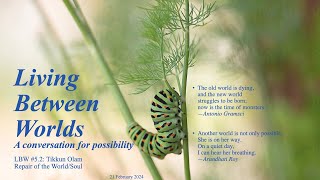
Gil Friend hosts a Living Between Worlds session with Ken Homer exploring tikkun olam, the Jewish concept of repairing the world. Ken shares how he shifted to living from a sense of being enough, while participants discuss moral anguish, land return, and the difference between fixing and improving through local action.
Chapters
Foreign. Hello, everybody. This is Living between Worlds for February 21, 2024. I'm Gil Friend and with co pilot Ken Homer. Want to welcome you to what I think is the 38th session of living Between Worlds. This is a conversation for possibility, where we explore together the perplexing and unsettling and occasionally thrilling experience of living in what Antonio Gramsci 100 years ago called the time of monsters. The time when the old world is dying and the new world is struggling to be born, and doing so together with grace and dignity and power. Before we dive in, Ken, want to orient people to the logistics for the call. Sure. Of course I'll recognize the Mission Impossible theme. I'm going to tell you a really quick story how that came to be. Laura Schiffman was given the the task of writing a theme for this spy thrower. And that's all he knew. He knew the name and it was a spy thrower. So he went to the Morse code dictionary and found out that the Morse code for M is dash, dash, and the Morse code for I is dot, dot. And so you get dash, dash, dot, dot, dash, dash, dot, dot. It's in five, four. Time or logistics? Please keep yourself muted when you're not speaking so that if someone else is speaking and you happen to cough or something, it doesn't bring your picture up. If you'd like to contribute to the conversation, please check the reactions. Some people have it in reactions, some people have a separate. For, raise your hand. We will begin on time as usual. I think that's. That's basically it. Please, if you can keep your camera on. It's always nice to see faces and feel free to jump in when it feels appropriate to do so. If you do raise your hand, it makes it easier for us because it puts you in a queue so we can call on you in the order in which you raised your hands. Gil, did I miss anything? No, you got it all. But let me add two other things. I'm between. I just had cataract surgery. I'm between glasses, so I can't read the chat very well. If there's anything in the chat you want to bring to my attention, or particularly surface, send it as a direct to Ken. We'll hopefully do that. Invite you all to watch the chat, see what's in it. I'll keep the chat. I'll watch it. And then Dave White said, see me from. We will post the recording of the call. We don't usually post the chat, so if you want to save the chat, save it yourself. Using the three dots in the chat window. I want to ask you to do something new today. There's a lot of very interesting things being said in these calls. Listen for interesting quotes and grab them, note them down. Either post them yourself or send them to us. I'd like to ask if somebody's artistically inclined. For next time, bring build us a meme template that we can drop quotes into after each call and pedal around on social media. And with that, I think that's it on logistics. We're off and running. Thank you all for being here and welcome to the new people. Deborah, I see you're new and some folks are joining us for this time. Please. Nice to just great to see you. Thank you for coming. Appreciate having you here. The between worlds thing becomes more evident every day. We're living this now. We feel it now. I've often thought that we look back at history and say there's a historical epoch, and I think mostly people didn't feel that when they were in the middle of it, but we sure as hell feel that now. So look at it. We've got climate crisis, we've got rising seas, acceleration of renewables and regeneration. We've got the whole ESG phenomenon. It's backlash in the United States, but leaping forward in the EU and in China, we've got refugees and immigration crises and the prospect of vastly more refugees in motion around the world as the climate unravels. We're living with the rise of authoritarianism and political corruption seemingly around the world. Many of you I know, are immersed in discussions of collapse and transformation. And of course, you've got the disruptions of what people call artificial intelligence for both good and ill. And we haven't even begun to see the tip of the tip of that iceberg that's moving toward us at staggering speed. So, you know, between worlds, between hope and despair, between action and inaction, this is a personal journey and a not personal journey for all of us. It's not about you or about me, but it's about all of us. And here we are in this thing and, you know, world changing, which is what everybody on this call is up to in some way, is hard work. Everybody spends a lot of time talking about how to do the work, what the work is. But there's also the matter of how we bring ourselves to the work and who we are in the matter. So there's a phrase in the tradition of my tribe called tikkun olam. It means in its most literal sense, repair of the world. Though, you know, the nature of the Hebrew language means that nothing is entirely literal or specific. Tikkun can mean repair, it can mean fix, it can mean tune, as with a musical instrument. Ken recently wrote an evocative post. You can find it on LinkedIn. Maybe Ken put the link in the chat, too, for people about his encounter with this notion, provoked for him by an observation of Joseph Campbell's. And we thought we'd start by sharing that Campbell quote with you and see what it will see, what it illuminates with you, and what sort of conversation emerges from us. We'll share the quote, and then Ken will say some words and he and I will converse for a few minutes. Then we'll open the room up to all of you, as we always do, sometime in plenary, sometime probably in breakout, sometime back in plenary again. Our commitment, as always, is for you to be provoked into fresh perspectives in these calls and to leave this call enriched. So that's what we're up to here. Ken, you want to start with reading Mr. Campbell's paragraph? Sure. You didn't tell me you were going to do that, so I had to go and find it on my computer. Yeah, okay, got it. I can do it because I got. I got it. I got it. This is from Hero with a Thousand Faces, which is a book that I read in my 20s. And I recently started to reread it and found out that, boy, it's really worth dipping back in after 40 years. Tikkun alone means repair of the world, soul. This is a living concept. What requires endeavor, a daily one and sometimes even an hourly one. It's a commitment to a right way of conduct, a form of living meditation, a kind of contemplative, pragmatic. I understand it this way. De Kunalom is giving one's attention and resources to repair that part of the world that is right before you, precisely within your spiritual, psychological, and physical reach. This is a really important part. According to your soul's sight, not egos alone. According to your soul sight, not egos alone. So, Ken, thanks for that. Let that sink for a moment, and I will copy it into the chat so people read it. Soul site, site S I G H T the site, the site of the soul rather than the sight of the ego. And let me, just before we dive in, give you a little perspective from Rabbi David Seidenberg, who has gone deep on this work. He said, tikkun olam in the earliest text. We're talking now, 1800 years ago, probably something like that means establishing order and balance Rightness, fitness, whether in nature or creation, whether in the world as a whole or as we do in society, as we amend our laws and try to steer our way through our social covenants. The social meaning which has become primary refers to acts that establish and repair society that is the present world. And of course, our normal lives. And emergent meaning has its roots in combining these themes that humanity is responsible for repairing the natural world that we have despoiled. So, Ken, for you, you wrote about this, that you felt at a certain point ill equipped to deal with these times. And something opened up for you in this passage. Something shifted. This shifted something for you. Tell us what that was and how you got there. It's a deeply personal story. When I turned 50, I had an amazing birthday party. My wife said, I'll throw you a party, but you need to tell me who to invite. So I went through my contact list and I discovered I had 250 people to invite. And I was really blown away. I didn't realize I had that many friends involved. Not only that, I had this story in my head that there's only a few people in my life that I can go really deep with that I can not see for years and pick up the conversation right away. And in compiling that list, I realized, wow, I have like 15 or 20 of them, which really amazed me. So 50 people showed up for my 50th birthday. And I was so happy. And the next day I started to get depressed. I just left a job after 10 years. I left kind of under a cloud. I couldn't really draw on the resources of that job. I didn't know what to do with myself. And I got more and more depressed. And it lasted an entire year. 365 days. I lost 40 pounds. I lost interest in life. I wasn't eating. I wasn't connecting with people. I was really in a. In a very deep and dark place. And the day after my 51st birthday, I awoke. And I have a little voice that speaks occasionally in my life. It usually says a half dozen words and disappears. And that morning it said to me, what if I'm actually enough? I was like, what? Wait, wait, come back. Come back where? You know? And it is gone, of course. And. And I thought, what if I'm actually enough? What a question to live into. What if I start to live my life from being enough? Because for the last year, I had lived this from my life, from a place of I'm not enough. I don't have what I want. I have things in My life, I don't want, I didn't. I'm not living the life I thought I'd have. When I was in my 20s, I really felt inadequate and I felt the world was overwhelming to me and I couldn't do anything. And that shift of what if I'm actually enough? It was world changing for me in the sense that my world shifted because I started to say, if I don't believe that I'm enough, then I may as well commit suicide because there's really no point to my life. But if I believe that I'm enough, even if I can't make a dent in the bigger world, I can be effective in my life where I am, with the people in my life, with what I have, and just maybe that will be enough for the world. And so that was a pivot point. That was 17 years ago now it's been or 16 years ago now it's been quite a while. But since that time it's really connected me to a deeper sense of being. And I see someone just said define soul. Thank you, Gene Dunaway, my old friend of 30 years, who Gene and I used to work together for three years. Soul is very difficult to define because it's, it's a concept that's been around for a really long time. If you go to Etymology Online and look up the word soul, you'll see it goes way back to a Proto Germanic word meaning sea or from the lake. It's associated with water. For me, soul is the part of my being that connects directly to the earth, which is why the Campbell cord is important, because it's about the world's soul and my soul connecting. And my soul site is how am I in the world connected to the world in a deep way where my ego is not driving my thinking, process and behavior, but that I feel and sense at a much deeper level that often involves suffering. What can I do to alleviate some of the suffering in the world? Gene, does that help? I, I, I appreciate your definition. It's tricky territory, of course, because yeah, well, I, I, I appreciate your definition of the word and clear. I'm still. It used to show me. It used to curious part of me the meaning. Now we're looking at a narrative idea of the existence itself. It used to be to me, it used to be one part of me that is. But now we're looking just another self word that we're then oneness have a soul. And how do we purpose and distinguish the soul's purpose word? As if I were accept it has A purpose. I would just call. I'm not sure meaning as if I don't know that. Great, great point, Gina. Well, I would just call it the. So I'm not sure meaning pre Christian. Great point Gina. It has to do with genius and your. Your demon. I'm referring such a way that the world Christian conception of soul is. It has to do with genius which was long before the mission being idea of the world in such a way that you know, it's. It's a word with layers and layers of. And it's simply. Which was long before the Christian. What I'm saying may resonate with some of you. You know it's. It's a word with. With division here. I'm simply trying to point to what I'm saying may resonate with some of you and may actually view off. I'm not attempting to create division here. I'm. I'm trying to point to. We are part of the earth and it's part of us. How do we actually Gaia as a living the only place in the universe we know life exists. We are part of the earth and it's part of. Infuses us with meaning as a living organ. A lot of us only place the universe we know of as where life exists. It. This is territory where for me if we're open to it but a lot of us enthusiastically and be very careful this is a defined territory where for me, Gene. For me that question makes me itch. Both dive in enthusiast. It's not like there is soul any more than there is define soul. These are ways we can. For me that question makes something that we experience. It's not like the organ soul any more than ego. There's ways we have of speaking of something and like Ken said, you know, for different people it's different meanings in the, you know English from the Germanic it goes to a water root in Hebrew. It seems to have more to do with breath and the body. Different traditions take it different ways, but it's something. It evokes something more than the individual identity grappling with what's right in front of me. And yet as Ken said that's where it comes back to is what do I do in this world that I encounter as a separate being, as a belonging to the living world. One of the sources I read preparing for this said tikkun olam means repairing the world. We've said that already which is what we're here to do because in case you didn't notice, the world is broken. Even the stuff that looks great isn't anywhere near what it's supposed to be. So some people say, that's just the way it is. Live with it. Others say, let the creator who made it fix it. Others say, escape it. I'm out of here. Others say, fix it, whatever you can do, wherever you are, because that's what you're here for. So let's Ken, let's open it up to the room. Who's got questions? What does this prove? What's your experience of these matters in your life? We'll have some more specific questions down the road, but let's start there. Alan, please. Well, thank you all. This is perfect. I'm glad to get into the beginning of this conversation. We're at a moment between these worlds where destruction is clearly in the offing and the repair has to be in some inclusive and redemptive way for all those participating in what has brought us to this time. And I see it as the need for civil society to mobilize itself to call the war makers to the peace table, the peace table which we do have for the people, and that each of us collectively are the expression of that civil society. And if we would each move through our networks, it would be even more manifest. And yet in our conversation, we remain too individualized. So my urgency in this to see what is the collective action and energy in our collective tycooning that we can do to heal the world, which I think is in some way to call civil society, as did the Hague appeal for peace in 1999, into some convergence to call the war makers to put down the gun and come to the table to talk that war does not work and we need to end it and begin a culture of peace and non violence for the children of the world. So that's what I'm glad to put into the beginning of this discussion. And I love you all. I hope we can actually become a weak. Thank you, Alan. David. David Witzel. Yeah, I was, I guess I was reacting to the. What you said there right at the end. Gil. Around the world is broken. And I'm kind of wondering, do you have to start with that framing or not? I mean, is the world. The world is. Is it more broken than it ever was? I. I've been trying to come from a framing of the world has huge potential and opportunity. Yeah. And yes, we can. I don't know if we're repairing it, but hopefully we're enhancing it. And I worry a little bit that the broken framing is a sign of privilege. It's like my Little experience outside of the United States in the last year or two. I don't feel like the people that I've been visiting in Thailand or Indonesia, they see the world as potential. And I wonder if we're caught in a cycle where it feels like it's broken, but that's because we've had such wonderful lives up to now or something. But anyway, I wonder if you need that broken framing or if you could start without that. Great question, David. I was. That. That was one source that I was reading. It's not the last word on the subject by any means, but it's a great question to toss into the mix here. I have some things to say about that, but I want to wait and hear from other people and bring them back later. So. David Morse. Yeah. What I was particularly taken with, I. I like the word soul, and I've used it and I've felt it, but I'm. I've never really been too much into the languaging of it. I do like what was said. The world speaks through us because I. I always feel that way. I'm. I'm really into nature, and everything is nature and everything is connected and. And I also like what David said. Yeah. Start with the positive, not with the negative. Thank you, Mitch. Welcome. Hi. I agree it's. It's not necessary to start with the framing of it's broken, but it's always improvable and. And the world is a pr. The universe is in the process of discovering itself and, at, to the best of our knowledge, primarily through us. I doubt that's true, but it's our articulation of the opportunities and the potential for improvement is, to me what soul is. I. I go back and forth between dualism and monism. Monism is making more sense to me recently in the sense that the philosopher Jacques Deleuze talked about manifolds, that we are all part of this diverse oneness. And I really have been thinking a lot about that lately. But this is also a timely conversation because I just made the move to radically change my life, to try to focus on what I can improve. I'm one of those people in the last category of we're here, so let's fix it, and particularly around what I can change. So I had been the CEO of a company for the last six years. I've handed that off because I was not growing it as successfully as I needed to. I took a job where I had an opportunity to work across a wide range of different projects, and I picked up and moved from the Seattle area to southern Oregon in the hills, 30 miles from almost anywhere, so that I could get completely connected to two acres of land, learn everything I can about how it is and how I need to preserve it in order to have at least that one impact. And in that context and the broader topic for today, my relationship with news is changing now that I'm not in the midst of the community all the time, and I'm much more selective. And so I'm finding all sorts of genuinely gratifying experience out of that decision. Right. Thanks for sharing that, Mitch, and congratulations, Shel Horowitz. We've got at least half of your head here. Oh, that better? All right. Okay. Yeah. I'm definitely in the I'm here to fix it category, and I think those of us in that category, which I suspect is the majority of people on these calls, need to celebrate the victories we do achieve. I've been fortunate to be part of some, and I've also been very frustrated with how, in the great scheme of things, how little in my 67 years, how little change I've actually been able to leverage. But at the same time, I. I did get to. To enjoy starting a movement that was successful, starting some organizations that lasted long past my tenure with them. So, you know, those things keep me going. And my eternal optimism, I think, is rooted to some degree in this history that, yes, I actually can point to a few things where I can say I made a difference here, but that difference is not nearly the difference I thought I'd be making by now. And that's a little frustrating. And I feel myself slowing down as I age and being busy grandparenting and being busy with this, that and the other thing, and losing some of the ambition that I had to. To really make my mark on the world. Thank you, George. Most of us here are. Are male. And so one of the default settings for males, at least in this culture, is to fix things. And that's not always what needs to be done. So perhaps first, the first the thing to do is to observe and see what's actually going on, and then to find the place where you can add a little bit so that things run more smoothly. But to come into it, to think that you have to repair and have to fix their sides of the same coin, and there's a third side, which is the edge, but I'm not going to get into that. Just a note that I count 13 women on this call at least. So out of 40 participants, that's not 41. That's. That's a substantial number. I just want to make sure we're not overlooking that I count 15 and more. Welcome. Please invite people. We'd like this to be as broad and diverse as possible. You know, the, the fixing thing is funny. You know, if I'm, if I'm a fisherman, one of the things I do is go out in a boat and toss out a net and catch fish. But one of the things I do is repair the net because the net frays and it tears and it wears out. You know, if I live in a house, I might have to paint the house more than once in its lifetime. You know, Paul Simon's got that wonderful song. Everything Put Together Falls Apart was the exact title. Ken, you're going to have that better than I do. But you know, we live in a world of entropy and that's part of the natural course of events. And so repairing is part of the natural course of events. It's not just a judgment that there's something wrong, but that things have an evolutionary potential and we have some role in that evolutionary potential. Some of you know, Barrett Brown, why as an interesting consultant and we did a workshop some years ago where Barrett led the, the dozens of people in the room through a fascinating meditation process was a three phase meditation. Some of you have probably done this first. He im invited us to imagine all the ways that the world was broken, everything that's wrong, all of our judgments about what's not good in the world that we're in. And I guarantee you people had plenty that surfaced. And we were invited to dive deeply into that conversations that we've had that we resist, which is like what's broken. And we did that for an uncomfortable amount of time and came back and breathed and centered and shared a little bit and then went to the second phase which was what's absolutely splendid and perhaps perfect about the world as it is. What's. How is this the worst. You know, the first one was what's, how is this the worst of all possible worlds? The second, how is this the best of all possible? And you know, we've, we can each of us and all of us surface plenty of stories about that. And again, time and meditation time together sharing a little bit and going then into the third phase, which was how is the world perfect as it is right now? And starting with that would have given a very different result than starting with the first two. But it brought generally to people a great sense of peace and groundedness and not passivity, but a readiness for action in the sort of spirit that Ken was evoking at the start of the call. Before you go to Heather, I just want to throw one more thing in. Sometime last year, we had a call about this Spanish word, senta pensar, and senta pensar con latiera, which is to think and feel with the Earth. And I think that's an example. A lot of indigenous people, whatever their conception of soul might be, it's always about belonging to the Earth and. And being in tune with the Earth and knowing what's going on with the Earth. And I think we have, as weird people, Western industrialized, educated, rich, and democratic. Many, a great many of us have lost that sense of being connected to the Earth. There's people living in, you know, many stories above the ground. They never really see much green. They don't know where food comes from. You know, it's. It's. It's a way of not. Not being connected. And I have a great deal of concern for people who aren't connected to the world because it's really easy for them to act in ways that. That cause it harm and don't bring that harmony and don't create that improvement that's being mentioned here so often, which I also really want to honor as a really valuable place to be, including in your stance that the world may have a lot of problems, but it's also got tremendous regenerative and healing properties. And if we stop doing damage to it, it'll probably heal way faster than anybody believes it could. If we keep doing damage to it, it might start to hit points that put it in places that are really harmful to all of us. Sorry, I just want to throw that in. Heather, please. So I just. I want to start by saying that I'm, like, completely provoked to the extent that I'm having in my physical body, a. An overwhelm of physical sensation that are like sparkles. And I'm not quite sure where to start, but where. Where I'm at without all the backstory is that I've been. My approach to this, in terms of my soul side, is to sit every day with, thank you for waking up alive on this beautiful planet today. And. And what is mine to do today? And. And that is a query that I make to the invisible realms that I can feel all around me. And so I've been sitting with what is mine to do today for quite a long time now. Maybe not a whole year, but. But long enough to finally get a sense of trying to figure out what is mine to do by watching what it is that I am doing. And. And what I have been doing in the places where I've been showing up is trying to investigate reality and question authority. And. And I keep in mind Leonard Cohen's song There's a light and there's a crack in everything that the light gets in. So I. I've come to see myself as a cracker and that where wherever I go, I seem to be making cracks by questioning authority. And the authority I most often question, because I do local political work, is to try to investigate the authority of our belief in settler colonialism as the way the world works. And that conquest and extraction of value is the only way we can organize ourselves in an economic system. And trying to invite people. And I'm very clumsy at this. I'm the first one to say I am not good at this, but my intention is to just. An extraction of value is the only way we can organize ourselves in an economic system and trying to invite people. And I'm very clumsy at this. I'm the first one to say I am not good at this. But my intention is to just try to ask the question of. In what ways is what we're doing still the source. The story of domination from. From, you know, the 1400s, the settler colonialism and. And racism and genocide, upon which, you know, the. The governance and economy of this country emerged from. And. And I keep trying to do that in a way that doesn't make people defensive. Like, you know, are you. Are you accusing us of being racist in our white privilege? That's the reaction I often get. And it's like, no, can we just talk about what we know to be true is that there were. There was a belief system that came out of Western Europe to. In the conquistadors, you know, from England and Spain and Portugal, but the conquest and extract mindset to. To steal the value from, you know, from the land, from the people. Can we just talk about that? And lately I've been having a problem with land acknowledgments that seem to be in the beginning of almost every meeting I go to. And it. It hit me over the weekend that it feels like such a hypocritical thing to do to acknowledge that. That I'm sitting on unceded land before the meeting. Here I am, I'm on the unceded land of this, that, or the other tribe. And now let's get to work. And it hit me over the weekend. It's like, well, wait a minute. If I'm acknowledging I'm on unceded land, Then in some way I'm acknowledging that I'm on stolen property right now. I'm sitting on stolen property and trying to figure out how to extract more value from stolen. The property that was stolen that I actually believe myself to own. Or in land use planning, the people who own the land think they own it without recognizing that it's actually stolen property. And that if I bought stolen property at a pawn shop and it had became revealed that it was stolen property, I would not be allowed to keep it. And so I, I'm going down. This, this is how I'm provoked. I'm provoked about how to make peace with the fact that, you know, I'm living on stolen property. And the way it was developed was through racism and genocide. And can we just talk about it and see the patterns so that we don't replicate the pattern any further? Okay, now I'm complete. Heather, can I ask you a question about what you said? What you said a little while back? Yes. You said, when you try to talk with other people about it and you get. Sometimes get a reaction of, are you calling me a race? And you say, no, no, no, you're just trying to explore something together. How has that exploration gone with people in your community? Have you been able to have open and productive conversations with surprising partners in that? Or does it, or does it get reactive and shut down? What happens? You know, it's. I've created some cracks, and I've created cracks in two places. One is with the local newspaper about how can we have a conversation about growth management planning that recognizes this heritage that we bring to the conversation. And the young person who's the innovation editor there has said, okay, let's talk about that. The other crack that has really surprised me is with the executive director of my local community foundation, which is sitting on. Sits on $50 million worth of assets. He was actually the first person who, after a meeting, emailed me the next day and said, I really appreciated what you said. Heather, let's talk. So, so the cracking, the cracking appears to be working. I have to really go slow, manage my own expectations, my own weariness, quite frankly, weariness and, and the deep brokenheartedness I feel for the planet. I just, Yeah, I, I just, I actually feel every day a direct myself to be a manifestation of, Of. Of that. Of love. The English word for it is not correct for me, but. But I know that the thrust of goodness through all of creation is, Is a driving force. And, and I can, I can feel that. And, and one other thing I've it's been, I've come to understand, is a concept of moral anguish by a woman named Mickey Cashton who lives in the Bay Area. And I was struggling with, you know, what is it I'm feeling and why do I feel so miserable? I don't know what the word is. My body. Blood pressure's high. You know, I'm like, I'm a wreck. What is it that I'm feeling? And then she posted an essay on what she called moral anguish. And the way she described moral anguish is the deep felt sense that one experiences when they know that the luxury and the comfort that they have in their life, like me turning me, getting in my car, going to the grocery store, or even turning on a light switch, that that level of comfort for me has come at the expense of the suffering of many, many others. And so that it becomes impossible to actually live comfortably in this. In this material comfort that I've got, because I'm too, too aware in my physiology beyond words, if not billions of other humans and forms of life through time. And so every day, every day, I just have to breathe into the discomfort of what I know to be true in terms of where I am right now and. And the benefits of my own white privilege. And I just struggle with that. But that's my soul site. My soul site is to, like, make cracks in our belief systems so that, like, light can get in. Thank you, Heather. This, this. This evokes for me Joanna Macy's work on grief and belonging and the work that connects. Let's take a moment just to breathe together before. David Schoenbrun. Would you hold just a moment? I think Stuart Levine had his hand up. I certainly fell off the screen. I'm not sure if that was a zoom accident or if you've stepped down. Stuart Levine, do you want to speak? Thank you, Gil. So I just wanted to say that I heard the. The daily quote this morning from the. From Sadhguru, who said, we won't have peace in the world until each of our minds is peaceful. And I think that that is just so true. And I also want to just thank Heather for her heartfelt articulation of stuff that I think many of us are feeling. I actually had taken my hand down, Gil, because I didn't want. I didn't want to add to the kind of agitation at this moment. That being said, words that have come up in the conversation, soul, spirit, and I, I expand that to consciousness, love, to reality, to authority. In some ways, the words, all of these words for me lately fall in some way inadequate. The. The discursive mind can dissect them into so many different places. And there's a way in which conversations become too heady, too intellectual. We're all aspiring, I think, to some feeling space in the world. And it's really hard to get there when you've, you know, we're sitting in the existence of, you know, global warming and climate change and. Invasions of other countries and aggressiveness and the whole capitalist system, which is so infused in our very consciousness and ways of being in the world. You know, we've got massive challenges when we talk about tikkun olam and fixing the world. And at some broader, bigger metaphysical level, the world is purchase and opportunities right here, right now. So in some ways, it's a very exciting generative time to be alive as long as you're not attached to anything deeply. So. So say, yeah, perfect is a funny word. You know, how. How I hear that when you're saying that steward is that the world is. It is what it is. And Byron, Katie, the teacher, her definition of suffering is denying that the world is what it is, is imagining that it's something other than what it is, which is not the same as accepting what it is than what we have right here, confronting reality as it is for her as a path to peace. In the mix of all this stuff, David, one more thing before I go to you. I look back in the Hero with a Thousand Faces to the page before Joseph Campbell offered his spin on healing the world soul, which, by the way, I think is his innovation. I don't find that in any of the Hebrew sources, putting world soul in instead of world, but cool, because that's what we do. But he said a couple. A page before he said, it appears that, quote, culture at the edge of utter corruption, unquote, and quote, world at the edge of utter destruction, close quote, are two of the oldest themes to be found in stories of the human race. It ain't just us, folks now, in this time between worlds. That is something that humans have experienced since maybe not forever, but since as long as we have stories of humans. And you know what does that open up for us, that perspective? Gil, before we go to David, I just want to know. Stuart, I was tracking, you said, and then you threw this little wrench in the works where you said, as long as you're not attached to outcomes. So that's a big developmental thing, man, to not be attached and yet passionate in the work. It's an amazing little dance. David, been enormously patient. Thank you for waiting as we've had various interventions before you take a shot before I get into what I had wanted Take a shot before I get into what I had wanted to say I wanted to extend upon what Heather said her the. The phrase she had moral. I don't think it was anguish moral something anguish. Well that's to say I wanted to extend upon what Heather said her the. The phrase she had moral. I don't think it was what I've been feeling in an excruc. Excruciating way in terms of being aware of this profound genocide in progress as we speak and living in a comfortable environment and anguish moral something. Well that's what I've been feeling in an excruciating way in terms I. I don't have a way of existing with those two realities simultaneously and I find it just extraordinarily troubling in terms of being aware of this. What I wanted to say I believe I have gone on a path different from most of you other attendees and I've been looking at material that is quite different and I put in the chat a link to an interview that Tucker Carlson did with a man named Mike Benz which is the most extraordinary interview I've ever had and the. The net. Net of it found genocide in progress as we speak and living in a comfortable environment. And I, I don't have a way of existing is that the military and intelligence community has decided that we the people are an impediment to their conduct of what they call democracy with those two realities simultaneously and and as a result they have instituted what they call disinformation suppression and which is in other words censorship. I find it just extraordinarily troubling. Yeah ship of us trying to communicate the truth of what's going on. I'm also a truther as regards the pandemic as having been a bioweapon attack by the military on us that the so called vaccine. What I wanted to say I believe I have gone on a path different from most of you others were a bioweapon as well as the virus being a bioweapon. So I've gone very deep down a rabbit hole that is very uncomfortable. But this, this interview is a bridge to that world to understand the immensity that that there's already been a coup and that we the people are not running for attendees and I've been looking at material that this government. David, how do you. How do you deal with that discomfort on. On a day is quite different. And I put in the basis. I let it drive my meditation. I. I just keep going deeper and deep, broader, bigger, metaphysical level. The world is perfect because we get to experience it with all its challenges and opportunities right here, right now. So in some ways it's a very exciting, generative time to be alive. As long as you're not at a link to an interview that Tucker Carlson did. Deeper into this sense of pain that I feel. And I believe that underneath that pain is you is the experience of unity. Thank you for that. So it's. It is a. It is entirely a spiritual approach. Thank you very much, Philip. Going back to the question of fixing versus improving with a man named Mike Benz, which when George mentioned the. Or implied the arrogance of the Mr. Fix it attitude, it was definitely something I identified with quickly because I definitely found myself trying to go in and fix a thing. It is the most extraordinary interview. I've been just mucking it up worse and making an ass of myself and generally being humbled by attached to anything. Hugely. So. So thank you. Yeah, perfect is a funny word. You know how, how I hear that when you're saying that steward is that the world is. It is what it is. And Byron, Katie, the teacher, her definition of suffering is denying that the world is what it is. How do you experience it? But listening to Heather, I'm reminded ever had. And the. The net. Net of it there is like a. And I guess combined with what you said, Gil, about the nets. You know, the thing about fixing is that at least implies a functional end goal that can be the terminus of our intervention, right or wrong. I can try to fix it up. I can see that I fix it. I can see that I didn't. I can be rebuked. I can be put back. And is that the military and intelligence community has decided that we the people are an impediment. If I'm trying to improve things, it's like, well, things can always be improved. And it's. There's no. It's much. Most of the things that have been done in the world are the most horrible things have been done with some narrative of improvement associated with them. And so is imagining that it's something other than what it is, which is not the same as accepting what it is. And it's not to be changed. It's just not pretending that it's something other than what we have right here. Confronting reality as it is for her as a path. I guess I think that, you know, going back to the question of the world, to peace in the mix of all this stuff David, one more thing before I go to you soul or the site, the soul site question. Well, obviously to their conduct of what they call democracy, both the fix it attitude and the improve it attitude can be expressed. And as a result they have instituted what they call disinformation, suppression and which is in other words, censorship of us trying to communicate the truth. I look back in the Hero with a Thousand Faces to the page before Joseph Campbell offered his spin on healing the world soul, which by the way, I think is his innovation. I don't find that in any of the Hebrew sources the hidden putting world soul in instead of world, but cool, because that's what we do. But he said a couple of page before he said, it appears that quote, culture at the edge of utter corruption, unquote, and quote world at the edge of utter destruction, close quote are two of the oldest themes to be found of what's going on. I'm also a truther as regards the pandemic as having been a bioweapon attack by the military on us, that the vaccine so called vaccines were a bioweapon as well as the virus being a bioweapon. So I've gone very deep down a rabbit hole that is very uncomfortable. But this, this interview is a bridge to that world to understand the immensity that, that there's already been a coup and that we the people are not running this government. David, how do you, how do you deal with that discomfort on, on a day to day basis? I let it drive my meditation. I, I just keep going deeper and deeper into this sense of pain that I feel. And I believe that underneath that pain is you, is the experience of unity. Thank you for that. So it's, it is a, it is entirely a spiritual approach. Thank you very much, Philip. Going back to the question of fixing versus improving, when George mentioned the or implied the arrogance of the Mr. Fix it attitude, it was definitely something I identified with quickly because I definitely found myself trying to go in and fix a thing and just mucking it up worse and making an ass of myself and generally being humbled by the experience that. But listening to Heather, I'm reminded there is like a. And I guess combined with what you said, Gil, about the nets. You know, the thing about fixing is that at least implies a functional end goal that can be the terminus of our intervention, right or wrong. I can try to fix it up. I can see that I fix it, I can see that I didn't. I can be rebuked, I can be put back and if I'M trying to improve things. It's like, well, things can always be improved. And it's. There's no. It's much most of the things that have been done in the world are the most horrible things have been done with some narrative of improvement associated with them. And so I guess I think that, you know, going back to the question of the world soul or the site the soul site question. While obviously both the fix it attitude and the improve it attitude can be expressions of arrogance, when we ask the question when we're fixing it, have I fixed it for me? Does it work for me? Or is it working for us? Then at least have another way to get out of this potential runaway train of arrogance that maybe the improvement narrative has a harder time getting out of the I like the questions of arrogance when we ask the question when we're fixing it question, Philip. Like the, you know, the fix it for whom or fix it for what? Bob Dunham likes to taught us to ask for the sake of what behind any request or proposal or opportunity, like, you know, why, for what? For whom you know, and you and others spoke before about this sense of feeling connected to the earth. The question that I've been living with lately, there's a real shift in my work. Those of you who know the work that I've been doing advising companies on sustainability strategies. The MO for from the beginning, which was really radical at the beginning, was to say, hey guys, you can be more successful financially by paying attention to the living world than by not. You're being blinded by limited economics. You can't see opportunity. And the MO is show them how they can be more successful and therefore they'll be better stewards. You know, there's been some merit to that and a lot of not. And the question I live with more these days is what might it be like if we actually did business and everything else as though we actually belonged to the living world? I'm stepping from what for me is further in than connected to, but belonging to. And I'm in a maybe it's just a phase in my life where I'm much more interested these days in questions than in answers. I'm much more interested in the in the in in. Well, Heather, it's the crack. It's like what can open up in a conversation. When I when I started work as CSO for City of Palo Alto, oh golly, long time ago now, 10 years ago now, the outgoing assistant city manager, woman named Pam Anton had this way of in in meetings that were bogging or stuck or, you know, not going anywhere. She would ask what might be possible here. Not, what should we do? Not, what can we do? Not. You're wrong. You're right. It's like just, you know, inviting imagination, inviting something to, you know, inviting a crack in. And so for me, that one, that, like, what might it be like if we lived as though we belong and we all have experiences of belonging in different realms and different aspects of our lives, have a taste of what that is. What happens if that sense comes into our physical, economic, technical, political lives as well? Alan, could I ask you to hold. I want to go to some people who haven't spoken yet, unless you've got a very succinct urgency, and we can come back to you. What do you think? You're muted, so I can't tell what you're saying. That's fine. Come back. Come back to me. I wanted to follow up on the land acknowledgment and land back. Okay, let's come back. Let's come back to that in a bit. Let's go to Sarah and Jane and Deborah, and I'll see where we are. Well, I've been thinking a lot about this and what my. What my skills are, what my place is. And as a. As a teacher of preschoolers, or actually as a visiting teacher of preschoolers, one of the things that I am working on now is to get kids to really, well, slow down. Okay. So we end up doing a yoga thing at the beginning where we are imagining ourselves a tree that gives out as we breathe. Gives. You know, as we. As we exhale, we give out. Well, in this case, carbon dioxide for humans and other animals to breathe in. And as people, we give out carbon dioxide for animal, for trees and plants to breathe in. And so through that, I'm hoping to really instill from the age of 5 years old, 3 years old, including just the feeling of connectedness. And it's slowly working. But if. If you can get a routine. I mean, was it. Heather was saying she woke up every morning grateful not only to be alive, but be a witness to all this, these wonders. So. So trying to get that. Plus the inviting, the imagination, the empathy of imagining yourself being powerful as somebody who breathes. Somehow I'm hoping this will work. This will help change attitudes. So I just wanted to add that in. Sarah, that's very beautiful. I'm fighting through tears because I'm. I'm so full of sorrow and joy at what a gift each of us and each of you are to the g. To what's going on, which seems to be evolution. That's what universe seems to be doing. It seems to be doing evolution. And I'm imagining that some human beings are learning to live far beyond a direct grounded connection to the earth, up in condos and skyscrapers. And in some sense some of us are learning to be disconnected into habitats that might make people appropriate space travelers or dwellers on space stations and developing a kind of emotional posture that enables them to do that without going simply mad. I'm reminded. Not that I think that's what should happen to the whole of the human race, but I think that life expands to exploit niches. And I'm imagining you teaching children on a space station, sitting in front of the collection of plants that drive the space station's airflow and life, teaching them the fundamental connection of our breathing to the existence of this platform in front of you. And, and that's part of perhaps of the emotional evolution of a human being that is concentrating a desire, a tremendous godlike passion to develop life and to create worlds and to seed life all over the place and to become ecologists in our bones, because we are life and each of us is a gift. I'm coming to think that our concept of death is peculiar and limited and very skewed by systems of power and that we're on a learning curve. And to be spiritual about it, we may say that we're on God's learning curve or Gaia's learning curve, but it's a learning curve and it hurts and there's joy in it. And Darwin. I came across a. A discussion of Darwin and it, and it quoted a passage, a very surprising passage in Darwin's book, one of his books, where he said if we could grasp the suffering involved in, I'll use my term, the learning curve of evolution that creatures endure, we would be reduced to weeping as a regular part of our existence. So being here, I think the knowledge and the learning that we accrue in our tissue and our protoplasm, the, the stuff that's outside the DNA of the nucleus, that's just in our protoplasm, that epigenetic learning that's passed on jelly to jelly as the cell divides. It's, it's, it's outside the. It's parallel to, but outside the stream of the genetic DNA RNA game that the learning. And at a spiritual level, when we're recycled into the. Into the recreation of life out of materials, our little learning goes into that. That dew drop gives its learning into the sea of all knowledge. And all experience and all love and all passion. And nothing is lost. So the suffering of our lives is not for nothing. It's for the vast accumulation of experience and hopefully love of the collective, the great collective unconscious or the great collective consciousness of the universe. This is how I comfort myself. And I think we're born to be able to comfort ourselves and we're tricked out of our self comfort by the domination of other thought forms that are employed for cruelty and domination. And I really so deeply appreciate what's going on in these calls. Because when we speak to ourselves and each other, we're speaking to the whole world from the inside. And we're not isolated in alone little dew drops that are only going to find their ocean when they're banded together rewire right now. We are the ocean. And when I speak in my emptiness, everyone hears me from the inside. That's. That's what I am today. Gil, you're on mute, so we're not hearing what you're saying. The magics of zoom. Thanks for letting me know. Deborah, you're up next. Feel free to take time before you speak if you'd like to do that. Thank you. It's such a. A gift to be here. This is my first time joining the group. And Tikkun Alam is something that has been very powerful kind of driving thinking in my life. And I had never seen that definition that was shared, the Joseph Campbell definition. And I love that. And I loved what you said, Jill, about tuning so that I. I'd always heard repairing the world, but I hadn't heard tuning. And so I love that definition because it suggests listening and calibrating. And so I love that and I really welcome that. And one of the areas that I'm very active in is around language and thinking about the language that we need for. For Tikkun olam, for addressing the brokenness and possibilities of this world. And so some of you know, I've been co creating a lexicon of change that brings this language of transformation to the fore and have a lot of vocabulary from different languages and different disciplines and all. I'll share the link for that. And I'm also very active as a poet and writer. And I think that language has such a capacity to heal and articulate and imagine different worlds. And so I think there's a huge role for art and literature in helping us to imagine a better world, a more fair world, a more just world. And just absolutely love being part of this conversation and wonderful to follow you, Jane. And all the joy and tears that you share. Deborah, thanks so much. And in particular, thanks for re. Invoking the image of tuning. And you added to it something I'd never heard before. Of course, tuning suggests listening. And we tend to think of conversations as speaking, but conversations are, of course, listening. That's where the meaning happens. It's not like we're giving information to each other. It's that we're this miraculous process. You know, vibrations in the air impact our eardrums and. And meaning appears in our lives, something that we do together. Remember that. You know, fixing is one of the ways to interpret the word tun, but it fundamentally means setting right. And so, Philip, I think you talked something before about fixing is this notion of an end goal. The notion of setting right doesn't have that. It's like, you know, you live our. Live our lives. The, you know, the air comes in, the air comes out, the tide comes in, the tide comes out. Things live and they die, they fall apart. We repair them, we renew them. It's the ongoing process of life. That is, as I'm hearing it, the kind of T Kun fixing, repair, tuning, listening, belonging that we're talking about here. Alan, we're back to you. Thank you. Deborah, we're back to you, and then to Shell, and then we'll see who is next. Thank you. What you were lasting, Gail, came out in the fortune cookie when I went with ordeal for Valentine's Day. Live out of your imagination instead of out of your memory. And I think that is really what we. Our memory is so much darkness and trouble. And if we can see what is really possible on the other side, that I think facilitates some kind of turn of heart, which I think is. Is key, more key in a way than what is the soul. But we are in a place of separation and we need to find ourselves in some collectivity. I wanted to say I put my hand up after Heather had spoken so beautifully and raised the question of land acknowledgment, which I think is quite important. And in our area, we have been pressing beyond land acknowledgment. The question is land return. How actually is another sovereignty recognized among us? And that we see this is a multiple nation interpenetrating here on this land and how to heal that first war on this land. And that is part of ending the whole war system, which is what I think really needs to be in front of our mind as a system change from domination to cooperation, to caring, sharing, helping, and particularly healing from the trauma of this time of war and the atrocity atrocities people do to One another. Outrageous. Just stop. That should be our common call until the war makers come to the table. Put down the gun and let's talk like human beings again and see whether there can be some redemption out of this insanity. Well, let's live out to the imagination. That's a good imagination and doesn't seem too likely, but that's what we need. Civil society needs to call the war makers to the peace table. Good imagination. I point people to the work of Phoebe Tickle in England, who's working with what she calls moral imagination. So she's the first person I know who's stuck those words together in that way, and she is often dancing with that. So have a look at that. Something we may, maybe. So we can bring her in on a future call. Stuart, back to you. Alan, thank you again. I thought I was next, Gil. Oh, you were, but your hand came down, so I didn't bring it down. I'm sorry. No, no, it's. I came. Zoom has its ways. Thank you for pointing it out. Stuart. Hang on a second. We'll go shell, and then. Stuart. I'll be very quick. I just wanted to follow Alan and. And point to a wonderful song by the iconic Jackson Brown called Roll out the Drums of War, which beautifully expresses exactly what Alan said. And thank you. Thank you to Jane Byrd. Thanks, Michelle. Thank you. Okay, so the first thing I want to talk about is the word perfect, which we typically see as an absolute. But I don't. I think it was in the preamble to the Declaration of Independence, there is the phrase toward a more perfect union. So then perfect becomes a process, and I think that opens up enormous possibilities. And then to David Shanbrun's points, I wanted to note that the struggle between the powers that are in power and the powers that would like to potentially displace them or bypass them, that's a very old tension that goes back at least to the Exodus story. And I. I think of. I mean, I remember I was working for a Socialist newspaper in 1976, and Robert Mugabe was hailed as a hero, and. And he got into power, and he was horrible. And the same with Lenin or Daniel Ortega or many, many other people who are seen as liberators, but then adopt the repressive processes and institutions of the existing state when they take power and they become the new enemy. So one of the things I like about nonviolent struggle versus armed struggle is that it's a little bit more likely not to replicate the things that we're fighting against. I won't Say it doesn't happen, but I do see that there is a way that it opens doors for new structures in society, new ways of being in power or sharing power. And I, I love the, the emphasis in the last 15, 20 years that we've begun to have on the rights of beings who don't happen to be human. And I think that's another very powerful doorway. Thank you. Take another few moments in silence. And breathing together. I'd love to hear from some people who haven't spoken yet. Not, not to put any pressure on you, but to just really invite you to bring your voices into the conversation. Armored will improve your throwing arms. Don, I see your hand up. Glad you're able to join us. You'll need to unmute. You did. You did say me? I did say you. Okay, I wasn't quite sure. Yes. First of all, I want to thank all of you for all of this wonderful sharing of your inner reflections. And I've been hesitant to come out because I think in many ways you're way beyond where I am. And I then thank you, therefore, where you are and how you shared it. But I do want to bring in this dimension. I'm part German and part Dutch, but I'm also half Sioux American American Sioux. And speaking of the land and how the Caucasian, especially Caucasian invaders into this land have run shipshot slipshod over the rights of the Indians and continue to do so in so many ways that there's so many lessons we can learn. And I listened carefully. There were many answers or good directions in helping to seek for answers to some of these things. And I'm seeing some, some slow, slow progress. That's one side. The other side, what I deeply, deeply use in my teaching and my writing and so on, is the seven generation principle of the Indians, where it isn't this short term my life time responsibility or, or that's it, but it's this. And by the way, seven doesn't mean seven, it means eternity. And in that aspect, thinking in that context and that like some of the other Indian writings, we are not the center of the universe. We're but a thread in this universe of thinking of all of the biospheric dynamics as well as the climatological and geological and so on, all of those parameters, we're just a tiny little thread. And so often we think we are so central. And so in that respect, I really feel that it's important to listen to, in this case, the American Indians. But others, if you look at some of the same, some of the tribes in Latin America and South America and other parts, they have some wisdom that we need to learn about. Thank you. Thank you, Don. Some wisdom evolved over a very, very long body of experience. Very, very long, very long tens of thousands of years of what it means to live in this world. Randy? Yes. Hi. I. I really love these conversations. I had a Indian midwife for my kids, and she said that their tradition was that the white would leave after 400 years, and they would be asking us how to live in harmony with nature. So perhaps that's where we have come to. But also, I'm reminded of a conversation I had with my grandmother, because I would ask her questions when I wanted to take a break from the long piano lessons she used to give me. And we had a relative who had totally left. He. He bought some land out in the wilderness and said, you know, enough of civilization. I need to be independent. Meanwhile, I was reading about Greenpeace and people in their rubber boats standing in front of or rowing in front of steamships. And I asked her, which should I do? And it was a great question for me for many years. And I finally realized that it was up to me to be in the present time with myself and do whatever I could do. I think we all kind of. Everyone here kind of knows what needs to be done, but each of us needs to be in motion. Change is always happening. There's nothing perfect or totally wrong with the world. It's in change. It's always in change. Like you say, between two worlds. And it's for us individually to keep moving, to be doing whatever we can do to put our energy into the changes that we believe need to happen. So we wanted to share that. Thank you for that, Peter, is. You don't need. You come off mute, please. There you go. Technically challenged. I have a different metaphor than between worlds, but I don't think it's a contradictory metaphor. But, you know, our metaphors come from who knows where in our background. I think this one comes from. I spent decades kayaking whitewater. So I think in terms of turbulence ahead. And I look and I see turbulence ahead in all those different ways, Gil, that you spoke initially. And the turbulence is of a nature that tends to pull us apart, separate us. And as to what's on the other, the downstream side of this turbulence, I don't know. I'd be a bit too bold to, you know, give my ideas about it. I don't. Who am I to say? But what I can say is that I think it's important that we Learn to, like in kindergarten, when you're crossing the road, hold hands and stick together. And in that light, I have become very sensitized to how easily we can fall into contention to argument. And sometimes we avoid argument by acquiescing, but that doesn't solve the problem either. I propose, like, a general approach that rather than kind of starting with our opinions and our recommendations and our ideas about what to do, which can show up to the other person like an imposition of their viewpoint that you need to argue with or submit to, I propose that we take a little time, intentionally, to cultivate a shared sense of what really matters. And like has been brought out so clearly here. There's many different views, many different ways of articulating what really matters. What matters. If we can get aligned. I didn't say agreed. Aligned, so that we're heading in a roughly same direction, then from there we can get a sense of what's important to pay attention to. Now, given this circumstance, this instance, this time, what's important to pay attention to and rather than argue for it, clarify the importance that it brings to this moment, given that this is what. What matters. And out of that begin to cultivate a resonance that, hey, this could be possible. That could be possible. And then by continuing to resonate in that sense about what's important, what really matters, and what could be possible, we can arrive at the next step forward without ever having to argue. And I think argument is one of the less useful human practices of our time. That's what I have to say. Beautifully said, Peter. And I'm gonna. I'm gonna brag on you for a moment. For those who don't know, Peter has just published a book. I'm gonna brag on you for a moment. For those who don't know, Peter has just published a book that goes into some beautiful depth and exploration of some of the themes that he's been touching on here. So it goes into some beautiful depth and exploration of some of the themes that he's been touching on here. So, Peter, you or somebody could put that in the chat. I encourage people to have a look at it. I. I love what you're saying, and it's. We talked about this a little bit over the weekend, and it's. Peter, you or somebody could put that in the chat. I encourage people to have a look at it. I love what you're saying, and we talked about this a little bit over the weekend, and it's an exploration that I'm finding myself in now. Goes back to what Deborah said about listening. I'm paying a lot of attention to listening and I noticed that historically my listening has been for the sake of something. It's an exploration that I'm finding myself in now goes back to what Deborah's like arguments like, am I agreeing with what you're saying? I'm upset about listening. I'm paying a lot of attention to listening. And I noticed that historically my listening has been for the sake of something like argument like, am I agreeing with what you're saying? Do my facts support your facts Preparing for what I'm going to say next to respond or agree or rebut rather than just letting it land first step. Second step is rather than oh, you're wrong or I disagree or here's another way to look at it. I have the opportunity to just be curious. Well, oh, you've said something novel for me. I haven't heard it before. I'm curious about how you came to that in your life. Maybe there is a sense of what matters together, a sense of, you know, things that we care about, that we share, which provides the basis for a very different kind of conversation. Conversation and the way I at least and I think a lot about do my facts support your facts preparing for them to say next to respond or agree or rebut rather than just letting it land first step. Second step is rather than oh, you're wrong or I disagree or habitually thrown to Peter yeah, yeah. You said a word that has really I found very, very important recently was this notion of something sense. And I recently tumbled on this idea that everything we do makes sense in the moment of doing it, although the next moment may be oh, I can't believe I did that but in the moment of doing it, what we do makes sense. Even if I shut up and don't say anything, even though I think here's another way to look at it. I have the opportunity to just be curious. Well, oh, you've said something novel for me. I haven't heard it before. I'm curious about how you came to that in your life. Maybe there is a sense of what matters together, a sense of, you know, things that we care about that we share which provides the basis for think you're wrong. Even if I argue because I think because it makes sense. So very different kind of conversation. And the way I at least and I think a lot of us then what you're saying about when I encounter habitually thrown to Peter yeah, yeah, you said a word that has really I found very, very important recently with this Notion of sense after someone's perspective, statement, actions that to me don't make sense, maybe I can find out the sense. And I recently tumbled on this idea that it makes for them and thus treat them not like an idiot who doesn't know the right thing, but like another person who's doing the best they can because it makes sense. And that's this shared sense of things that I'm aiming for that I believe we can construct. If we have open hearted people who are willing to take time and not be right about every damn thing and not give in so easily, but that everything we do makes sense in the moment. Really look for the sense of others and find a way to align and resonate so that we can go forward together into the world that we cannot predict. Peter, thank you. I want to say one other thing about where you started and then Sarah, I'll come to you. We need to be brief because we're, we're at time here. We're gonna go. Thanks for letting me hog the air there. We're hanging up a little bit over. Don't, don't go yet. One second. Because you talked about turbulence and I think that's for me that's the powerful metaphor from where we are now. If I'm going down, if I'm going, going down Class 5 white water in a rap with a bunch of people. I don't have a lot of ability to predict what's going to happen. I, you know, unless I've already done that river before, I don't know what's around the next bend. I know there's uncertainty and forces and tumult and you know, David Grossoff, to your point, you know, yeah, intense wrestling. But what I can do there is, is net is something like navigate. I can be prepared. I can have my body condition and train my equipment there. Trust built with the people that I'm in the boat with. It's not a place for argument. You know, you don't get to argue when you're going down Class 5 rapids. You get to figure out how to do something together. How to tune yourselves, to tune yourselves to be able to navigate unpredictable changes that are coming at you all the time. And so for me, the physical metaphors of whitewater or martial arts or other things are very, very powerful resonance with the kind of things Peter, that you've been saying. So thank you so much for bringing that forward. Put, put the name of your book in the chat so people can get it. Sarah, let me ask you to open your mic and please be brief. Sure, I'll be very brief. I think Peter answered in some ways much of my question question I'm thinking about specifically about wars and trying to find the commonalities or trying to make peace and I think that might be something that our leaders should look into find. And then also how do we respond to people who are very much into interrupting and contradicting. I'm not. I I see a lot of people who are learning specifically from Fox News and and ex President Trump how to how the best way to relate to people and in their opinion which makes it very difficult and so I don't know. I hope that helps. I'll give it a try. Sarah, thank you for that. Let's let's all of us give it a try. Since we started off with the discussion of Tikkon Olam, a comment on that from from Rabbi Nachman of Bratzlav, a Hasidic master of the 18th century who said if you believe it is possible to ruin, believe it is possible to repair. Over to you and Wendell Love the quick Prophet the annual raise Vacation with pay. Want more of everything ready made. Be afraid to know your neighbors and to die and you will have a window in your head. Not even your future will be a mystery anymore. Your mind will be punched in a card and shut away in a little drawer. When they want you to buy something, they will call you. When they want you to die for profit, they will what you know. So friends, every day do something that will compute. Love the Lord, love the world world Work for nothing. Take all that you have and be poor. Love someone who does not deserve it. Denounce the government and embrace the flag. Hope to live in that free republic for which it stands. Give your approval to all that you cannot understand. Praise ignorance for what man has not encountered, he has not yet destroyed. Ask the questions that have no answers. Invest in the millennium. Plant sequoias. Say that your main crop is the forest that you did not plant, that you will not live to harvest. Say that the leaves are harvested when they have rotted into mold. Call that prophet. Prophesy such returns. Put your faith in the 2 inches of hummus that will build under the trees every thousand years. Listen to carrion. Put your ear close and hear the faint chattering of the songs that are to come. Expect the end of the world. Laugh, laughter is immeasurable. Be joyful though you have considered all the facts so long as women do not go cheap for power. Please women more than men. Ask yourself will this satisfy a woman satisfied to bear a child. Will this disturb the sleep of a woman near to giving birth? Go with your love to the fields. Lie easy in the shade. Rest your head in her lap. Swear allegiance to what is nighest in your thoughts. As soon as the generals and the politicos can predict the motions of your mind, lose it. Leave it as a sign to mark the false trail, the way you didn't go. Be like the fox who makes more tracks than necessary, some in the wrong direction. Practice resurrection. Thank you all for being with us. And remember, you can dance in a hurricane you. But only if you're standing in the eye. You can dance in a hurricane, but only if you're standing in the eye.










