Living Between Worlds - #2.5 System Change
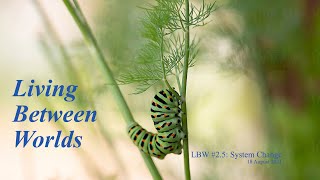
Recording of a monthly discussion (Living Between Worlds series) led by Gil Friend (host) exploring "systems change"—why complex social, economic, ecological and institutional systems resist change and how they do change. The session is conversational, with many participants describing moods, barriers (habit, inertia, self-interest, institutional design, feedback loops, language/frames), and practical approaches (mapping, dialogue, philanthropy, community-level projects).
Chapters
Greetings, everybody. Glad to have you with us. This is. This is the fifth in a series of monthly calls I'm calling Living Between Worlds. I'm calling it that because that's where we're living. Between the old world that we can see is dying around us, the new world. That Arundhati Roy says that on a quiet day she can hear breathing. And between the old world and the new ground, she said it's the time of monsters. And here we are in the time of monsters. Monsters can be dangerous, they can be terrifying, they can be the harbinger of some kind of change and we don't know what it is. We're between worlds and we've been exploring that from the perspective of history, strategy, mood, personal action, many realms in that world. I was thinking of skipping the call this month just to take a break and let the dust settle a bit. And frankly, because I've been in a very strange mood the last couple of weeks. In the wake of the IPCC report, the Code Red report the UN came out with a week ago Monday, the breakout of Delta virus, the fall of Kabul, and the list goes on. My mood was dark, uncharacteristically dark for me. And over the course of a couple of days, it shifted from dark to dark and determined. And this morning, following another two hour call before this one, and some of the conversations I've been in the last couple of days and being deeply moved by the kind of creative innovation that's going on all around the planet, in every sector you can think of, my mood today is ambitious and fierce. There's work to be done. I'm girded up to do it and I'm actually thrilled by the possibilities that are in front of us. A friend of mine called that this morning. Radical hope. And so that's where I am. We'll talk today about systems change, which is something that we're all of us up to. But let me first hear briefly from each of you. How are you in this moment, in this very strange and unsettling historical moment that we're in? A couple of words, just a couple of words about your mood. And please stay on mute when you're not speaking. Will help us manage the whole thing better. Alan, I've got you on screen. First, let me just ask you, what's your mood these days? Concerned and a bit confused. Okay, next you can raise your hand or you can just pop in. Gil, this is Lucy. Hi, Lucy. Hi. I'm. I am. I am so stressed. I am really, really distressed and so. Got it. Thank you, Carly. Grieving. Okay. A good practice. Thank you. Who else? This is not obligatory, but if you just care to give us a couple of words about where you find yourself in your body and your being in your perspective. Right now I'm feeling outrageously ambitious. Okay. Thank you, Oren. I'm trying to see the patterns over the long view. Yeah, it's a good time for that. Frustrated and pissed off. Frustrated and pissed off. Thank you, George. I'm actually quite energized and very bullish about the opportunities. Great, Gilad, thank you. Welcome. Deeply concerned about Afghanistan. Only that? No, lots more. That's the four word version. Yeah. Good. I haven't hit the news yet today, so. Alistair, I think you lost the distance award to Gilad, but. Hi. Welcome. Optimistic about my own life, but yeah, resigned. Depressed about Afghanistan. Thank you. I'm surprisingly grounded and watching it all unfold and doing what I can where I am. There you go. Thank you. Yeah, I'm on the opposite end of the spectrum there. I'm feeling unmoored. Unmoored is the word for the day. Or else a little bit of a holding pattern. Yeah. I've mentioned this before, but I've often been in a mood of unsettlement this summer. Just like unmoored, I guess, in a way. But I've been surprised that mostly it's been unsettled and calm and curious. Like some of the people have said. I know I'm unsettled. I know I'm not standing on solid ground, but I'm awake and listening and watching and looking for pattern and seeing where to move. And sometimes, some days I'm unsettled and freaked out and immobilized and so there's a dance going on there for me. Sounds like for some of you also. Will. Thank you. Good to see you. Anybody else? Quite positive. Many of the things I've been working on seem to be converging, coming together with the general unsteadiness of the world. So I'm going for it. Good deal. Thank you, Alan. For those of you who just joined, I'm asking just for a couple of words. Your mood in the moment these days. Jane and then Stacy and then David. I'm feeling feisty and bullish and gravely ambitious. Gravely ambitious? Gravely ambitious. There's life and death at stake in my ambition, both for my own tackling my own cancer at a metabolic level and also at the global level of my impersonal body, trying to understand how to get in league with nature, to be in the business of commerce with nature that's creative and ecological and out competing the business models that destroy us. What Bucky Fuller used to call the grunch. That's right. David Schoenbrun. Welcome, David. I'm overwhelmed by what appears to be a global genocidal conspiracy. I've been researching that in depth. Okay, thank you, Stacy. I'm with you feeling radically hopeful. But I'm really recognizing what a great need there is going to be to help people with their emotions during this time. Okay, thank you, Stacy. Felix, then Brad, then Michael. I thought about how people make fun of that light at the end of the tunnel, but we actually have to see that light. And I'm realizing that what the world needs most of all is hope. That we can actually build a better world. Hope is good. I'm a fan of courage also, because we need a boatload of that right now. Brad, Oren Felix just reminded me, hopefully that light at the end of the tunnel is not a train coming right at you. That's always the question. On the global level, very sad. And on a personal level, ecstatically happy. Okay, thank you. Michael Savant. Welcome. Good to see you. Nice to see you, Gil. As you know, I tend to be a very upbeat, optimistic person. And in my personal experiences, I have found that when I get down, it's often a precursor of change coming in. And I've been feeling down, and so, you know, I'm expecting positive things to be showing up on the horizon very shortly. Thank you. Okay, let's see. Anybody else? Okay, this is Matt Mahon. I feel scared, but very optimistic. Okay. Interesting combination, though. Yeah. So I'm. I'm Doug. Please. Yeah. It's like riding a bicycle. Don't stop. That seems to me to be what we need to be keeping. Yeah, yeah, yeah. Need to. Need to. Need the momentum. And we really need the gyroscopic effect, which doesn't just affect whether we tip over on the bike or not. It affects our mood and our bearing in this moment. You know, it's a crazy time. This is, you know, we're living through history. People are going to look back and write about this 200 years from now as a. As a crazy interval on the human experience. If people are still doing that 200 years from now, a transition point. Well, it would be nice if it was that clean. I don't know that it will be, you know, and it's. It's a mix, you know, it's a mix between Buckminster Fuller, who, you know, I often quote, he was an informative mentor for me. And Jane said it's, you know, it's a choice between utopia or oblivion. It's really close. It could be touch and go. That's why I do what I do, he said. And I suspect that's why we all do what we do. So I wanted to open a conversation with you about systems change. That's been the background of our previous conversations in some form or another. It's what I think everybody on this call does in some way or thinks about. Certainly I don't know all of you, but for those of you I know, I know that that's what you do. And I suspect that some of the attractor that's brought the rest of you to this. And that's a complicated story. Some of you may have had a chance to read the interview that Joel McCower published in Green Biz yesterday. I sent you a link to that last night. And he talked with a number of us about, well, what is systems change anyway and how do we think about it? And it was an interesting kind of article because he did not come up with any clear answers. He was wandering and wondering and talking with people. And that would raise more questions and more questions. But this, maybe that's one of those things. You know it when you see it. So let me ask you this. I'm not going to ask you about what's a system. That will take us off on a big side conversation. And I'm not going to ask you yet, what is systems change? But if we're going to talk about changing systems, maybe it's useful to think first about how do systems not change? What keeps systems in place as they are? Inertia. Inertia. Inertia. What does that mean? Habit. Habit is one of the strongest, in my opinion. Habit is one of the strongest human things around and causes Most of us, 90% of our day is pretty much habit. And unless you break it apart with it with a. Which is not. Which is not entirely a bad thing, as grandfather said, you don't want to be conscious of anything. You don't have to be conscious of a lot of stuff has to be automatic. And habit, like you're saying is. Alan, Alan, could I ask you to mute your mic, please? Thank you. And everybody, if you're not speaking, please mute. Habits are not just something that happened to us in our own bodies. We have habits and institutions. We have habits in cultures. We have. We've always done it this way, easiest downhill path. So there's that Doug and then Lena. One way to get people into a discussion about why things don't change is to ask them if their project started to be successful. Who would resist? It's amazing. Let's come back to that one. Doug, hold that if you would, for a minute. Elena. And then Lucy. I would say that a lot of the problem is we've got too many positive feedback loops, particularly around misinformation and not enough negative or error correcting feedback loops that are trusted by everyone or most people. Could you give us a 30 second definition of those two terms for folks who don't? Sure. Sorry. A negative feedback loop is a correcting feedback loop, like the homeostasis that keeps our body temperature where it's in a healthy range or the thermostat. Thermostat in your home. A homeostat is a balancing mechanism. We've got piles and piles of them in our body, sugar level, salt level, et cetera, and all throughout society. Positive feedback loop is an enhancing, like an arms race or falling in love, where the feedback leads to more of the same. Instead of saying oops, too much lesser the same, which could be an affirmative intentionally generating loop, or it could be a break in a negative loop. It could be that too. Thank you, Lucy. I was going to say mediocrity. I mean, back to your original question, Gil, you know what keeps people. Unpack that a little, Lucy. How does mediocrity keep things the same? I think when we have people who are innovative, you get change. When people are, you know, when people are not. Maybe it has to do with habit, as someone earlier said, that we put one foot in front of the other and we keep moving and we do so with a level of ennui or mediocrity. I think that things stay the same. You need to have innovation. Yeah, thank you. I think it's actually worse than that, but let's keep going. Okay. Well, something else you want to say? No, I just wanted if you were going to say something worse than that. No, I'll come back later. You'll come back? Okay, George. And then. And then Gilad. Do people know Eric Hoffer's, his favorite book, the Ordeal of Change? He begins the book when he was a farm worker and he's laying in his bunk in the bunk house and they've just finished picking peas. And he's worried because the next day they're going to start picking beans. And he's looking at himself worrying about the change from picking peasants to picking beans and wondering why it is he's worried about even such a minor Change. Change is scary. The change from picking peas to picking beans is scary. Imagine how scary it is to think that we have to change our whole economic system. Yeah. And the change from peas to beans was scary because. Did he know? Did he have a suspicion? It was a change. It was a change. He'd been picking beans for a week and a half. He'd been picking peas for a week and a half, two weeks, and now he was going to do something else. Well, let me say it. Up on the trellises, they were down on the ground. Yeah. And so it might not work. It might not go well. It might not go well for him. Whatever. Anyway, there we go. Gilad and then Stuart. Yeah, I couldn't agree more. I think it's all about fears. I think it's a fear from. From unknown. I think it's a fear from failure. I think it's a fear. Gilad, you're really hard to hear. Can you speak up? Can you get louder, please? Yes, I know better. That's better. Can you hear me? Can you hear me now? Well, yes, go ahead. Yes, I don't have the best coverage. I'm saying that it's all. It's all about fear. It's all about fear of change. And I couldn't agree more. I think that the majority of the majority of us are simply afraid of the unknown, afraid of a change, and therefore systems resist the change because we don't know what would come. There's something else that's maybe an analog fear, I don't know if it's different, or an analog fear called resignation, which is. There's nothing that could be done. Nothing could possibly be different. It's always been this way. There's nothing I could do about it. And there's kind of a surrender to the inevitability of what has been. There's maybe fear woven into that, but not necessarily so. Thank you. Let me go to Stuart and I've got a bunch of other hands coming up. Yeah, go ahead. If I just may, I think that all what you said are translation of the fear. So people are. What is it that this. The change? What is it that is, I believe, is the fear? We're losing you on audio, Gilad. Yeah, we're losing your audio. Let me just thank you for that. Let me just say for all of us that, you know, we don't need to decide between these various factors. These are all there. We all see this in different ways, have different experiences, have different interpretations of what we're seeing. I'm not going to ask you to vote on which is the number one. Let's just see what is in the field that we are listening to here. Stuart, I think you're next. Thanks. It's something about just drilling down a little bit into inertia. Growing up with a certain worldview, growing up with a certain psychology that things are going to be ok. It's kind of living in some ways and I'm speaking personally with my head up my ass at times that there are all these potential calamities and catastrophes going on and thinking somehow that it's going to be okay. Self delusion may be part of it. I mean, all of those things I think are factors. Thank you, Chain. I think that we have to distinguish human systems from other systems. I think for the human being, unconscious training goes a long way to describe how things don't change. I think the main way is by pretending to change and not being real change. I think one of the main jobs of corporate media is to maintain the pretense that things change. If we step out of the human experience for a moment, Jane, and look at natural systems, why does change not happen there? It has to do with rate and scale, the feedback loops, the sensitive differences haven't reached sufficient magnitude to trigger the change. So differences are detected that are not yet different enough. Well, there's also the homeostasis that Elena was talking about before. That resistance to change is actually a healthy thing in a living system. If you're, if you're, you know, if your metabolic parameters go out of whack, your body will attempt to self correct to keep you alive, to preserve your identity as a living being. And so, you know, and we even have this in shock absorbers in our cars that smooth out the bumps, you know, make them less perceptible in living in, in, in a body, you know, growth and repair and inflammation and eating the enemy. These are all part of how we maintain homeostasis. Allison and then Chauncey, I want to welcome you and ask you a question. If you're still. I saw you join. I think you're still here somewhere. Allison. Stasis. Allison and then Chauncey, I want to welcome you and ask you a question, if you're still, I saw you join. I think you're still here somewhere. Alison. Yeah, I think that we tend to feel really busy and you know, change happens. It happens. Yeah, I think that we tend to feel really busy and you know, change happens, it happens cyclically. So it's always happening. But like what has been said so many times the patterns that are ingrained in us, we don't even recognize or see or when we want to take action. Knowing which direction to go towards and being a part of a group wanting to map economic ecosystems, talking about it, and cyclically. So it's always happening. But like what has been said so many times, the patterns that are ingrained in us, we. We don't even recognize or see or when we want to take action. Knowing which direction you go to, saying, okay, so what are those? How do we know if we're successful on the right trajectory? And being a part of a group wanting to map economic ecosystems, talking about it. And if we can feed in different designs? Well, on one hand, we could go towards peace. On the other hand we could go towards justice and just simple things like that. On one hand, we can go towards regeneration. On the other hand, we can go towards private property. So the sense of. Of what the right direction is to go or how to come to a consensus or how to understand each other, even in terms of our communication, that feels challenging right now to me. That feels like a big challenge. Thanks. Saying. Okay, so what are those? How do we know if we're successful and on the right trajectory, if we can feed in different designs? Well, on one hand, we could go towards peace. On the other hand, we could go towards justice and. And just simple things like that. On one hand, we can. Gotcha. Chauncey Bell, are you here in the room or did you slip away when I wasn't looking? Okay, I guess he slipped out. Let's see. He's still here. I'm here. Oh, okay. I was muted. Yeah, There you go. I didn't see you on my screen. My screen, I guess, is too small. Let's see. We're talking about the theme of systems change. And the question I asked is, how do systems not change? And I thought I might put you on the spot and give you a chance to answer that question or speculate in that territory. Let me put it that way, Gilts. Say. Say a little bit more. Give me context. How do you mean, how do systems not change? You're talking about word systems. You know, Jane's talking about systems in the, you know, in the nature notion of systems. Yes. You say systems, I think in terms of the systems that we human beings construct. Yes. Which one? Both of those. Both of those. Brad was talking about habits. So it's the system of a person, of an individual person or person in a group or a family. I'm speculating that there's some through line that connects the not changing in all of those. Well, I think. I can't remember which paper. I think it's in a paper that I called Wise Organizations that I talked about how when we construct, when. When we go to work to change a situation, there are good reasons why we very often end up with the same thing. We end up. We end up using new tools to do the same old thing that we were doing. And I think that there are powerful habitual ways of interacting with each other that frequently produce us ending up doing exactly the same thing that we were doing. My friend Werner Erhart used to say that people go to the mountains and take their flippers and snorkels because they were most recently going to the. Going to the beach. And so I'm going on vacation. So I take my flippers and snorkel because out of. Out of habit, which is one piece of the puzzle. It's. I think the culprit here is. And maybe that's part of what you're looking for. I. There is a culprit. The culprit is language, because we think that words mean things, and we are oblivious to the invisibility to the way in which everything that we speak about in our language with each other is invisible, except for the narratives that we have in the background that we don't pay attention to. So. So, you know, that was what I was going after when I asked you, what do you mean systems? Because the word system is. Is a word. Yeah. But it doesn't connect to a thing or a phenomenon. It's just a word. Yeah. And. And I love the. The work that. Well, hell, what is his name? Just a second. I love the work that Merleau Ponty does. He has a book called the Visible and the Invisible, in which he says, in some moments, he says in the book, it's really a miracle that we ever have real conversations with each other. When you look closely at the fact that what I'm saying is going to be the words that I'm using and what I'm pointing to is going to be invisible to everyone who's listening to me unless we open up and examine the narratives that I'm living in as I'm talking to you. And he does, he concludes, it's a miracle that we ever have real conversations with each other because this is all invisible stuff. And we depend upon these narratives that we have in the background and we trust. What the hell does he call it? I'm going to. He has a wonderful phrase. He calls it the Perceptual faith, The perceptual faith. It's that we trust that what we see is something and that by seeing it, other people are going to see it and they're going to see the same thing. And we are confident that as we talk about what we see, we're having a good conversation. And it's worse than that because not only is what you're saying and what's giving rise to what you're saying invisible to me, and I'm making leaps of faith that we're having a conversation here. My own listening is invisible to me. That's right. And yet somehow we managed to have some semblance of communication and coordination with each other. To your question about system, pretty much whenever I say that maybe this is inside baseball, I'm speaking about the living system of Jane's body, the living system of Klaus's forest, the living system, the system of your company, the system of our political economic game. You know, bunches of things interacting in some kind of way that. Where there seems to be discernible patterns and interactions. And I'm. My speculation is that there's. There's interesting correspondence across those very different kinds of assemblies of things that can inform each other. That's one of the backgrounds that I'm bringing into this conversation. For better or for worse. Well, it could be what you remind me of, and I'm hesitating to report it just for a second. I don't think I'm going to report it. So when I. Shortly after I met Fernando Flores and began to work with him, I was reading his thesis in which he speculated that we human beings coordinate action by doing speech acts with each other is a systematic behavior that can be found in all languages and across all populations. We make requests, we make promises, we make, we ask questions. There are half a dozen types of language actions that we always do that we all do. And this guy John Austin in England, he discovered it and wrote about it originally, or he was one of the first people to write about it systematically, to use the word again. And so Flores, I became involved in building a tool, tool to help people in organizations coordinate action with each other more systematically. That we called the coordinator. And one of the things that was fascinating was we began to do that is that out of the bowels of Silicon Valley came a group of people who were horrified at what we were doing and who called us fascists and Nazis. Remember that? For attempting to control the way that people were communicating with each other. How dare we tell people that they should Make a request or an offer at a particular moment in time. How audacious, how outrageous that we should do it. And they were successful. Basically, they killed. They and others who joined them killed what we were doing. Now, interestingly, Chauncey, my reaction to the same thing at the same time was that this technology was enormously liberating. Yeah, me too. Was. It was that it gave me freedom and effectiveness and power and much more capability of coordinating effectively with people for the goods that we were trying to do. And I heard the same chatter. So isn't that fascinating? Yeah, well. Right. So it's an example of how change gets stopped, or systems, anyway. I don't know what is an example. Thank you for that. I don't want to bring in some other people here, but let me say something in a moment. Thank you very much for that because that figures into the larger story here. Again, I'm asserting or I guess speculating, that there are learnings, insights available to us from across these supposedly different kinds of systems. And in this one, for example, the homeostasis and coordination mechanisms are not in language, at least not language as we understand it. Yeah, well, right. So it's an example of how change gets stopped, or systems, anyway. I don't know what it's an example of. Thank you for that. I don't want to bring in some other people here, but let me say something in a moment. Thank you very much for that, because that figures into the larger story here. But something is going on that maybe has analogs, maybe not. This system changes by changing and by not changing. How does it change? We change through genetics and mutation, which change through accretive structures, things growing on existing things. Think about the form of the sun. Again, I'm asserting, or I guess speculating, that there are learnings, insights available to us from across these supposedly different kinds of systems. And in this one, for example, the homeostasis and coordination mechanisms are not in language, at least not language as we understand it in the Fibonacci spiral. Environmental systems change through environmental perturbation, through evolution, through predatory pressure. We can name those things in the living world, in the world of cultures and norms, but something is going on that maybe has analogs, maybe not, and social relations and mind and mindset. This system changes by changing and by not changing. How does it change? We change through genetics and mutation. We change through accretive structures, things growing on existing things. Think about the form of the sun, which is the territory that we're playing in when we're talking about transforming the global economy. I have found over and over again in my 30 some odd years of advising companies that the technology is the relatively easy part of the transformation. It's the humans that are challenging. The hard stuff is easy and the soft stuff is hard, as some people have said. So you know, that's where the inquiry here is aimed. Chauncey, thank you. Let me go to. I've got David, Allen and Shell, please. In the Fibonacci spiral, environmental systems change through environmental perturbation, through evolution, through predatory pressure. We can name those things in the living world, in the world of cultures and norms. Be succinct if you can. Others of you. There's a bunch of you here who haven't talked much on these calls. I want to welcome your voices if you feel comfortable sharing. David, to you, three quick points. The first, I wanted to connect the notion of habit with your notion of, of the gyroscopic and social relations and mind and mindset, you know, which is the territory that we're playing in when we're talking about transforming the global economy. You know, I have found over and over again in my 30 some odd years of advising companies that the, that the technology is the relatively easy part effect of the bicycle wheel. I think habits serve that function. Second, Tina, there is no alternative. It is a very forceful expression of there is no system change possible. And finally of the transformation. It's the humans that are challenging. The hard stuff is easy and the soft stuff is hard, as some people have said. So that's definitely from my world. What I see holding back change is self interest. The people that are, that receive benefits from the status quo are desperately holding on to it. Thank you. Thank you. Well, you know, self interest, but also perhaps where the inquiry here is aimed. Chauncey, thank you. Let me go to, I've got David, Allen and Shell, please see self interest, which are not necessarily the same thing but work in very similar ways. So thank you for raising that. And yet for change to happen in social systems, people's perception of their self interest has to shift. Yeah. And we've seen that happen in history, you know, and we can, we can name the time. So that's, that's intriguing to me. Be succinct if you can. Others of you, There's a bunch of you here who haven't talked much on these calls. I want to welcome your voices if you feel comfortable sharing. David, what you said about Tina, I actually heard it first the other way. You know, I look at the world we're facing now and I say there's no alternative but to change it. You know, in the Israeli war of independence, 1948, one of the slogans there was no alternative, we will either succeed or we will die. To you, three quick points. The first, I wanted to connect the notion of habit with your notion of the gyroscopic. There's no third option here. And some would say we're in that situation now, that stasis is not an alternative for us. David. Thank you, Alan. And then Michelle. Yeah, thank you. Very interesting. Most of the effect of the bicycle wheel, I think habits serve that function. Second, Tina, there is no alternative is a very forceful expression of there is no system change possible. And finally, discussion is how we people in our mind prevent change. But I would like to. When we demonstrated against the war in Vietnam, Paul Potter said, the important thing is to name the system. From my world, what I see holding back change is self interest. The people that receive benefits from the status quo are desperately holding onto it. Thank you. Thank you. Well, you know, self interest, but also personal. And it's not dealing with the general system, which society I was in since the mid-50s, but the particular system and the system we are in is a system of domination, hierarchy, imposition, command, impunity, and ultimately violence. And extraction. Extraction, yes. Drawing out more than is in the natural balance. And we are seeking a different system based on healing from this time. Caring, sharing, help, seed, self interest, which are not necessarily the same thing, but work in very similar ways. So thank you for raising that. And yet for change to happen in social systems, people's perception of their self interest has to shift. Yeah, and we've seen that happen in history, you know, and we can. We can name the time. So that's. That's intriguing to me. Cooperation, mutual aid, and recognizing. We are in a situation where survival is the question. We cannot simply continue in the same way, but we are up against ultimately violence of the system maintaining itself, which has gotten itself into this place by war. What you said about Tina, I actually heard it first the other way. You know, I look at the world we're facing now, and I say there's no alternative but to change it. You know, the. In the Israeli war of independence, 1948, one of the slogans there was Ain Brera, no alternative. We, you know, we will either. We will either succeed or we will die by deceit and various criminalities or the concurrent consensus on which America itself was formed back in its beginning, that everybody gets along to get along. So we are dealing with a war system, not with system in general. And ultimately there's no third option here. And some would say we're in that situation now that states this is not an alternative for us. David, thank you. Alan defends itself by the threat of violence. So that was just a factor in. Yeah, and modern capitalism is built on violence. We can, you know, from slavery to colonization to other dimensions, to the enclosure acts of the 18th century. I'm intrigued though, Alan, by what you're saying that in the. And then Shell. Yeah, thank you. Very interesting. In the face of a system of violence, as you're asserting the core actions you described were linguistic. To take a note from what you know, from Chauncey's conversation. Calling things what they are, I think is the way you put it, or naming them in a way that evokes something in the people that we're speaking with, the people that are hearing those words. These discussion is how we people in our mind prevent change. But I would like to. When we demonstrated against the war in Vietnam, Paul Potter said the important thing is to name the system. They have their listening of what those mean. But it evokes something perhaps different than resignation, perhaps different than this is how it is, how it's always been, what it always will be. There's something else that opens up there. Let me go on to Shell and thank you very much for that. Okay, I've got two points. And it's not dealing with the general system, which society I was in since the mid-50s, but the particular one going back to Gilad and a bunch of people earlier, much earlier in this call about what barriers to change, change. One that I didn't notice anybody mentioning was institutional, built in resistance. Perhaps particularly dramatic example is the Iranian constitution, the post 1979 document that basically system and the system we are in is a system of domination, hierarchy, imposition, command, impunity, and ultimately says we are always going to have an Islamic state. And has a number of other conditions that make change very difficult on a legal level without throwing away the constitution. We see that in the responses of all sorts of bureaucracies, government, private industry, academia, the institutions themselves have built in violence and extraction. Extraction, yes. Drawing out more than is in the natural balance. And we are seeking a different system based on healing from this time. Caring, sharing, help what they see as survival mechanisms. But often resistance to change is not a very good survival mechanism because change is going to happen whether or not. And then the other point. So it's not that people are carrying it out. The structures that some people set up maybe five generations ago Cooperation, mutual aid and recognizing. We are in a situation where survival is the question. We cannot simply continue are now a big heavy set of handcuffs. There are people in the same way, but we are up against ultimately violence of the system maintaining itself, which has gotten itself into this place by war Bull can't fear figure out how to move out from under the bureaucratic restrictions that were seen as necessary. If you think about how often did we have somebody try to blow up an airplane with a shoe bomb? Once. How often do we take our shoes off at the airport? Every single time we fly. Well, that was very rapid change then. That's. That's where it can be changed, right? Yes. But now the next by deceit and various criminalities or the concurrent consensus on which America itself was the next bomber isn't going to have it in his shoe. It's going to be somewhere else. So it's an exercise in futility. But the other point I wanted to make, Gil, you said that nature doesn't change. And I'm going to challenge you. No, I didn't say that. I didn't say nature doesn't change. It changes by form. Back in its beginning that everybody gets along to get along. So we're dealing with a war system, not with system in general and ultimately it changing. Okay, I missed that. I heard you say something that sounded like nature's essentially static and obviously it's not. Well, it's. You know what I think what I was trying to say is that there is this. There's this dance of static and dynamic. It's dynamic. It changes in order to maintain. And Elena spoke to that early on the homeostatic process of how my defends itself by the threat of violence. So that was just a factor in this. Yeah. And modern capitalism is built on body manages my blood chemistry. Yeah. You know, things violence, we can, you know, from slavery to colonization to other dimensions to the enclosure acts of the 18th century. I'm intrigued though, Alan, by what you're saying that in the out of whack different processes emerge that bring it back into the fold. It's a kind of. It's preserving identity in a way which is. You know what the bureaucratic systems you're complaining about are also doing. It's hard to imagine a system that isn't designed in some way to maintain it face of a system of violence as you're asserting the core actions you described ruling itself or preserve itself. Nature does it through very big sweeping changes in order linguistic to take a note from what you know from chauncey's conversation. Calling things what they are, I think is the way you put it, or naming them in a way that evokes something to maintain a very large and complicated whole. But species go extinct, winding. And the people that we're speaking with, the people that are hearing those words, patterns change, all of these things in an effort to get the balance back. And I think we're seeing that certainly with climate change, the earth is fighting back against human intervention in the last 200 years. I'm not going to anthropomorphize it, but yeah, they have their listening of what those mean, but it evokes something, perhaps Alice there. Thanks. Shel. You mentioned the linguistic aspect of change. And I just wanted to mention different than resignation, perhaps different than this is George Lakoff and his work on metaphors and how they affect us, how it is, how it's always been, what it always will be. There's something else that opens up there. Let me go on to Shel, and thank you very much for that. Okay, I've got two points. Want to say any more about that? Not much. I don't really know much. One of the things that Lakoff said is that in political conversations in America is that one going back to Gilad and a bunch of people earlier, much earlier in this call about what barriers to change. One that I didn't notice anybody mentioning was institutional, built in resistance. Perhaps particularly dramatic example is the Iranian constitution, the post 1979 document that basically create frames was the word he used to basically set the boundaries within which the conversation happened and the frames generate new norms. And so, you know, Ronald Reagan in the 1980s came along and said that the government is the enemy. Whereas before in Franklin Delano Roosevelt's era, in the 1930s and 40s, government was the common enterprise of the nation to lift itself out. He says we are always going to have an Islamic State and has a number of other conditions of the Depression together. Completely different frame of how to think about government. And if you look at the political dialogue in this country, it's too nice a word to use for it. Positions that make change very difficult on a legal level without throwing away the Constitution. We see that in the responses of all sorts of bureaucracies, government, private industry. The past several decades, that has become kind of a background norm. Eth, academia, the institutions themselves have built in. People on the more progressive side of the political spectrum bow to that norm because a frame was successfully set. And it's frank, you know, Lakoff would argue that it's Something that the Republicans in this country have done much more successfully than the Democrats. What they see as survival mechanisms, but often resistance just don't have the same kind of grasp of language in the political arena. Change is not a very good survival mechanism because change is going to happen whether or not. And then the other point. So it's not that people are. Alex there. Thank you for bringing that up. Elena and Jane, I don't know if your hand is up. Actively carrying it out. The structures that some people set up maybe five generations ago we were from before. So after Elena, we'll come back to you. I'd like to mention after Lakoff, that George Kelly's personal construct theory is a way of dealing with situations where people are using the same words to mean different things are now a big heavy set of handcuffs. And his repertory grid technique asks people to nominate elements or can't figure out how to move out from under the bureaucratic restrictions that were seen as necessary. If you think about how often did we have somebody try to blow up an airplane with a shoe bomb once. How often do we take our shoes off at the airport every single time we fly. Well, that they're concerned with. And then to look at the constructions that they're putting on those elements. And the technique asks people to take three of the elements, compare them and talk about the distinction that separates two from the third. And that is a very powerful way of getting at. It's very rapid change then. That's. That's right. Yes. But now what people are meaning and how the way that they construct the world differs where it may or may not be as incompatible as they think. And it certainly. Oh, go ahead. I'm going to ask just a clarification. The next bomber isn't going to have it in his shoe. It's going to be somewhere else. So it's an exercise in futility. But the other point I wanted to make, Gil, you said that nature doesn't change. And I'm going to challenge you. No, I didn't say that. I didn't say nature doesn't change. I said it changes by. What do you mean by the constructions they put on the elements. What does that mean? Well, to take it from where he began, which was as a traveling psychologist in Depression era Kansas is he observed that people changing. Okay, I missed that. I heard you say something that sounded like nature's in the same circumstances were reacting very differently. And his way of finding out how that was so was to essentially static. And obviously it's not. Well, it's you know what I think what I was trying to say is that there is this, there's this dance of static and dynamic. It's dynamic, it changes in order to maintain. Elena spoke to that earlier on. The homeostatic process of how my. That the way people construed their experiences differed. So if they construed their experiences as, you know, this is a hard time and we have to get through it, then those people didn't have as much of a problem dealing with the day to day hardships as the people who felt that body manages my blood chemistry. Yeah, this was God telling them they were a failure or that there was nothing that they could do or, or any number of other sort of self defeating constructions. So out of whack, different processes emerge that bring it back into the fold. It's a kind of, it's preserving identity in a way which is, you know what the bureaucratic systems you're complaining about are also doing. It's hard to imagine a system that isn't designed in some way to maintain it. Yeah, thank you for that. Okay, keep going. Sorry for the interrupt. And it seems to me that right now we're having a lot of problem because people are using the same words to mean very different things. And other people, I think with a very opportunistic aim are using those terms to basically rile people up about extraneous distractions. And they're focusing people's fear and uncertainty. Nature does it through very big sweeping changes in order to maintain a very large and complicated whole. But species go extinct, wind patterns change, all of these things in an effort to get the balance back. And I think we're seeing that certainly with climate change. The Earth is fighting back against human intervention in the last 200 years. I'm not going to anthropomorphize it, but. Yeah, Alice there. Thanks, Shel. The fact that there are differences about whether or not people want to wear masks when they are inside in a store or a school or whatever, but that is really an absurd distraction in terms of dealing with the actual way that we need to work. You mentioned the linguistic aspect of change and I just wanted to mention George Lakoff and his work on metaphors and how they affect us operate to defeat the pandemic. And I think that it's, it's just really so relatively easy to mislead people when they're frightened. They go right back to the reptile brain and they're not as clever as they are when they're not frightened and want to say any More about that? Not much. I don't really know. One of the things that Lakoff said is that in political conversations in America is that fact. And it's a very cynical way, I think, to try to influence public opinion. It is, but here we are. Yeah, create frames was the word he used to basically set. I mean, the bad news, and this echoes something that Chauncey said earlier, is that we interpret our experience all the time. We can't not do that. It's not like it's hard out there, it's hard in here because I say that it is. And somebody facing the same circumstance may say, oh no, that's exciting. So we lay the boundaries within which the conversation happens and the frames generate new norms. And so Ronald Reagan in the 1980s came along and said that the government is the enemy, whereas before in Franklin Delano Roosevelt's era. And then I live. We live in that realm of interpretation that we maybe have some ability to witness and notice and question ourselves. Is that the best interpretation from 30s and 40s government was the common enterprise of the nation to lift itself out right now? Is that the one that I want to live with? The good news in the story is that there's lots of experience on this of the possibility of guiding people past their interpretations to find very common concerns across very diverse groups of people. Bill Reed has done this around community of the Depression together. Completely different frame of how to think about government. And if you look at the political dialogue in this country, it's too nice a word to use for it. Over the past several decades, that has become kind of the background norm. Even people on the more progressive side of the political spectrum bow to that norm. Development. Joan Blades with the Living Room Project bringing together right wing and left wing Americans in their living rooms to be social and talk. And people find often in these processes very common cares, very concerns that people care about very different interpretations about what they mean, really, because a frame was successfully set and it's frank, you know, Lakoff would argue that it's something that the Republicans in this country have done much more successfully than the Democrats just don't have the same kind of grasp of language in the political arena came from what to do about that. But just the fact of getting people to look around the room and say, yeah, we agree about maybe this tiny sliver of things, even if we disagree about these others. Alex there, thank you for bringing that up, Elena And Jane, I don't know if your hand is up active, what can we do with that? And this is you know, critically important in political coalitions where you, you know, you need the votes of somebody who you may not like or agree with on some issues to get support for other issues. And there's that political horse trading that is very problematic in certain ways. But, you know, there it is. So thank you for clear from before. So after Elena, we'll come back to you. I'd like to mention after Lakoff that George Kelly's personal construct theory is a way of dealing that And Brad. Yes. Search for common ground has been doing that for decades internationally in Northern Ireland, during the troubles with Israel, Palestine, other conflict regions in the world. Finding a way to bring people together across differences in the language that I would use is to find shared concerns and some with situations where people are using the same words to mean different things. And his repertory grid technique asks people to nominate elements common basis to coordinate action together. Jane and then Heather and then I want to shift us a little bit. Okay. That they're concerned with and then to look at the constructions that they're. They're putting on those elements. And the technique asks people to take three of the elements, compare them and talk about the distinction that separates. I think the misuse of language often constitutes emotional abuse. And I think that the political misuse of language is a particularly brutalization in our culture and two from the third. And that is a very powerful way of getting at what people are meaning and how the way that they construct the world differs where it may or may not be as incompatible as they. Gregory Bateson was famous for describing the double bind theory of communication. And I think we're often involved in that politically. And what's called gaslighting I think of as an example of that. And it certainly. Oh, go ahead. I'm going to ask just a clarification. And it all has to do with this. We're constantly in competition models of reality and we need to shift cooperative model. What do you mean by the constructions they put on the elements? What does that mean? Well, to take it from where he began, which was as a traveling psychologist, as Alan alluded to, we've put our economies in conflict and competition with nature itself, which is the mother of all economies in depression era of Kansas is he observed that people in the same circumstances were reacting very differently commerce and this is completely insane. And we're having to abuse language in order to adjust people to this insanity to get them to accept it. So if we stop buying what they're selling, we might shift our economies politically. And his way of finding out how that Was so was to note that the way people construed their experiences differed as well. Thank you, Heather. They construed their experiences as you know, this is a hard time and we have to get through it. Then those people didn't have as much of a problem dealing with the day to day hardships as the people who felt that. So 10 years ago I was on the design team for Living Room Conversations project and did four of the six test drives. The first this was God telling them they were a failure or that there was nothing. The first two of which were in Grand Junction, Colorado on the west slope in the oil and gas fields. And I was working for an environmental organization and invited one of my republic well invited some Republicans to our test drive. They could do or. Or any number of other sort of self defeating constructions. Yeah, thank you for that. Okay, keep, keep going. Sorry for the interrupt and that it seems to and the big takeaway in those in my first four test drive conversations of the Living Room Project Living Room Conversation Project was a moment when someone who had different to me that right now we're having a lot of problem because people are using the same political points of view looked at me with tears in her eyes and words to mean very different things. And other people I think with a very opportunistic aim are using those said oh my God, Heather, I don't feel it the way you feel it. I get it that your experience in this world is that it's breaking your heart and I don't feel it that way. So what you said Gil, about how we interpret things, how we are those terms to basically rile people up about extraneous distractions and they're focusing people's fear and uncertainty on the fact that there are differences about whether or not our lived feeling felt experience is very different too. And the Living Room Conversations Project in its early days, I don't know how it's working now, but in its early days it really opened up a space for compassion for people to go oh my God. I had no people want to wear masks when they are inside in a store or a school or whatever. But that is a really an absurd distraction in terms of dealing with the actual way that we need to idea you felt that way. It was a beautiful thing. I hope it still is. I think it still is related to that. Heather, There was an article that came across my screen in the last week. The headline was about masking and vaccine and the anger that those who support those operate to defeat the pandemic. I think that it's just so relatively easy to mislead people when they're frightened. They go right back to the reptile brain and they're not as clever as they are when they're not frightened. And strategies have. Against the folks who don't and actually probably vice versa. And like a number of other people, he said, you know, you're not going to win this with anger. You're not going to win this with logic. And what he called for was, was empathy. And it's a very cynical way, I think, to try to influence public opinion. It is. But here we are. Yeah. And curiosity. I get that you're really upset about this thing. Can you tell me why do you feel that way? Not trying to convince, but trying to listen in a very open way that allowed someone space. George and I have been sort of, I mean, the bad news, and this echoes something that Chauncey said earlier, is that we, we interpret our experience all the time. We can't not do that. It's not like it's hard out there, it's hard in here because I say that it is. And somebody wrestling on the side this morning about an alleged quote from Mahatma Gandhi. Not sure if it's really from him or not, but the alleged quote was that all persuasion is violence. And whether he said it or not, I find it a very interesting provocation because, you know, I spend a bunch of my life trying to convince people to be facing the same circumstance. May say, oh, that's exciting. Right? So we live. We live in that realm of interpretation that we maybe have some ability to witness and to do things that they maybe don't want to do or maybe don't see the opportunity of doing. I think of it as being a gift to them to open their eyes to something that I see as cool and profitable and so forth. But is, you know, is that. Is that a viable approach versus saying, going in and saying notice and question ourselves. Is that the best interpretation for me right now is that the one that I want to live with. The good news in the story is that. And there's lots of experience on this of I'm glad to be here. What do you care about? What's bugging you? What's given rise to this in you and actually learning from, quote, adversaries. So in that regard, I'm working on, as always, since you've known me, Gil, local food work. And we're doing the possibility of guiding people past their interpretations to find very common concerns across very diverse groups of people. Bill Reed has done this around community development. Joan Blades with the Living Room Project, bringing together a film project now in very conservative Republican Clark county where we're trying to shift the mindset and awake people up to food system inequities and blah, blah, blah. And the creative team that we're working with, after listening to us activists leaned back and said, well wing and left wing Americans in their living rooms to be social and talk. And people find often in these processes very common cares, very concerns that people care about very different interpretations about what they mean, where they, you know, if we've learned anything is that you only the best way to attract people to your cause is with affection. And so we are creating a love letter from the land for our community as a way of inviting people to a shift in their system from what to do about that. But just the fact of getting people to look around the room and say, yeah, we agree about maybe this tiny sliver of things, even if we disagree about these others systems thinking around food and food systems and food sovereignty. Very nice. Heather, please meet Klaus Major who's on this call. What can we do with that? And this is critically important and plus, please meet Heather. It might be fruitful for you guys to have a conversation. Hello, Klaus. Not to put you on the spot or anything, but that's one of the things I do. Okay, thanks. Political coalitions where you need the votes of somebody who you may not like or agree with on some issues to get support for other issues. And there's that political horse trading that you. All right, I said, I said that I was going to shift the frame after Heather, but let me now go to Jane first and see what TR are you writing. Yeah. Thank you, Jane. I shouldn't have my hand up. I'm sorry. Okay, this is very promising. Problematic in certain ways, but there it is. Thank you for that. And Brad, Yes. Search for common ground. It's been doing that for decades. Internationally in Northern Ireland during the troubles with Israel, Palestine, other conflict regions in the world. Fair enough. So this has been juicy. I'm intrigued at where we've gone. Some of it not what I expected. I'm grateful for it. I want to zoom out a bit because I opened up suggesting that we talk about systems change, which is maybe different than change. It's talking about change. The finding way to bring people together across differences and you know, in the language that I would use is to find shared concerns and some common basis to coordinate action together. Jane and then Heather job systems, which are their nature, more complex systems change implies a breadth and A depth and maybe a durability of impact. You know, whether we're talking about. Some of you have said changing the economic system, changing the agricultural system, changing the way people interact. And then I want to shift us a little bit. Okay. I think the misuse of language often constitutes emotional abuse in the community. It implies a reset of the norms and the things we take for granted, as Reagan, for example, successfully did, as Chauncey spoke to before. Talk about that for a bit. How is that? And I think that the political misuse of language is a particularly brutalization in our culture and similar or different, you know, for me. So I'm struggling right now with changing a habit called my bedtime and, you know, committed to getting to being asleep by 10 o' clock every night, even though I like to sleep stamp, like listen to music or whatever. So that's me. A simple system compared to a. Gregory Bateson was famous for describing the double bind theory of communication. And I think we're often involved in that politically and what's called gaslighting global economic system or techno, you know, industrial, agricultural complex. What's similar? What's different? I mean it. You know, I'll start us with one thing. We're very clear at the beginning of that game that you don't get to do just one thing. I think of as an example of that, you know, you don't move a complex system with a single intervention. It's a web of intervention and it all has to do with this. We're constantly in competition models of reality and we need to shift cooperative models at different scales at different levels, I suspect. So let's. What is. What does that provoke for you? When those of you who are ecologists or environmentalists in some way remember the John Muir quote that, you know, I find that everything as Alan alluded to, we've put our economy in the universe is hitched to everything else. Barry Commoners he's in conflict and competition with nature itself, which is the mother of all four laws of ecology. One of the laws was you can never do only one thing. I'm using commerce. And this is completely insane. And we're having to abuse language in order to adjust people to this. Because everything is interconnected to everything else. Sri Nasrigadatta Maharaj said that causes are numberless insanity to get them to accept it. So if the cause of anything is everything, all the causes, we stop buying what they're selling. We might shift our economies politically to all the effects and trying to tease it apart into billiard balls. Is doomed to failure. Knowing those things which we all know in varying degrees, how do we think about systems change? How do we think about moving the big powerful as well? Thank you, Heather. Deeply rooted, taken for granted, systems that contribute. So 10 years ago, I was on the design team for Living Room Conversations Project to the world that Alan Haber described decried at the start of the call. Stuart and I'm asking that did four of the six test drives the first, not just to a group of curious people I know that, you know, most of you are operating the first two of which were in Grand Junction, Colorado on the west slope in the oil and gas fields and I was working for an environmental organization. And in these questions, most of the time, maybe not always consciously, but your lives are in this territory. That's why we're here on these, on this, on this series of calls. Stuart, please, you're on mute. Stuart, I did one of my republic well invited some Republicans to our test drive. Exactly true in terms of being in this kind of inquiry and the big takeaway in those in my first four test drive and it's interesting, there's a way in which I'm trying to write my way through it to see what comes out from deep inside. And one of the places I find myself going to is leaning towards authoritarian systems as the only way to change conversations of the Living Room Project. Living Room Conversation Project was a moment when someone who had different on a large scale I look to Israel and to Chinese communism political points of view looked at me with tears in her eyes as, as, as, as, you know, recent historical systems that have achieved massive change in short amounts of time. Because it seems to me that the democratic process is, is just not going to work. Said, oh my God, Heather, I don't feel it the way you feel feel. And I'll throw that out for, you know, as an opening for a discussion. I get it that your experience in this world is that it's breaking your heart and I don't feel it that way. So what you said, Gil, about how we interpret things, how we are, you know, because sometimes I listen on a call like this and I say we're moving deck chairs around the Titanic and the ship is going down. Well, I hope you wind up with the right autocrat in charge. Well, that's, that's, that's what's positive, obviously. Thank you for that. And, and I want to, I want to hang, I want to hang that one up. Our lived, feeling, felt experience is very different too. Up in the parking lot, it's an interesting conversation. Let's not focus on that democracy versus autocracy choice right now. Right. Because there's stuff in motion here. And I also want to allow some time in Felix to talk with you about a systems change project. That's pretty interesting. Great. And the Living Room Conversations project in its early days, I don't know how it's working now, but in its early days it really opened up a space for compassion for people to go, oh my God, I had no. Thank you. David Grossoff, welcome. Thank you. You're on. Yes. Well, I just want to push back on the. Everything's connected to everything else and it's all very, very compl. I think one reason a lot of us are here is at a concern for climate change, which whose the confidence in which is a result of idea you felt that way. It was a beautiful thing. I hope it still is. I think it still is related to that. Heather, there was an article reductionist program in modeling an extremely complicated system on which it is very hard to do experiments, namely all these climate models. And so there are no systems where there aren't some points that are. A lot came across my screen last week. The headline was about masking and vaccine and the anger that those who support those more sensitive to others and systems in general that humans and societies develop are subject to change, not just to environmental shocks, but a lot of other variables. So I just want to sort of push back on the kind of obscurantist fuzz that might strategies have against the folks who don't and actually probably vice versa. And like a number of other people, he said here two statements that everything is connected to everything. I just want to, you know, you're not going to win this with anger. You're not going to win this with logic. And what he called for was, was empathy. Sort of. I have to, I have to wave the flag as a experimental scientist that every system, you know, is every model is not the territory, but we can really learn a lot. And I have a lot of confidence in that. Notwithstanding and curiosity, I get that you're, you know, the Robert McNamaras of the world. Good deal. And you're really upset about this thing. Can you tell me why do you feel that way? Not trying to convince, but trying to listen in a very. I love being busted for obscurantist fuzz. I've been busted by obscurantist fuzz. That's a different thing. So I talk about the complexity. Not to imply there's nothing that we can do, but to suggest that the very open way that allowed someone space. George and I have been sort of obvious simple points of action may not be sufficient to make the moves we want to have happen. Or made a wrestling on the side this morning about an alleged quote from Mahatma Gandhi. Not sure if it's really from him or not but the alleged quote was that all persuasion is violence generate other effects that we're not too happy about. So being able to have some grasp of the shape and the dynamics of the system and as we talked about last call I'm sorry I can get this brought up right now. And whether he said it or not, I find it a very interesting provocation because you know I spend a bunch of my life trying to convince people to danella Meadows scheme for the places to intervene in the system. Oops, we don't have that working. But most of you know that which is a kind of a charmingly mechanistic view of a holistic system strategy do things that they maybe don't want to do or maybe don't see the opportunity of doing. I think of it as being a gift to them to open their eyes to something that I see as cool and profitable. You know and people. People take that and assume that she meant you got to always work at the highest and so forth. But is you know, is that. Is that a viable approach versus saying going in and saying leverage stuff. And that's not what she meant. She meant there that's important and you need to be doing things at every level of the system. Somebody said at the top of the call I'm doing what I can where I am given what you know, what you're in contact with, what your capacities are. But understanding the dynamics and the interrelationships and the interconnectivities is glad to be here. What do you care about what's bugging you? What's given rise to this in you and actually learning from from quote adversaries. So in that regard I'm working on as always since you powerful approach in my experience. I couldn't agree more and I just want to say that one thing that puzzles me known me Gil local food work and we're doing is the quest for the single best thing to do or three things to do when you look when So I had a conversation with a political scientist a film project now in very conservative Republic in Clark county where we're trying to shift the mindset and awake people up to food system who's a close friend of mine and he said you know the climate change Movement should look to the Negro civil rights movement. There were many different types of effort underway simultaneously and to give inequities and blah blah, blah. And the creative team that we're working with after listening to us activists leaned back and said well a feel for the texture of what it was like outside. Like the best documented and most famous official episodes. There's a. I think it won an Emmy or something documentary from 30 years ago called the Strange Death of Jim Crow about how Houston desegregated. And it involves basically, you know, if we've learned anything is that you only the best way to attract people to your cause is with affection. And so we are creating pretty wealthy black bourgeoisie who couldn't risk as much underwriting and supporting dating A love letter from the land for our community as a way of inviting people to a shift in their system in various ways. The younger college student and young people who were putting their asses on the line and getting arrested and sometimes beat up. And though I don't want to summarize a whole movie, you know about a different social systems thinking around food and food systems and food sovereignty movement but it gave me such a under the nails. Very nice. Heather, please meet Klaus Major who's on this call. Sense of the texture of actual social change from a lot of different people doing what they can do their particular powers and resources in concert with others towards a common goal. Not trying to fix the entire. Please meet Heather. Might be fruitful for you guys to have a conversation. Hello Klaus. Not to put you on the spot or anything but that's one of the things I do. Okay, thanks Higher world. But if the goal is to desegregate Houston without totally poisoning. All right. I said that I was going to shift the frame after Heather race relations thereafter from getting a victory that's Pyrrhic. This is how you have to coordinate a lot of different pieces with different strengths and weaknesses. And thank you for that. And one of the things that happens there is some. Some digger. But let me now go to Jane first and see what TR are you writing. Yeah. Yeah. Thank you, Jane. I shouldn't have my hand up. I'm sorry. Okay. Agree of common view of what the system is or what we. You know how we name the. The defects as Alan was talking about. Scott Spann, among others does a wonderful process of bringing together large diverse communities and working together to map the system to identify like what are. Fair enough. So this has been juicy. I'm intrigued at where we've gone. Some of it not what I expected. I'm grateful for it. The pieces, how do they connect with each other? What are their interrelationships? Which causal loops can. I want to zoom out a bit because I opened up suggesting that we talk about systems change, which is maybe different than change. It's talking about chain, you see there. And the process isn't complete until everybody in the room might be 30 or 200 people. Everybody looks at the wall and says, yeah, that seems to be what there is here. Different question than do you like it? Different question than what do you think we should do about it? But just to get a diverse group of people to say that seems to be the world that we're living in. Of systems which are by their nature more complex systems. Chains implies a breadth and a depth and maybe a durability of. Opens up the possibility. David, for exactly what you're talking about. Like, you know, I'm in the back row and I say, you know, I'm interested in that piece and I think I have something to contribute to that piece. And you. Do you know what you want. We don't have to all forge agreement on what the strategy is. Pact, you know, whether we're talking about. Some of you have said changing the economic system, changing the agricultural system, changing the way people interact. We can proceed in multiple directions. Let me go to Alan and then Klaus and then we'll do another shift. Yeah, thank you again. The way I see this is that the human species in a community, you know, it implies a reset of the norms and the things we take for granted. For 5,000 years has been within this war system, as Reagan, for example, successfully did, as Chauncey spoke to before. For. Let's talk about that for a bit. How is that system. And in some moral struggle toward peace, toward cooperation, toward being human with one another. And there is this structures of domination of the state of the armies and so forth, similar or different, you know, for me. So I'm. And what is needed is to raise this moral struggle. I'm struggling right now with changing a habit called my bedtime. And you know, committed to some metaphoric in the sky passion play that people can say, I'm in the war system. People can say, I want out. I want the other way. I want the getting to being asleep by 10 o' clock every night, even though I like to stay up late, listen to music or whatever. So that's me. A simple system compared to a system. I want to be one of the heroes of the future somehow. That in the global economic system or techno, you Know, industrial, agricultural, complex. Individuals can place themselves in the larger struggle as to maintaining the system or changing the system at its most fundamental level. And I was struck as a kid, a child in Germany. What's similar? What's different? I mean, I'll start us with one thing. We're very clear at the beginning of that game that you don't get to do just one thing. You don't move a complex system with a single intervention. It's a web of intervention. Germany witnessing the passion play at Ober Ammergau, where the whole community was engaged with this struggle in the sky. And it seemed to me in some way that that's what we are in and that the human species has to begin to see how at different scales, at different levels, I suspect. So let's. What is. What does that provoke for you, those of you who are ecologists or environmentalists? How do we identify ourselves and begin to take sides in some way? Remember the John Muir quote that, you know, I find that everything in the universe is hitched to everything else. Barry Commoner is seeking it. In keeping it or in changing it from the war system total domination, as the Pentagon says, to the peace system of full spectrum cooperation. Some mythic four laws of ecology. One of the laws was you can never do only one thing level in the sky to identify with beyond these simple struggles that because everything is interconnected to everything else we have in our particulars. I just want to put that pebble in the pond because pebbles in the pond and I see ripples. You know, it's not just about the Pentagon, it's also about my neighborhood. Same thing. Klaus and then Jan and then Swee, Nasrigadatta Maharaj said that causes are numberless. The cause. You know, I'm going to shift this. Yeah, maybe a different. The cause of anything is everything. You know, all the causes, control perspective here. I've been following Otto Sharma's theory at MIT for some time and I think it's an amazing Social systems change management contribute to all the effects and trying to tease it apart into billiard balls is doomed to failure. Knowing those things which we all know. Enduring degrees. How do we think about system crime focused on social systems change. How do we think about moving the big powerful. And one of the core principles is that a system needs to see itself deeply rooted, taken for granted. Systems that contribute. So you can't change something you don't understand. So I'm working with a group of NGOs in the federal policy spectrum for the Sierra Club citizen climate lobby Business climate leaders and so on. And I'm astounded at the lack of to the world that Alan Haber described decried at the start of the call, Stuart. And I'm asking this information that the policymakers have to really understand the impact of their decisions at ground level. There are some astonishing ideas floating in Congress now amongst business leaders, amongst the investment community, completely divorced from what is not just to a group of curious people. I know that most of you are operating in these questions most of the time, maybe not always consciously, but your lives are in this territory. That's why we're here on this series of calls actually happening inside of communities. So for example, Heather is working now on a community level, community based food system. And so you can see how separated you are from your own environment, from your soil, from your biodiversity. Please, you're on mute, Stuart. Exactly true in terms of being in this kind of inquiry, your water security inside your own community. And I think if we, so that's what we're doing, right? We want to bring a spotlight onto. And it's interesting, there's a way in which I'm trying to write my way through it to see what, what comes out from deep inside. And one of the places I find myself going to is leaning towards authoritarian systems as the only way to change, to ground up, bottom up issues that are impacting community by community because each community may be united in many ways, but each community is dealing with unique socioeconomic conditions. They have unique soil, they have unique climate, they have unique access to water. So they need to customize around this on a large scale. I look to Israel and to Chinese communism as recent historical systems that have achieved massive change in short amounts of time. Because it seems to me that what they are facing here, and I think if we just go practical, I mean all this angst around how do people change and so on, People will change when they see a reason to change and when it becomes personal. And so democratic process is just not going to work. And I'll throw that out for, you know, as an opening for a discussion. Assist communities to create a snapshot of this is what is happening here. This is how we are organized. Here are opportunities and challenges that we're facing here. We can reach out to resources to assist us and then share that, you know, on the way up with your local, you know, because sometimes I listen on a call like this and I say, well, we're moving deck chairs around the Titanic and the ship is going down. Well, I hope, I hope you wind up with the Right. Autocrat in charge. Well, that's, that's, that's what's positive. A member of Congress with your local senator, with your city council and so on. That's really what it takes. That's what grassroots engagement in my mind really is all about, with the localized interpretations and experience, but a common frame that's shared across many different communities around the world. Thank you for that. And, and I want to, I want to hang, I want to hang that one up in the parking lot. It's an interesting conversation. Let's not focus on that debt democracy versus autocracy choice right now. Right. Because there's some stuff in motion here. And I also want to allow some time to feel that that dance is part of the story. Klaus, thank you very much. Jan, we'll go to you and then I'm going to shift over to Felix in just a moment. So I just really enjoy the breadth of exploration and so forth here. I, I just wanted to pick up, I was thinking about Scott as well. Scott Spann and my to talk with you about a systems change project. It's pretty interesting. Great. Stuart, thank you. David Grossoff, welcome. Thank you. You're on. Yes. Work recently has really focused on giving people an experience that causes them to question their worldview. And I find that this is the most powerful thing that I can do is I take people through collaboratively. Well, I just want to push back on the. Everything's connected to everything else and it's all very, very complicated. I think one reason a lot of us are here is at a concern for climate change which whose collaboratively designed experiences that in the experience people go wait a minute, I thought it was this way. It's actually this way or that way and actually causing people to question that perceptual faith in the moment without saying the confidence in which is a result of reductionist program in modeling an extremely complicated system on which it is very hard to do experiments, namely all these climate models. You're stupid or you're seeing it wrong or whatever other things you can say declaratively but actually taking people through an experience of experiencing reality. I call it we bring spirit to money and joy to work by co creating environments in which everyone can give their gifts. So there are no systems where there aren't some points that are a lot more sensitive to others and systems in general. I find that when I create these environments where the gifts start being given people that humans and societies develop are subject to change not just to environmental shocks, but a lot of other variables. So I just want to sort of actually realize, oh, my God. A significant portion of the things I've been thinking are either pure hallucinations or paranoid, you know, thinking. And that actually what's going on is something over here that I hadn't really noticed. Push back on the kind of obscurantist fuzz that might adhere. And somehow we have to be able to give a lot of people, those here to statements that everything is connected to everything. I just want experiences to cause them to question their own perceptions and begin to maybe start working with language and perception in a different way. John, thanks for that. I'm intrigued by what you're describing. I want to talk with you more about it, sort of. I have to wave the flag as a experimental scientist that every system, you know, is. Every model is not the territory. I will question whether you're causing anything to happen. But we can really learn a lot, and I have a lot of confidence in that, notwithstanding, given what I said about cause and effect before. But you're certainly creating a situation in which something happens, in which something arises in people, in their own experience, in, you know, in interaction with you. And, you know, it reminds me that the. If we're talking about systems, you know, the Robert McNamaras of the world, good deal. And I love being busted for obscurantist fuzz. I've been busted by obscurantist fuzz. That's a different thing. So I talk about the change, the big system. At the background of. Everything we're talking about here is the system of, oh, well, everybody knows that. Yeah, no, maybe we don't. We could go. I want to. I want to just add one other thing, which is this briefly using the same words for different things and different words for the same things, which we're all doing complexity. Not to imply there's nothing that we can do, but to suggest that the obvious simple points of action may not be sufficient to make the moves we want to have happen or made. The only solution to that is to develop what we call sacred glossaries, where within a particular situation, we agree that when we're using these specific words, we mean these things. And I don't. I haven't found any other. Generate other effects that we're not too happy about. So being able to have some grasp of the shape and the dynamics of the system. And that's we, you know, as we talked about, way to deal with that. That has to be done, you know, live with the particular group of people. Yeah, exactly like what Scott and I do. Yeah. Thank you. So last column so I can get this brought up right now. Whoops. Whoops, Whoops. Thank you, thank you all of you for this. We could go a lot further with the thread we're going to go on, but I want to take a moment to introduce you to one example of systems change from a guy who is a sort of serial systems changer, Donella Meadows, you know, scheme for the the places to intervene in the system. Oops, we don't have that working. But you most of you know that which is a kind of a charmingly just found, just found this button on my my dresser the other day. Should pass that along. Felix Kramer, longtime friend, the founder of alcars, which was significantly responsible for plug in hybrids coming to the United States has been the mechanistic view of a holistic system strategy. And people take that and assume that she meant you got to always work at the highest leverage stuff. And that's not what she meant. She meant that's important and you need to be doing things at every level of the system. Somebody said at the top of the call I'm doing what I can. Where I am devoting his time for the past couple years to climate activism in some very clever and creative ways. I've asked him to share his current effort with you. And Felix, you can do that in, you know, five or six minutes, give a little bit of chance for questions and discussion and then five minutes for us to wrap up. You know, given what you know, what you're in contact with, what your capacities are. But understanding the dynamics and the interrelationships and the interconnectivities is in time for our promise close at the bottom of the hour. So Felix, over to you. But it's not going to work if you're muted. Thanks so much, Gil. We've been comparing notes for over two decades and he's been real helpful with ActiveAllies.org, my project powerful approach in my experience. I couldn't agree more. And I just want to say that one thing that puzzles me for intergenerational activism on climate change and Gil thinks I may be onto something that could affect individual is the quest for the single best thing to do. Philanthropy especially. So I'm an ex entrepreneur. I've had the privilege to be able to volunteer for over 20 years and three things to do. So I had a conversation with a political scientist who's a close friend of mine and he said, you know, the climate change movement should look to the Negro civil rights movement. There were many different I'm now in a new evolution in addition to ACT activism and advocacy to thinking about how I give away money. And I was very inspired by Mackenzie Scott who's working real hard so far she's falling behind further but working hard to give away types of effort underway simultaneously and to give away $50 billion as soon as possible in Amazon money and also the Climate Emergency Fund a new foundation that's giving supporting cutting edge and grassroots donations. So I'm 72 and as having become a grandparent and doing the feel for the texture of what it was like outside like the best documented and most famous official episodes There's a I think it won an Emmy or something documentary from 30 years ago called the Strange Death of Jim Crow about how Houston desegregated and it involves basically some financial planning. We discovered something surprising which is that we have more money than we need for the rest of our lives if we take into account medical catastrophes how much we need financial family pretty wealthy black bourgeoisie who couldn't risk as much underwriting and supporting in various ways the younger college student and young people who were putting their asses on the line and getting arrested and sometimes beat up and obligations or intentions we still have more. And so that led me to realize that the way people give away money with a will and a surprise and secrecy and shame doesn't make sense for us. And so basically I want to act with the I don't want to summarize all movie about a different social movement but it gave me such a under the nails the speed that our opportunities and our crises merit the name Emily's List that means that comes from early monies like east money given now in the next year or two or three could be transformational in many many ways sense of the texture of actual social change from a lot of different people doing what they can do their particular powers and resources in concert with others towards a common goal. Not trying to fix the entire announcing and I'm trying this out. I've been trying it out individuals this is one of the first public place I'm announcing It actually is that I've decided to give away a million dollars in 202122 to bold and effective organizations that direct all of our intersecting higher world. But if the goal is to desegregate Houston without totally poisoning race relations thereafter from getting a victory that's Pyrrhic. This is how you have to coordinate a lot of different pieces with different strengths and weaknesses crises and I've been trying this out on people and one of the starting points is anyone who has high net wealth, not high net worth, remember, high net wealth over $10 million is basically in the position where they could do something like this. And there are. And thank you for that. And one of the things that happens there is some degree of common view of what the system is or what we, you know, how we name the defects, as Alan was talking about. In the Bay Area alone, there are tens of thousands of people in that, in that position. And so I like to back cast and think about what I'd ideally like. And I imagine what would happen if 1000 Scott Spann, among others, does a wonderful process of bringing together large diverse communities, wealthy people like that announced that they announced publicly and working together to map the system, to identify like what are privately, anonymously, that they were going to do that they were going to give a million dollars away this year. That could be really, you know, have a. Make a big difference to all the organizations in the Bay Area and the causes that they care about globally. And it could start a different kind of way of thinking about this. So that's kind of the pieces. How do they connect with each other? What are their interrelationships? Which causal loops can you see there? And the process isn't complete until everybody in the room might be 30 or 200 people. Everybody looks at the wall and says, yeah, that seems to be what there is here. Different questions where I am. And I put in the. Early in the chat a link to a Google Doc that's one pager about this. I just this morning posted a little about it at LinkedIn and I'm looking to talk to people about it. A variety of different people. Question then, do you like it? Different question than what do you think we should do about it? But just to get, you know, to get a diverse group of people to say that seems to be the world that we're living in. Opens up the possibility, David, for exactly what you're talking about. Like, you know, I'm in the background. I started having conversations with people who say I might think of this. I'm having conversations with people who say, oh, I know somebody who might be interested in this. And others who say I'd like to help advance this idea. And I plan to be hiring a project manager with climate justice backgrounds. So, you know, I'm interested in that piece and I think I have something to contribute to that piece. And you do you know what you want? We don't have to all forge agreement on what the strategy is to help me on this. And I'd love to hear what all of you think about this. So that's. That's it. And you can find me on LinkedIn @Felix Gramer, if you don't have any other link. Phyllis, why don't you also put your email in the chat if that's. Or however whatever way you'd like people to reach. We don't have enough time here for a long time. We can proceed in multiple directions. Let me go to Alan and then Klaus and then we'll do another shift. Put my email in there as well. Put that in there and know. So here's. You know, here's strategic systems change. The system is wealth management, philanthropy, financing of environmental initiatives, technologies and so forth. And Felix has identified a missing piece or thank you again. The way I see this is that the human species for 5,000 years has been within this war system missed lever in the system that can be targeted and resourced and have and in some moral struggle toward peace, toward cooperation cascading impact. Any quick comments over the next couple of minutes? Whether about what Felix is up to or about what what ideas this opens up for you in your work. At least go check out the website. I just being human with one another and there is this structures of domination of the state of the armies and so forth. And what is needed is to raise this moral struggle multitasking. So I just went and looked Felix, amazing stories about the people that are working with you. And I want to read some more. I don't have the million myself yet, but who knows. Yeah, there you go. And look at the Active Allies website also that's actually very pertinent to all of you because that's about partnering up more into some metaphoric in the sky passion play that people can say senior activists like many of us with with emerging talent. I'm in the war system. People can say I want out, I want the other way. I want the in a kind of internship, mentorship relationship. Very, very simple and powerful idea. In fact shout out to Gillian Lee who's my system. I want to be one of the heroes of the future. Somehow that end of the back producer on these calls Felix hooked us up together for this purpose. So great idea. George on mute, please. Money is good. But my observation is that individuals can place themselves in the larger struggle is to maintain money has a tendency to freeze things in the system or changing the system at its most fundamental level. And I was struck as a kid, a child in Germany witnessing the passion play at Ober Ammergau where the whole what Gil was talking about in terms of the mentorship and the relationships I think are almost always more more important than the money even though money is necessary in this world. So I would watch out for those two things how money freezes things was engaged with this struggle in the sky and it seemed to me in some way that that's what we are in and that the human species has to begin to to see how and the the primacy of the relationships and one thing that Bezos is Jeff ex wife is doing which is really interesting is that she's doing her that we identify ourselves and begin to take sides in her giving alone with her new husband and she's giving organizations rent phone the basics which most foundations never will not fund. They never sticking it and keeping it or in changing it from the war system total domination as the Pentagon says to the pieces operating costs. Thank you for that. I will agree full spectrum cooperation some mythic level in the sky to identify with beyond these simple struggles that agree with you and stipulate that money is dangerous. But I also think it's part of the mix and the question is how do we do the money thing in a way that's different and that doesn't freeze because we've got to play there too. Chris Yongil oh my We've got a lot of hands up please. So we're going to go over people if you need to leave please just leave. We have in our particulars I just want to put that pebble in the pond because pebbles in the pond and I see ripples. You know it's not just about the Pentagon, it's also about my neighborhood. Same thing Klaus and then Jan and then no no harm with that but let me ask the next five of you to keep it brief if you can and let's see where we go. Chris Yolan, it's nice to see you here. Welcome to see you Gil I'm up in Marin county and active in project I'm going to shift us yeah maybe a different Marin drawdown which is Marin County's perspective here. I I've been following and borrowing from Paul Hawkins seminal work on solutions around climate change. So we're undergoing a number of shovel ready projects. Many of them are theory u@mit for some time and I think it's unfunded. At the same time the county is putting together its first economic development saying social systems change management program focused on social systems change plan in its history and it hasn't had a particular stellar history of having coordinated efforts. So what I'm trying to do and I'm having inclusion. Right right. Yeah so what I would love help on through the chat or just contact and one of the core principles is that a system needs to see itself so you can't change something you don't understand. So I'm working with in a phone call would be how do you combine those two that is you have a goal on the part of the community and the part of the supervisors and mayors to contribute to lowering of admissions. We also want to create jobs a group of NGOs in the federal policy spectrum for the Sierra Club citizen climate lobby, business climate leaders and so on. And I'm astounded at the lack of the right kind of jobs and the right kind of young companies that are scalable. So how do you combine those two groups and those two efforts so that our economic development plan includes innovation around climate. Please put your contact information that policymakers have to really understand the impact of their decisions at ground level There are some in the chat so people can reach you if you have anything to contribute or share with Chris I'd like to tarnishing ideas floating in Congress now amongst business leaders amongst the investment community completely divorced from what is talk with you. We did Berkeley's economic development plan in the early 1990s which was one of the first environmental economy plans notably not only did it get adopted 90 by a 54 city council but it got the governor's award for economic development in the state from a Republican governor for crazy left Berkeley actually happening inside of communities. So for example Heather is working now on a on a community level community based food system and so you can see how separated you are from your thank you for that. Thank you for everybody. There's a lot more to be said here. We'll continue next month third Wednesday of every month at noon Pacific time. Please come back register you can register for the whole series for the rest of the year on and environment from your soil you know from your biodiversity. Please help expand the diversity of these conversations by bringing in one other person with you who is not like you and not like me and looks different than what the screen we have here perhaps to broaden that conversation. Let me just say by way of closing we've been talking about system change. There was kind of an implied contact. The award is security inside your own community. And I think if we so that's what we're doing right. We want to bring a spotlight on between systems change and other kind of more tactical change. But I would suggest to ground up bottom up issues that are impacting community by community because each community may be united in maybe all changes, system change because you can't do just one thing because everything is connected to everything else. So maybe all change assistance change. It's just that some of it is more skillful than others and some of it is better for many ways. But each community is dealing with unique socioeconomic conditions. They have unique soil, they have unique climate, they have unique access to water. So they need to customize around what they are facing here. And I think if it's just called practical our concerns, the things that we deeply care about than others. And so for me, the starting point is two things. One is that kind of common mapping we talked about. Scott Spansberg, Jan talked about the glossary, Alan talked about what we name things. So building something, all this angst around how do people change and so on. People will change when they see a reason to change and when it's some kind of common frame of reference. And Heather beautifully talked about how living room dialogue has brought people to some recognition, not necessarily agreement, some recognition of each other's experience open opening up the door for empathy and curiosity to invent something different. It becomes personal now. And so to assist communities to create a snapshot of this is what is happening. And with that, some sense of what the common concerns are can maybe open the door to a commitment to the common good, whatever that might be. I mentioned where in the email last night that we two years ago this is how we are organized. Here are opportunities and challenges that we're facing here. We can reach out to resources to assist us and then share that on the way up with your local, a member of Congress, with your local senator, with your city council and so on. I was part of a very interesting gathering at the United nations and the World bank looking at the future of capital. It was a very Diverse group of 50 people from around the world, great ideas, lots of wrestling over what was it that we're talking about and how people wanted to name the project. And finally we designated three people who are all major, you know, that that's really what it takes. That's what grassroots engagement in my mind really is all about, with the localized interpretations and experience, but a common frame. Innovators and leaders in the socially responsible investment movement said go up in a room together and figure this out. Because you all not only have experience, you have three really different ideas about what we're doing here. So if you can find some agreement, maybe that will be helpful. And a half a day later, they came back and they said, and we're hearing two ideas that run through this whole story. One is systems change. That's shared across many different communities around the world. That dance is part of the story. Klaus, thank you very much. Jan, we'll go to you and then I'm going to take good. But you know, but for the sake of what where systems change for the common good. And all around the room, everybody just like eyes popped out little. People said that's what we're talking about. And that led to an engagement with 60 of the largest asset managers in the world speaking about money. And that's what is happening in Shift over to Felix in just a moment. I just really enjoy the breadth of exploration and so forth here. I just wanted to pick up, I was thinking about Scott as well. Scott Spann. And my work recently has really focused on giving people many of the initiatives that you have all been talking about in the course of this call. So maybe all changes, systems change and hopefully get good at it. Thank you all for experience that causes them to question being here. Save the chat if you want it. Use the three, three dots at the bottom of your screen to grab that. I'm not going to be sending out the chat. We will post the video to my YouTube channel. Well, either by the end of this week or by early next week. You'll also find there the videos of all of our prior calls. So have a look at that and thank you all for what you do and thanks for being here today. Their worldview and I find that this is the most powerful thing that I can do is I take people through collaboratively, collaboratively designed experiences that in the experience people go, wait a minute, I thought it was this way. It's actually this way or that way. And actually causing people to question that perceptual faith in the moment without saying you're stupid or you're seeing it wrong or whatever other things you can say declaratively. But actually taking people through an experience of experiencing reality I call it we bring spirit to money and joy to work by co creating environments in which everyone can give their gifts. And I find that when I create these environments where the gifts start being given, people actually realize, oh my God. A significant portion of the things I've been thinking are either pure hallucinations or paranoid thinking. And that actually what's going on is something over here that I hadn't really noticed. And somehow we have to be able to give a lot of people those experiences to cause them to question their own perceptions and begin to maybe start working with language and perception in a different way. John, thanks for that. I'm intrigued by what you're describing. I want to talk with you more about it. I will question whether you're causing anything to happen, given what I said about cause and effect before. But you're certainly creating a situation in which something happens, in which something arises in people, in their own experience, in, you know, in interaction with you. And, you know, it reminds me that the. If we're talking about systems change, the big system at the background of everything we're talking about here is the system of, oh, well, everybody knows that. Yeah. And now maybe we don't. We could go. I want to. I want to just add one other thing, which is this briefly, using the same words for different things and different words for the same things, which we're all doing. The only solution to that is to develop what we call sacred glossaries, where within a particular situation, we agree that when we're using these specific words, we mean these things. And I don't. I haven't found any other way to deal with that. That has to be done, you know, live with the particular group. Yeah, exactly. Like what Scott and I do. Yep. Thank you. So thank you. Thank you, all of you, for this. We could go a lot further with the thread we're going to go on, but I want to take a moment to introduce you to one example of systems change from a guy who is a sort of serial systems changer. Found this button on my. On my dresser the other day. Should pass that along. Felix Kramer, longtime friend, the founder of calcars, which was significantly responsible for plug in hybrids coming to the United States, has been devoting his time for the past couple years to climate activism in some very clever and creative ways. Asked him to share his current effort with you, and if, Felix, you can do that in, you know, five or six minutes, give a little bit of chance for questions and discussion, and then five minutes for us to wrap up in time for our promised close at the bottom of the hour. So, Felix, over to you, but you. But it's not going to work if you're mute. Thanks so much, Gil. We've been comparing notes for over two decades and he's been real helpful with active allies.org, my project for intergenerational activism on climate change. And Gil thinks I may be onto something that could affect individual philanthropy especially. So I'm an ex entrepreneur. I've had the privilege to be able to volunteer for over 20 years, and I'm now In a new evolution, in addition to activism and advocacy, to thinking about how I give away money. I was very inspired by Mackenzie Scott, who's working real hard so far. She's falling behind further, but working hard to give away $50 billion as soon as possible and Amazon Money and also the Climate Emergency Fund, a new foundation that's supporting cutting edge and grassroots donations. So I'm 72 and having become a grandparent and doing some financial planning, we discovered something surprising which is that we have more money than we need for the rest of our lives. If we take into account medical catastrophes, how much we need, financial, family obligations or intentions, we still have more. And so that led me to realize that the way people give away money with a will and a surprise and secrecy and shame doesn't make sense for us. Basically I want to act with the speed that our opportunities in our crises merit. The name Emily's List that comes from early money is like east money given now in the next year or two or three could be transformational in many, many ways. And so what I'm announcing and I'm trying this out, I've been trying it out individuals, this is one of the first public place I'm announcing it actually is that I've decided to give away a million dollars in 202122 to bold and effective organizations that direct all of our intersecting crises. And I've been trying this out on people and some people and one of the starting points is anyone who has high net wealth, not high net worth. Remember, high net wealth over $10 million is basically in the position where they could do something like this. And there are in the Bay Area alone, there are tens of thousands of people in that position. And so I like to back cast and think about what I'd ideally like. And I imagine what would happen if 1,000 wealthy people like that announced that they announced publicly or privately, anonymously that they were going to do that, they were going to give a million dollars away this year. That could be really make a big difference to all the organizations in the Bay Area and the causes that they care about globally. And it could start a different kind of way of thinking about this. So that's kind of where I am. And I put in the early in the chat a link to a Google Doc that's one pager about this. I just this morning posted a little about it at LinkedIn and I'm looking to talk to people about it, a variety of different people. I've started having conversations with people who say I might think of this I'm having conversations with people who say, oh, I know somebody who might be interested in this and others who say I'd like to help advance this idea. And I plan to be hiring a project manager with climate justice backgrounds to help me on this and I'd love to hear what all of you think about this. So that's it. And you can find me on LinkedIn at Felix Gramer if you don't have, have any other link. Felix, why don't you also put your email in the chat if that's, or however, whatever way you'd like people to reach you. We don't have enough time here for a long time. Put my email in there as well. Put that in there. And you know, so here's, you know, here's strategic systems change. The system is wealth management, philanthropy, financing of environmental initiatives, technologies and so forth. And Felix has identified a missing piece or a missed lever in the system that can be targeted and resourced and have cascading impact. Any quick comments over the next couple of minutes? Whether about what Felix is up to or about what ideas this opens up for you in your work, at least go check out the website. I just, I'm multitasking so I just went and looked. Felix, amazing stories about the people that are working with you and I want to reach more. I don't have the million myself yet, but who knows? Yeah, there you go. And look at the Active Allies website also. That's actually very pertinent to all of you because that's about partnering up more senior activists like many of us with, with emerging talent in a kind of internship, mentorship relationship. Very, very simple and powerful idea. In fact, shout out to Gillian Lee who's in the back producer on these calls. Felix hooked us up together for this purpose, so great idea. George, unmute please. Money is good. But my observation is that money has a tendency to freeze things. What Gil was talking about in terms of the mentorship and the relationships I think are almost always more important than the money, even though money is necessary in this world. So I would watch out for those two things. How money freezes things and the primacy of the relationships. And one thing that Bezos ex wife is doing, which is really interesting, is that she's doing her giving alone with her new husband and she's giving organizations. Rent, phone, the basics, which most foundations never will not fund. Yeah, they never fund operating costs. Thank you for that. I will agree with you and stipulate that money is dangerous, but I also think it's part of the mix. And the question is how do we do the money thing in a way that's different and it doesn't freeze because we've got to play there too. Chris Yan, Gil oh my. We got a lot of hands up, please. So we're going to go over people, if you need to leave, please just leave. No, no, no harm with that. But let me ask the next five of you to keep it brief if you can and let's see where we go. Chris Yolanda, it's nice to see you here. Welcome to see you. Dill. I'm up in Marin county and active in Project Marin Drawdown, which is Marin County's cap and borrowing from Paul Hawkins seminal work on solutions around climate change. So we're undergoing a number of shovel ready projects. Many of them are unfunded. At the same time, the county is putting together its first economic development plan in its history and hasn't had a particular stellar history of having coordinated efforts. So what I'm trying to do. Right, right. That county. Yeah, yeah. So what I would love help on through the chat or just contacts in a phone call would be how do you combine those two, that is you have a goal on the part of the community and the part of the supervisors and mayors to contribute to lowering of admissions. We also want to create jobs, the right kind of jobs and the right kind of young companies that are scalable. So how do you combine those two groups in those two efforts so that our economic development plan includes innovation around climate. Please put your contact information in the chat so people can reach you. If you have anything to contribute or share with Chris, I'd like to talk with you. We did Berkeley's economic development plan in the early 1990s, which was one of the first environmental economy plans. Notably, not only did it get adopted 90 by a 54 city council, but it got the Governor's Award for Economic development in the state from a Republican governor for crazy left Berkeley. Thank you for that. Thank you for everybody. There's a lot more to be said here. We'll continue next month. Third Wednesday of every month at noon Pacific time. Please come back, register. You can register for the whole series for the rest of the year. Please help expand the diversity of these conversations by bringing in one other person with you who is not like you and not like me and looks different than what the screen we have here. Perhaps to broaden that conversation. Let me just say by way of closing, we've been talking about system change. There was kind of an implied contact between systems Change and other kind of more tactical change. But I would suggest that maybe all changes, systems change because you can't do just one thing because everything is connected to everything else. So maybe all change assistance change. It's just that some of it's more skillful than others and some of it is better for our concerns, the things that we deeply care about, than others. And so for me, the starting point is two things. One is that kind of common mapping we talked about. Scott Spansberg, Jan talked about the glossary, Alan talked about, about what we name things, so building some kind of common frame of reference. And Heather beautifully talked about how living room dialogue has brought people to some recognition, not necessarily agreement, some recognition of each other's experience, opening up the door for empathy and curiosity to invent something different. And with that, some sense of what the common concerns are can maybe open the door to a commitment to the common good, whatever that might be. I mentioned in the email last night that we Two years ago I was part of a very interesting gathering at the United nations and the World bank looking at the future of capital. It was a very Diverse group of 50 people, people from around the world, great ideas, lots of wrestling over what was it that we're talking about and how people wanted to name the project. And finally, we designated three people who are all major innovators and leaders in the socially responsible investment movement. We said, go off in a room together and figure this out, because you all not only have experience, you have three really different ideas about what we're doing here. So if you can find some agreement, maybe that will be helpful. And a half a day later they came back and they said, we're hearing two ideas that run through this whole story. One is systems change. Okay, good. But, you know, but for the sake of what were systems change for the common good. And all around the room, everybody just like eyes popped open and people said, that's what we're talking about. And that led to an engagement with, you know, 60 of the largest asset managers in the world speaking. And that's what is happening in many of the initiatives that you have all been talking about in the course of this call. So maybe all change, the systems change and hopefully we'll get good at it. Thank you all for being here. Save the chat if you want it. Use the three dots at the bottom of your screen to grab that. I'm not going to be sending out the chat. We will post the video to my YouTube channel. Well, either by the end of this week or by early next week, you'll also find there the videos of all of our prior calls. So have a look at that. And thank you all for what you do, and thanks for being here today.










